Cultural Significance of Folk Dance: Identity, Heritage and Community
The cultural significance of folk dance reaches far beyond colourful costumes, rhythmic footwork and festival performances. Traditional dances can help communities express identity, transmit stories and language, mark weddings and religious occasions, strengthen social relationships and connect younger generations with inherited knowledge. What audiences see on stage is often only the most visible layer of a much larger cultural practice.
This is why folk dance is better understood as living heritage rather than simply old choreography. UNESCO’s approach to intangible cultural heritage emphasises practices that communities continue to recreate and transmit from one generation to another. Dance may be central to that process, but so are the music, language, knowledge, clothing, social occasions and people that allow the tradition to remain meaningful.
What Is Folk Dance?
“Folk dance” is a broad term rather than a precise scientific category. It generally refers to dance traditions associated with particular communities, regions or cultural groups and transmitted socially rather than created solely as individually authored stage choreography.
That definition includes considerable variation. Some dances are performed by almost anyone in a community, while others require specialist training. Some are closely connected with weddings, religious observances or seasonal festivals; others are now performed mainly by organised cultural societies and professional ensembles. A tradition can also exist simultaneously in family celebrations, village gatherings, schools, competitions and international stages.
Age alone does not determine whether a dance is culturally significant. A practice does not have to remain unchanged for centuries to become part of collective heritage. Living traditions survive precisely because communities continue to practise, reinterpret and transmit them as circumstances change.
The Meaning of Folk Dance Is Usually Larger Than Its Individual Steps
Popular explanations sometimes present traditional dance as though every gesture contains a fixed symbolic message: one movement means harvest, another means victory, a particular colour always represents fertility, and a specific formation has carried the same meaning for centuries.
Some traditions genuinely do attach particular meanings to gestures, costumes or movements. But in many cases, the deeper meaning lies in the whole social event—who is dancing, why they have gathered, what music accompanies the dance, who watches, who joins, what occasion is being marked and how the community understands the performance.
A circular formation, for example, may matter not because “the circle” has one universal symbolic meaning but because people repeatedly experience that formation as part of weddings, festivals and communal gatherings. Meaning accumulates through participation and memory.
Four very different traditions—Kalbelia, Dabkeh, Kolo and Saman—show why understanding context matters more than reducing folk dance to costume or choreography.
Kalbelia: Dance, Song and Community Memory in Rajasthan
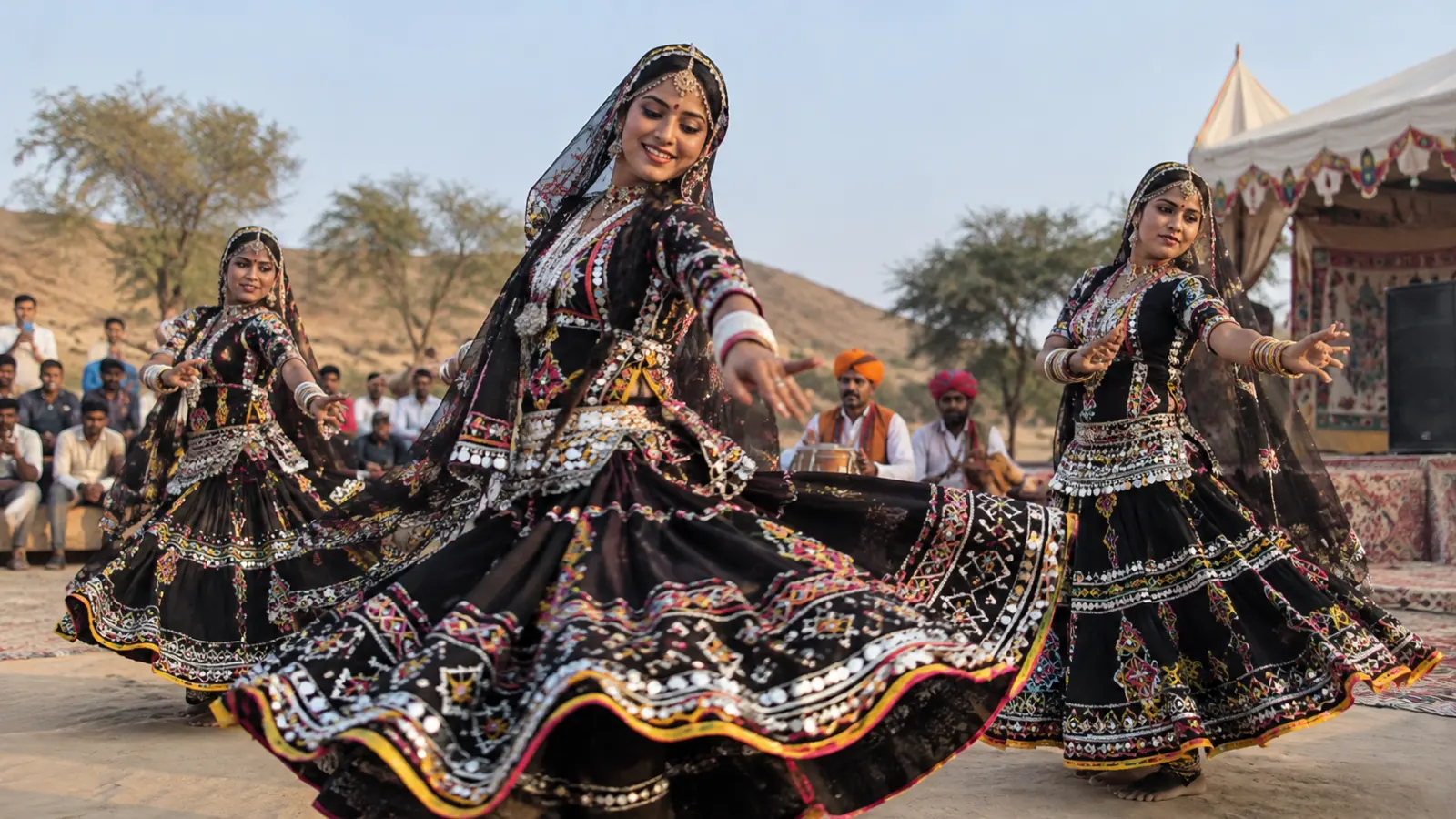
UNESCO inscribed the Kalbelia folk songs and dances of Rajasthan on the Representative List of the Intangible Cultural Heritage of Humanity in 2010. The tradition is associated with the Kalbelia community, whose members were historically known as professional snake handlers.
The visual movement is striking: women in flowing black garments turn and swirl in ways UNESCO describes as evoking serpentine movement, while men traditionally accompany performances with instruments including the poongi and khanjari. But the dance cannot be understood through movement alone.
Kalbelia songs transmit stories and mythological knowledge, and performers have traditions of improvising lyrics during performance. Special dances are associated with occasions including Holi. UNESCO describes the songs and dances as a source of pride and a marker of Kalbelia identity at a time when the community’s older travelling lifestyle and traditional role in rural society have changed substantially.
That makes Kalbelia an important example of cultural adaptation. Public and stage performance do not automatically mean that a tradition has ceased to be authentic. The practice can change its setting while continuing to serve as a vehicle for identity, memory and livelihood.
Dabkeh: When Coordinated Movement Expresses Cohesion
Dabkeh is performed across parts of the Levant in different local forms. UNESCO inscribed Dabkeh, traditional dance in Palestine on its Representative List in 2023. In the Palestinian tradition documented by UNESCO, dancers form a straight line or semicircle, clasping hands and shoulders while performing coordinated steps to traditional wind instruments and popular singing.
Dabkeh is performed during festivals, weddings, graduations and other social occasions. Its formation makes an important cultural idea physically visible: individual dancers participate in a coordinated group rather than performing entirely as separate soloists.
This does not mean that every Dabkeh performance carries exactly the same message. At a wedding, the dance may primarily express celebration and social connection. At a cultural festival, it may foreground heritage and identity. The meaning changes with context while the underlying practice continues to connect participants through shared rhythm and movement.
Kolo: A Chain That Makes Community Visible
Serbia’s Kolo provides another example of collective movement. UNESCO inscribed the traditional folk dance on the Representative List in 2017. Dancers link together in a chain, commonly holding hands and moving in circular or curved formations while accompanied by music.
UNESCO specifically describes Kolo as having an important integrative social function. It is performed at public and private gatherings and can express local, regional and national identities.
The dance also demonstrates how transmission evolves. Direct participation remains an important way of learning Kolo, but cultural-artistic societies, folk ensembles, schools, festivals and competitions now help transmit it. Institutions therefore become part of the living tradition rather than necessarily replacing it.
What may once have been learned mainly by joining relatives and neighbours can now also be learned in organised practice. The social structure changes, yet continuity remains possible.
Saman: Synchrony, Language and Collective Discipline
The Saman dance of the Gayo people of Aceh in Indonesia presents a very different visual form. Performers sit or kneel in tight rows and create rapidly changing patterns through clapping, striking the chest and thighs, finger movements, swaying and tightly coordinated movement.
UNESCO inscribed Saman in 2011 on the List of Intangible Cultural Heritage in Need of Urgent Safeguarding, rather than the Representative List. UNESCO describes the tradition as strengthening friendship, fraternity, goodwill and awareness of the historical continuity of the Gayo people.
Language is also important. Verses led by the central performer are largely sung in the Gayo language and can contain religious, romantic, humorous or advisory content. In this way, dance, music, oral expression and language reinforce one another.
The extraordinary synchronisation for which Saman is internationally recognised is therefore more than technical spectacle. The coordination depends on shared knowledge and discipline, while the performance participates in a larger system of relationships between performers, teachers, communities and cultural occasions.
UNESCO placed Saman on the Urgent Safeguarding List partly because opportunities for traditional transmission were declining. Migration, changing forms of entertainment, ageing knowledge holders and disappearing cultural spaces were among the concerns identified.
Folk Dance Makes Community Identity Visible
Kalbelia, Dabkeh, Kolo and Saman look very different, yet all demonstrate how dance can turn an abstract idea such as belonging into visible social action.
Participants learn more than steps. They learn when the dance is performed, which music accompanies it, how a group is organised, how clothing is worn, how performers interact and what behaviour is expected during particular occasions. Knowledge of those conventions signals familiarity with a shared cultural world.
This is one reason folk dance can become particularly important during periods of social change. Migration, urbanisation or economic transformation may weaken some older forms of community life, while performances become occasions through which cultural connection is deliberately renewed.
For diaspora communities, that role can become especially explicit. Cultural associations and weekend schools may teach dances to children who live far from the places in which those traditions developed. What was once learned informally at community events may become organised instruction precisely because transmission can no longer be taken for granted.
Music and Dance Often Form One Cultural System
It is convenient to separate dance and music when organising museums, competitions or academic subjects, but many traditions do not work that way in practice.
Musicians control tempo and rhythm. Singers may carry narrative, history or religious content. Dancers respond to musical changes, while audiences may clap, sing, call out or eventually join the performance. UNESCO notes more broadly that music frequently forms an integral part of dance, ritual, festive events and oral traditions rather than functioning as a completely separate cultural domain.
Removing a dance from its musical setting can therefore preserve the visible choreography while losing part of its cultural logic. The same problem occurs when a short stage demonstration is treated as though it represents everything the tradition means in community life.
Traditional Dress Is More Than Decoration
Costume is often the first aspect of folk dance that attracts attention, particularly in photographs and tourism campaigns. Yet traditional clothing can perform practical and social functions as well as aesthetic ones.
Fabric changes how movement appears. Jewellery can add rhythm through sound. Footwear affects the way steps strike the ground. Embroidery, head coverings, colours and accessories may be associated with region, community, gender, occupation, status or ceremonial context.
At the same time, audiences should be cautious about assuming that every costume seen on a modern stage is an unchanged ancient form. Performance groups may standardise clothing so that an ensemble appears visually coherent. Materials may change because older ones are expensive or unavailable, and garments may become more elaborate when a tradition moves from local gatherings to professional performance.
The costume is therefore part of cultural history, but it too can evolve.
Folk Dance Can Help Preserve Language and Oral Tradition
Traditional dance frequently exists alongside songs, calls, poetry and spoken introductions. That relationship can help keep words, phrases and regional language varieties in active circulation.
Kalbelia songs transmit stories and are associated with improvisational poetic traditions, while Saman verses are largely performed in Gayo. These examples show how learning a dance can simultaneously become a form of language and oral-history transmission.
A young performer may initially encounter vocabulary through a song before regularly using it elsewhere. This is why cultural practices are better thought of as interconnected ecosystems rather than isolated categories of dance, music, language and clothing.
Tourism Can Support Folk Dance—and Change It
Tourism and public performance can create real opportunities. Performers may earn income, festivals can attract funding and wider recognition can make younger members of a community more interested in learning a tradition.
But commercial success can also alter what audiences see. Performances may be shortened to fit tourist schedules, dramatic elements may be emphasised, costumes may become more spectacular and complex social or ceremonial contexts may disappear.
The result is not automatically “fake.” Living heritage changes, and communities themselves may actively choose professionalisation. The more useful questions concern agency and benefit: Who decides which changes are acceptable? Do the people who carry the tradition retain control over its representation? Do economic benefits reach them? Are important cultural boundaries respected?
UNESCO’s contemporary safeguarding guidance similarly emphasises community participation and context-sensitive management rather than treating economic activity itself as incompatible with living heritage.
Stage Performance Is Not the Opposite of Authenticity
The idea that a folk dance becomes inauthentic the moment it enters a theatre is too simplistic.
Stages, cultural organisations, schools and touring ensembles can provide rehearsal space, professional opportunities and structured methods for preserving technically demanding repertoires. Kolo, for example, continues through both community participation and cultural-artistic societies. Kalbelia performers have adapted their tradition to changing social and economic circumstances while maintaining its importance as a marker of identity.
The more important distinction is between a tradition that changes through the participation of its practitioners and one whose meaning is imposed entirely from outside.
A living tradition cannot remain exactly as it was at an arbitrary moment in history. UNESCO explicitly describes intangible cultural heritage as something continually recreated by its bearers and transmitted between people and generations.
Folk Dance Is Not Frozen in the Past
The word “folk” can produce an image of an isolated rural community preserving an unchanged practice for centuries. Real cultural history is rarely so neat.
Traditional dances have interacted with migration, cities, religious institutions, schools, states, broadcasting, tourism, popular music and changing technology. Communities themselves change occupations, languages, social structures and places of residence.
A tradition can therefore remain meaningful even when its performance environment changes. A wedding dance may enter competitions. A village tradition may appear on national television. A dance learned informally may later be taught in schools.
Change does not automatically destroy heritage. In many cases, the ability to adapt is precisely what allows heritage to survive.
UNESCO Recognition Can Protect Heritage but Also Reshape It
International recognition can dramatically alter how a cultural practice is perceived. UNESCO inscription can raise visibility, encourage safeguarding activity and help a community’s heritage receive greater respect.
It may be especially significant for traditions associated with communities that have experienced marginalisation. UNESCO’s Kalbelia decision, for example, noted that recognition could draw attention to the creativity and adaptability of a historically marginalised community.
Recognition, however, does not freeze a definitive version of a tradition. Once a dance becomes an official heritage symbol, institutions may prefer a standardised version that is easy to present at festivals, in schools or to tourists. Local variations can then receive less attention.
A dance may also become promoted as a regional or national symbol even though its history belongs more specifically to particular communities. Responsible heritage interpretation should preserve that connection rather than allowing a broad national label to erase the people who developed and maintained the practice.
Why Safeguarding Means More Than Filming the Dance
Recording a performance can preserve valuable information about steps, music and costume. Archives of film, photography and audio can help later generations recover forgotten repertoire and compare different versions.
But documentation alone cannot keep a living tradition alive.
A dance may depend on musicians, instrument makers, costume makers, teachers, elders, rehearsal spaces, festivals, family gatherings and audiences willing to participate. If those relationships disappear, a technically accurate video can survive while the cultural practice itself becomes inactive.
UNESCO therefore defines safeguarding broadly. It includes documentation and research, but also preservation, transmission, education, promotion and revitalisation, with active participation from the communities that create and maintain the heritage.
For performing arts specifically, UNESCO emphasises transmission of knowledge and techniques and the relationships through which those skills are learned.
Young People Determine Whether Living Heritage Continues
Generational transmission is one of the central challenges facing many traditional practices. Saman’s safeguarding history demonstrates what can happen when younger people migrate, performance opportunities decline and older knowledge holders have fewer successors.
This does not mean that young performers must reproduce everything exactly as previous generations did. They may use new venues, collaborate with contemporary musicians, teach through digital media or adapt performance length and presentation.
Communities then negotiate where continuity ends and unacceptable alteration begins. There is rarely one universal answer, because living heritage belongs to people rather than to a museum display.
UNESCO’s safeguarding framework consequently treats transmission as an ongoing creative process, including formal and non-formal education, rather than merely the replication of fixed artefacts.
The Same Dance Can Mean Different Things on Different Occasions
A traditional dance does not necessarily communicate one timeless message everywhere it appears.
The same form may be performed at a wedding, religious festival, graduation, school programme, competition, state ceremony or international cultural event. Participants may change clothing, duration, musical accompaniment, formation and level of audience participation according to the occasion.
Context therefore matters as much as choreography. A researcher trying to understand cultural meaning should ask not simply “What does this movement mean?” but “Who is performing it, for whom, on what occasion and under whose authority?”
That approach avoids both romanticising traditions and stripping them of meaning.
Why Different Folk Dances Should Not Be Reduced to One Story
Comparing Kalbelia, Dabkeh, Kolo and Saman is useful precisely because they are not versions of the same phenomenon.
Their histories, languages, movements, performance settings and systems of transmission are different. Even their UNESCO status differs: Kalbelia, Dabkeh and Kolo are on the Representative List, while Saman is on the List of Intangible Cultural Heritage in Need of Urgent Safeguarding.
The value of comparison lies instead in recognising recurring mechanisms. Coordinated movement can reinforce belonging. Songs can transmit memory and language. Public performance can transform local traditions. Institutions can support transmission while also encouraging standardisation. Recognition can bring resources while creating new pressures.
Understanding those mechanisms makes folk dance more interesting, not less.
Frequently Asked Questions
Why is folk dance important to culture?
Folk dance can help communities express identity, mark important occasions, transmit music and language, preserve shared memories and connect generations. Its importance usually comes from the wider cultural relationships surrounding the dance rather than from choreography alone.
Is folk dance the same as traditional dance?
The terms overlap and are often used interchangeably, but neither has one universal definition. “Folk dance” commonly refers to socially transmitted community-based dance traditions, while “traditional dance” can be used more broadly for inherited dance practices, including highly specialised or ceremonial forms.
Can folk dances change and still remain authentic?
Yes. Living cultural traditions continually change as communities change. New venues, teaching methods, costumes or performance arrangements do not automatically make a dance inauthentic. The participation and agency of the communities that practise and transmit the tradition are crucial.
How does folk dance preserve cultural identity?
Dance creates repeated opportunities for people to learn movements, songs, language, clothing practices, social roles and stories associated with their community. Participation can therefore turn cultural identity from an abstract idea into a shared social experience.
Does UNESCO preserve folk dances?
UNESCO does not simply preserve one official choreography. Under the 2003 Convention, safeguarding focuses on maintaining the conditions that allow living heritage to continue, including documentation, education, transmission and community participation.
Why are costumes important in folk dance?
Costumes can influence movement, sound and visual identity and may communicate regional, ceremonial or community distinctions. However, costumes can also evolve or become standardised for stage presentation, so they should not automatically be treated as unchanged evidence of an ancient practice.
The Meaning Lives in the Relationships
The deepest cultural significance of folk dance is not hidden inside a secret dictionary of movements. It lies in the relationships between dancers, musicians, teachers, audiences, families, places, occasions and memories.
A costume may be the first thing an outsider notices, and spectacular movement may be what makes a performance memorable. But the tradition survives because people continue to know when to dance, how to participate, what the music means to them and why the practice deserves to be passed on.
That is what turns choreography into living heritage: not simply the preservation of steps, but the continued ability of communities to recognise themselves in the act of performing them.