₹56.8-Crore BDL Tender to Ex-Chief's Family Firm Raises Questions
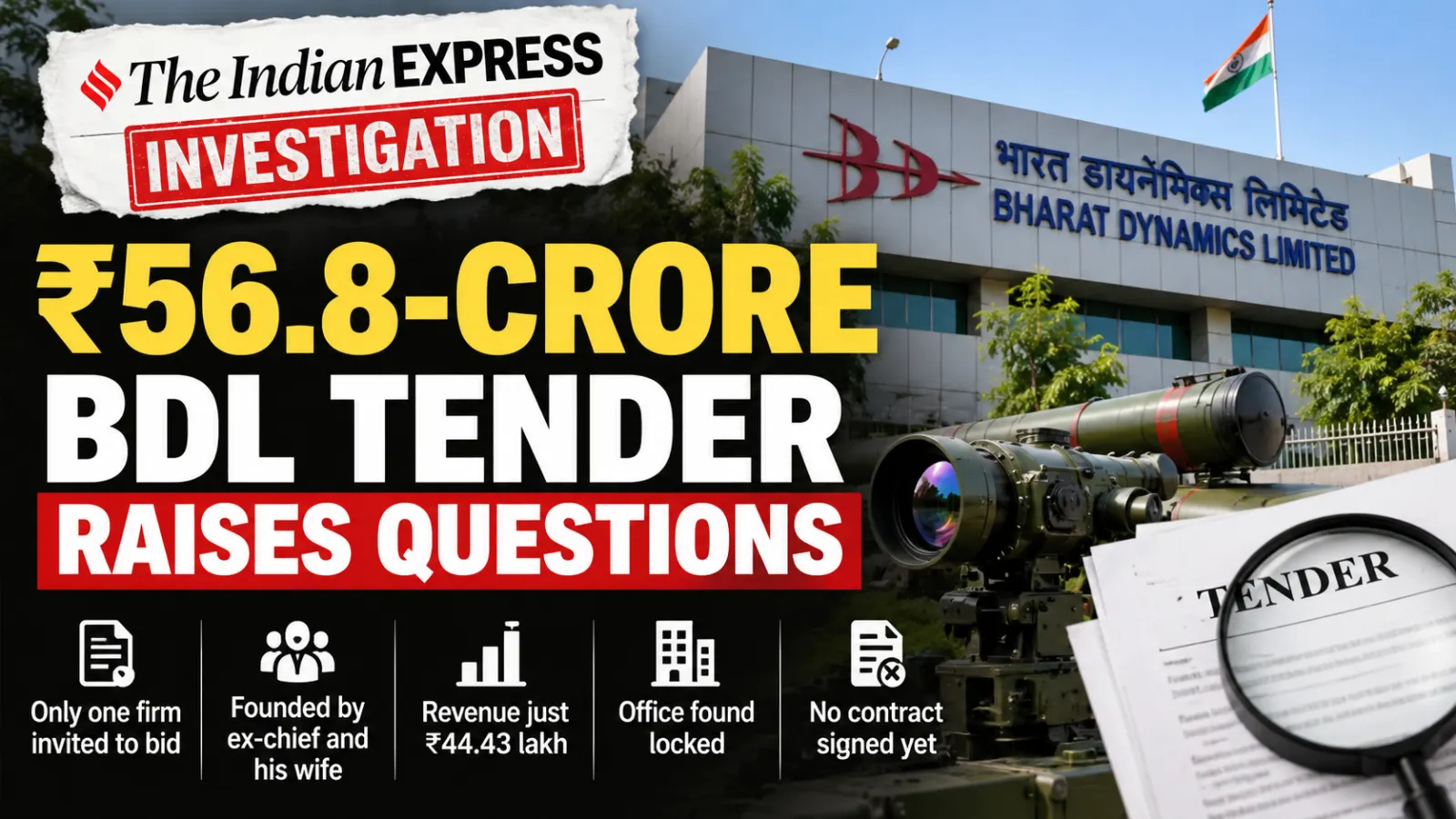
A ₹56.8-crore defence procurement controversy has raised serious questions about transparency and potential conflicts of interest at Bharat Dynamics Limited (BDL), a government-owned defence manufacturer operating under India's Ministry of Defence. The controversy centres on a non-competitive tender issued to Aindri Defence Advisory Private Limited, a company established by BDL's former Chairman and Managing Director, Siddharth Mishra, and his wife.
The Hyderabad-based defence public sector undertaking invited only Aindri Defence Advisory to bid for the supply of 300 optical sights used in anti-tank guided missiles. The company quoted ₹56.8 crore and cleared technical evaluation, even though its available financial records show comparatively modest revenue and no listed manufacturing facilities.
The procurement has attracted scrutiny because the company was founded by a former senior executive of the same government enterprise that invited it to participate. BDL cited urgency to justify the single-tender process, but the publicly available tender documents did not explain the specific circumstances requiring this approach.
Importantly, the ₹56.8 crore represents the company's quoted bid, not a confirmed payment. As of the latest reported status on October 18, 2026, financial evaluation was still underway and no final contract had been signed.
How a Former BDL Chairman's Family Firm Became the Only Bidder
Bharat Dynamics Limited issued the single tender in May 2026 for 300 optical sights, equipment used in the targeting systems of anti-tank guided missiles. Instead of inviting multiple suppliers to compete, the company restricted the procurement process to Aindri Defence Advisory.
The private company was incorporated in May 2024 by Siddharth Mishra and his wife, Shambhavi Mishra. Both initially held equal ownership stakes. Mishra had previously served as BDL's Chairman and Managing Director from March 2019 until his retirement in March 2023.
Mishra subsequently stepped down as a director and shareholder of Aindri in January 2025, around the time of his appointment as a technical member of the National Company Law Tribunal in Kolkata. Following the ownership changes, Shambhavi Mishra came to hold 95% of the company's shares, while fellow director Kaushiki Nandan Vatsyayana held the remaining 5%.
This sequence of appointments, ownership changes and procurement decisions has prompted questions about whether appropriate safeguards were applied to prevent possible conflicts of interest.
A family relationship between a former public-sector executive and a prospective government supplier does not, by itself, establish wrongdoing. However, the absence of competition makes scrutiny of the selection process particularly important.
Locked Office and Financial Records Add to the Controversy
Further questions emerged after a ground investigation of Aindri Defence Advisory's registered office at the National Small Industries Corporation campus in Kushaiguda, Hyderabad.
The fourth-floor office was found locked during the visit. An employee working elsewhere in the building indicated that the premises were opened only occasionally. Corporate filings showed that the company had leased approximately 1,050 square feet of office space in April 2026 before changing its registered address in June.
Its available financial disclosures also attracted attention.
According to the company's financial statements for 2024–25, Aindri Defence Advisory reported revenue of ₹44.43 lakh and a profit of ₹2.89 lakh. The recorded revenue came from services rather than manufacturing operations.
The financial statements did not list property, manufacturing plant or other such assets, raising questions about how the company intended to fulfil a potentially substantial defence-equipment supply order.
Its ₹56.8-crore bid is approximately 128 times its reported annual revenue for 2024–25. However, this comparison alone cannot determine whether a supplier is technically or financially capable of executing a contract, particularly when subcontracting or other authorised supply arrangements may be involved.
The company had also reported business transactions with firms connected to the wider defence supply chain. Those relationships do not establish impropriety, but they underline the importance of examining the proposed manufacturing and procurement arrangements.
Why Did BDL Abandon Competitive Tendering?
One of the central questions concerns the change in BDL's procurement approach between 2024 and 2026.
In both 2024 and 2025, the defence manufacturer procured similar optical sights through competitive tendering processes restricted to eligible public-sector enterprises. India Optel Limited, another government-owned defence company, secured the orders in both years.
The procurement process changed substantially in 2026.
Instead of continuing with competition among eligible suppliers, BDL issued a single tender specifically to Aindri Defence Advisory, a private company linked to its former chairman.
A single-tender procurement allows an organisation to invite only one supplier under permitted exceptional circumstances, including certain urgent requirements or situations where only one supplier can meet the necessary specifications.
BDL's tender documentation cited urgency and indicated that the competent authority had recorded the justification for avoiding the normal competitive process. However, the publicly available documents did not detail why the requirement had become urgent or why alternative suppliers were not invited.
The tender also required a long-term technical-support commitment covering maintenance, repair and overhaul for at least 15 years.
The central issue is therefore not simply whether single-tender procurement can be lawful. It is whether the specific reasons, supplier-selection criteria and approvals were sufficiently robust and justified in this case.
Has the ₹56.8-Crore Defence Contract Been Awarded?
Despite reports describing the tender as awarded, the distinction between issuing a tender, evaluating a bid and signing a contract is critical.
Aindri Defence Advisory was invited as the sole bidder and submitted its ₹56.8-crore quotation. Five sample units reportedly underwent technical inspection and passed validation requirements. The company also cleared the technical evaluation stage.
However, financial evaluation had not been completed as of the latest confirmed reporting on October 18, and no final contract had been signed.
People familiar with the process maintained that the prescribed procedures had been followed, although they did not publicly elaborate on the urgency cited for selecting the non-competitive route.
The passage of several months since the May tender has generated an additional question: if procurement was sufficiently urgent to justify bypassing competitive bidding, why had the contract not been finalised by October?
That question cannot be answered conclusively without further information about technical assessments, financial scrutiny, approvals and procurement timelines.
What Has BDL and the Company Said?
The investigation also sought responses from the individuals and organisations involved in the procurement.
BDL did not respond to the questions submitted during the original investigation. Siddharth Mishra and Shambhavi Mishra also did not respond to requests for comment, while Aindri Defence Advisory did not answer questions sent to its registered email address.
Kaushiki Nandan Vatsyayana, the company's other director, declined to disclose details of the tender.
The absence of a public response should not be treated as an admission of wrongdoing. Equally, the questions raised by the ownership structure, financial records and procurement method remain matters of legitimate public interest.
There is no verified finding in the available reporting that Siddharth Mishra improperly influenced the tender, that Aindri Defence Advisory committed fraud or that public funds were misappropriated.
Why the Controversy Matters for India's Defence Procurement
India's defence manufacturing sector is undergoing significant expansion, with greater emphasis on domestic production, indigenous technology and participation by private enterprises.
Private-sector involvement can improve manufacturing capacity, innovation and supply-chain resilience. Nevertheless, government procurement systems must maintain transparent selection procedures, appropriate financial safeguards and effective conflict-of-interest controls.
Defence procurement involves additional sensitivities because equipment quality, delivery reliability and long-term maintenance can directly affect military preparedness.
In the BDL case, the unresolved questions concern why a single private supplier was selected, how urgency was established, whether the company's proposed delivery arrangements were adequately assessed and whether potential conflicts of interest received sufficient scrutiny.
The most important next development will be the outcome of the financial evaluation and whether BDL provides a fuller explanation of the procurement decision.
Until those details emerge, the ₹56.8-crore tender remains a significant transparency controversy rather than a proven corruption case.
The broader question is whether India's defence procurement system can demonstrate that public contracts are awarded through fair, accountable and properly justified processes, particularly when prospective suppliers have family connections to former senior officials.