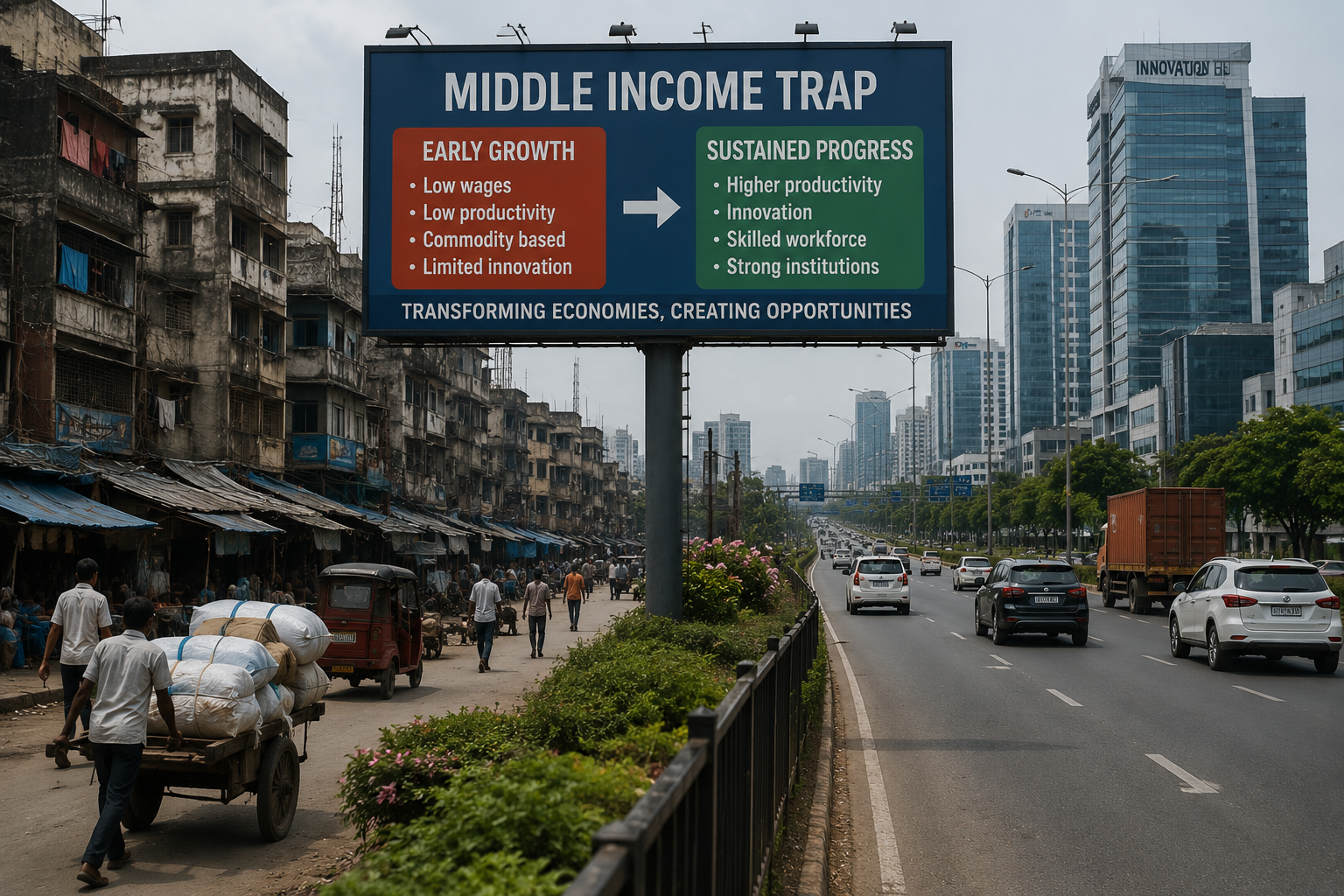
The middle income trap is one of the most important warnings in development economics. It describes the situation in which a country rises from poverty to middle-income status, but then struggles to become a high-income economy. The country is no longer poor enough to compete only on cheap labour, but not yet productive, innovative or institutionally strong enough to compete with advanced economies.
This trap matters because early growth can be misleading. A developing country can grow quickly by moving workers from agriculture to factories, building roads, attracting foreign investment, expanding basic education and using low wages to compete in global markets. These are powerful growth engines. But after a point, they weaken. Wages rise. Easy infrastructure gains are exhausted. Urban land becomes expensive. Basic literacy is no longer enough. Export competition intensifies. The country must move from accumulation to productivity.
What the middle income trap means
The middle income trap refers to the difficulty many countries face in moving from middle-income levels to high-income levels. In simple terms, it is the point where the growth model that helped a country escape poverty becomes insufficient for the next stage. The country needs a new engine, but institutions, skills and firms may not be ready for it.
At low income levels, growth often comes from basic structural transformation. Workers shift from subsistence agriculture to manufacturing or urban services. Roads, electricity, ports and schools produce immediate returns. Foreign companies invest because labour is cheap. Domestic consumption rises because incomes are improving from a low base.
At middle income levels, the challenge changes. The country must produce more value per worker. It must innovate, improve management, deepen capital markets, upgrade education, protect competition, build credible courts, invest in research, and move into more complex products and services. Without these changes, growth slows.
Why cheap labour stops being enough
Low-cost labour can attract factories, but it cannot carry a country forever. As incomes rise, workers demand better wages, better housing, better services and better security. This is good for society, but it means the country loses some of its original cost advantage. If productivity does not rise with wages, firms become less competitive.
A country stuck in the middle income trap may face pressure from both sides. Poorer countries can produce labour-intensive goods more cheaply. Richer countries can produce advanced goods with better technology, brands, intellectual property and productivity. The middle-income country is squeezed: too expensive for low-end competition, too weak for high-end competition.
Escaping this squeeze requires upgrading. Firms must move from assembly to design, from imitation to innovation, from informal management to professional systems, from low-margin production to higher-value products. Workers must move from basic skills to technical, managerial and creative capabilities. Governments must move from providing basic infrastructure to building sophisticated institutions.
The productivity challenge
Productivity is the heart of the middle income trap. A country becomes richer over the long term not merely by working more, but by producing more value with each hour of work, each unit of capital and each piece of land. Productivity rises when workers are better trained, machines are better used, logistics are faster, firms are better managed, technology spreads, and institutions reduce waste.
Many middle-income economies struggle because productivity growth slows after the easy gains are over. Moving a worker from a low-productivity farm to a factory can create a big jump. But after that, further progress requires better technology, better processes and better skills. The economy must learn to improve continuously.
This is where education quality becomes decisive. A country cannot build advanced manufacturing, biotechnology, semiconductor capability, high-end services or complex infrastructure with weak foundational learning. It also cannot innovate if universities, research institutions and industry remain disconnected. The middle income trap is often a human-capital trap in disguise.
Institutions and the quality of capitalism
Institutions decide whether investment becomes productivity or merely construction. Courts, regulators, tax systems, land records, bankruptcy processes, competition authorities and public procurement rules shape economic behaviour. If contracts are hard to enforce, firms remain small. If corruption distorts licences, capital goes to influence rather than efficiency. If competition is weak, dominant firms may protect margins instead of innovating.
The quality of capitalism therefore changes at middle income levels. Early growth may tolerate some inefficiency because the gains from basic development are large. Later growth is less forgiving. To become high income, economies need trust, transparency, competition, professional management and predictable policy. They need states strong enough to build capacity but disciplined enough not to suffocate enterprise.
The role of industrial upgrading
Countries that escape the middle income trap usually upgrade their industrial structure. They do not remain permanently dependent on raw materials, low-end assembly or protected domestic markets. They move into sectors with higher productivity, stronger learning and better global demand. This may include advanced manufacturing, electronics, pharmaceuticals, automotive components, digital services, green technology, finance, logistics, healthcare and knowledge industries.
Industrial upgrading requires coordination. Firms need infrastructure, skills, credit, standards, export access and technology. Governments need to support learning without permanently protecting inefficiency. Banks need to finance productive risk, not only real estate or politically connected projects. Universities need to produce talent relevant to industry. The export market often acts as a discipline because global competition exposes whether firms are truly competitive.
The policy challenge is balance. Too little state support can leave firms unable to upgrade. Too much protection can create lazy incumbents. The middle income trap is avoided when support is linked to performance, competition and learning rather than entitlement.
India and the middle income question
India's growth debate increasingly has a middle income dimension. The country has built major strengths in services, pharmaceuticals, digital public infrastructure, finance, entrepreneurship, space technology and domestic consumption. It has also improved infrastructure and expanded formal financial access. These are real advantages.
But the next stage is harder. India must create enough productive jobs for its working-age population, raise manufacturing competitiveness, improve school learning outcomes, increase female labour force participation, deepen research and development, strengthen local governments, and reduce logistics and compliance frictions for firms. It must also manage inequality so that growth becomes broad-based demand rather than narrow prosperity.
India cannot rely only on population size. A large market helps, but it does not automatically create high income status. The country needs productivity at scale. It needs cities that work, firms that scale, workers who can learn, and institutions that reduce uncertainty. Otherwise, high growth episodes may alternate with slowdowns without producing a decisive structural leap.
Why some countries escape and others do not
Countries that escape the middle income trap usually combine several features: export competitiveness, high savings and investment, strong education systems, technological upgrading, capable bureaucracy, disciplined macroeconomic policy and social stability. They also adapt. The policies that work at one stage are revised when conditions change.
Countries that remain stuck often suffer from one or more weaknesses: dependence on commodities, weak education, high corruption, low innovation, premature deindustrialisation, inequality, poor urban planning, fragile public finances or political systems that reward short-term distribution over long-term capability building.
There is no single formula. But the pattern is clear. To escape the trap, a country must make the transition from factor accumulation to productivity growth, from cheap labour to skilled labour, from imitation to innovation, and from basic state capacity to high-quality institutions.
Final reader takeaway
The middle income trap is not a curse. It is a warning. It tells countries that early success can become a comfort zone. The factories, services, infrastructure and consumption that lifted an economy out of poverty may not be enough to make it advanced.
For India and other emerging economies, the lesson is direct: growth must become more productive, more innovative, more inclusive and more institutionally disciplined. The next leap cannot be powered only by population, cheap labour or domestic demand. It must be powered by capability. That is the difference between becoming a large economy and becoming a rich one.
Editorial Disclaimer
This article is for general financial and economic education. It does not constitute investment, tax, legal or policy advice. Readers should verify current rules, official data and professional guidance before making financial or business decisions.