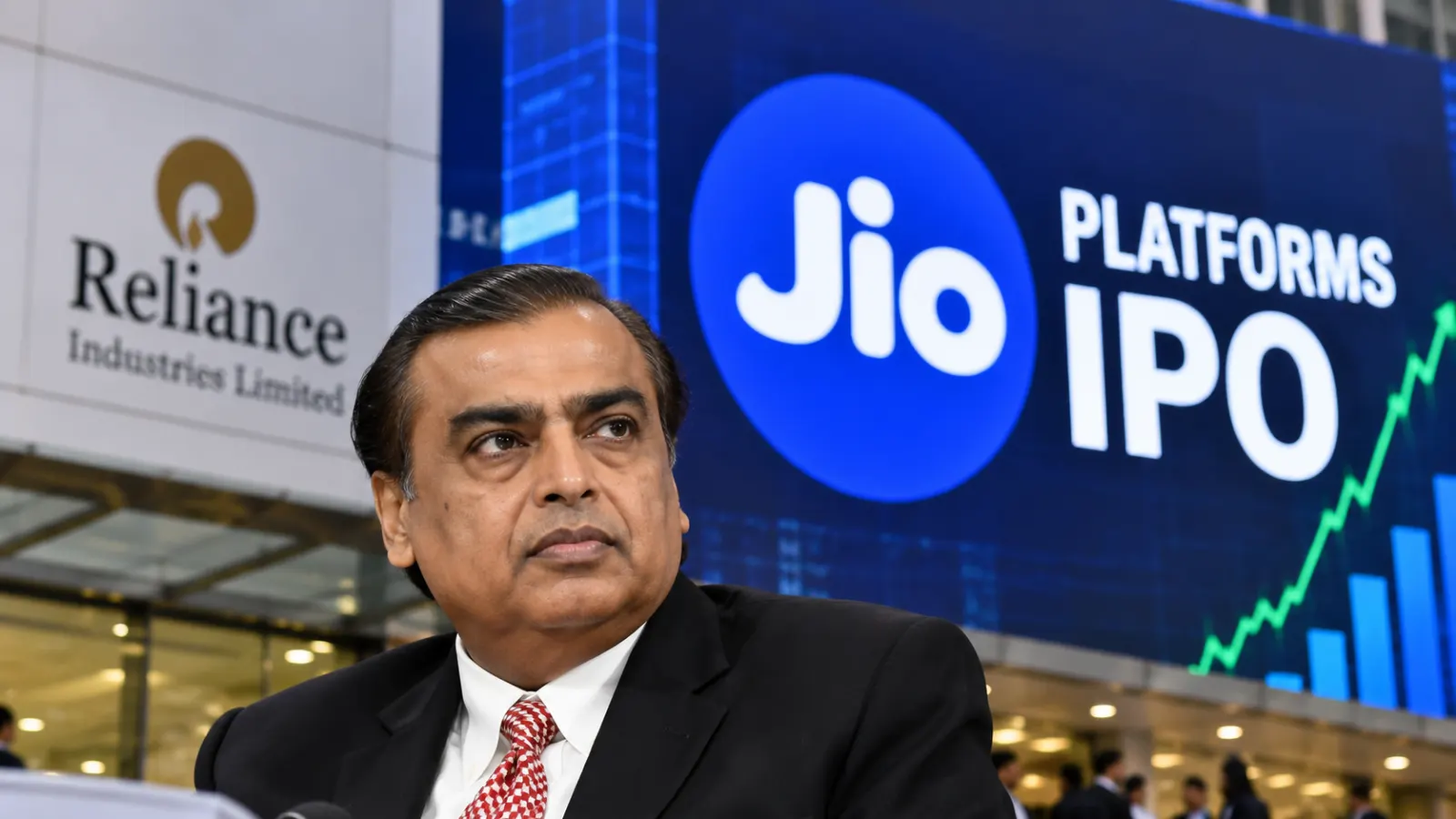
Jio Platforms IPO: Why India’s Biggest Listing Could Matter
Jio Platforms is preparing for what could become the largest initial public offering in Indian stock-market history, with plans reportedly being made to launch the IPO process on October 21, 2026 and list the company later in the month. The proposed offering is expected to raise about $3.8 billion, potentially surpassing Hyundai Motor India’s 2024 IPO and making Jio one of the most closely watched listings India has ever seen.
The development is significant not simply because of the size of the proposed IPO. Jio Platforms sits at the centre of Reliance Industries’ digital ecosystem, combining telecom, broadband, digital services and technology investments under one of India’s most recognisable corporate groups. A public listing would allow investors to value that digital business independently from the broader Reliance conglomerate.
The IPO would also test how much investors are willing to pay for a company that already dominates large parts of India’s telecom market but is increasingly trying to position itself as a broader technology platform.
What is Jio Platforms?
Jio Platforms is the digital and technology holding company within Reliance Industries.
Its most visible business is Reliance Jio Infocomm, the telecom operator that transformed India’s mobile-data market after its commercial launch in 2016. Jio entered with low-cost data and aggressive pricing, forcing competitors to reduce tariffs and accelerating the shift from voice-led mobile usage to data-led consumption.
Over time, Jio expanded beyond mobile connectivity.
Its businesses now include 4G and 5G telecom services, fixed broadband, digital entertainment, cloud-related services, enterprise technology and a growing collection of consumer applications and platforms.
This structure is important because investors buying shares in Jio Platforms would not simply be buying a traditional telecom operator. They would be investing in a broader digital ecosystem built around hundreds of millions of users.
That distinction is one reason Jio has attracted major global investors in the past.
Meta, Google and several large private-equity and sovereign investors invested billions of dollars into Jio Platforms during its 2020 fundraising round, giving the company both capital and international strategic relationships.
An IPO would take that ownership structure a step further by opening the business to public-market investors.
How large could the Jio IPO be?
The proposed IPO is expected to raise around $3.8 billion, although the final figure could change before the offering is formally launched.
At that scale, Jio could overtake Hyundai Motor India’s IPO as the largest ever completed in the Indian market.
The size matters for several reasons.
Large IPOs require significant institutional and retail demand. Domestic mutual funds, insurance companies, foreign investors and individual investors must collectively absorb billions of dollars of shares.
That means the Jio offering will effectively test the depth of India’s capital markets.
The Indian IPO market has grown substantially over the past several years, with large companies increasingly choosing domestic exchanges instead of automatically looking overseas for listings. A successful Jio IPO would reinforce the idea that Indian markets are now capable of financing some of the country's largest businesses.
It could also encourage other large private companies and corporate subsidiaries to pursue public listings.
Why is Reliance listing Jio now?
Reliance has spent years building Jio into a company capable of standing independently in public markets.
The business has already passed through several phases.
The first phase was aggressive network investment.
Reliance spent enormous amounts building nationwide telecom infrastructure before Jio’s commercial launch. The company then used very low pricing and free introductory services to build scale rapidly.
The second phase was monetisation and strategic investment.
In 2020, Reliance sold minority stakes in Jio Platforms to global investors, raising a large amount of capital and significantly reducing pressure on the parent company’s balance sheet.
The third phase has been expansion into 5G, broadband, enterprise services and digital technologies.
An IPO represents the next logical step.
Listing Jio creates a publicly traded valuation for a business that is currently embedded within Reliance Industries. That can make the value of Reliance’s different businesses easier for investors to understand.
Reliance operates across energy, petrochemicals, retail, telecom and digital technology. Investors sometimes apply what is known as a conglomerate discount when valuing companies containing several very different businesses under one corporate structure.
Separately listing major subsidiaries can help markets assign independent valuations to them.
Where would the IPO money go?
The proposed offering is expected to help reduce debt within Jio’s telecom operations.
Telecommunications is extremely capital intensive.
Operators must continuously spend on spectrum, towers, fibre networks, data centres, equipment and technology upgrades. Jio has also invested heavily in 5G infrastructure across India.
Even a highly profitable telecom company therefore requires substantial capital.
Using IPO proceeds or related transaction benefits to strengthen the balance sheet could give Jio more financial flexibility for future expansion.
Lower debt can also reduce interest costs.
That becomes particularly important when interest rates are elevated because servicing large borrowings becomes more expensive.
A stronger balance sheet could allow Jio to direct more future cash towards technology investment, network expansion and new services rather than debt repayment.
However, investors will need to examine the final offer documents carefully because the exact structure of the IPO—how much consists of newly issued shares versus shares sold by existing investors—will determine how much capital actually goes directly to Jio.
Why the IPO matters for Reliance Industries shareholders
Reliance shareholders already have indirect economic exposure to Jio Platforms because Reliance owns the controlling stake.
A separate Jio listing therefore raises an important question: what happens to Reliance’s valuation?
One possibility is that an independently traded Jio share price makes Reliance’s digital business easier to value.
Suppose the stock market assigns Jio Platforms a very high valuation after listing. Investors can then more clearly calculate the value of Reliance’s remaining stake in Jio.
This can potentially support the parent company’s valuation.
But there is another consideration.
Some investors may prefer buying Jio directly instead of purchasing Reliance Industries shares to gain exposure to the digital business. That could change how investors allocate money between the parent company and the newly listed subsidiary.
Markets will therefore closely watch the relationship between Jio’s IPO valuation and Reliance Industries’ share price.
The biggest question will be Jio’s valuation
IPO size attracts headlines, but valuation determines whether the shares ultimately represent an attractive investment.
A great company can still become a poor investment if investors pay too high a price.
Jio has several obvious strengths.
It has enormous scale.
It has one of India’s largest telecom subscriber bases.
It owns substantial network infrastructure.
It benefits from growing mobile-data usage.
It operates within an economy where digital payments, streaming, online shopping, cloud services and connected devices continue expanding.
But investors will also examine how much of that future growth is already reflected in the IPO price.
A company valued primarily as a telecom operator may trade at one type of earnings multiple.
A business valued as a technology platform could command a substantially higher one.
Jio will likely try to convince investors that it belongs increasingly in the second category.
Whether public markets agree could determine the success of the listing.
Telecom dominance does not mean unlimited pricing power
Jio’s rapid expansion changed the structure of India’s telecommunications industry.
The market eventually consolidated around a small number of major operators, particularly Jio and Bharti Airtel, with Vodafone Idea remaining under financial pressure.
A more consolidated industry can improve profitability because operators are no longer competing purely through extremely low tariffs.
Indian telecom companies have gradually increased prices in recent years, helping improve average revenue per user.
That benefits Jio.
But telecom remains politically and socially sensitive because mobile connectivity is now an essential service for hundreds of millions of people.
Operators therefore cannot assume they can continuously increase prices without consequences.
Competition, regulation and consumer affordability will remain important.
Investors will be trying to determine how much Jio can increase revenue per user while continuing to grow its subscriber base.
5G is important, but monetisation is the real test
Jio has invested heavily in its 5G network.
The technological achievement is significant, but for investors the more important question is how that network generates additional profit.
Consumers do not necessarily pay dramatically more simply because their phone connects to 5G.
Telecom companies therefore need to build services that justify the investment.
One opportunity is fixed wireless access, where 5G networks provide broadband connections to homes and businesses without requiring traditional fibre lines all the way to the property.
Enterprise services represent another opportunity.
Factories, logistics companies, hospitals and large businesses may eventually use private 5G networks, connected devices and cloud-based services.
Jio could also combine connectivity with AI, cloud infrastructure and digital applications.
If those services generate higher margins than ordinary mobile connectivity, Jio’s business could gradually become less dependent on telecom tariffs.
That would strengthen the argument for treating Jio as a broader technology company.
Meta and Google investments remain strategically important
Meta and Google became shareholders in Jio Platforms during the company’s massive fundraising exercise in 2020.
Those investments were significant for more than the money.
Meta’s relationship with Jio created possibilities around WhatsApp-based commerce and digital payments.
Google’s investment strengthened cooperation around affordable smartphones and Android-related technology.
The presence of global technology companies also gave Jio external validation at a time when Reliance was attempting to demonstrate that Jio should be valued as a technology platform rather than merely as a telecom operator.
Public-market investors will now be able to compare the valuation those investors accepted privately with the valuation placed on Jio through the IPO.
That comparison may receive substantial attention.
Jio could become a proxy for India’s digital economy
One reason the IPO may attract foreign investors is that Jio offers exposure to several long-term trends occurring simultaneously in India.
Internet penetration continues growing.
Smartphone usage remains high.
Digital payments have expanded rapidly.
Video consumption is increasingly online.
Businesses are adopting cloud services.
Artificial intelligence is becoming more important.
5G infrastructure is expanding.
An investor buying Jio is effectively making a broader bet that India’s digital consumption and technology adoption will continue increasing.
This makes the company different from a traditional telecom stock whose growth depends primarily on adding mobile subscribers.
India is already a mature mobile market in terms of basic connectivity.
Jio’s next stage of growth therefore needs to come increasingly from earning more revenue per customer and selling additional services.
Could Jio eventually compete with global technology giants?
Jio’s ambitions extend beyond telecommunications, but comparisons with companies such as Google, Amazon, Microsoft or Meta should be made cautiously.
Those global companies generate enormous revenue from cloud computing, advertising, software and global digital platforms.
Jio remains heavily dependent on India and on connectivity-related businesses.
However, Reliance has repeatedly signalled ambitions in AI, cloud infrastructure, enterprise services and digital commerce.
The company’s greatest strategic advantage may be distribution.
Jio already has direct relationships with hundreds of millions of Indian consumers.
A new digital product does not necessarily need to acquire users from zero if it can be distributed through Jio’s existing ecosystem.
That can significantly reduce customer-acquisition costs.
Whether Jio can convert that distribution advantage into highly profitable digital businesses remains one of the most important questions for long-term investors.
What risks should investors watch?
The size and prominence of Jio do not eliminate investment risks.
Telecom businesses require continual capital expenditure.
Spectrum is expensive.
Technology changes quickly.
Competition from Airtel remains strong.
Regulatory decisions can affect pricing, spectrum costs and market structure.
Another risk is valuation.
Highly anticipated IPOs can sometimes be priced aggressively because demand before listing is strong.
If the valuation assumes years of exceptional growth, even good financial performance may disappoint investors if it does not exceed those expectations.
There is also execution risk.
Jio operates across a growing number of businesses. Expanding simultaneously into broadband, enterprise technology, AI, cloud services and consumer platforms requires significant management and capital.
Not every digital initiative will necessarily become successful.
Retail investors should separate the company from IPO excitement
Jio is one of India’s most recognisable corporate brands.
That creates enormous public interest.
But familiarity with a company is not the same thing as understanding its valuation.
Retail investors considering the IPO should examine the prospectus when it becomes available rather than deciding purely on brand recognition.
Important numbers will include revenue growth, profit margins, debt, capital expenditure, average revenue per user, subscriber growth and the valuation compared with listed competitors.
Investors should also understand whether they are buying newly issued shares or shares sold by existing investors.
The allocation of IPO proceeds matters.
So does the percentage of the company being offered to the public.
A successful listing day can generate headlines, but long-term returns depend on what the business earns relative to the price investors paid.
Why this could reshape India’s IPO market
If Jio successfully raises around $3.8 billion, the offering would demonstrate that India's domestic capital markets can absorb extraordinarily large listings.
That matters beyond Reliance.
India has several large privately held businesses and subsidiaries that may eventually seek public-market access.
A strong Jio IPO could encourage them to accelerate those plans.
It could also attract additional global capital to Indian equities.
Large international investors need sufficiently liquid stocks to deploy significant amounts of capital. A listed Jio could eventually become one of the largest and most widely traded Indian technology-related companies.
Over time, it could also become eligible for major domestic and international stock indices.
That would generate automatic demand from index funds and exchange-traded funds.
The Jio IPO is about more than raising money
The proposed listing represents the culmination of a transformation that began when Reliance decided to spend heavily on telecom infrastructure more than a decade ago.
Jio entered a crowded telecom market and fundamentally changed consumer pricing.
It then became one of India’s dominant mobile networks.
Global technology companies invested in it.
5G expanded its infrastructure.
Digital services broadened its ambitions.
The next step is asking public investors to place an independent value on that business.
That is what makes this IPO especially significant.
The question is no longer whether Jio changed India's telecom industry. It clearly did.
The question for investors is whether the company can use that enormous telecom foundation to build the much larger technology platform Reliance has been promising.
If Jio succeeds, the IPO could become more than India's biggest listing.
It could mark the point at which one of India's largest telecommunications businesses begins being valued primarily as a digital technology company rather than simply as a mobile-network operator.