Ola, Uber Bike Taxis Must Go Electric in Maharashtra: What Changes?
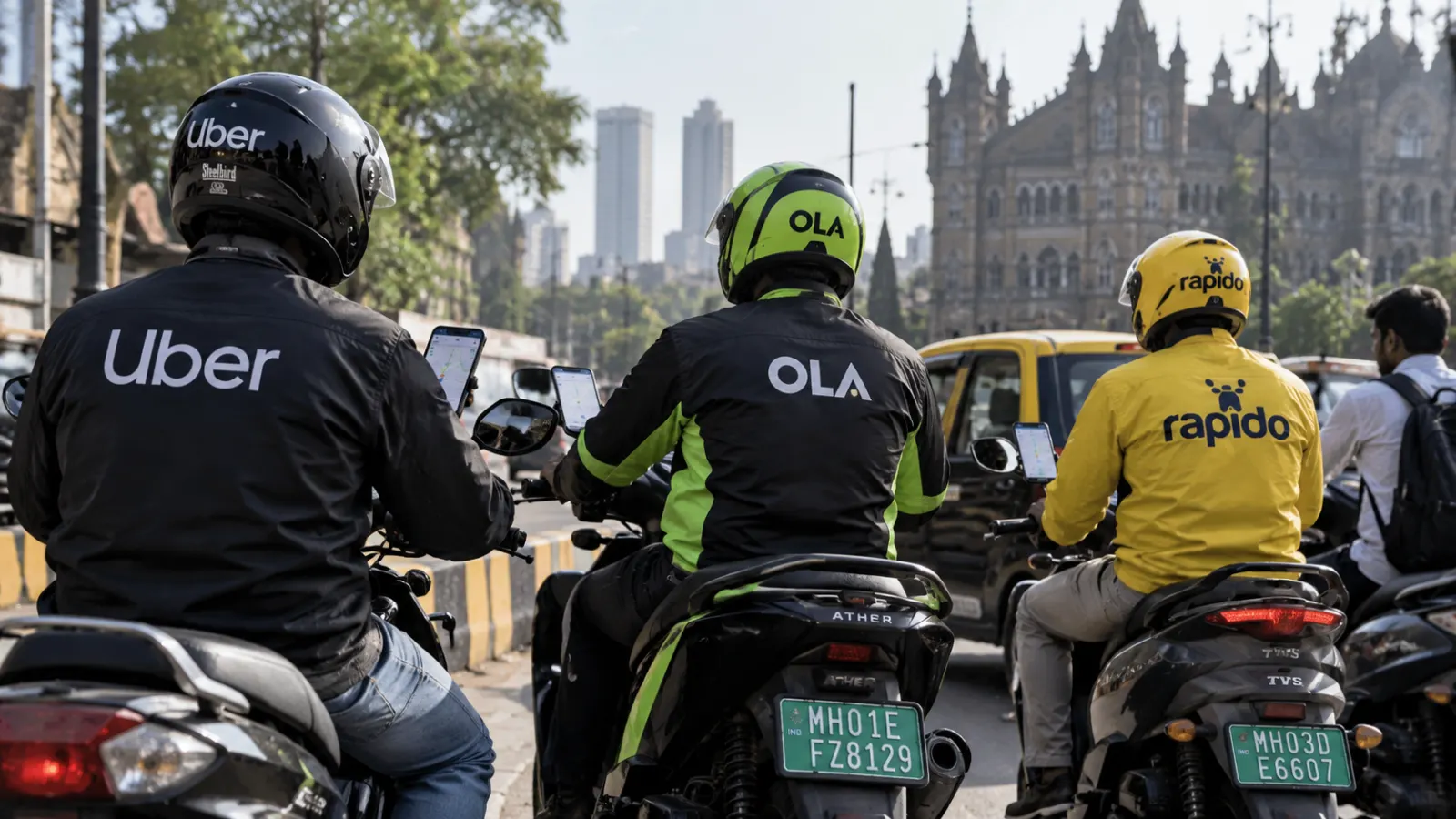
Maharashtra has given bike-taxi aggregators including Ola, Uber and Rapido roughly nine months to move to 100% electric bike-taxi fleets, setting July 2027 as the deadline for the transition. The decision applies specifically to bike-taxi operations, not to every car or cab operating through these platforms. For riders, drivers and aggregators, the order could reshape how app-based two-wheeler transport works across the state, particularly in Mumbai, Pune and other cities where low-cost bike rides have become an increasingly visible alternative to autos and cabs.
The government’s position is that bike taxis operating under Maharashtra’s regulatory framework should use electric vehicles rather than petrol motorcycles. Aggregators and rider groups have raised concerns about the speed of the transition, arguing that thousands of drivers currently own petrol bikes and cannot simply replace them overnight. They have also pointed to the cost of electric two-wheelers, battery life, charging availability and the practical difficulties of using EVs for intensive commercial work.
The debate therefore goes beyond whether electric vehicles are cleaner. Maharashtra is effectively asking an entire emerging transport business to change its underlying vehicle technology within months.
What exactly has Maharashtra ordered?
The state Transport Department has directed bike-taxi aggregators to transition their fleets completely to electric vehicles by July 2027. The transition is being implemented in phases rather than through an immediate ban on every petrol bike being used for app-based rides.
Operators currently running petrol-powered bike taxis are being given an initial period of about six months to shift towards EVs. Companies that have applied for provisional or temporary licences under the state’s bike-taxi framework are expected to receive additional time, taking the overall transition window to roughly nine months.
The policy is significant because Ola, Uber and Rapido do not necessarily own the motorcycles used on their platforms. Most rides are provided by individual drivers using vehicles they own or finance themselves. A requirement for a platform to become fully electric therefore ultimately requires thousands of individual riders to acquire electric motorcycles or scooters.
That makes the transition considerably more complicated than asking a corporate fleet operator to replace vehicles from a central garage.
For a driver earning daily income through a petrol motorcycle that may already be fully paid for, switching to an EV means taking on another major financial decision. The driver needs to evaluate the purchase price, financing cost, battery warranty, charging arrangement, real-world range and resale value before deciding whether continuing as a bike-taxi rider remains worthwhile.
Why Maharashtra wants electric bike taxis
Bike taxis sit at an unusual intersection of transport and environmental policy. They can reduce the cost of short urban journeys and occupy less road space than cars, but a rapidly expanding fleet of petrol motorcycles also adds fuel consumption and tailpipe emissions.
By restricting commercial bike-taxi operations to electric vehicles, Maharashtra is attempting to make the sector grow without simultaneously creating a large new class of petrol-powered commercial vehicles.
Electric two-wheelers are particularly attractive for this purpose because urban bike-taxi journeys are usually relatively short. Unlike long-distance buses or trucks, a two-wheeler travelling within a city may be able to complete a substantial number of rides within the daily range offered by modern electric motorcycles and scooters.
The economics can also become favourable over time. Electricity generally costs less per kilometre than petrol, while electric powertrains have fewer moving mechanical parts. For a vehicle that travels large distances every day, fuel savings can become significant.
But this advantage depends heavily on utilisation. A private owner who rides only a few kilometres a day may take years to recover the higher upfront cost of an EV. A commercial bike-taxi rider travelling extensively can potentially recover that difference faster because the vehicle is used far more intensively.
This is one reason governments increasingly see commercial fleets as a good place to accelerate electrification.
Why drivers are worried about the deadline
The strongest resistance is likely to come from riders who already own petrol motorcycles.
A bike-taxi driver may have purchased a petrol motorcycle before the EV-only framework became clear. That vehicle may still have several years of usable life remaining. If the driver now has to purchase an electric vehicle to continue earning through an aggregator, the existing motorcycle does not simply disappear as an economic cost.
Drivers may have to sell it, keep it for private use or continue paying an outstanding loan while financing another vehicle.
For full-time commercial riders, reliability is also critical. A personal vehicle can remain parked while charging. A bike used to generate income cannot earn money during that period.
If a rider completes high daily mileage, battery range becomes a business constraint rather than merely a technical specification. The rider must know whether one charge can cover an entire shift, whether rapid charging is available and whether charging time will reduce the number of rides completed each day.
Battery degradation also matters more under commercial use. An electric scooter travelling 150 kilometres per day accumulates battery cycles much faster than one travelling 20 kilometres.
A cheap EV with inadequate real-world range may therefore cost the rider more in lost working time than the petrol savings justify.
The policy can succeed only if the available electric two-wheelers are suitable for this kind of intensive usage.
Charging may become the biggest practical challenge
Maharashtra has a growing EV charging network, but bike-taxi riders need something different from occasional public charging.
Many drivers live in rented accommodation or dense neighbourhoods where they do not have dedicated parking with an electrical socket. Charging a vehicle overnight may therefore not be straightforward.
Public chargers can help, but commercial riders cannot spend long periods waiting for a charger to become available. Charging infrastructure needs to be located where drivers actually operate and rest during the day.
Battery-swapping systems could provide another solution. Instead of waiting for a depleted battery to recharge, a rider could exchange it for a charged battery within minutes. But battery swapping requires standardisation, sufficient swap stations and compatible vehicle models.
Aggregators may eventually need to become more involved in the energy side of the business. Ola, Uber or Rapido could negotiate fleet discounts with EV manufacturers, work with charging companies, offer battery-swapping partnerships or help riders obtain lower-cost vehicle finance.
Without these supporting systems, the government could technically mandate EVs while the practical burden falls almost entirely on individual drivers.
Could bike-taxi fares increase?
They could, particularly during the transition, although an EV requirement does not automatically mean permanent fare increases.
There are opposing forces.
An electric vehicle can reduce the rider’s running cost because electricity is generally cheaper than petrol. If maintenance costs are also lower, drivers may eventually be able to operate more cheaply per kilometre.
But the upfront cost of changing vehicles can increase financial pressure. A driver who takes a new loan for an electric two-wheeler has monthly repayments that need to be covered through ride income.
Aggregators may also have to spend money on incentives, charging partnerships, technology changes and driver-support programmes to meet the deadline.
If the number of eligible bike-taxi riders temporarily falls because some petrol-bike drivers leave the platforms rather than switch vehicles, supply could also tighten. During busy periods, fewer available riders could mean higher dynamic pricing or longer waiting times.
The final effect on fares will therefore depend on how smoothly the transition occurs.
If enough drivers acquire affordable EVs quickly, lower operating costs could eventually help keep fares competitive.
If vehicle supply, financing or charging infrastructure becomes a bottleneck, consumers may experience higher prices or reduced availability in the short term.
Why this matters particularly for Rapido, Ola and Uber
The three platforms have different business structures, but the core challenge is similar: they rely heavily on independently owned vehicles.
Unlike a traditional taxi company that buys 10,000 cars and employs drivers directly, ride-hailing platforms connect customers with individual vehicle owners. That model allows rapid expansion without enormous expenditure on vehicles.
An EV mandate changes part of that advantage.
Platforms may now need to influence what type of vehicle drivers purchase if they want to maintain a sufficiently large rider network. That could force them deeper into financing, leasing, vehicle partnerships and charging infrastructure.
Companies might offer drivers discounted EVs through manufacturers or lenders. They could provide lease-to-own plans where riders pay for the vehicle gradually through earnings. Some may partner with electric-mobility companies that operate vehicles as dedicated commercial fleets.
This could gradually change bike taxis from an informal “use the motorcycle you already own” model into a more organised commercial-vehicle ecosystem.
That may improve standardisation and regulation, but it could also raise the barrier to entry for people who currently join platforms using an ordinary petrol bike they already possess.
Will petrol bikes disappear from Maharashtra?
No.
The rule concerns the use of vehicles for regulated bike-taxi services, not private ownership of petrol motorcycles across Maharashtra.
A person can still own and ride a conventional petrol motorcycle subject to normal motor-vehicle regulations.
Even Ola, Uber and Rapido may continue having petrol and diesel vehicles elsewhere in their operations where permitted. The new requirement is specifically relevant to bike taxis covered by Maharashtra’s policy.
This distinction is important because headlines saying that Maharashtra has ordered Ola or Uber to become “100% electric” can easily create the impression that every car and motorcycle attached to the apps must become an EV.
That is not the practical scope of the current bike-taxi transition.
Will drivers lose jobs?
Some could leave bike-taxi work if they decide that purchasing an EV is not economically viable, but it is too early to know the scale.
The effect will depend on how much support drivers receive during the transition.
Suppose an electric motorcycle suitable for commercial use costs significantly more than the resale value of a rider’s existing petrol vehicle. Without affordable financing, many drivers may struggle to make the switch.
If manufacturers, lenders and aggregators offer commercial EV packages with manageable instalments, the transition could instead create a relatively straightforward upgrade path.
The underlying demand for low-cost urban transport is unlikely to disappear simply because the powertrain changes. If consumers continue using bike taxis, platforms will still need drivers.
The question is whether existing riders can transition or whether the new system favours larger fleet operators capable of purchasing hundreds or thousands of electric vehicles.
That distinction could have important consequences for gig workers.
The EV rule also raises a fairness question
Environmental regulation often creates benefits that are spread across society while imposing immediate costs on a narrower group.
Cleaner bike taxis can reduce fuel consumption and local emissions. The benefits accrue to cities, passengers and residents generally.
But the cost of replacing an existing petrol motorcycle may fall primarily on the driver.
That creates a legitimate policy question: who should pay for the transition?
Governments can provide incentives.
Manufacturers can discount vehicles.
Aggregators can subsidise financing.
Banks can create commercial EV loans.
Charging companies can offer lower fleet tariffs.
Drivers can contribute through the fuel savings they receive over time.
A successful transition is likely to require some combination of these rather than expecting individual gig workers to absorb the entire upfront cost.
The environmental objective and the livelihood question are not mutually exclusive. Both can be addressed if the transition is designed carefully.
Could Maharashtra become a model for other states?
Possibly.
India does not have one completely uniform approach to bike taxis. States differ in how they classify, license and regulate them, and the sector has faced repeated legal and policy disputes.
If Maharashtra manages to create a functioning EV-only bike-taxi ecosystem, other states may study the model.
The attraction is clear. Governments can legalise and regulate a service that consumers already use while simultaneously accelerating EV adoption.
Commercial two-wheelers also accumulate far more kilometres than many privately owned vehicles. Electrifying one heavily used bike taxi can therefore potentially eliminate more petrol consumption than electrifying a private scooter used only occasionally.
That makes the segment attractive from an emissions perspective.
But other states will also watch what goes wrong. If Maharashtra experiences driver shortages, fare increases or inadequate charging capacity, governments elsewhere may choose longer transition periods.
The next nine months will therefore serve as a real-world test of whether EV-only bike taxis can work at scale.
What passengers should expect
For passengers, nothing changes overnight.
Ola, Uber and Rapido bike-taxi services are not suddenly required to stop using every petrol vehicle immediately. The transition period exists specifically to allow platforms and drivers to adjust.
Over the coming months, passengers are likely to see an increasing number of electric bikes appearing on the apps.
There may eventually be changes in availability if platforms remove non-compliant petrol vehicles faster than they add EV riders. Prices could fluctuate depending on supply.
Passengers may also begin seeing more clearly identified electric-bike options as companies use the transition for marketing.
The most visible change may actually be quieter rides. Electric motorcycles produce far less engine noise at low speeds, which could become noticeable if large urban bike-taxi fleets move to battery power.
The real test is whether the economics work for drivers
Maharashtra can set an electric-vehicle deadline, but regulation alone cannot guarantee a successful transition.
For bike taxis to become genuinely electric at scale, the business case needs to work for the person riding the motorcycle every day.
A driver needs an EV with adequate range, reliable batteries, affordable financing, convenient charging and low enough operating costs to make switching worthwhile.
Aggregators need enough drivers to maintain short waiting times.
Passengers need fares to remain attractive compared with autos, buses and cabs.
And the government needs compliance without destroying the livelihood opportunities the bike-taxi sector was intended to create.
If these interests align, the July 2027 deadline could accelerate one of India’s largest experiments in commercial two-wheeler electrification.
If they do not, Maharashtra may discover that moving from petrol to electric transport requires much more than simply setting a date.
The next nine months will reveal whether Ola, Uber and Rapido can transform thousands of independently owned motorcycles into an organised electric fleet without making bike taxis either too expensive for passengers or financially unattractive for drivers.