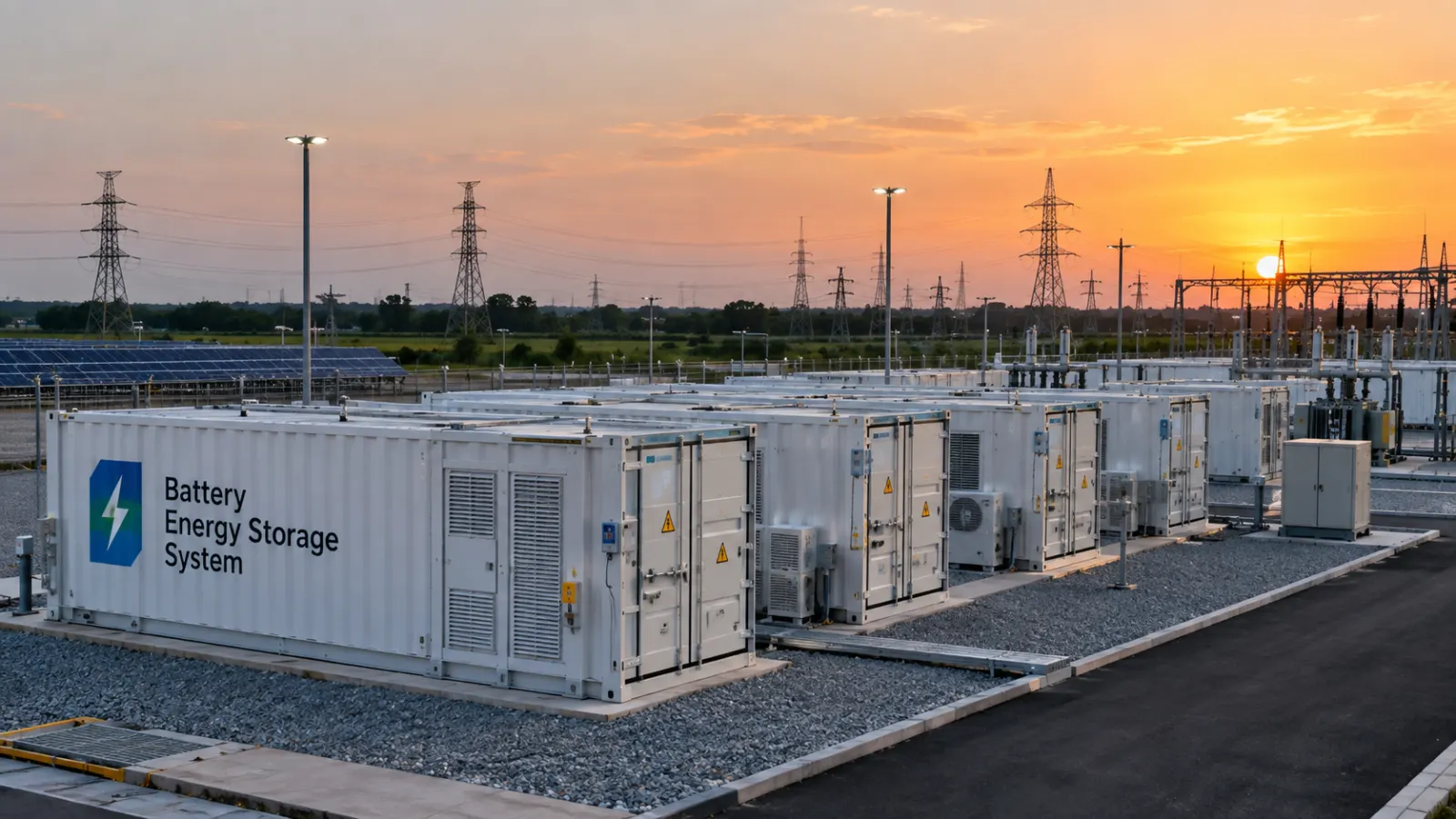
What Is BESS? Why Jupiter Wagons Is Betting on Battery Storage
Jupiter Wagons is expanding beyond its traditional railway and mobility businesses with two new battery energy storage projects in Uttarakhand and West Bengal. On October 5, the company announced that its energy business had secured a 41 MW/102.5 MWh standalone Battery Energy Storage System project in Uttarakhand and received a formal Letter of Award for a 50 MW/200 MWh BESS project in West Bengal. The Uttarakhand project is expected to involve around ₹100 crore of supply and commissioning work, while the West Bengal project will be developed at the Jeerat 132 kV substation in North 24 Parganas.
The announcement is important not only for Jupiter Wagons. It reflects a much larger shift taking place in India’s electricity system. As solar and wind power expand, the grid increasingly needs large batteries capable of storing electricity when generation is high and releasing it when demand rises. That is where BESS comes in.
What exactly is a Battery Energy Storage System?
A Battery Energy Storage System is essentially a large-scale rechargeable battery connected to the electricity grid. Instead of powering a phone, laptop or electric vehicle, these systems store electricity measured in megawatt-hours and return it to the grid when needed.
The difference between MW and MWh is important. Megawatts measure how much power a system can deliver at one time, while megawatt-hours measure how much energy it can store. Jupiter Wagons’ Uttarakhand project is rated at 41 MW/102.5 MWh, which means it can deliver up to 41 MW while storing enough energy for roughly two and a half hours of discharge at full rated output. The West Bengal project, at 50 MW/200 MWh, has a four-hour storage duration at maximum output.
This ability to separate electricity generation from electricity consumption is becoming increasingly valuable. Solar farms generate most of their electricity during daylight hours, but household demand often peaks in the evening. Wind production can also vary significantly from hour to hour. Without storage, electricity produced when demand is low may be underutilised, while power plants still need to supply the grid when renewable generation falls. Batteries help bridge that gap.
Why India suddenly needs large batteries
India is adding renewable-energy capacity at a rapid pace. Solar and wind are now central to the country’s long-term electricity strategy, but both sources are variable. A coal or gas plant can generally increase or decrease generation when required. Solar generation drops sharply after sunset, while wind output depends on weather conditions.
That creates a balancing problem for grid operators. Electricity supply and demand must remain closely matched at all times. If generation falls suddenly while demand remains high, grid stability can be affected. Battery storage provides a fast-response solution because batteries can begin discharging almost immediately.
This makes BESS useful for more than simply storing solar power. Large battery installations can support frequency regulation, reduce peak-load pressure, improve grid stability and provide backup capacity during temporary disruptions. They can also reduce the need to build expensive generation capacity that may operate only during short periods of peak demand.
As India adds more renewable generation, these services become increasingly important. A power system containing a small amount of solar can absorb variations relatively easily. A system where a large share of electricity comes from renewable sources requires far more flexibility.
Why the Uttarakhand project matters
Jupiter Wagons’ Uttarakhand project has been awarded by Uttarakhand Power Corporation Limited. The company’s subsidiary participated with Madhav Infra Projects under a tariff-based competitive bidding process and emerged as the lowest bidder for the relevant cluster.
The 41 MW/102.5 MWh system will add large-scale storage to the state’s electricity infrastructure. Uttarakhand presents an interesting energy-storage case because the state already has substantial hydropower resources while also integrating other renewable sources and strengthening its transmission network.
Battery storage can complement hydropower rather than simply competing with it. Hydroelectric plants can provide flexibility, but batteries can respond extremely quickly to short-duration fluctuations. Combining different flexible resources can make the electricity system more resilient.
For Jupiter Wagons, the project also represents an entry into a market expected to expand significantly over the coming years as state utilities begin procuring standalone storage capacity through competitive tenders.
Why the West Bengal project is larger in energy terms
The second project is a 50 MW/200 MWh standalone BESS installation at the Jeerat 132 kV substation in North 24 Parganas, West Bengal. Jupiter Wagons had previously secured the project and has now received the formal Letter of Award from the state electricity distribution company.
The four-hour storage duration is particularly notable. A 50 MW battery capable of storing 200 MWh can theoretically provide 50 MW continuously for four hours before requiring recharge. That makes it useful for shifting substantial amounts of electricity from periods of low demand or high renewable generation into evening peak periods.
This type of storage is becoming one of the most commercially important configurations globally because four hours is long enough to cover a significant portion of an evening demand peak. It does not replace all conventional generation, but it can reduce how frequently expensive peak-power sources need to operate.
The location at an existing substation also illustrates how batteries are likely to be integrated into the grid. Rather than operating as isolated facilities, large storage systems can be positioned close to important transmission and distribution infrastructure where they can support local reliability and manage congestion.
Why Jupiter Wagons is moving into energy storage
Jupiter Wagons is best known for manufacturing railway wagons and other mobility equipment. Its expansion into battery storage is therefore part of a broader diversification strategy rather than a continuation of its traditional business.
The company has increasingly built capabilities around electric mobility and energy systems through its subsidiaries. Battery technology creates a connection between those businesses because similar underlying technologies are used in electric vehicles and stationary energy storage, even though the engineering requirements can be very different.
For companies already investing in battery packs, power electronics, thermal management and electric-mobility systems, stationary storage represents an adjacent opportunity. Grid batteries require sophisticated control systems, safety architecture and integration with electricity networks, but many capabilities overlap with the broader battery ecosystem.
Jupiter Wagons has indicated that it is targeting a BESS order book of around ₹1,000 crore by FY27. The Uttarakhand and West Bengal projects therefore appear to be part of a larger attempt to establish the company as an energy-storage player rather than one-off contracts.
Why BESS is becoming a major business opportunity
Battery storage is moving from a niche technology towards a major infrastructure category because electricity systems around the world are adding more renewable generation. India is particularly attractive because power demand is still growing, renewable capacity is expanding and the grid requires substantial new infrastructure.
A battery project can earn revenue in several ways depending on its contract structure. A utility may pay the storage operator for making capacity available, for charging and discharging electricity at specific times, or through tariffs determined during competitive bidding. Batteries may also provide grid-support services such as frequency regulation.
This creates a new type of infrastructure investment. Traditional electricity businesses revolve around generating power or building transmission lines. Battery-storage companies provide flexibility—the ability to move electricity through time rather than simply through geography.
That distinction could become increasingly valuable. A solar project can produce abundant low-cost electricity at noon, but the electricity may be worth much more at 8 PM. Storage allows some of that value difference to be captured.
Falling battery costs are changing the economics
The growth of electric vehicles has dramatically increased global battery manufacturing. Larger factories, improved chemistry and intense competition have helped reduce battery costs over time, although prices still fluctuate with raw-material markets.
Lower battery costs directly improve the economics of grid storage. A project that would have been too expensive several years ago can become commercially viable when battery pack prices decline and financing improves.
Lithium-ion batteries currently dominate most new grid-storage projects because they combine high efficiency, fast response times and a mature manufacturing supply chain. However, alternatives such as sodium-ion batteries, flow batteries and other long-duration storage technologies are also being developed.
India has a strategic interest in developing domestic battery-manufacturing capacity because relying entirely on imported cells would create another form of energy dependence. Companies moving into energy storage are therefore competing not only for power-sector contracts but also for positions within an emerging domestic battery supply chain.
BESS will not replace every power plant
Battery storage is sometimes described as if it will make conventional electricity generation unnecessary. That is unlikely in the near term.
Most lithium-ion grid batteries are designed to store electricity for a few hours, not for several days or weeks. They are extremely useful for evening peaks and short-duration grid balancing, but long periods of low solar and wind generation still require other resources.
Hydropower, thermal generation, nuclear power, transmission connections and eventually long-duration storage technologies will all continue playing roles in grid reliability.
The value of BESS is therefore not that it replaces the entire electricity system. It allows the existing system to operate more efficiently and absorb a much higher share of variable renewable generation.
This is especially important during India's energy transition. The country needs to increase electricity supply while simultaneously reducing the carbon intensity of that supply. Storage makes those objectives easier to reconcile.
What does this mean for electricity consumers?
Consumers are unlikely to notice a battery-storage project directly. There will be no new application to download and no visible battery connected to individual homes. The impact occurs behind the electricity system.
If storage works effectively, it can reduce peak-power costs, improve reliability and help utilities integrate cheaper renewable electricity. Over time, this can reduce the need for some expensive infrastructure investments and make electricity supply more resilient.
However, batteries also cost money. Utilities must pay for storage capacity, and those costs ultimately form part of the power system. Whether BESS lowers total electricity costs therefore depends on whether the savings it creates exceed the cost of installing and operating the batteries.
Competitive bidding is intended to help achieve that balance. When several companies compete to provide storage at the lowest viable tariff, utilities can discover the market price of the service rather than relying solely on administratively determined costs.
What investors should watch in Jupiter Wagons’ BESS expansion
Winning projects is only the first stage. Jupiter Wagons now needs to demonstrate that it can execute them efficiently, maintain battery performance and generate acceptable returns.
Battery projects involve several risks. Equipment costs can change, project timelines can slip and battery degradation must be carefully managed over many years. Safety is also critical because large lithium-ion installations require sophisticated monitoring and fire-protection systems.
Investors should therefore watch not only the size of the order book but also margins, project execution, technology sourcing and working-capital requirements. A rapidly growing order book can create revenue opportunities while simultaneously increasing the amount of capital required to deliver projects.
The company’s ₹1,000 crore BESS order-book ambition is significant, but the quality and profitability of those contracts will ultimately matter more than the headline value alone.
Why these projects matter beyond Jupiter Wagons
The bigger story is the emergence of battery storage as a mainstream part of India’s electricity infrastructure.
A few years ago, most discussion around batteries in India focused on electric vehicles. The market is now expanding into another enormous application: storing power for the electricity grid.
Utilities in multiple states are beginning to procure large BESS projects. Renewable developers increasingly recognise that solar generation combined with storage can provide more predictable power. Transmission planners are considering batteries as an alternative or complement to conventional grid upgrades.
That creates opportunities for companies across the value chain, including battery manufacturers, power-electronics suppliers, software companies, project developers and engineering contractors.
Jupiter Wagons’ Uttarakhand and West Bengal projects are therefore important less because of their individual size and more because they illustrate how quickly this market is moving from pilot projects into commercial deployment.
India spent the past decade rapidly building renewable electricity generation. The next phase of the energy transition will increasingly focus on making that renewable power available when consumers actually need it.
That is why BESS is becoming one of the most important technologies in India’s power sector—and why companies far beyond traditional electricity utilities are now trying to enter the market.