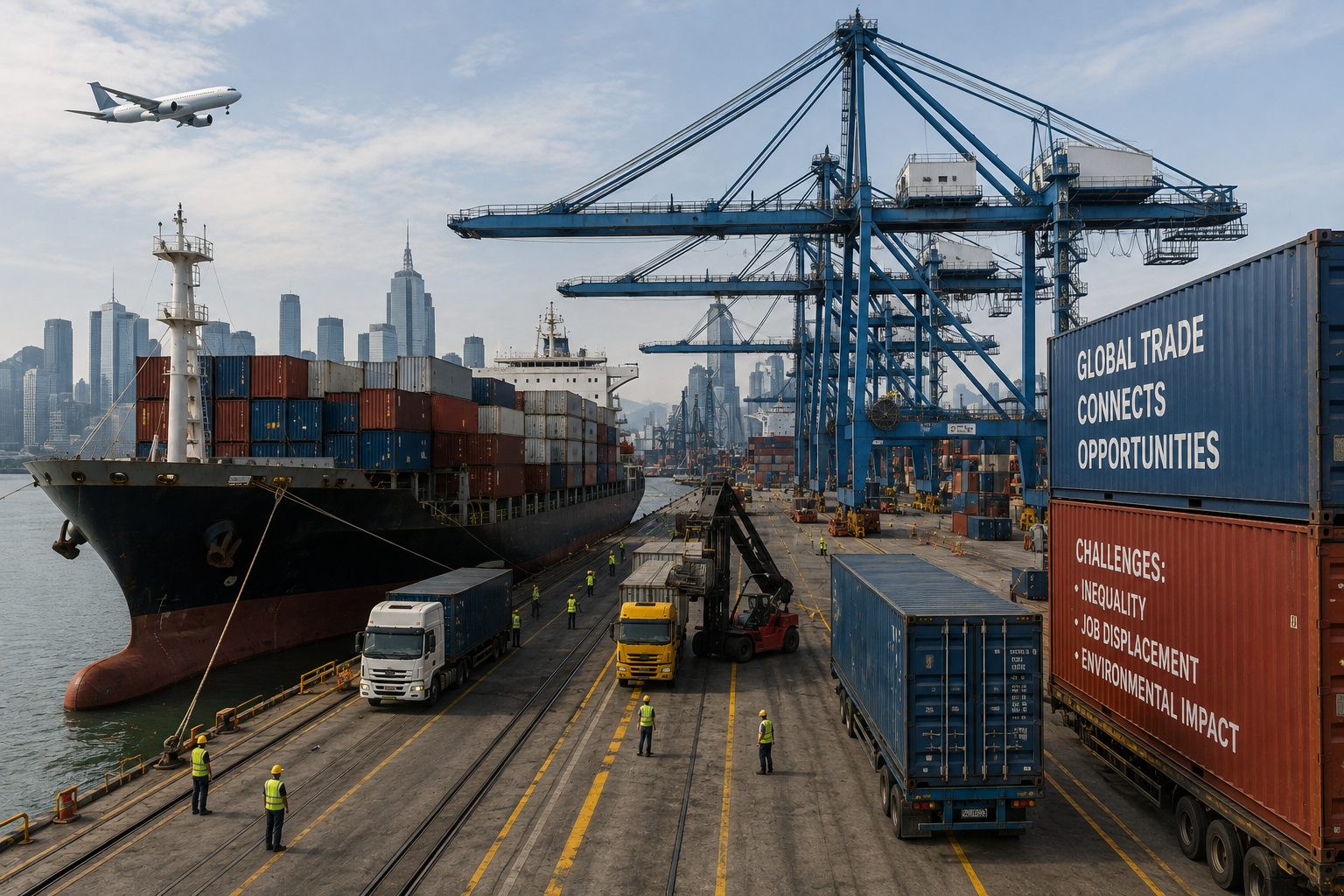
Globalisation is often described as the world becoming more connected. That description is true but incomplete. Economically, globalisation is the process through which goods, services, capital, technology, data, people and ideas move across borders more easily, making national economies increasingly interdependent. A shirt may be designed in one country, made from cotton grown in another, stitched in a third, shipped through a fourth, sold through a global platform and paid for through an international financial network.
This connectivity has changed modern prosperity. It has lowered prices for consumers, expanded markets for firms, spread technology, lifted many people out of poverty and made production more efficient. But it has also created vulnerabilities: job losses in some sectors, financial contagion, supply-chain dependence, tax competition, environmental stress and a sense that local communities are exposed to decisions made far away. Globalisation is neither a miracle nor a conspiracy. It is a system of opportunity and exposure.
What globalisation means in economic terms
Economic globalisation has several dimensions. Trade globalisation means countries buy and sell goods and services across borders. Financial globalisation means money moves internationally through investment, loans, bonds, equity markets and banking channels. Production globalisation means companies organise supply chains across multiple countries. Technology globalisation means knowledge, software, platforms and standards spread quickly. Labour globalisation means people migrate or provide services across borders, physically or digitally.
These dimensions reinforce one another. A company may invest in a foreign factory, import components, export finished goods, borrow in global markets, use international software, hire migrant workers and sell through digital platforms. The modern economy is built on these layers of connection.
The important point is that globalisation changes the meaning of economic distance. Geography still matters, but costs of communication, transport and coordination have fallen dramatically compared with earlier centuries. A firm in India can serve a client in Europe, use cloud infrastructure from the United States, depend on components from East Asia and receive investment from a global fund. This is globalisation in daily business form.
How globalisation creates growth
Globalisation can support growth through specialisation. Countries do not have to produce everything themselves. They can focus on goods and services where they have comparative advantage, import what others produce efficiently, and use trade to expand total welfare. Consumers benefit from lower prices and more choice. Firms benefit from larger markets and cheaper inputs.
It also supports scale. A company that sells only in its domestic market may remain small. A company that sells globally can expand production, invest in technology, improve quality and reduce average costs. Export exposure can force firms to become more competitive because global markets punish inefficiency more quickly than protected domestic markets.
Technology transfer is another channel. Foreign investment, trade, licensing, migration and global competition can spread better machines, management practices and standards. Countries that integrate intelligently can learn from advanced economies and move up the value chain. This is one reason export-led growth played a major role in the rise of several East Asian economies.
The consumer side of globalisation
For consumers, globalisation often appears as variety and affordability. Electronics, clothing, medicines, cars, smartphones, food products, educational tools and financial services are shaped by global supply chains. Competition from imports can reduce prices and improve quality. Digital globalisation gives users access to global knowledge, entertainment, software and services.
But the consumer benefit can hide production-side pain. A cheaper imported product may help households, but it can hurt domestic producers who cannot compete. A globally efficient supply chain may lower prices, but it may also make a country dependent on distant suppliers for essential inputs. The same process can create winners and losers inside one economy.
This is why the politics of globalisation is difficult. People experience it differently depending on whether they are consumers, workers, entrepreneurs, exporters, import-competing firms, farmers, investors or taxpayers. A policy that lowers consumer prices may reduce jobs in one sector. A policy that protects local firms may raise costs for consumers. Serious economic analysis must recognise these trade-offs.
Jobs, wages and inequality
Globalisation affects labour markets unevenly. Workers in export-oriented sectors may benefit from higher demand. Skilled professionals may gain access to global clients and higher wages. Migrant workers may earn more abroad than at home. But workers in industries exposed to import competition may face job losses, wage pressure or insecurity.
The distributional effect depends on domestic policy. Education, retraining, labour mobility, social security, regional development and industrial strategy decide whether workers can move from declining sectors to growing sectors. Without adjustment support, globalisation can produce resentment even when the economy as a whole gains.
Inequality can rise when the gains of globalisation concentrate among capital owners, highly skilled workers, large firms or globally connected cities. Smaller towns, less skilled workers and informal enterprises may not benefit equally. This does not mean globalisation must be rejected. It means integration must be paired with domestic capability building and social protection.
Supply chains and vulnerability
The most visible lesson of recent years is that globalisation improves efficiency but can reduce resilience. Just-in-time supply chains minimise inventory costs, but they can break during pandemics, wars, port disruptions, sanctions, energy shocks or geopolitical tensions. A shortage of semiconductors, shipping containers or critical minerals can affect industries across continents.
This has changed the debate. Countries now ask not only where production is cheapest, but where it is reliable, politically safe and strategically acceptable. Words such as reshoring, nearshoring, friendshoring and supply-chain resilience have entered policy language. The world is not abandoning globalisation, but it is trying to redesign it with more attention to risk.
For firms, this means diversification. They may use multiple suppliers, hold strategic inventories, localise some production or build regional supply chains. For governments, it means identifying critical sectors such as food, energy, medicines, defence, electronics and digital infrastructure. Economic interdependence is useful, but dependence without alternatives can become vulnerability.
Globalisation and India
India's relationship with globalisation is complex. The 1991 liberalisation opened the economy to more trade, investment and competition. Over time, India became a major services exporter, especially in information technology, business process services, pharmaceuticals, engineering talent and professional services. Indian consumers also gained access to more products and technologies.
Yet India has not used manufacturing globalisation as deeply as some East Asian economies did. Its share in global goods exports remains below its potential relative to its population and market size. Infrastructure, logistics, regulatory complexity, land constraints, skill gaps and firm size distribution have limited manufacturing scale. This is why India's next globalisation challenge is not simply openness; it is competitiveness.
India must also balance integration with strategic autonomy. It wants foreign investment, export markets and technology partnerships, but it also wants domestic capability in critical sectors. This balance is visible in debates around electronics manufacturing, semiconductors, renewable energy, defence production, digital infrastructure and pharmaceuticals. The goal is not isolation. The goal is intelligent integration.
Is globalisation reversing
Globalisation is changing rather than simply ending. Goods trade may face more tariffs, security screening and industrial policy. But services trade, digital flows, data, cross-border finance, migration networks and global knowledge exchange continue to matter. Companies may reduce dependence on one country, but they rarely return to complete national self-sufficiency.
The future may be more fragmented. Trade could increasingly follow geopolitical trust. Strategic sectors may be protected. Regional blocs may gain importance. Countries may use subsidies and standards to shape supply chains. This is sometimes called deglobalisation, but a better description may be selective globalisation: more openness in some areas, more control in others.
For developing countries, this creates both risk and opportunity. The risk is that advanced economies close markets or capture high-value technologies. The opportunity is that companies diversifying supply chains may look for new production locations. Countries that offer stability, infrastructure, skills and market access can benefit.
Final reader takeaway
Globalisation is best understood as interdependence. It allows countries, firms and consumers to benefit from each other's strengths, but it also transmits shocks. It can reduce prices and expand opportunity, but it can also deepen insecurity if domestic systems fail to help people adjust.
The question is not whether globalisation is good or bad in the abstract. The question is what kind of globalisation a country builds. Smart globalisation expands trade while protecting essential resilience. It welcomes investment while building domestic capacity. It supports consumers while preparing workers. It connects the economy to the world without forgetting the people and regions that need help adapting. That is the balanced way to understand its economic effects.
Editorial Disclaimer
This article is for general financial and economic education. It does not constitute investment, tax, legal or policy advice. Readers should verify current rules, official data and professional guidance before making financial or business decisions.