International Climate Cooperation: Why Countries Must Work Together
International climate cooperation exists because the atmosphere does not recognise national borders. A tonne of carbon dioxide contributes to global warming regardless of whether it was emitted in Delhi, Beijing, Houston or Berlin. One country's emissions therefore impose consequences beyond that country's territory, while the benefits of reducing emissions are shared internationally. This creates a classic collective-action problem: every government has reasons to want a stable climate, but each controls only part of the emissions causing the problem.
The difficulty becomes sharper because countries start from radically different positions. Some became wealthy through more than a century of fossil-fuel-intensive industrialisation. Others contributed relatively little to historical warming but now need enormous investment in electricity, transport, housing and industry as their populations and economies develop. Small island states and other highly vulnerable countries can face severe climate damage despite contributing only a tiny fraction of cumulative global emissions. Climate diplomacy is therefore not only about reducing tonnes of greenhouse gases; it is also about development, responsibility, finance, technology, vulnerability and trust.
No international agreement can replace domestic action. The United Nations cannot directly order a government to close a coal plant, redesign its electricity grid or build a railway. Those decisions remain largely under national and subnational authority. What international cooperation can do is create common objectives, reporting rules, financing arrangements, technological partnerships and mechanisms through which governments can compare progress and make national action less isolated.
The practical problem is therefore not how to create a world government for climate change. It is how sovereign states can cooperate enough to manage a physical problem that none of them can solve alone.
From the UN Climate Convention to the Paris Agreement
The modern international climate system developed in stages. The United Nations Framework Convention on Climate Change, adopted in 1992, created the basic institutional structure and established the principle that countries share responsibility for climate change but do not carry identical obligations or capabilities. The 1997 Kyoto Protocol then created quantified, legally binding emissions commitments for a group of industrialised countries and economies in transition.
Kyoto demonstrated that international emissions accounting and legally structured targets were possible, but its political reach remained limited. The United States never ratified the Protocol, and large developing economies did not face Kyoto-style binding national emissions caps. As the geography of global emissions changed, negotiators increasingly needed a framework in which essentially every country could participate while still recognising different historical responsibilities and development circumstances.
The Paris Agreement, adopted in 2015, responded with a different design. Instead of internationally negotiating one binding emissions quota for each country, Paris requires every Party to prepare, communicate and maintain a nationally determined contribution, or NDC. Countries determine the substance of their own targets, while the international framework establishes common cycles of planning, transparency and review. NDCs are submitted every five years, and successive contributions are expected to represent progression and reflect each Party's highest possible ambition. (unfccc.int)
This structure explains both the strength and the weakness of Paris. Near-universal participation is politically easier because countries retain substantial control over their own commitments. But there is no international authority assigning each government an emissions pathway guaranteed to add up to the temperature goals. Collective ambition therefore depends on countries strengthening domestic targets and actually implementing them.
Paris tries to address that weakness through an iterative cycle. Governments submit NDCs, implement policies, report information and periodically assess collective progress. Beginning in 2023, the global stocktake occurs every five years and is intended to inform the next round of national commitments. The theory is that better information, political comparison, technological progress and growing awareness of climate risks will gradually increase ambition. (unfccc.int)
Whether that ratchet works depends less on diplomatic language than on what happens inside economies.
Transparency Matters Because Countries Need to Know Whether Others Are Acting
International cooperation becomes much harder if governments do not trust one another's claims. A country considering expensive industrial changes may hesitate if competitors appear able to announce climate targets without demonstrating progress. Finance providers similarly need credible information about national policies, emissions and investment needs.
The Paris Agreement's Enhanced Transparency Framework was designed partly to solve this problem. Countries submit Biennial Transparency Reports containing information on greenhouse-gas emissions, progress toward NDCs, adaptation and various forms of climate support. These reports do not guarantee implementation, but they create a more systematic evidence base against which national claims can be evaluated.
The UNFCCC's first synthesis of Biennial Transparency Reports, published in 2025, drew on more than 100 first reports and associated inventory submissions received by April 2025. Those submissions represented around three-quarters of total global greenhouse-gas emissions in 2020 and provided the first broad picture of implementation under the new transparency framework. (unfccc.int)
The significance lies less in the number of reports than in the institutional change they represent. Countries are building inventories, coordinating ministries, creating databases and learning how to track policies across sectors. The synthesis also documented continuing capacity constraints, particularly in developing countries, where technical expertise, data availability and institutional resources can limit reporting quality. Climate transparency therefore requires its own form of international cooperation: training, finance and technical support for governments expected to meet increasingly sophisticated reporting standards.
Transparency is often dismissed as bureaucracy because it does not itself reduce emissions. But cooperation without trusted measurement quickly becomes politically fragile. Reporting formats, inventories and expert reviews are part of the infrastructure through which governments decide whether others are doing what they promised.
Trust in climate diplomacy is built partly through spreadsheets.
Climate Finance Is Where Questions of Fairness Become Concrete
Climate cooperation becomes especially contentious when negotiations move from emissions targets to money.
Developing countries often face a difficult combination of rapid infrastructure needs, high borrowing costs, limited fiscal space and increasing exposure to climate impacts. Some of the world's largest opportunities for renewable-energy expansion, resilient infrastructure and low-carbon urban development are located in countries that also face expensive financing and competing demands for healthcare, education and poverty reduction.
Climate finance is therefore not simply diplomatic generosity. It affects whether agreed climate objectives can physically be implemented.
At COP29 in Baku in 2024, countries agreed a new collective quantified goal on climate finance. The agreement calls for developed countries to take the lead in mobilising at least USD 300 billion per year for developing countries by 2035, while also calling on all actors to work together to scale total climate finance from public and private sources to at least USD 1.3 trillion annually by 2035. (unfccc.int)
The Baku to Belém Roadmap to 1.3T, developed through 2025, attempted to make that broader figure more operational by examining barriers to mobilising capital at the required scale. Its underlying logic is that global capital is not inherently scarce enough to make climate investment impossible; the problem includes borrowing costs, currency risk, weak project pipelines, institutional barriers and uncertainty that prevent finance from flowing where climate investment is most needed. (unfccc.int)
The quality of finance matters as much as the headline number. A solar project with predictable revenues may attract private investors relatively easily. A seawall protecting a vulnerable community, an early-warning system or climate-resilient public-health infrastructure may produce enormous social benefit without creating a direct revenue stream. Adaptation therefore often requires greater reliance on public or concessional finance.
Debt creates another problem. A climate-vulnerable country can receive money for resilience yet become more financially fragile if most support arrives as expensive loans. Least developed countries and small island states have consequently argued strongly for grant-based or highly concessional support. Climate finance debates are therefore arguments about who pays, which instruments count, how risk is distributed and whether the transition increases or reduces existing economic inequality.
The 1.3-trillion-dollar figure should not be understood as one pot of aid that rich-country governments are expected simply to transfer. It is a broader mobilisation objective involving public budgets, multilateral development banks, private capital and other financial channels. That makes the number larger, but it also makes accountability more complicated.
Technology, Carbon Markets and Cooperation Beyond Finance
Money alone cannot produce a low-carbon transition if suitable technologies, technical capacity and supply chains are unavailable.
International climate cooperation therefore includes technology development and transfer. Under the UNFCCC system, the Technology Mechanism includes the Technology Executive Committee and the Climate Technology Centre and Network. These institutions are intended to support the development and deployment of low-emission and climate-resilient technologies, particularly in developing countries. The mechanism continues to operate under the Paris Agreement, and COP30 in Belém adopted further technology-related decisions, including a Belém Technology Implementation Programme. (unfccc.int) (unfccc.int)
Modern technology cooperation is more complicated than one country inventing equipment and another simply importing it. Governments increasingly want domestic manufacturing, skilled jobs, technological capability and resilient supply chains. Solar modules, batteries, electric vehicles, critical minerals and industrial technologies have become strategic economic assets as well as climate tools.
This creates tension between climate diffusion and industrial competition. Export restrictions, subsidies, intellectual-property disputes and concentrated supply chains can slow deployment even when countries agree on the environmental objective. Effective technology cooperation increasingly requires training, finance, local capacity, research partnerships and diversified production rather than technology transfer understood as a simple commercial transaction.
The Paris Agreement also provides formal mechanisms through Article 6 for countries that want to cooperate directly in meeting climate targets. Article 6.2 establishes accounting and reporting guidance for internationally transferred mitigation outcomes. Article 6.4 establishes a UN-supervised crediting mechanism, while Article 6.8 covers non-market approaches. (unfccc.int)
These mechanisms can lower mitigation costs and potentially move finance toward emissions-reduction projects. They also inherit many of the integrity problems that emerged under the Kyoto Protocol's carbon markets. If two governments claim the same emissions reduction, global accounting becomes misleading. If a credit is issued for an activity that would have happened anyway, buying it may not produce additional climate benefit.
Article 6 rules therefore involve technical questions such as corresponding adjustments, methodologies, registries, reporting and additionality. COP30 continued refining implementation of Article 6.2 and the Article 6.4 crediting mechanism, including rules concerning reporting infrastructure, governance, methodologies and transparency. (unfccc.int)
Carbon cooperation can reduce costs.
It cannot substitute for credible accounting.
Adaptation and Loss and Damage Change the Meaning of Cooperation
Mitigation asks how the world can reduce the future causes of climate change. Adaptation asks how societies can cope with impacts that can no longer be completely avoided. Loss and damage goes further by addressing consequences that exceed the capacity of communities to prevent or adapt to them.
These issues make climate cooperation morally and politically more difficult because the countries suffering the greatest harm are not necessarily those most responsible for the accumulated emissions producing that harm.
Small island states facing sea-level rise provide an obvious example. A country's entire territorial future can be threatened while its contribution to historical global emissions remains negligible. Drought, stronger coastal hazards and extreme heat can similarly impose enormous costs on economies with limited fiscal capacity.
The international architecture around loss and damage has consequently expanded. The Fund for responding to Loss and Damage was established to assist developing countries that are particularly vulnerable to the adverse effects of climate change in responding to both economic and non-economic losses. It operates within the UN climate financial architecture and continued receiving guidance at COP30. (unfccc.int)
The Warsaw International Mechanism and Santiago network also continue working on knowledge, technical assistance and institutional responses to loss and damage, with joint reporting continuing in 2026. (unfccc.int)
These institutions do not resolve the political controversy. Funding remains far below the scale of potential climate losses, and governments continue debating who should contribute, how vulnerability should be defined and what forms of assistance are appropriate.
But their existence reflects a significant change in climate diplomacy.
International cooperation is no longer only about dividing responsibility for future emissions reductions. It increasingly has to address how the costs of already-occurring climate damage are distributed.
Trade and Geopolitics Make Climate Cooperation Harder—and More Necessary
Climate policy increasingly overlaps with industrial strategy and international trade.
Carbon border measures, clean-energy subsidies, local-content requirements, battery supply chains and green industrial standards can accelerate domestic transition while creating conflict with trading partners. A government may describe a policy as necessary to prevent carbon leakage; exporters may see it as protectionism. Developing countries can reasonably worry that environmental standards created in wealthy markets may become barriers to trade when producers lack finance to upgrade.
Climate cooperation therefore needs rules for measurement and recognition that reduce unnecessary fragmentation. Common methodologies for carbon intensity, compatible product standards and targeted finance for cleaner production can reduce some of these tensions.
But there is no expectation that trade conflict will disappear.
Decarbonisation changes comparative advantage. Countries possessing abundant renewable energy, critical minerals, manufacturing capacity or technological intellectual property can gain strategic economic influence. Climate transition is therefore becoming part of geopolitical competition rather than remaining a separate environmental policy sphere.
Wars, sanctions and energy-security crises can further complicate cooperation. A government confronting a sudden fuel shortage may prioritise short-term energy security over long-term climate plans. Strategic rivalry can limit technology exchange or concentrate supply chains inside politically aligned blocs.
This does not make multilateral cooperation obsolete.
It makes a minimum common framework more valuable.
Strategic rivals can still benefit from compatible greenhouse-gas accounting, weather information, methane measurement, disaster cooperation and rules preventing double counting in carbon markets. Cooperation does not require geopolitical friendship. It requires enough coordination that competition does not destroy the institutions needed to manage a shared physical problem.
This is also why universal UN negotiations and smaller partnerships increasingly operate together. Bilateral arrangements can finance electricity grids or industrial projects. Regional organisations can harmonise electricity markets. Groups of countries can cooperate on methane, steel, shipping or clean technology. Smaller coalitions may move faster than negotiations involving almost every country on Earth.
The key question is whether these arrangements reinforce the broader climate system or fragment it into competing standards.
COP30 Was Another Stage, Not the End of the Process
Annual climate summits can create the impression that international cooperation rises or falls on one dramatic meeting. In reality, negotiations continue throughout the year through subsidiary bodies, expert committees, national ministries and specialised institutions.
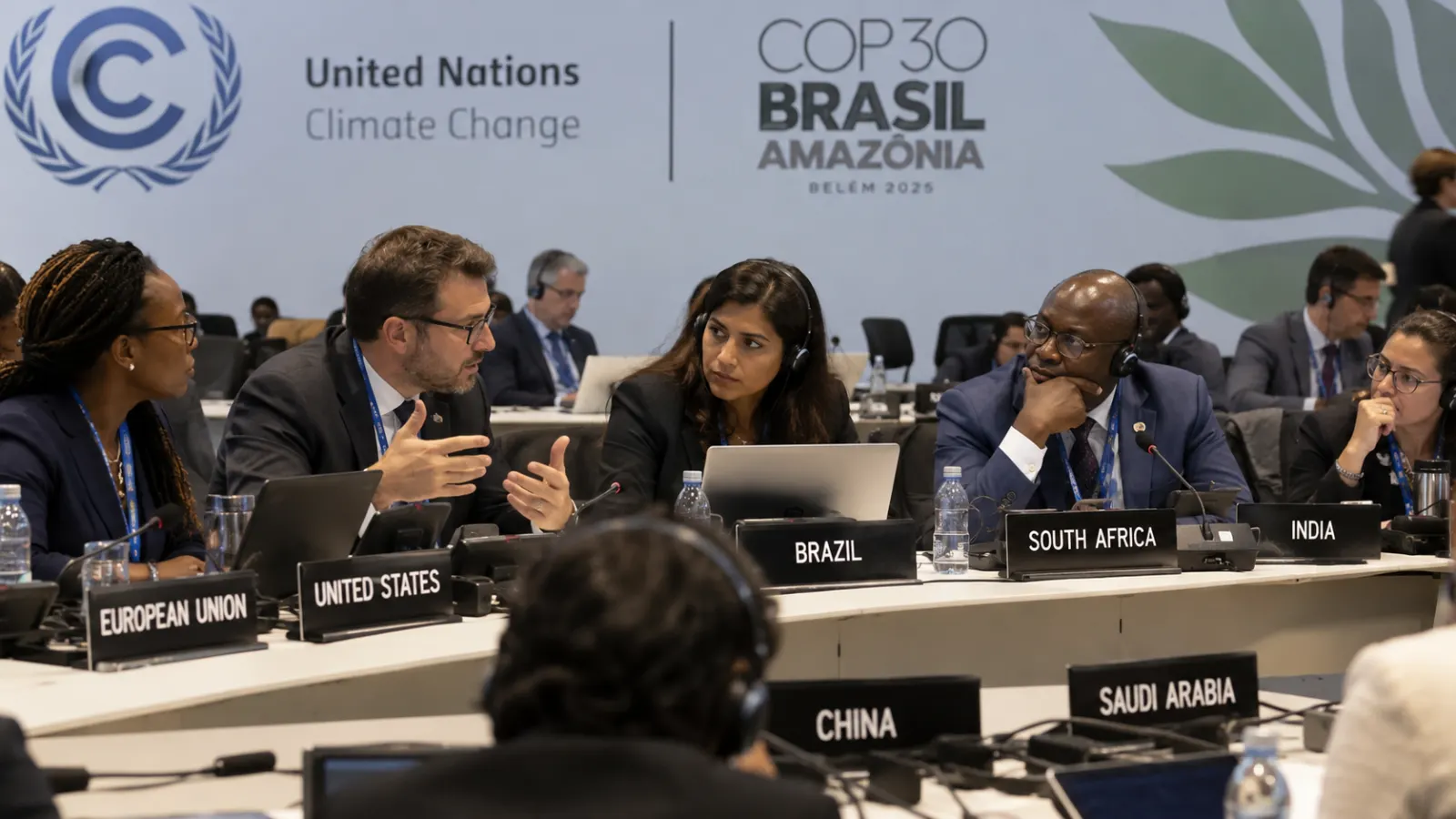
COP30, held in Belém, Brazil, in November 2025, adopted decisions across areas including finance, the global stocktake, just transition, adaptation, loss and damage, technology and gender. It also continued implementation work on Article 6 and other elements of the Paris Agreement. (unfccc.int)
None of those decisions completed global climate cooperation.
The process has already moved toward COP31 in Antalya, Türkiye, scheduled for 9–20 November 2026. The COP30 and incoming COP31 presidencies have been coordinating through 2026 to prepare negotiations and engagement before the conference. (unfccc.int)
This continuity explains both the frustration and resilience of the UN climate process.
Critics are correct that negotiations can be slow, compromises can weaken ambition and conference declarations do not automatically produce emissions reductions. Governments can agree to language internationally and fail to provide the laws, infrastructure or finance necessary at home.
But there is also no other institution with comparable global membership, continuous legal architecture and capacity to connect mitigation, adaptation, finance, technology, transparency and loss and damage in one system.
The value of a COP is therefore not whether it produces one headline announcing that climate change has been solved.
It is whether it strengthens the machinery through which countries continue coordinating after the conference hall empties.
Trust Is the Scarce Resource Behind Climate Cooperation
Every part of the international climate system ultimately depends on trust.
Countries need confidence that reported emissions are credible. Developing countries need confidence that promised finance will actually arrive. Governments selling or buying carbon credits need confidence that reductions will not be counted twice. States accepting new trade standards need confidence that climate policy is not merely being used to disguise economic protectionism.
Trust is difficult to build because climate negotiations contain long institutional memories.
A missed finance commitment does not disappear when the next summit begins. Disagreement over historical responsibility affects later negotiations. Questions about the quality of carbon credits can weaken confidence in future markets. A government that frequently changes its climate policy may struggle to persuade investors and other states that new commitments will survive.
This is why apparently technical climate institutions are politically important.
Inventories, registries, expert reviews, common reporting formats and finance disclosures create evidence that allows promises to be tested.
Trust does not require governments to believe that every other country is acting altruistically.
It requires enough confidence in common information and procedures that cooperation remains rational even when national interests differ.
International Cooperation Succeeds Only When It Changes Domestic Reality
The ultimate test of international climate cooperation is not the number of treaties signed, delegates attending conferences or pages of negotiating text produced.
The test is whether cooperation changes what happens outside the diplomatic system.
Are electricity grids becoming cleaner? Are governments able to finance adaptation? Are forests being better protected? Are industrial processes changing? Are vulnerable communities receiving support? Are national targets being translated into enforceable policies and investment?
International agreements can help create those outcomes by providing long-term signals, financial mechanisms, common standards and accountability. They can strengthen domestic ministries that need evidence to justify climate policy and provide investors with greater confidence that transition will occur across multiple markets rather than in one isolated country.
The relationship also works in reverse. International negotiators cannot credibly promise what governments lack the authority, finance or domestic political support to deliver. Climate cooperation therefore moves in two directions: national politics shapes international commitments, while international agreements reshape national expectations.
That interaction explains why climate diplomacy often progresses incrementally.
The atmosphere is global.
Political authority is still predominantly national.
International climate cooperation is the institutional bridge between those realities.
It cannot eliminate conflicts over fairness, trade, finance or development. It cannot guarantee that governments will fulfil every promise, and it cannot substitute for the national policies that actually reduce emissions or protect communities.
What it can do is make national action less isolated, create common rules for judging progress, move technology and finance across borders and establish a permanent arena in which governments must confront the consequences of their collective behaviour.
Climate change does not require countries to agree about everything.
It requires them to cooperate enough on the one fact they cannot negotiate away:
they share the same atmosphere.