A Plate Can Contain a Biography
Ask someone what they ate yesterday and the answer may sound ordinary. Ask what dish reminds them of childhood and the conversation changes.
A smell can return someone to a grandmother's kitchen. A sweet may evoke a festival. A soup may recall illness and care. A particular spice may signify home to a migrant living thousands of kilometres away.
A meal therefore exists at two levels simultaneously. It provides nourishment. It also carries meaning.
Social scientists often use the term foodways for the wider cultural practices surrounding food: not only what people eat, but how food is produced, prepared, served, shared and understood. To understand food culturally is to look beyond the recipe.
Food Answers the Question 'Who Are We?'
Communities often describe themselves partly through food. Regional identity may be linked with particular grains, cooking fats, spices, preservation methods or festive dishes. Families distinguish our way of preparing something from another household's.
Diaspora populations recreate foods associated with an ancestral homeland. Religious communities organise dietary rules and festival meals around shared beliefs.
UNESCO increasingly treats food-related practices as forms of living heritage—not simply individual dishes, but the knowledge, cultivation, preparation and social practices surrounding them. That distinction is essential. A recipe alone is not a culture. The relationships around it are.
Geography Enters the Kitchen
Traditional cuisines develop within environments. Climate determines what can grow. Water availability shapes agriculture. Coasts support different food systems from mountains. Pastoral communities develop different habits from settled farming populations. Preservation methods respond to temperature and seasonality.
Food therefore contains geography. FAO notes that cultural identity and sense of place are often closely connected to landscapes and food systems and that culinary traditions grow around locally adapted agricultural diversity and accumulated knowledge.
A cuisine is consequently not an arbitrary collection of flavours. It often represents generations of negotiation with an environment.
Food Is Learned Behaviour
Humans require nutrients. Culture determines many of the ways those nutrients become meals.
A child learns what counts as breakfast; whether people eat together; which foods are celebratory; which are avoided; what is considered polite at the table; which ingredients belong together; whether food should be eaten by hand or with particular utensils; who cooks; who serves; and who receives the first portion.
Most of these habits eventually feel natural. They are not. They are learned.
Family Recipes Are Small Archives
Not every important cultural archive belongs to a museum. A family recipe can preserve migration, scarcity, adaptation and preference.
Perhaps an ingredient was substituted because the original was unavailable after migration. Perhaps a dish once reserved for a festival became ordinary as incomes increased. Perhaps a technique survives because one grandmother taught three generations.
The recipe changes while retaining an identity. This is how living culture often works. The dish does not need to remain chemically identical for people to recognise continuity.
Food Makes Memory Physical
Memory is frequently triggered by sensory experience. Food is unusually powerful because it combines taste, smell, texture, place and social context.
A meal eaten repeatedly at important moments accumulates associations. Birthdays acquire cakes. Religious observances acquire particular foods. Mourning may involve communal meals. Weddings develop elaborate food conventions. Annual festivals revive dishes rarely prepared at other times.
Food therefore does not merely accompany memory. It helps create it.
Sharing Food Creates Relationships
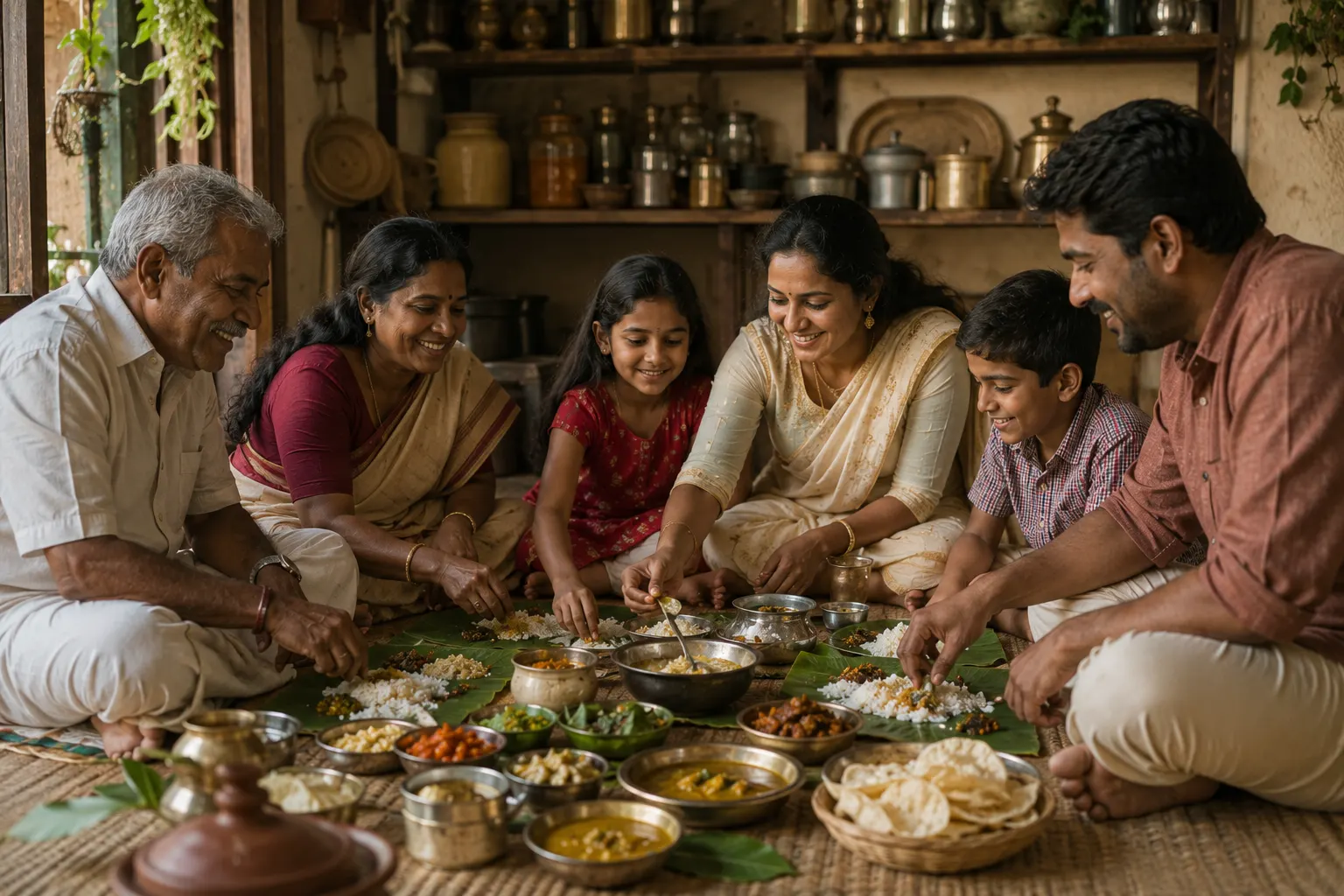
Eating together—sometimes called commensality—is a basic social act. A host offers. A guest accepts. A household demonstrates care. A community distributes food during a celebration. Colleagues become less formal over lunch. Relatives negotiate family life around the table.
Traditional culinary practices can create opportunities for conversation and exchange and may contribute to social cohesion.
But food can also mark boundaries. Who may eat with whom? Who prepares the meal? Which foods are permitted? Who receives the best portion? The table may reveal hierarchy as clearly as hospitality.
Religion Gives Food Moral Meaning
For many societies, food is not morally neutral. Rules may govern fasting, slaughter, preparation, purity, abstinence or the timing of meals. Certain foods become offerings. Others are prohibited. A period of fasting may end in communal feasting.
Food can therefore connect the body with theological ideas. People do not simply believe something. They practise belief through appetite, restraint, preparation and sharing.
Food Can Express Status
What people eat can communicate wealth, aspiration or distinction. Rare ingredients may signal prestige. Imported goods can become status symbols. Certain restaurants function as social markers.
At other times, elite preferences move in the opposite direction and elevate foods once considered rustic or poor. Cuisine therefore participates in class formation.
What counts as refined food is historically unstable. Yesterday's necessity can become tomorrow's delicacy. Yesterday's luxury can become a supermarket staple.
Migration Changes Food Without Erasing It
Migration provides one of the clearest demonstrations that cuisine is flexible. People carry recipes but encounter new ingredients, prices, regulations and neighbours.
Substitutions become necessary. Cooking equipment changes. New influences enter. Children born in the destination country develop different preferences. Yet traditional foods may become even more symbolically important because they provide continuity.
The resulting cuisine is neither a perfect copy of the homeland nor entirely new. It is cultural adaptation made edible.
There Is Rarely One Authentic National Cuisine
Statements such as Indians eat, Italians cook or Chinese food is conceal enormous variation. National cuisines contain regions. Regions contain classes, religions, ethnic communities and urban-rural differences. Families vary from one another. Historical eras change ingredients. Migration introduces new forms.
An authentic dish may itself be the result of earlier cultural exchange. This does not mean authenticity is meaningless. Communities can have legitimate standards about how a traditional practice should be performed. It means authenticity is contextual rather than universal.
Food Can Carry Political Meaning
Food becomes political when questions arise about land, labour, identity and ownership. Who controls seeds? Who receives recognition for a traditional product? Who profits when a local dish becomes internationally fashionable? Whose cuisine is represented as national? Which foods are subsidised? Which farming systems survive?
FAO's work on Indigenous food systems emphasises the connection between traditional food practices, cultural continuity, food security and well-being. The cultural meaning of food therefore cannot always be separated from questions of power.
Modernisation Does Not Simply Destroy Traditional Food
Industrial food systems can weaken local practices. Urbanisation can reduce the time available for labour-intensive cooking. Standardised products can displace regional ingredients. Climate change can threaten crops. Advertising changes tastes.
Yet culinary traditions also adapt. Restaurants revive forgotten dishes. Diaspora communities popularise regional cuisines. Farmers restore traditional varieties. Young cooks reinterpret older techniques. Digital platforms spread recipes that might once have remained local.
Preserving Food Culture Does Not Mean Freezing It
A traditional cuisine kept unchanged by order would cease to be fully living. People innovate because ingredients, environments and lives change.
The important questions are different: Is knowledge still being transmitted? Do communities retain control over how their traditions are represented? Are culturally important ingredients still available? Can the people who maintain the practice earn a viable livelihood? Are younger generations able to participate?
Preservation should support continuity rather than demand artificial purity.
Food Is an Everyday Form of Culture
Architecture can appear monumental. Music can require a performance. Ceremony occurs at particular moments. Food is different because culture enters the body several times a day.
Choices about grain, spice, cooking method, fasting, hospitality and table manners may seem routine. Together they form a remarkably dense cultural system.
This is why food can become emotionally charged so quickly. When someone criticises a cherished dish, the reaction may not be about flavour at all. They may be touching memory, family or identity.
More Than a Recipe
To ask what a dish means is to ask a chain of questions. Who makes it? Who taught them? When is it eaten? Where do the ingredients come from? Who is invited? What memories surround it? What rules govern it? How has it changed?
Those questions transform a recipe into cultural evidence. And they explain why food occupies such an unusual place in human life.
We consume it. We share it. We inherit it. We change it. And through all four processes, food becomes one of the most ordinary ways people carry culture from one generation to another.
The next article in this series takes the argument one step further: if food carries culture, cuisine can also preserve traces of history—migration, empire, trade, technology and exchange.