Ujjain Shahi Masjid Row: Why Part of the Mosque Is Being Removed
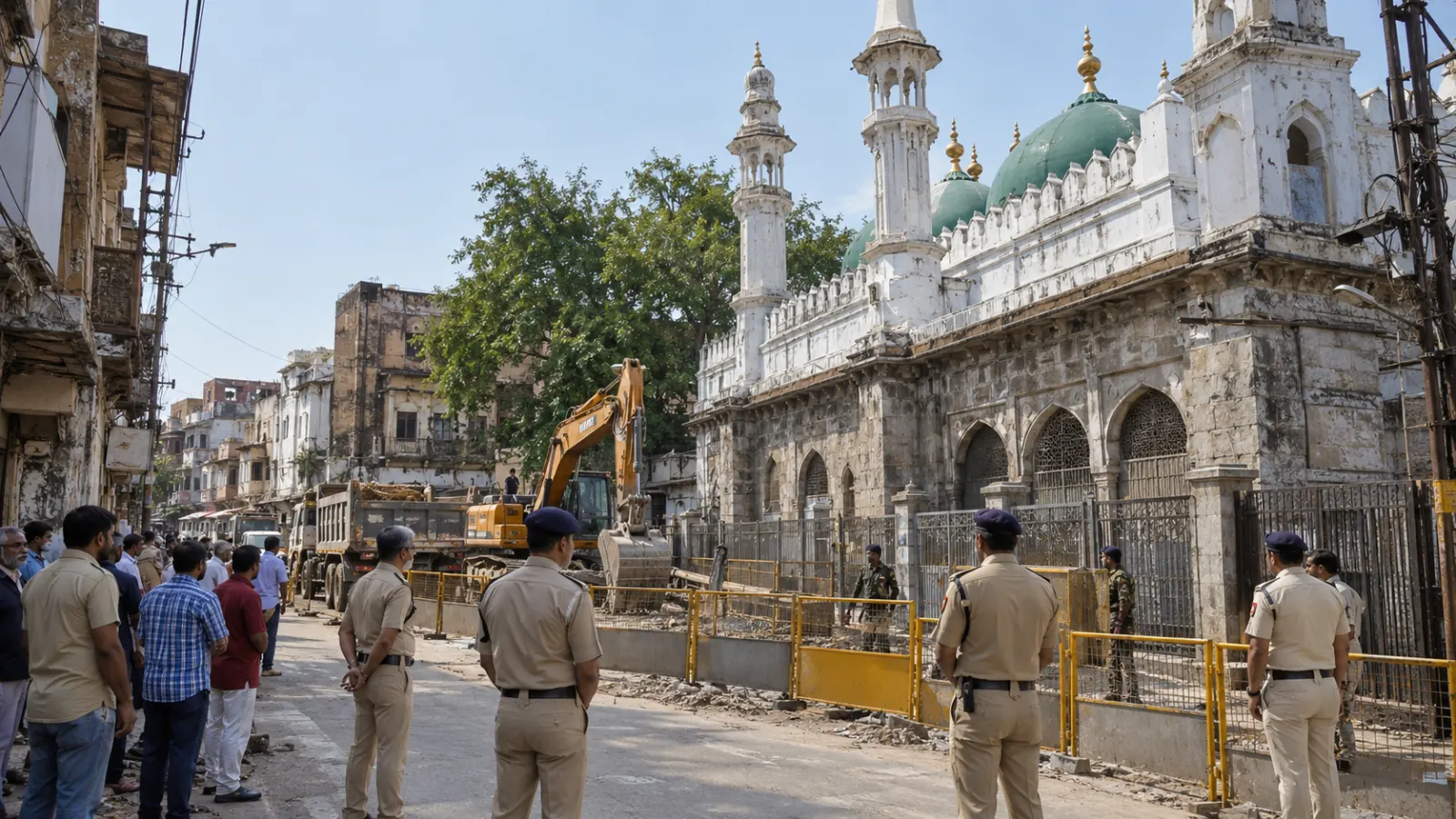
Tensions in Ujjain escalated on September 28, 2026, as authorities moved ahead with the removal of a portion of the Shahi Masjid for a road-widening project connected with preparations for Simhastha 2028. Protesters and police clashed near the mosque in the morning, stone-pelting was reported and police used tear gas to disperse the crowd. By the afternoon, however, the situation had changed significantly: members of the mosque community had begun removing the affected portion themselves following an agreement with the Ujjain Municipal Corporation, and the Madhya Pradesh High Court disposed of an appeal after taking note of that settlement. The Indian Express
The dispute has generated strong reactions because it brings together several sensitive issues—religious property, urban redevelopment, preparations for a major Hindu pilgrimage gathering, constitutional protections for religious practice and questions about whether authorities have treated different religious structures equally.
Understanding the controversy therefore requires separating three issues: why the road is being widened, what the mosque committee objected to, and what the courts have actually decided.
Why does the Ujjain administration want part of the mosque removed?
The Ujjain Municipal Corporation is widening the roughly 900-metre road between Kanthal Chauraha and Gopal Mandir to 15 metres as part of infrastructure work ahead of Simhastha 2028. Simhastha is held in Ujjain every 12 years and attracts very large numbers of devotees, particularly around the Mahakaleshwar Temple and the Kshipra River. The Indian Express
The Shahi Masjid is located close to this heavily used religious and traffic zone. A portion of the mosque falls within the proposed road alignment.
The legal proceedings describe the affected structures as including part of the prayer hall, a minaret and the Mazhar Chouk Shahi. During the later appeal hearing, the municipal side told the High Court that the portion affected amounted to less than 10% of the mosque's total area. The Indian Express Live Law
The administration argues that the project is not directed specifically at the mosque. In the earlier High Court proceedings, the municipal corporation said approximately 80 religious structures across Ujjain were being shifted or removed for road widening. On the same road, the court recorded that portions of 10 temples and one mosque had already been removed. The Indian Express
That information became important to the court because the petitioners had argued that the mosque was being treated unfairly.
Why did members of the Muslim community oppose the removal?
The mosque is registered as Waqf property, and members of its management and the local Muslim community argued that a religious structure should be protected from demolition.
Imam Mohammad Ibrahim told The Indian Express that the mosque should be excluded from the widening exercise and claimed that it dates to 1390. That date is the imam's claim and should not be treated as independently established historical dating without further documentary evidence. Community representatives also argued that authorities could consider changing the road alignment or removing other structures opposite the mosque instead. The Indian Express
For opponents of the demolition, the issue was not simply the physical size of the portion being removed. A mosque is a functioning religious space, so even a partial alteration can carry significance for worshippers.
This explains why hundreds of people gathered around the site on Sunday and remained there overnight. Municipal teams and heavy machinery had arrived, but the administration initially held back while police and community representatives attempted to negotiate. The Indian Express
The dispute therefore involved two competing considerations: the administration's claim of a citywide infrastructure requirement and the community's desire to preserve an established place of worship.
What did the Madhya Pradesh High Court originally decide?
Before the September 28 confrontation, the dispute had already reached the Madhya Pradesh High Court.
On September 9, a single judge dismissed two petitions challenging the municipal corporation's action. The petitioners had invoked constitutional protections including Article 14, which guarantees equality before law; Articles 25 and 26, concerning religious freedom and management of religious affairs; and Article 300A, relating to property. The Indian Express
The municipal corporation argued that statutory procedures had been followed, including notices and opportunities to object.
The court accepted that position.
It also considered whether the mosque had been singled out because it was a Muslim religious structure. The court noted that other religious structures, including temples, had also been affected by the widening project and concluded that the corporation's action could not be regarded as discriminatory merely because the affected property was a mosque. The Indian Express
The judgment also gave weight to public-interest considerations surrounding Simhastha 2028. The court noted that the mosque is situated close to the Mahakaleshwar Temple and the Kshipra River, an area expected to experience extremely heavy pedestrian and vehicular movement during the gathering. The Indian Express
Importantly, this was a judicial conclusion about whether the municipal action could legally proceed. It was not a declaration that religious concerns were irrelevant.
Why did the dispute continue if the court had already ruled?
The September 9 judgment did not immediately end the legal dispute.
The mosque side pursued an appeal before a Division Bench of the Madhya Pradesh High Court. At the same time, negotiations between community representatives and municipal authorities continued on the ground.
That produced an unusual situation on September 28: protesters were confronting police in the morning even as discussions about a negotiated removal were continuing.
The confrontation escalated when protesters allegedly threw stones at police personnel. Police used tear gas, barricaded the area and deployed a large security force. Reports put the deployment at around 2,000 to 2,500 personnel, including forces brought in to prevent the unrest from spreading. The Indian Express Hindustan Times
The violence should be distinguished from the legal challenge itself. Peacefully opposing a demolition, challenging it in court and arguing for an alternative road alignment are different matters from alleged stone-pelting or attacks on police.
Responsibility for any violence must therefore be established separately.
What changed later on September 28?
By the afternoon, the immediate dispute had moved towards a negotiated resolution.
Ujjain Superintendent of Police Pradeep Sharma said the removal of the affected portion of the mosque was continuing with the consent of the mosque committee. Ujjain Collector Roshan Singh similarly said community members were voluntarily carrying out the removal. The Indian Express
City Qazi Khalil Qureshi Rehman, who participated in talks with the administration, publicly appealed to people not to travel to the site or respond to rumours. He said the mosque issue had been resolved through mutual agreement the previous night. The Indian Express
This development materially changes how the event should be described.
The latest position is not simply that the government forcibly demolished the mosque despite an unresolved legal challenge. Rather, after intense disagreement and confrontation, an agreement was reached under which the affected portion was being removed with the involvement of the mosque's authorised representatives.
That does not erase the earlier opposition or controversy. It explains the legal and administrative position as it stood later on September 28.
What did the High Court decide in the appeal?
The High Court's Division Bench also addressed the dispute on September 28.
Justices Subodh Abhyankar and Jai Kumar Pillai disposed of the appeal after being informed that a settlement had been reached between the authorised mosque committee and the Ujjain Municipal Corporation. Live Law
Interestingly, the Bench said that the full details of the settlement were not before it.
The mosque side asked the court to formally record the existence of the agreement and expressed concern that the municipal corporation might not honour all of its commitments.
The court therefore made an important clarification: assurances given by the municipal corporation in its reply and demolition notice would remain binding on the corporation. Live Law
The appeal was then disposed of.
This means the current legal position is different from a court ordering an immediate halt to the project. The litigation concluded at this stage after the settlement was brought before the Division Bench.
What happened after the clashes?
Police have started identifying people allegedly involved in the morning violence and in circulating material that authorities say contributed to tensions.
As of the latest police statement reported by The Indian Express on Monday evening, 15 people had been detained and an FIR registered against seven people. Police said social-media content creators were among those being investigated, and officers were examining CCTV footage, drone recordings, posts and messages connected with the confrontation. The Indian Express
Earlier reports gave different numbers as the police action was developing, so these figures should be treated as a snapshot of the situation at the time of the latest update rather than a final count.
Authorities have also warned against circulating rumours or provocative content.
Any legal action over social-media posts will need to be assessed according to the specific material involved. Criticism of government action or opposition to demolition is not the same thing as unlawful incitement; determining whether particular posts crossed a legal threshold requires examining their actual content and applicable law.
Was the mosque being demolished to build a Hindu religious structure?
Based on the court record and the administration's stated project, the immediate purpose of the removal is road widening, not construction of another place of worship.
The project is connected to preparations for Simhastha 2028, a Hindu religious gathering, but the infrastructure itself is intended to widen a public road and improve traffic management. The High Court's September 9 order specifically considered the expected number of pilgrims and public-safety requirements while upholding the municipal action. The Indian Express
Critics, including AIMIM leader Asaduddin Owaisi, have placed the dispute in the broader political context of Waqf law and concerns over Muslim religious properties. Those are political interpretations of the dispute rather than findings made by the High Court. The Indian Express
The administration, by contrast, points to temples and other religious structures affected by the same road-widening programme as evidence that the action is not religion-specific.
Both positions are part of the public debate, but the documented legal question in the Shahi Masjid case was narrower: whether the municipal corporation had the authority to remove the portion falling within the approved road alignment after following the required procedure.
The single judge concluded that it did.
Can governments remove parts of religious structures for roads?
Religious freedom under the Constitution is substantial, but it is not an absolute exemption from generally applicable laws relating to public order, safety, planning or infrastructure.
Article 25 itself makes freedom of religion subject to public order, morality and health, while Article 26 protects religious denominations' rights subject to similar constitutional limitations.
At the same time, authorities cannot simply invoke “development” to bypass lawful procedure. They must act under statutory authority, follow applicable planning and property rules, provide notices where required and avoid discriminatory treatment.
That is why the question of equal treatment became so important in the Ujjain litigation.
If authorities had removed only a mosque while preserving comparable structures belonging to another religion in the same alignment without a legally defensible reason, an equality challenge would raise very different issues.
The High Court instead relied partly on evidence that numerous other religious structures had also been affected by the same infrastructure programme. The Indian Express
This makes the Ujjain dispute less useful as a simple “religion versus development” story than as an example of the difficult legal balance between religious rights, property, equality and public infrastructure.
Why Simhastha 2028 matters to the project
Simhastha is one of the major Kumbh-related gatherings and takes place in Ujjain on the banks of the Kshipra River.
Large pilgrimage gatherings create unusually demanding urban-planning problems. Roads that normally handle local traffic must temporarily accommodate enormous numbers of pedestrians, buses, emergency vehicles and visitors.
That creates pressure to widen roads, remove bottlenecks and redesign traffic routes well before the event begins.
In the Shahi Masjid litigation, the municipal corporation relied heavily on this expected increase in traffic. The High Court accepted that accommodating large numbers of devotees and ensuring public safety were legitimate considerations. The Indian Express
But infrastructure preparation can also affect homes, businesses and religious places that have occupied an area for decades or centuries.
The consequences are therefore not purely technical.
A road may appear as a line on a planning map. For people living beside it, that same line can pass through a home, shop, temple, mosque or other place carrying personal and religious significance.
That is why consultation, compensation where legally applicable and transparent procedures become particularly important.
The Ujjain dispute is now entering a different phase
The most dramatic images from September 28 show police, protesters, tear gas and barricades.
But the later developments may prove more important.
The mosque's authorised representatives and the municipal corporation have reached a settlement. The High Court has disposed of the appeal while making municipal assurances binding. Community members have begun removing the affected portion themselves. Police are now concentrating on those allegedly responsible for violence and inflammatory online activity. The Indian Express Live Law
Several questions nevertheless remain.
What precisely are all the terms of the agreement between the mosque committee and the corporation? What parts of the religious complex will ultimately remain? How will the surrounding road and public space be redesigned? And will the commitments made by the corporation be implemented exactly as agreed?
Those details will determine whether the compromise resolves the controversy or produces further disputes.
The Ujjain Shahi Masjid row therefore cannot be reduced accurately either to “a mosque demolished for a Hindu festival” or to “ordinary road widening with no religious issue involved.”
The documented situation is more complex.
A portion of a functioning Waqf mosque falls within a road-widening alignment designed partly to manage crowds during Simhastha 2028. Worshippers resisted its removal and challenged the action in court. The High Court found that the municipal procedure was lawful and noted that numerous other religious structures had also been affected. Protests later escalated into clashes, but the authorised mosque committee and municipality subsequently reached a settlement under which the affected portion is now being removed.
That combination of law, religious freedom, development and negotiation is the real story behind the Ujjain dispute.