India’s Food Warning Labels: Why the Red Hexagon Is Contested
India is moving closer to introducing prominent front-of-pack warning labels on packaged foods high in sugar, salt or fat, but the proposal has triggered a fresh dispute between public-health advocates, food companies and regulators. The Food Safety and Standards Authority of India (FSSAI) now proposes a red hexagonal warning symbol on products that exceed prescribed limits for even one nutrient of concern, replacing an earlier plan that would initially have required warnings only when at least two nutrients crossed the threshold. MarketScreener
The Supreme Court is closely examining the proposal and, on September 28, questioned why the government needed additional months of consultation and implementation time after years of debate over front-of-pack labelling. The court has indicated that it expects faster progress, while the food industry has asked for changes to the colour, thresholds and calculation method before the system becomes mandatory. Dubai Eye 103.8
At first glance, the debate may appear to be about the colour of a symbol. In reality, it raises a much larger question: how much information should food companies be required to place directly in front of consumers, and how strict should India be when deciding what counts as high sugar, high salt or high fat?
What FSSAI is proposing
Under the latest proposal before the Supreme Court, packaged foods that exceed specified limits for added sugar, fat or salt would carry a warning on the front of the package, rather than requiring consumers to search the nutrition panel printed on the back.
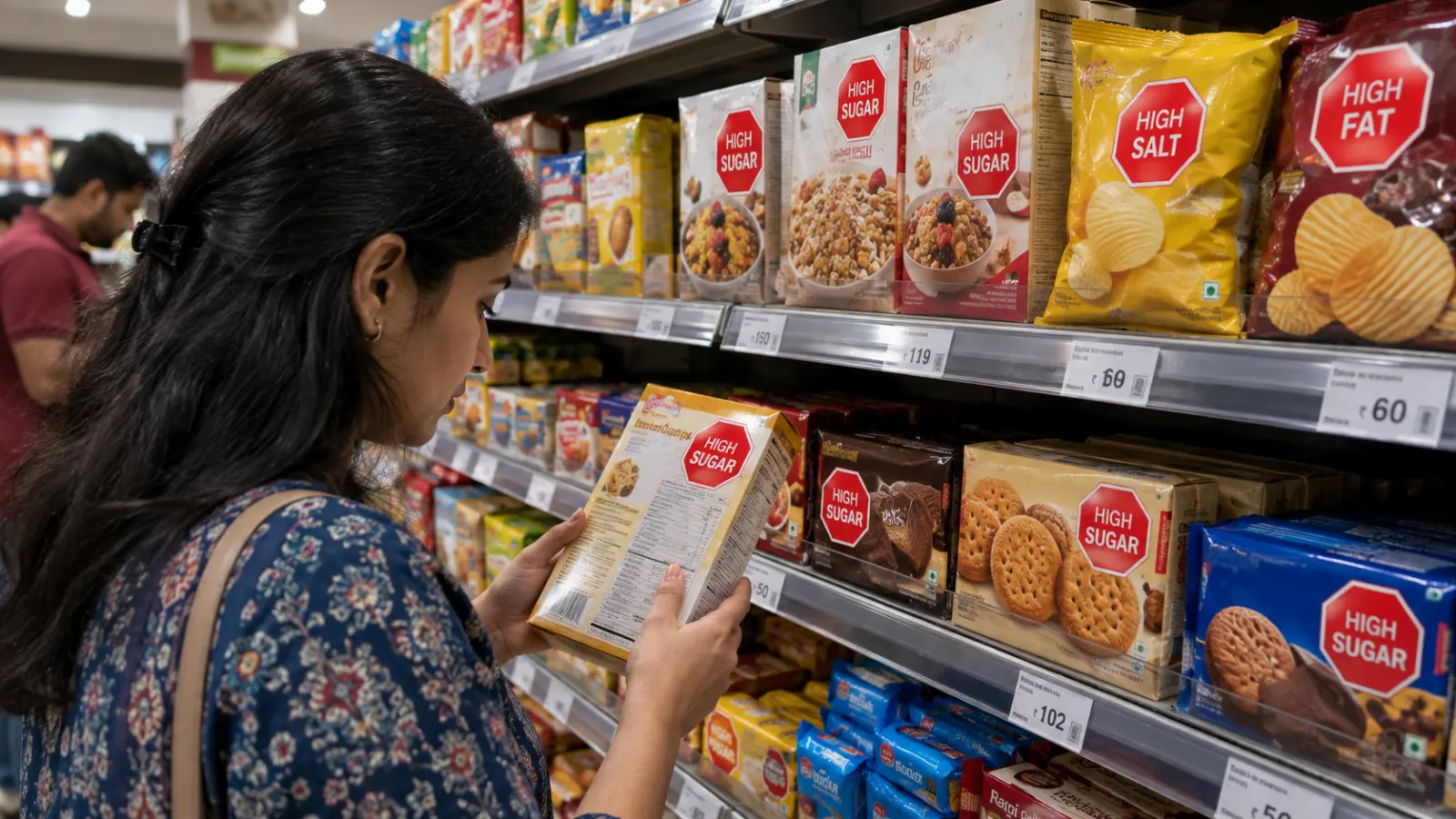
The warning would appear as a red hexagon placed on a white background, prominently positioned near the upper-left side of the package. Depending on the product, it could carry declarations such as “HIGH SUGAR,” “HIGH SALT” or “HIGH FAT.” India Today
The latest version is stricter than FSSAI’s original August proposal.
Initially, the regulator proposed introducing warnings in two stages. During the first stage, a product would generally receive a warning only if it exceeded limits in at least two of three categories: added sugar, salt or saturated fat. A later phase would have extended warnings to products high in even one nutrient.
Public-health groups criticised that system, arguing that a product extremely high in sugar but not high in another nutrient might escape the warning altogether. After questions from the Supreme Court, FSSAI changed course and told the court it was prepared to implement the stricter standard in a single phase, meaning that one excessive nutrient could be enough to trigger a warning. Reuters
That change significantly increases the number of packaged foods that could potentially carry warnings.
Why put the warning on the front?
Most packaged foods already provide nutritional information.
The problem is that consumers may need to turn the product around, locate a relatively small nutrition panel, understand serving sizes and calculate whether the amount of sugar, fat or sodium is high in relation to what they actually consume.
Front-of-pack warning systems attempt to simplify that decision.
Instead of asking a shopper to interpret multiple numbers, the package delivers a direct visual message before purchase: this product contains a high amount of a nutrient associated with health risks when consumed excessively.
FSSAI has told the Supreme Court that the objective is to create a warning that is simple, prominent and easily understood by consumers. The Indian Express
The idea is not unique to India. Several countries have experimented with front-of-pack systems ranging from warning symbols to traffic-light colours and nutrition scores. The designs differ, but the basic principle is similar: important health information should be visible without requiring consumers to decode a detailed nutrition table.
The debate becomes more difficult when regulators decide exactly where to draw the line between an ordinary product and one that deserves a warning.
Why the food industry objects to the red colour
One of the latest objections concerns the colour itself.
The All India Food Processors Association, which represents a range of domestic and multinational food businesses, told the Supreme Court that the proposed red symbol could confuse Indian consumers because red has historically been associated with the identification of non-vegetarian food. MarketScreener India
The industry body has therefore asked authorities to reconsider whether red is the most appropriate warning colour.
There is some nuance here. Existing FSSAI rules currently use a brown symbol for non-vegetarian food and a green symbol for vegetarian food, but industry representatives argue that many consumers continue to associate red broadly with non-vegetarian identification. India Today
The industry says it is not opposing front-of-pack warnings in principle. Its objection is that the design should communicate health risk without creating confusion about the product's vegetarian or non-vegetarian status. Dubai Eye 103.8
Public-health advocates may respond that warning colours are supposed to attract attention and that red is already widely used internationally to signal caution or risk.
The policy question is therefore not whether red looks alarming. That is partly its purpose. The question is whether the symbol communicates the intended message clearly enough for Indian consumers.
The bigger fight is about the thresholds
The colour dispute is visually obvious, but the more consequential argument concerns how much sugar, salt or fat is too much.
FSSAI’s proposed thresholds are linked to the Dietary Guidelines for Indians, 2024, issued by the Indian Council of Medical Research–National Institute of Nutrition. The Indian Express
Reuters reported that, under the proposal, solid foods containing added sugar above roughly 3% by weight could trigger a warning, while the proposed threshold for fat is around 4.2%. Industry representatives argue that these limits are stricter than those used in several other markets. Dubai Eye 103.8
Their concern is that many common products could receive red warnings, including foods that consumers normally eat in small quantities.
That leads directly to another dispute: should nutrition be assessed per 100 grams of food or according to a realistic serving size?
A pickle is not eaten like a packet of chips
The industry's serving-size argument is relatively straightforward.
People do not consume every food in 100-gram quantities.
A person may use 10 grams of pickle with a meal, 15 or 20 grams of a spread or condiment, and much larger quantities of another food. The All India Food Processors Association has told the court that using the same 100-gram comparison across such different products can produce warnings that do not reflect real consumption. Dubai Eye 103.8
From this perspective, a product can appear extremely high in salt or sugar per 100 grams even though a normal portion is very small.
Food companies therefore argue that thresholds should account for how much people normally eat at one time.
But serving-size systems create problems of their own.
If manufacturers can define or influence serving sizes, an unhealthy product can appear less concerning simply because the stated serving is made artificially small.
A packet might technically contain several servings even though many consumers routinely eat the entire package.
A standard per-100-gram benchmark avoids some of that manipulation because every product is measured against the same reference quantity.
This creates a genuine regulatory trade-off.
A uniform standard is easier to compare and enforce.
A serving-based standard may better reflect actual consumption.
Neither approach is automatically perfect.
Why health experts wanted stricter rules
Public-health advocates have criticised the weaker versions of India's labelling proposals for years.
Their central argument is that the purpose of a front-of-pack warning is defeated if a product that is extremely high in one harmful nutrient can avoid the label simply because its other nutrient levels remain below the threshold.
For example, a beverage could contain very high added sugar but relatively little salt and fat.
Under the earlier two-nutrient trigger, critics argued, such a product could potentially avoid a warning during the first stage.
Health activists described that design as an “industry-friendly loophole.” Hindustan Times
The Supreme Court questioned the same logic during hearings. Justice J.B. Pardiwala asked why a product should need to be high in both sugar and salt before receiving a warning, prompting FSSAI to reconsider the phased approach. The Print
The regulator's latest proposal addresses that criticism by allowing a single excessive nutrient to trigger the warning.
The dispute has therefore shifted from whether warnings should exist towards how strict and how quickly they should be implemented.
Why the Supreme Court is impatient
The Supreme Court's role has become central because India has debated front-of-pack labelling for years without implementing a final mandatory system.
Earlier in September, the court gave FSSAI and the government a deadline to provide a clear and scientifically justified implementation pathway. Judges asked questions about the size, shape, colour, thresholds and timetable for the warnings. Internazionale
FSSAI subsequently proposed roughly four months to complete notification and consultation, followed by a 365-day transition period for companies to comply. Business Standard
On September 28, the Supreme Court questioned why so much additional time was necessary.
Justice Pardiwala asked why authorities wanted to spend more time on fresh consultations when food labelling had already been discussed extensively, particularly given the public-health concerns involved. The court indicated that it expects to issue a final order on the matter. Dubai Eye 103.8
That does not mean warning labels will appear on every packet immediately.
Regulations still require finalisation, manufacturers need time to redesign packaging and regulators need enforcement mechanisms.
But the court's intervention has substantially increased pressure for a firm timeline.
Why packaged-food labels matter for India
India's packaged-food market is enormous and rapidly expanding.
Global companies including Nestlé, PepsiCo, Coca-Cola, Mondelez and Unilever compete alongside large Indian companies and thousands of smaller manufacturers. Reuters has valued the market at more than $100 billion. Reuters
At the same time, India faces rising concerns about obesity and diet-related non-communicable diseases.
Reuters cited research published in The Lancet estimating that India had about 180 million overweight or obese adults in 2021, with the number projected to rise to approximately 450 million by 2050 if current trends continue. Dubai Eye 103.8
No label can solve obesity on its own.
Body weight and chronic disease are influenced by total diet, physical activity, genetics, income, access to healthy food, education and many other factors.
But food labels address one narrower problem: whether consumers have clear information at the moment they decide what to buy.
A package may prominently advertise protein, vitamins, fruit content or phrases such as “healthy” and “natural” while information about added sugar or sodium appears only in smaller print elsewhere.
A warning label changes that information imbalance by giving potentially negative nutritional information similar visual prominence.
Warning labels could also change the food itself
The impact of front-of-pack labelling may extend beyond consumer behaviour.
Companies generally do not want large warning symbols covering the front of their packaging.
If a product narrowly exceeds a threshold, manufacturers may have an incentive to reformulate it by reducing sugar, sodium or fat sufficiently to avoid the warning.
That means the policy can influence food even when shoppers never consciously respond to the label.
Reformulation is one reason public-health researchers pay attention to warning-label policies.
However, it also explains some of the industry's concern. Changing recipes can affect taste, texture, shelf life, manufacturing processes and costs.
A food product developed over decades may require significant reformulation to fall below a regulatory threshold.
For small manufacturers, changing recipes and packaging may also impose proportionally greater compliance costs than for multinational companies.
Regulation therefore needs to balance public-health objectives with implementation realities without allowing transition concerns to become an indefinite reason for delay.
Are all foods covered?
No.
The debate principally concerns packaged foods regulated under the proposed front-of-pack framework.
Different categories can also receive different treatment or exemptions depending on how the final regulations are written.
This has itself generated controversy.
Public-health groups have warned that broad exemptions can weaken the effectiveness of warning systems, while manufacturers of traditional foods argue that products such as condiments, sweets and other culturally established foods should not automatically be treated in the same way as highly processed packaged snacks.
The distinction between “traditional” and “processed,” however, does not necessarily determine nutritional content.
A traditional product can still contain substantial sugar, salt or fat.
A modern packaged product can sometimes contain relatively little.
A scientifically credible system therefore needs to judge products primarily by measurable nutritional composition while recognising legitimate differences in consumption patterns.
The label should inform, not decide for the consumer
A red hexagon does not mean a product is poisonous.
Nor does it mean that eating the product once will cause disease.
The purpose of the warning is simpler: to indicate that the product contains a comparatively high amount of a nutrient that people are generally advised to limit.
Consumers can then decide what to do with that information.
Someone may still buy a high-sugar dessert because they intend to eat it occasionally.
A parent comparing two breakfast cereals may choose the one without a high-sugar warning.
A person with hypertension may pay particular attention to high-salt labels.
The policy works only if consumers understand what the warning means.
This is why the Supreme Court has also asked the government about nutrition education and nutritional literacy, including how children are taught to understand food labels. Internazionale
A symbol without education can easily become misunderstood.
The final design will determine whether the policy works
India now appears much closer to mandatory front-of-pack warnings than it was only a few months ago.
FSSAI has accepted the principle of red warning labels.
It has abandoned the weaker two-stage nutrient trigger in favour of a proposed single-phase system.
The Supreme Court is pressing for faster implementation.
Health advocates want strong thresholds and minimal exemptions.
Food companies say they support clearer labelling but want changes to the colour, nutrient limits and use of a 100-gram benchmark. Dubai Eye 103.8
The difficult part is therefore no longer agreeing that consumers deserve better information.
It is designing a system that is scientifically credible, easy to understand and difficult to manipulate.
If the thresholds are too weak, the warnings will appear on too few unhealthy products to be useful.
If they are poorly designed, consumers may misunderstand them.
If virtually every product carries the same warning regardless of realistic consumption, the symbol may eventually lose its impact.
And if implementation is repeatedly delayed, the entire debate remains academic.
The red hexagon has become the visible symbol of this argument, but the real issue is much larger.
When consumers pick up a packet of food, how quickly should they be able to understand not only what companies want to advertise about it—but also what they might need to know before eating it?