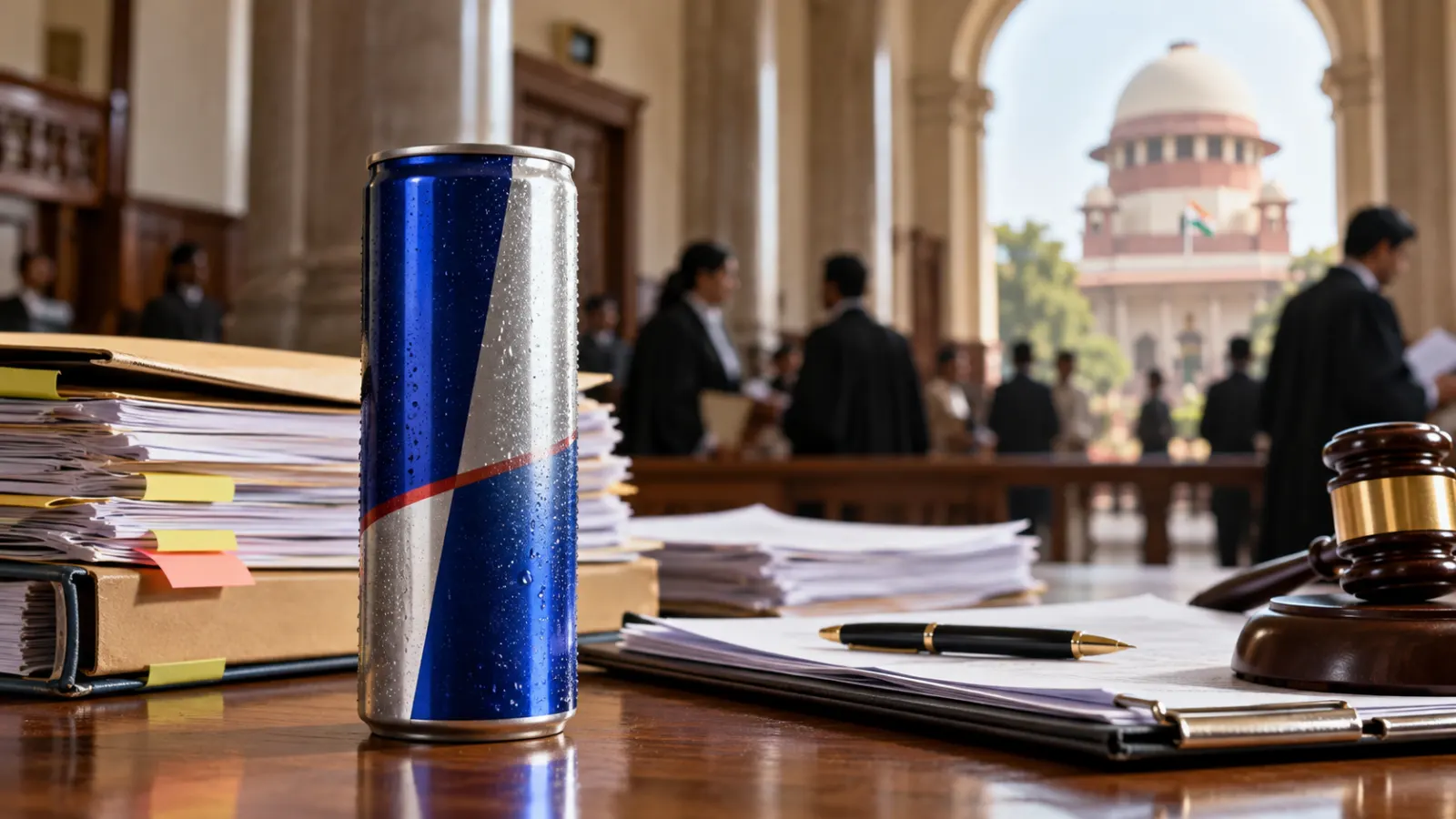
Why Red Bull Is Challenging FSSAI’s ‘Energy Drink’ Ban
Red Bull has moved the Delhi High Court against a Food Safety and Standards Authority of India (FSSAI) direction requiring the company to stop using the term “Energy Drink” on its caffeinated beverages in India. The case came before Justice Amit Mahajan on September 28, 2026, with the court questioning whether FSSAI had first issued Red Bull a show-cause notice or given the company an opportunity to be heard before ordering the change. The matter is scheduled to return to court on September 29, and no interim protection was granted to Red Bull at the first hearing.
The dispute may sound like an argument over two words printed on a can, but the consequences are much broader. “Energy drink” is the category through which consumers recognise products such as Red Bull, Sting and Monster. FSSAI says India does not formally recognise a regulatory category called “energy drinks” and has ordered companies selling high-caffeine beverages to stop using that description. Red Bull argues that the regulator allowed the terminology for years and cannot suddenly reverse its position without following proper procedure.
The case therefore raises two separate questions: can FSSAI prohibit the term “energy drink,” and did it follow the legally required process when doing so?
Why did FSSAI target the term ‘energy drink’?
FSSAI began taking action against several major beverage brands in July 2026, including Red Bull, PepsiCo’s Sting and Adrenaline Rush, Monster Energy, Hell Energy and Reliance’s Campa Energy. The regulator said these products were being marketed using the term “energy drink” even though Indian food regulations do not contain a specific standard or formally notified category under that name.
From FSSAI’s perspective, the issue is partly about classification and partly about marketing.
These beverages are regulated as caffeinated beverages, but companies frequently use “energy” in product names, advertisements and promotional claims. FSSAI has also objected to statements suggesting that such drinks “vitalise body and mind,” improve focus, boost energy or help with weakness, saying functional or therapeutic claims of that kind may not be permissible under existing food regulations.
The regulator therefore ordered affected companies to remove “energy drink” and similar terminology from labels and marketing within roughly 90 days. FSSAI later rejected industry requests for a much longer transition period.
That decision created an unusual situation: products globally recognised and marketed as energy drinks could continue to be sold in India, but potentially without calling themselves energy drinks.
What exactly is Red Bull challenging?
Red Bull is challenging two FSSAI actions.
The first is a June 30, 2026 direction requiring the company to discontinue the use of “Energy Drink” for its caffeinated beverage products.
The second is a July 17 communication asking food-safety authorities across states and Union Territories to take action against products that did not comply with the regulator’s position.
Red Bull says it has sold products in India using the “Energy Drink” descriptor since 2002 and that FSSAI had previously issued licences, import permissions and other regulatory clearances for products carrying the same terminology. The company also relies on what it describes as a March 2024 FSSAI advisory and an April 2024 Union Health Ministry communication supporting the permissibility of the terminology for appropriately licensed caffeinated beverages.
Its argument is therefore not simply that “energy drink” is commercially useful.
Red Bull is effectively saying: if regulators previously allowed this terminology, they need a lawful and transparent basis for reversing that position.
Why did the Delhi High Court question FSSAI?
At the September 28 hearing, Justice Amit Mahajan focused immediately on procedural fairness.
The court asked whether Red Bull had been issued a show-cause notice before FSSAI directed it to stop using the term. It also questioned whether there had been any urgent circumstance that justified taking action without first hearing the company.
This goes to a basic legal principle known as natural justice.
When a regulator takes action that materially affects a company’s business, licence, branding or legal rights, the affected party will often argue that it should first receive notice of the proposed action and a reasonable opportunity to respond.
The exact procedural requirements depend on the statute, regulation and circumstances. But the Delhi High Court’s questions indicate that the process followed by FSSAI may become just as important as the underlying interpretation of food-labelling law.
Red Bull argues that no adequate notice or hearing was provided.
The court has asked FSSAI to obtain instructions specifically on that point before the next hearing.
Why does the phrase ‘energy drink’ matter so much?
For a consumer, changing “energy drink” to “caffeinated beverage” may appear minor.
For a company such as Red Bull, it affects the entire identity of the product.
The global category is built around the phrase “energy drink.” Supermarket shelves, online marketplaces, advertising, sporting sponsorships and consumer searches all use it. Removing the terminology can therefore affect how consumers understand and discover the product.
That is why the industry has resisted FSSAI’s order.
India’s energy-drink market is also growing quickly. Reuters reported earlier this year that the market is expected to reach around $1.6 billion by 2028, with sales expanding rapidly and international as well as Indian brands competing aggressively.
For companies operating in such a market, category terminology has substantial commercial value.
If a consumer walks into a shop and asks for an “energy drink,” companies want their products clearly identified as belonging to that category.
If regulations instead require “caffeinated beverage,” the consumer may not immediately recognise what the term means.
Industry representatives have argued that this could create more rather than less confusion.
But does an ‘energy drink’ actually provide energy?
This is where the dispute becomes more interesting from a consumer perspective.
The everyday meaning of “energy” differs from its nutritional meaning.
In nutrition, energy generally refers to calories. Sugar-containing drinks provide calories and therefore dietary energy.
But when consumers buy a product described as an “energy drink,” many are seeking something different: greater alertness, reduced tiredness or improved concentration.
Those effects are generally associated primarily with caffeine, and sometimes with sugar, rather than with the word “energy” itself.
This helps explain FSSAI’s concern about marketing language. A consumer may interpret terms such as “boost energy,” “improve focus” or “vitalise body and mind” as claims about performance or health rather than simply descriptions of a caffeinated beverage.
The regulatory question is therefore whether the category name itself is misleading or whether clearer caffeine warnings and restrictions on specific promotional claims would be sufficient.
Those are not necessarily the same issue.
A regulator could theoretically permit the widely understood term “energy drink” while separately prohibiting unsupported health or performance claims.
FSSAI has taken a stricter position by challenging the category description itself.
Why high-caffeine drinks attract regulatory attention
Energy drinks have received increasing regulatory scrutiny internationally because they can contain substantial caffeine, sugar and other ingredients such as taurine.
Caffeine is a stimulant. In moderate quantities, it can temporarily improve alertness and reduce feelings of tiredness. But excessive caffeine consumption can contribute to symptoms including restlessness, sleep disruption, rapid heartbeat and anxiety, particularly in people who are sensitive to caffeine.
Concerns become greater when highly caffeinated beverages are consumed rapidly, combined with other caffeine sources or marketed heavily to younger consumers.
These concerns do not automatically establish that every energy drink is unsafe.
The relevant questions are dose, serving size, frequency of consumption and the individual consumer.
That distinction matters because food regulation works best when warnings communicate specific risks rather than simply implying that an entire product category is dangerous.
FSSAI’s current action is formally centred on labelling and permitted descriptions, not a nationwide ban on selling caffeinated beverages.
Red Bull says FSSAI changed its own position
One of Red Bull’s strongest arguments concerns regulatory consistency.
According to its Delhi High Court petition, FSSAI itself had previously recognised the use of “Energy Drink” for appropriately licensed caffeinated beverages. Red Bull says that products using this terminology received licences, import clearances and no-objection certificates for years.
The company argues that FSSAI has now reversed that position without identifying a change in the law, scientific evidence or underlying regulations that would explain the reversal.
This argument relates to the legal idea of legitimate expectation.
Broadly, when a regulator consistently follows a particular interpretation or gives repeated approvals, regulated businesses may argue that they are entitled to expect that position will not suddenly change without a fair process and adequate explanation.
Legitimate expectation does not mean regulators can never change policy.
Regulators regularly revise rules when new scientific evidence emerges, laws change or previous interpretations are found to be incorrect.
The issue is whether the change is made lawfully, rationally and transparently.
That is what the Delhi High Court will now examine.
Other brands are affected too
The Red Bull lawsuit does not concern Red Bull alone.
FSSAI’s enforcement action has affected an entire category that includes Sting, Monster Energy, Hell Energy, Campa Energy and Adrenaline Rush.
Some companies have already begun preparing label changes. PepsiCo, for example, has indicated compliance with the regulator’s direction for Sting, while other companies and industry bodies have continued lobbying against the change.
The regulatory uncertainty has already affected distributors.
Reports in July and August said some distributors were reluctant to accept new stocks because they feared being left with products carrying labels that might soon become non-compliant. Some state authorities also began enforcement action against existing inventory.
This illustrates why labelling disputes can have immediate commercial consequences even before courts reach a final decision.
Packaging is produced months in advance.
Imported inventory may already be in transit.
Advertising campaigns are planned around product names.
Retail systems categorise products using established terminology.
A regulatory change affecting only two words can therefore require alterations throughout an entire supply chain.
Could Red Bull simply rename the product?
Technically, companies can continue selling compliant caffeinated beverages if they meet applicable food-safety standards.
The dispute is about what those beverages can be called and how they can be promoted.
A company could theoretically describe the product as a “caffeinated beverage.”
But for Red Bull, the problem is not merely printing new cans.
Its brand has been associated globally with the energy-drink category for decades. Much of its sponsorship strategy—from Formula One to extreme sports—is built around the idea of energy and performance.
Removing “energy” from the category description could therefore have consequences far beyond regulatory compliance.
The same applies to products such as Monster Energy and Campa Energy, where the disputed word is embedded directly in branding or market positioning.
FSSAI, however, has taken the view that commercial consequences cannot determine what terminology food regulations permit.
That conflict between established branding and regulatory classification lies at the heart of the dispute.
The case also fits a broader FSSAI crackdown
The Red Bull case is part of a wider period of unusually assertive food and beverage enforcement in India.
FSSAI has recently scrutinised front-of-pack warning labels, packaged-food claims, alcoholic-beverage labelling and terms such as “100%” in advertisements and packaging. The regulator has taken enforcement action against companies across several food categories.
At the same time, the Supreme Court is examining FSSAI’s proposed front-of-pack warning system for products high in sugar, salt or fat.
That means two debates are unfolding simultaneously.
One concerns what companies can call their products.
The other concerns what regulators should force companies to warn consumers about.
Together, they reflect a larger shift in Indian food regulation towards stricter scrutiny of how packaged products are described and marketed.
What happens next?
The Delhi High Court has listed the Red Bull case for further hearing on September 29.
FSSAI has been asked to clarify whether Red Bull was formally given notice and an opportunity to respond before the June 30 direction was issued.
The court could eventually examine both the procedural question and the broader legality of FSSAI’s interpretation.
For now, however, several things remain unresolved.
The court has not struck down FSSAI’s direction.
It has not ruled that Red Bull may permanently continue using “Energy Drink.”
And it has not decided whether the regulator’s interpretation of Indian food law is correct.
The first hearing primarily raised questions about how the decision was made.
That is an important distinction for consumers and businesses following the case.
The dispute is ultimately about what a product name promises
The Red Bull–FSSAI conflict is easy to portray as a battle between a multinational company and a regulator.
The more useful question is what consumers should reasonably understand when they see the words “energy drink.”
If the phrase simply identifies a widely recognised category of caffeinated beverages, banning it may create unnecessary confusion.
If the term implicitly suggests health, strength or performance benefits that cannot be scientifically justified, regulators have stronger reasons to intervene.
And even if intervention is justified, regulators still need to follow fair procedures when imposing rules that affect established businesses.
Those are separate questions.
The Delhi High Court will now have to determine how those principles apply to Red Bull’s case.
For India’s rapidly expanding beverage market, the outcome could determine much more than the wording on one company’s cans.
It could decide whether “energy drink” remains a recognised commercial category in India at all.