Folk Arts: How Communities Create, Preserve and Adapt Tradition
Art does not begin in museums, galleries or formal academies. Much of human creativity develops in homes, villages, neighbourhoods, workshops, places of worship, seasonal gatherings and community celebrations. A song may have no single identifiable composer. A weaving pattern may have been refined by generations of makers. A dance may be learned by joining older performers rather than reading notation. A painted motif can be visually beautiful while also carrying religious, social or historical meaning.
These are some of the characteristics commonly associated with folk arts, but the category is more difficult to define than it first appears. Folk art should not simply mean “old art”, “rural art” or art produced by people outside elite institutions. Nor does every handmade object automatically belong to a folk tradition. The more useful way to understand folk arts is through the relationship between creative forms, shared cultural knowledge and the communities that practise them.
A folk tradition normally draws on a repertoire inherited from earlier practitioners—techniques, patterns, stories, movements, symbols or ways of making—but each performance or object is still produced in the present. Makers choose materials, improvise, correct mistakes, respond to audiences, adapt to new markets and teach younger practitioners. The tradition survives because people keep recreating it rather than because they reproduce an untouched original.
This places folk arts close to what the World Intellectual Property Organization calls traditional cultural expressions, a category that can include music, dance, art, designs, symbols, performances, ceremonies, handicrafts and narratives associated with the cultural identity of Indigenous and local communities. UNESCO's concept of intangible cultural heritage similarly emphasises traditions and skills that are transmitted across generations while continuing to evolve.
The important question is therefore not simply whether a work looks traditional. It is who carries the knowledge, what the form means within a community, how it is learned and who controls its adaptation.
Folk arts carry memory through practice
Formal archives preserve documents, photographs and objects, but communities also remember through repeated creative forms.
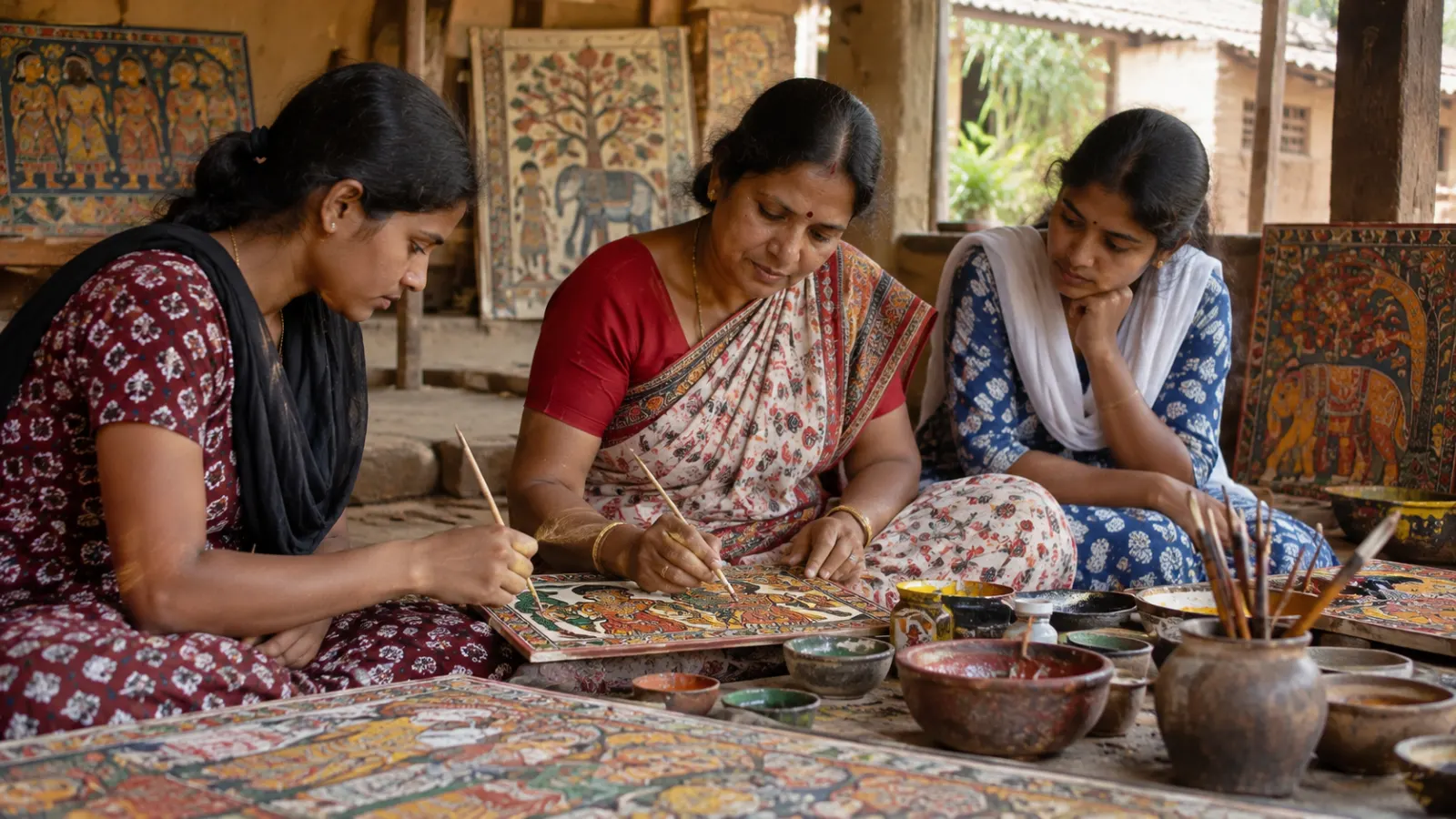
A song can preserve memories of migration, labour, courtship, conflict or resistance. A dance can encode the sequence of a religious or seasonal ceremony. A painted narrative can transmit mythology or local history. Embroidery or weaving patterns can identify place, kinship, status or community affiliation.
These forms do not operate like neutral historical databases. They select and interpret the past.
A folk song may transform a historical event into a moral story. A ritual performance may emphasise one version of collective memory while ignoring another. A traditional design can acquire a new political or cultural meaning generations after its first appearance.
That selectivity matters because folk arts should not be romanticised as pure repositories of historical truth. Traditions can preserve hierarchy as well as resilience. They can carry stereotypes, exclusions and unequal social roles alongside extraordinary technical and artistic knowledge.
Their value as historical evidence therefore lies partly in showing how communities remember and emotionally interpret experience, not merely in establishing exactly what happened.
This also helps explain why apparently similar art forms can mean very different things in different contexts. A motif reproduced on a commercial product may look identical to one used in a ceremonial setting, yet its social significance can be entirely different.
Context is part of the art.
Skill is transmitted through people, not only through objects
Traditional craftsmanship illustrates this particularly clearly.
A museum can preserve a beautifully made pot, textile, mask or carved object for centuries, but the survival of the object does not guarantee the survival of the craft. UNESCO's guidance on traditional craftsmanship explicitly emphasises that safeguarding should focus on the knowledge and skills involved in making, not simply on conserving finished products.
Much artistic knowledge is tacit.
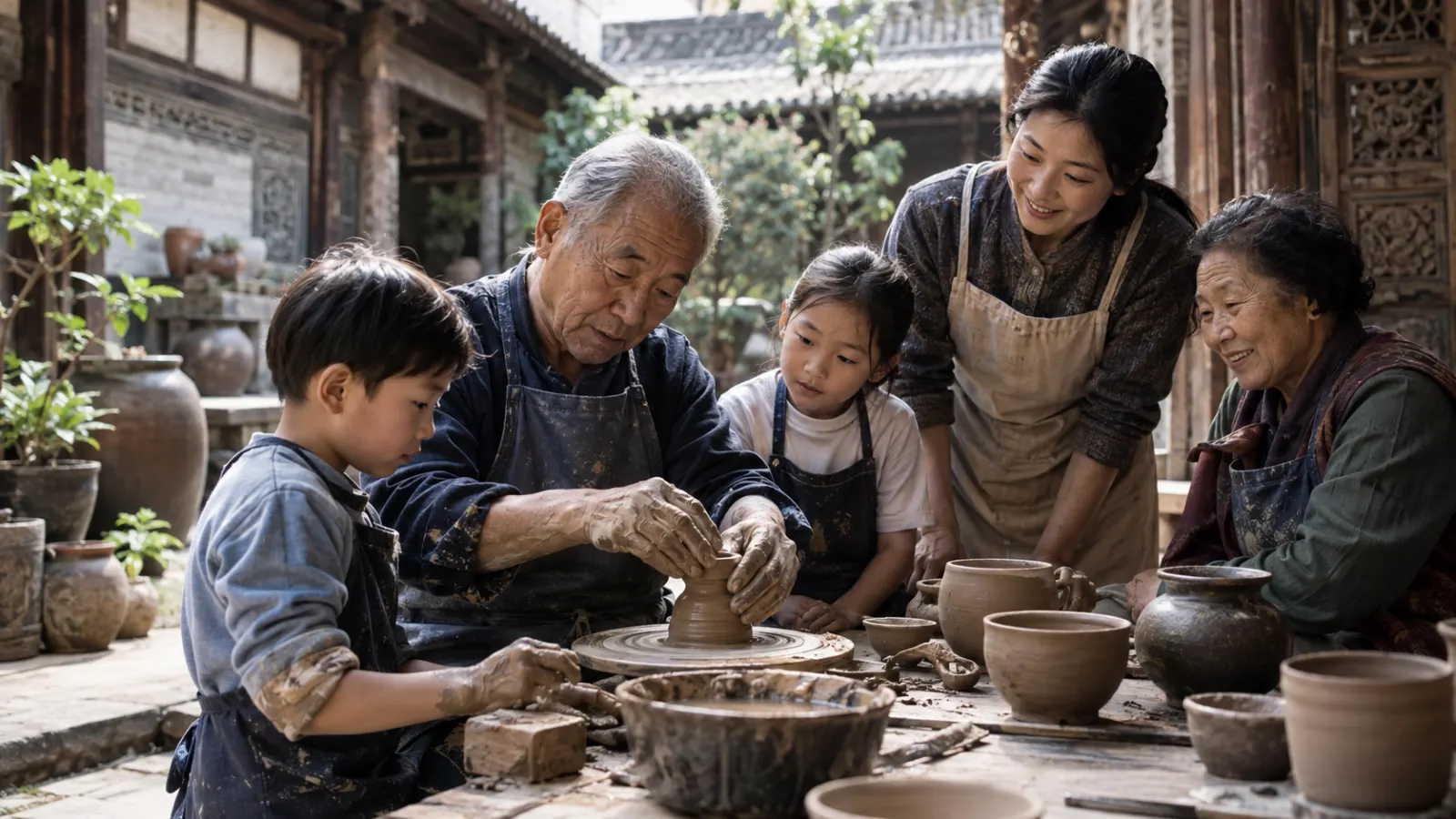
A written instruction can specify a measurement, but an experienced maker may judge moisture by touch. A musician can recognise when a tempo needs to change because of the audience or occasion. A potter can feel when pressure on the clay is slightly wrong. A dancer may learn how much weight to shift through repeated observation rather than verbal explanation.
This knowledge lives partly in bodies.
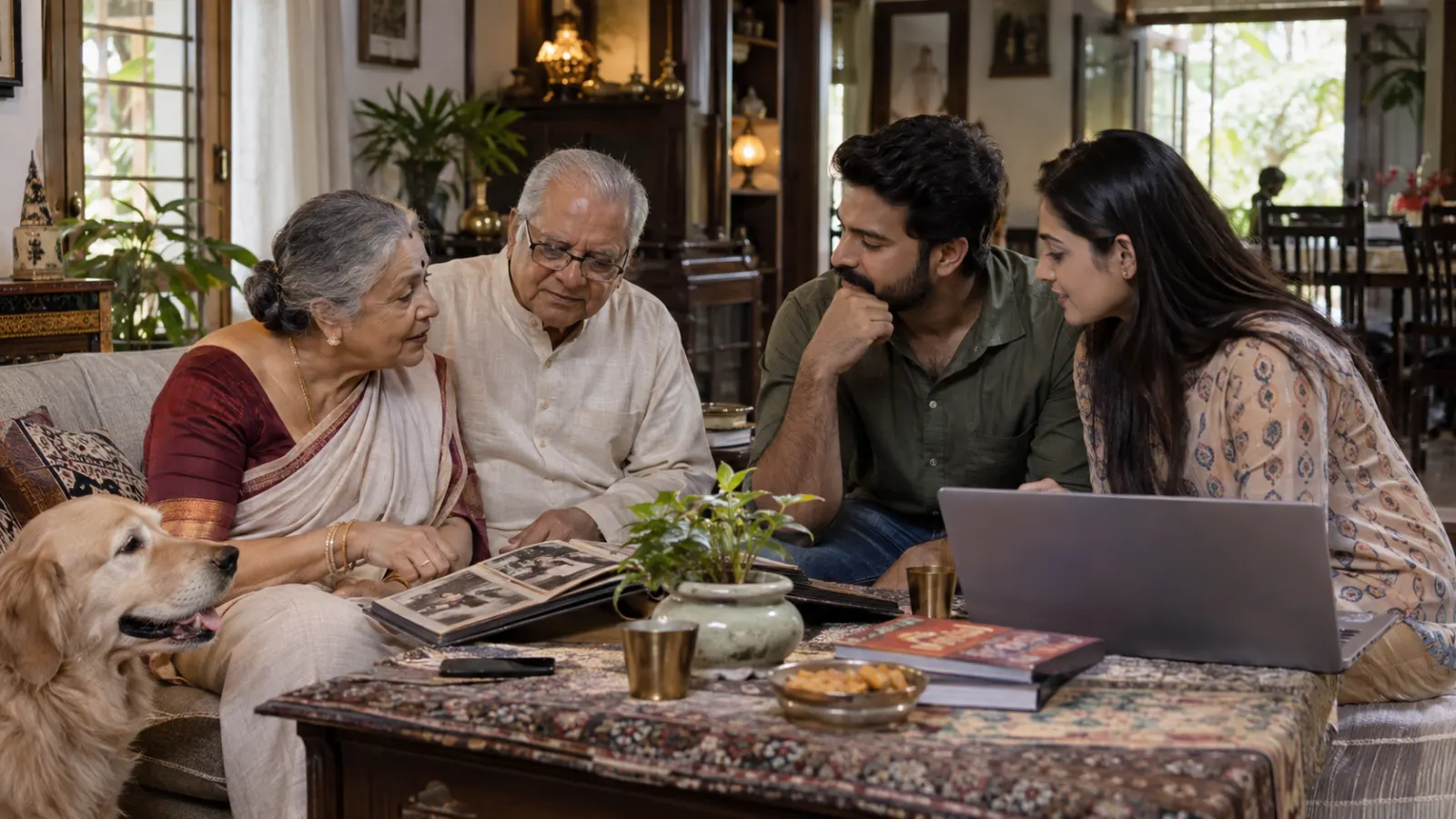
It is acquired through repetition, correction, imitation and shared work. An apprentice may need years to develop the speed that makes a craft economically viable. A child may absorb songs by hearing them repeatedly at family gatherings. A young performer may first participate at the edge of a community ceremony and gradually take on a larger role.
Documentation can support this process. Video recordings, pattern books, digital archives and oral-history projects can preserve information that might otherwise disappear.
But documentation is not transmission.
UNESCO emphasises that the viability of living heritage depends on the continuing transfer of specialised knowledge and skills from person to person and generation to generation. A video can demonstrate a weaving technique, but it cannot automatically create a functioning network of teachers, learners, materials, markets and social occasions in which the skill remains useful.
Safeguarding folk arts therefore requires more than collecting examples.
It requires supporting the conditions in which people can continue practising them.
Materials connect folk art to landscapes and livelihoods
Many folk arts are inseparable from local material knowledge.
Clay differs from one region to another. Fibres must be harvested and prepared. Natural dyes depend on plants, minerals and techniques for fixing colour. Wood species behave differently when carved or bent. Metalworking depends on fuel, temperature and inherited knowledge of alloys. Building crafts depend on local stone, soil, timber and climate.
Losing a craft can therefore mean losing more than an artistic object.
It can also weaken ecological knowledge about plants, seasons, harvesting, preparation and repair.
At the same time, authenticity should not be reduced to permanent use of one historical material.
A community may adopt synthetic dyes because natural pigments have become scarce. Craftspeople may use electric tools to reduce physical strain. New materials may make products safer, cheaper or more durable. Designs originally used for ritual purposes may be adapted for household or commercial markets.
Change does not automatically destroy a tradition.
UNESCO's wider approach to living heritage specifically rejects the idea that safeguarding requires freezing a cultural practice in one supposedly authentic form. Living traditions continually evolve through transmission.
The more useful questions are: Who controls the change? Do practitioners still understand the inherited techniques and meanings? Are they benefiting from the adaptation?
A craft that adopts new tools under the control of its practitioners may remain a living tradition. A factory copying its designs while removing the community from production raises a very different issue.
That distinction separates adaptation from extraction.
Markets can sustain folk arts and distort them at the same time
Commercialisation is sometimes treated as evidence that a tradition has become inauthentic. That is too simplistic.
Artists and craftspeople have always needed livelihoods.
Markets can give younger people a reason to invest years in learning difficult techniques. Tourism can create new demand. Online commerce can allow artisans to reach buyers without depending completely on local intermediaries. Collaborations with contemporary designers can introduce new products and increase public recognition.
Professionalisation can also improve working conditions and status.
The problem arises when buyers, intermediaries or institutions gain more power over the tradition than the people who practise it.
A complex ceremonial object may be simplified into an easily sold souvenir. Production may be accelerated until teaching and craftsmanship deteriorate. Middlemen may capture most of the financial value. A visually attractive pattern may be copied onto mass-produced goods while the community associated with it receives neither attribution nor income.
A tradition can therefore become more visible while its practitioners become more economically marginal.
WIPO's work on traditional cultural expressions is relevant precisely because traditional music, designs, handicrafts, performances and narratives raise difficult questions about intellectual property, attribution and control. WIPO notes that these expressions form part of the identity and heritage of traditional and Indigenous communities and are transmitted across generations.
Conventional intellectual-property systems do not always fit them neatly. Copyright, for example, is generally designed around identifiable authors and limited terms of protection, while many folk forms are collectively maintained and may have no single creator.
Artificial intelligence creates a newer version of the same problem.
Traditional visual motifs, musical patterns and craft aesthetics can now be absorbed into large digital datasets and reproduced at enormous scale. A generated image may imitate the appearance of a community's artistic tradition without acknowledging practitioners or returning any benefit to them.
The technology changes, but the underlying question remains familiar: who has the power to reproduce cultural expression, and who benefits when it circulates?
Recognition can increase respect while creating new hierarchies
Folk arts have not historically received equal cultural status.
Forms associated with courts, formal academies or elite institutions were often collected, archived and taught differently from practices associated with labouring communities, minorities or marginalised groups. Calling a practice “art” rather than simply “custom” or “craft” can therefore have political consequences.
Recognition can increase the status of practitioners.
Museums may collect their work. Universities may study it. Governments may provide grants. Festivals may introduce traditions to larger audiences. Younger community members may see a practice that once appeared economically obsolete as something worthy of learning.
But institutional recognition can also reshape the tradition.
One regional version may be selected as the official form. Performers who fit stage expectations may receive more invitations. Slow or less visually spectacular aspects of the tradition can be neglected. A community practice may be reorganised around competition, tourism or cultural festivals.
The institution then begins influencing what counts as authentic.
This resembles a broader challenge identified in intangible-heritage safeguarding: recognition is useful only if it supports the people who maintain the tradition rather than turning their culture into a fixed performance script.
UNESCO stresses that living heritage is community-based: a practice becomes heritage because communities, groups or individuals recognise and maintain it, not because outsiders independently decide that it should be heritage.
This is an important principle for folk arts.
Curators, researchers and governments can provide expertise and resources, but practitioners should not become passive suppliers of cultural content to institutions that then control its meaning.
Participation makes folk art a social relationship
One reason folk arts can be difficult to separate from wider social life is that the boundary between artist and audience may be porous.
People may join a dance rather than watch it passively. A crowd may sing a refrain with performers. Families may decorate shared spaces before a festival. Children may learn patterns used at home. Participants in a procession may simultaneously be performers, audience members and ritual actors.
This participation turns art into a form of social relationship.
People experience culture as something they do, not simply something they are told belongs to them.
That helps explain why folk traditions can remain important within diaspora communities. A music group, dance class, language circle or craft workshop abroad can become a place where several forms of cultural transmission happen simultaneously. Younger participants may learn artistic technique while also encountering family histories, vocabulary and relationships with older generations.
Migration inevitably changes the tradition.
A practice originally connected to a particular agricultural cycle may move into an urban community hall. Performances may shift to weekends because participants work during the week. Teachers may standardise sequences because learners from several regional backgrounds attend the same class.
These changes are not automatically cultural loss.
They reveal how traditions adapt to new social environments.
The better question is whether the practice still carries meaningful relationships and whether participants retain the ability to shape its development.
Digital media expands transmission but changes incentives
Digital technology has transformed how folk arts circulate.
A local musician can reach international audiences through a phone. Craft tutorials can help younger practitioners learn techniques. Diaspora communities can access songs and performances from their region of origin. Artisans can sell directly to customers through digital platforms instead of relying entirely on physical markets.
These possibilities can strengthen traditions.
But platforms reward particular forms of visibility.
A thirty-second spectacular performance may circulate more widely than the slower apprenticeship through which the performance became possible. An intricate craft may be reduced to a satisfying process video. Algorithms reward engagement, not necessarily cultural context.
The most shareable version of a tradition can therefore become mistaken for the tradition itself.
Digital replication also makes appropriation much easier. Images can be copied instantly. Designs can be detached from the communities that created them. Generative systems can reproduce stylistic features without preserving lineage, meaning or economic benefit.
This does not mean cultural expressions should remain offline.
It means digital access should be evaluated in terms of agency, attribution and benefit.
Who controls the account?
Who owns the photographs?
Do artisans receive the income generated by sales?
Can sacred or restricted material be posted publicly?
Are younger practitioners gaining opportunities, or are outsiders simply gaining easier access to cultural resources?
The technology is not neutral because it changes who can reproduce and distribute artistic forms.
Safeguarding folk arts means supporting living systems
The strongest way to protect folk arts is rarely to insist that practitioners repeat exactly what previous generations did.
A safeguarding programme should instead ask what the tradition needs in order to remain viable.
That may include teachers and apprentices, access to raw materials, community spaces, performance opportunities, fair markets, legal protections, documentation, archives, education and public recognition.
Different traditions require different interventions.
A thriving practice may need little institutional assistance. An endangered craft may need apprenticeships or material support. A minority language song tradition may depend on wider language revitalisation. A ritual performance may need access to a particular place rather than increased tourism.
UNESCO's approach to traditional craftsmanship illustrates this distinction clearly: the objective is less to preserve individual craft objects than to create conditions encouraging artisans to continue producing and transmitting their knowledge.
Safeguarding should also respect the right of communities to change or even discontinue practices.
The purpose of heritage policy is not to require descendants to perform inherited identities forever.
Communities may decide that a practice no longer reflects their values. Younger practitioners may take the tradition in a different direction. Certain forms may disappear while others evolve.
Cultural agency includes the right to adapt.
This is why the source draft's emphasis on community practice is so important: folk traditions survive because people continue to select, improvise, teach and adapt, not because institutions mechanically reproduce the past.
Folk art matters because creativity is larger than the formal art world
Folk arts challenge a narrow understanding of who creates culture.
Art history often focuses on named individuals, recognised masterpieces and formal institutions. Folk traditions reveal another form of creativity: collective, cumulative and distributed across generations.
That does not mean individual artists disappear.
Skilled practitioners can innovate dramatically. Particular performers may become famous. One craftsperson can introduce a design that later spreads through a community.
But their work often develops inside a shared repertoire rather than from the expectation that originality requires complete separation from what came before.
Tradition provides material for creativity instead of preventing it.
This is why comparing folk arts across regions can be useful when the comparison focuses on process rather than surface appearance. We can ask how skills are transmitted, how markets alter production, how migration changes performance, how communities recognise expertise and how younger practitioners negotiate innovation.
Those questions reveal common social mechanisms without pretending that traditions are interchangeable.
The danger begins when folk arts are reduced to a catalogue of “colourful customs”.
A responsible account needs to return repeatedly to the particular people, histories and power relationships behind the visual form.
The best way to respect folk art is therefore neither to romanticise it as untouched tradition nor to treat it simply as material for tourism, museums, fashion or digital content.
It is to recognise practitioners as contemporary cultural actors.
Their arts contain inherited knowledge and collective memory, but they are also being made now. They can respond to new technologies, new markets, migration and changing identities while remaining connected to histories that give them meaning.
Folk art survives not because every generation copies the previous one perfectly.
It survives because enough people continue to know how, understand why, and retain enough control to decide what the tradition should become next.