“Climate refugee” is one of those phrases that seems to explain itself.
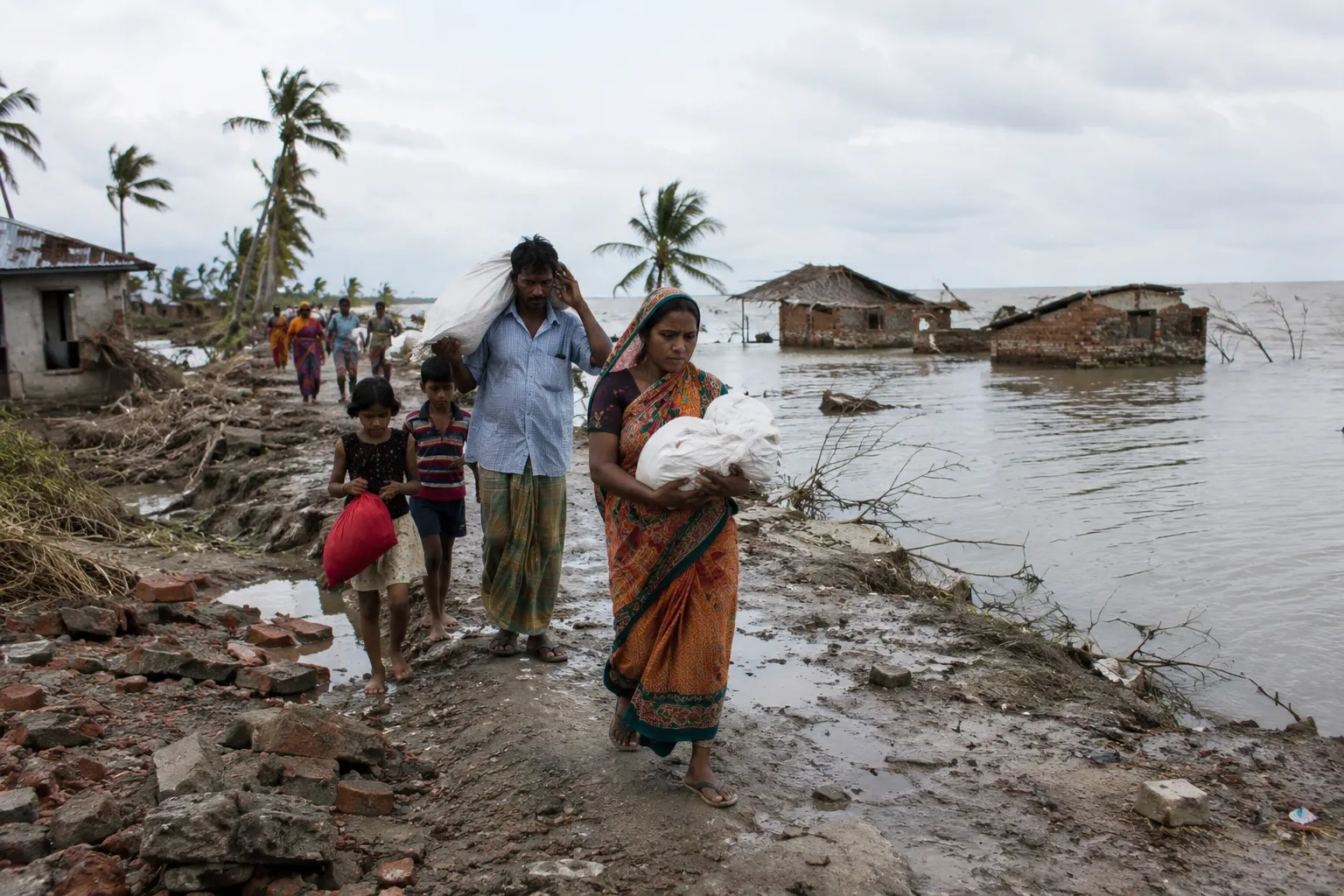
A family loses its home to repeated coastal flooding. Farmers can no longer sustain crops after years of drought. An island community plans relocation as seas rise around it.
If environmental change makes continued life in a particular place impossible, calling those who leave “climate refugees” can sound obvious.
Legally, however, it is not.
The UN Refugee Agency states explicitly that “climate refugee” is not a term recognised in international law and is not endorsed by UNHCR. It prefers formulations such as people displaced in the context of disasters and climate change.
That does not mean climate-related displacement is imaginary.
It means the relationship between climate, migration and refugee protection is considerably more complicated than the popular phrase suggests.
What is a refugee in international law?
The modern international refugee framework developed primarily around persecution.
Under the 1951 Refugee Convention, a refugee is someone outside their country who has a well-founded fear of persecution connected to specified grounds such as race, religion, nationality, membership of a particular social group or political opinion.
Crossing an international border is therefore a fundamental part of the Convention framework.
A person forced from their home by a cyclone but remaining elsewhere within the same country is generally an internally displaced person, not a refugee under the Convention.
UNHCR emphasises that most displacement connected with climate-related disasters takes place within national borders.
This alone makes the expression “climate refugee” misleading when used as a blanket description.
Climate change rarely acts alone
Migration decisions are usually multi-causal.
Imagine a farming household experiencing declining rainfall.
The eventual decision to leave may reflect drought, crop failure, debt, higher food prices, unemployment, lack of irrigation, family networks elsewhere and political instability.
Which factor “caused” migration?
There may be no honest way to isolate one.
IOM's work on migration and climate change emphasises that environmental conditions have long influenced human movement and that climate change can intensify both sudden disasters and slow environmental degradation.
Climate change is therefore often best understood as a risk multiplier or contributing driver rather than a solitary explanation for movement.
Sudden disasters and slow-onset change
Climate-related mobility can emerge in very different ways.
A cyclone can force a community to evacuate within hours.
A flood can destroy housing and produce months of displacement.
Drought may gradually undermine agricultural livelihoods over several seasons.
Sea-level rise, salinisation or coastal erosion can make a location increasingly difficult to inhabit over decades.
These processes create different forms of human mobility.
Some people flee temporarily and return.
Others permanently relocate within the same country.
Some move pre-emptively before conditions become catastrophic.
Others cross borders.
Some communities undergo organised planned relocation with government support.
The single label “climate refugee” compresses these very different experiences into one category.
Displacement is not the same as migration
The words are sometimes used interchangeably, but they carry different implications.
Displacement generally suggests movement that is forced or involuntary.
Migration is broader. It can include voluntary, semi-voluntary and compelled movement across a wide spectrum.
Environmental deterioration often blurs the boundary.
A farmer who moves to a city after several failed harvests may technically have made a choice. But if remaining at home no longer offered a viable livelihood, how voluntary was that decision?
This ambiguity is one reason climate mobility has become a difficult field for both researchers and policymakers.
IOM's research stresses the complexity of profiles and circumstances among people affected by weather-related displacement rather than treating them as one homogeneous population.
Most movement may happen close to home
Popular discussion sometimes imagines climate change producing a single vast wave of international migration.
Reality is usually more geographically layered.
People commonly move first to nearby locations: another village, district or city within their own country.
That can reflect cost, family ties, language, legal barriers to international migration and the desire to remain close enough to return.
UNHCR specifically notes that climate-related disasters typically generate internal displacement before cross-border movement.
This distinction has major policy consequences.
People displaced internally remain primarily under the responsibility and jurisdiction of their own government rather than entering the international refugee regime.
Does refugee law ever protect people affected by climate change?
Potentially - when climate impacts interact with circumstances already recognised by refugee law.
Suppose drought intensifies conflict over land and water, and a particular ethnic group becomes the target of persecution.
Or imagine disaster conditions exposing a group to discriminatory denial of essential assistance.
In such situations, a person's protection claim may involve climate-related conditions, but refugee status would not necessarily arise merely because the climate changed.
UNHCR explains that existing refugee law may apply when the adverse effects of climate change interact with armed conflict, violence or persecution. Regional refugee frameworks may also offer broader protection in certain circumstances.
The legal analysis is therefore contextual.
Why not simply create a new legal category?
The idea is attractive, but difficult questions quickly appear.
What level of environmental deterioration would qualify?
Would a person need to prove that climate change - as opposed to natural variability or poor resource management - caused the displacement?
Would drought qualify but economic collapse triggered partly by drought not qualify?
Would protection be temporary if the disaster ended?
Who would decide when an area became uninhabitable?
Would the category apply only to people crossing international borders or also internally displaced populations?
These are not arguments against stronger protection.
They illustrate why turning a powerful political phrase into a workable legal definition is difficult.
The people who cannot migrate
There is another problem in focusing only on migrants.
Sometimes the most vulnerable people are those who cannot leave.
Migration requires money, transport, information and social networks.
A wealthier household may relocate before repeated disasters destroy its assets. A poorer household may remain trapped in a deteriorating environment because it cannot afford to move.
Climate mobility policy must therefore account both for displaced populations and for people whose immobility is itself a form of vulnerability.
This is one reason IOM's recent work emphasises locally grounded approaches, social protection, adaptation and community-level planning rather than treating migration only as an emergency response.
Migration can also be adaptation
Movement is often described only as evidence of failure.
That is incomplete.
Migration can sometimes reduce climate risk.
A family member may move seasonally and send income home. Communities can diversify livelihoods. Planned relocation can move households away from repeatedly inundated land before catastrophe.
This does not make forced displacement desirable.
It means public policy should distinguish between chaotic displacement and mobility that expands people's choices.
The objective should not automatically be to stop migration.
It should be to reduce forced displacement while allowing safe, dignified and voluntary mobility when movement becomes a sensible adaptation strategy.
Why terminology matters
Words influence policy.
Calling everyone who moves because of environmental stress a “refugee” can draw attention to an urgent problem, but it may also blur the rights attached to an existing legal category.
UNHCR's preferred terminology is more cumbersome precisely because the reality is more complex: persons displaced in the context of disasters and climate change.
For journalism, “climate refugees” remains a legitimate term to explain because readers search for it and public debate uses it.
But responsible reporting should immediately explain its limitations.
The real issue is larger than the label
Climate change is already reshaping where and how people can live.
Floods destroy settlements. Drought alters livelihoods. Rising seas threaten coastal communities. Slow environmental degradation can gradually make remaining in place harder.
Some people will move temporarily.
Some permanently.
Some internally.
Some across borders.
Others will want to leave but lack the means.
No single legal or political phrase captures all those experiences.
“Climate refugee” succeeds as a warning that environmental change has human consequences.
It fails when treated as if it were already a precise legal category.
The important question is therefore not merely what to call people who move.
It is whether governments and international institutions can create systems that protect people before, during and after climate-related mobility - whatever legal category ultimately applies to them.