Why Theatre Matters: How Live Performance Shapes Culture, Memory and Community
A film can be replayed decades after its actors leave the set. A novel can wait unopened on a shelf. Theatre exists differently: performers and audiences must encounter one another in time. Even when the script, cast and staging remain unchanged, no two performances are exactly identical because pauses shift, actors respond differently, audiences laugh or remain silent at different moments, and the atmosphere of the room changes. This liveness is one of theatre’s defining cultural characteristics. Theatre does not simply present a story; it temporarily creates a community around the act of witnessing it. UNESCO’s discussions of traditional performing arts likewise show that theatre is far broader than the modern indoor stage, encompassing forms that combine acting, music, dance, recitation, gesture, puppetry, masks, ritual and specialised performance spaces.
That breadth explains why theatre matters beyond entertainment. A theatrical tradition can preserve language, music, movement, craftsmanship and collective memory simultaneously. It can make social conflict visible by placing people and relationships physically before an audience. It can offer satire, ritual, political argument or community participation. It can transform a street, courtyard or school hall into a temporary cultural space. And because performance has to be recreated repeatedly, theatre transmits culture through people rather than storing it only in objects. The script may survive in an archive, but theatre remains alive only when people still know how to perform, stage, interpret and watch it.
Theatre Is Older and Broader Than the Theatre Building
Modern theatre is often imagined through a familiar institution: a stage, rows of seats, lighting equipment, tickets and professional actors. Historically and globally, theatre has taken many other forms. Performances occur in temples, village squares, streets, royal courts, school halls, courtyards and temporary structures. Some traditions depend heavily on written drama; others transmit performance through oral instruction, rehearsal and embodied technique.
UNESCO describes traditional theatre as frequently combining acting with music, dance, dialogue, narration, recitation, puppetry or pantomime, and it recognises the costumes, masks, instruments, objects and performance spaces connected with these practices as part of intangible cultural heritage. Theatre is therefore not just literature performed aloud. It is an ecosystem in which language, movement, sound, design, craft, space and social convention work together.
This becomes particularly clear in long-lived forms such as Japanese Nôgaku, Malaysian Mak Yong and India’s Kutiyattam. Nôgaku integrates codified acting, music, dance and masks; Mak Yong combines acting, vocal and instrumental music, gesture and elaborate costume and has also existed in ritual contexts; Kutiyattam relies on highly specialised gesture, eye movement and lengthy performer training. If such a theatre tradition disappears, the loss may extend far beyond the plays themselves.
Theatre Turns Stories Into Bodies
A written story leaves readers to imagine voice, gesture, timing and physical presence. Theatre makes those choices public. An actor’s silence can change a scene. Distance between two performers can express intimacy or hostility. Costume, posture, rhythm and movement can communicate meaning before a line is spoken.
This is why a script and a performance are not interchangeable. Shakespeare’s Hamlet, for example, remains the same text while productions can make Hamlet appear melancholy, politically calculating, emotionally unstable or darkly comic. Casting, pacing, design and performance choices create interpretation.
Theatre therefore transforms interpretation into visible action. A director or actor cannot merely claim to have a new reading of a character; that interpretation must survive on stage in front of an audience.
The Audience Helps Create the Performance
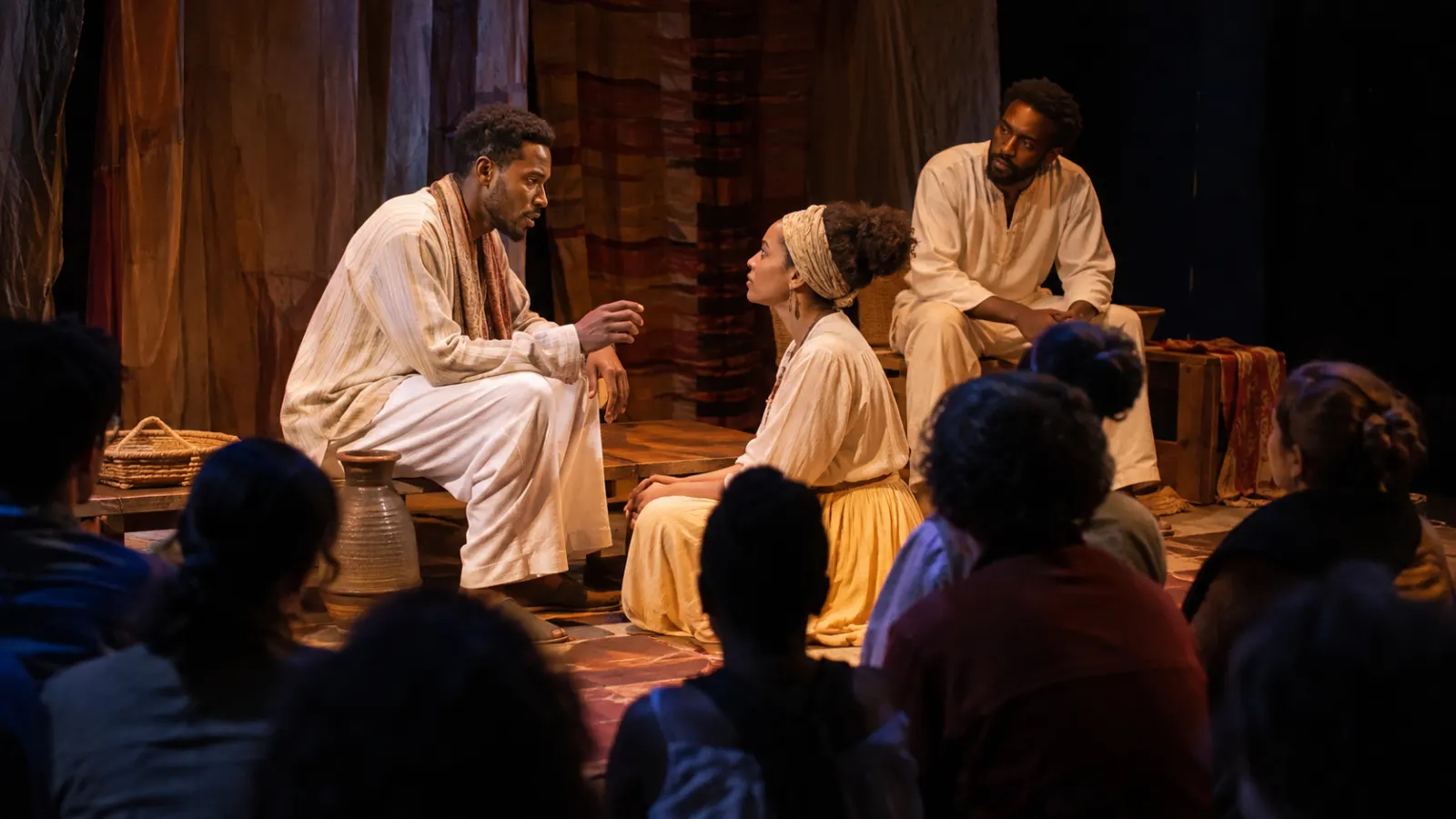
Theatre is unusual because the audience is physically or temporally part of the event. Spectators laugh, become silent, shift uneasily, applaud, respond verbally or sometimes participate directly. Performers perceive those responses and can adjust timing, energy and emphasis accordingly.
This creates a feedback loop absent from most recorded media. UNESCO’s historical writing on theatre has emphasised that the direct physical encounter between performers and audience helps make each performance unique.
In some theatrical traditions, the boundary between performer and spectator is even less rigid. Audiences may answer performers, join songs, move through the performance area or contribute to ritual action. Theatre in these contexts is not simply an object delivered to passive consumers. It is socially produced.
That helps explain why recordings of theatre are valuable but not identical to the medium itself. A camera decides where the viewer looks. Editing controls perspective. A recorded audience cannot respond to the viewer, and performers cannot react to someone watching years later. The recording preserves evidence of theatre while becoming a different audiovisual experience.
Theatre Preserves Language in Public
Language survives most strongly when people can use it in meaningful social situations. Theatre can provide precisely that space. Dialogue, songs, recitation and storytelling can keep dialects, minority languages, poetic forms and specialised performance vocabulary in circulation.
This matters because language preservation is not only about dictionaries and archives. A language also needs occasions on which people hear it, speak it and associate it with contemporary social value. A regional-language theatre company can make a language publicly visible even when national media overwhelmingly favours a dominant language.
Theatre can also preserve forms of speech that ordinary conversation no longer uses. Classical vocabulary, ceremonial speech, poetic metres, dialect humour and historical registers may remain intelligible because performers repeatedly bring them before audiences.
In this sense, theatre acts as a living language archive—but an archive that speaks back.
Theatre Preserves More Than Words
Traditional theatre can carry several cultural systems simultaneously. Music may rely on specialised musicians. Masks may require craftspeople. Costumes can preserve weaving, embroidery or dressing techniques. Puppetry depends on carving and manipulation skills. Stage properties may reflect local technologies and materials.
UNESCO explicitly recognises that performing arts are connected with instruments, costumes, masks, props and cultural spaces, which means safeguarding performance can also require safeguarding the knowledge surrounding it.
This makes theatre vulnerable in ways that are not immediately obvious. A play can remain documented while the craftsperson capable of constructing its traditional mask disappears. A musical score can survive while nobody remembers the style in which it was performed. A costume can sit safely in a museum while the community loses the knowledge needed to wear it correctly.
Cultural preservation therefore requires communities of practice, not merely collections.
Rehearsal Is Where Much Cultural Transmission Happens
Audiences see the finished production, but much of theatre’s cultural transmission occurs before opening night. During rehearsal, experienced performers correct younger ones, directors explain conventions, musicians adjust timing, actors learn pronunciation and technicians transfer practical knowledge.
Some of this information never appears in the script.
A stage direction may say that a character enters, but it cannot preserve every convention governing how a performer moves, where the eyes focus, what rhythm accompanies the entrance or how one teacher’s interpretation differs from another’s.
Rehearsal is therefore not merely preparation for culture.
It is one of the places where culture is reproduced.
When rehearsal communities disappear, archives can preserve traces of the tradition without preserving its full competence.
Theatre Makes Social Relationships Visible
Theatre can represent arguments about family, class, gender, authority, religion, race, generation and political identity through embodied relationships. Audiences do not merely hear an abstract debate about power. They watch someone interrupt another person, obey, rebel, hesitate, deceive, forgive or remain silent.
That embodiment gives theatre unusual analytical force. Ideas acquire consequences.
A discussion of social hierarchy can remain theoretical; a stage can show how hierarchy affects who is allowed to speak, who is interrupted and whose suffering is ignored. A debate about family obligation becomes different when audiences watch loyalty collide with individual desire.
Theatre does not automatically produce one correct interpretation. Its cultural power often comes from making conflict difficult to keep abstract.
Comedy Can Criticise Without Becoming a Lecture
Comedy, satire and farce have long allowed theatrical traditions to expose hypocrisy, pretension and political absurdity. Exaggeration can make social contradictions visible while laughter lowers some of the resistance audiences might feel toward direct moral instruction.
But comedy is not inherently liberating. The same mechanisms can reinforce stereotypes, humiliate marginal groups or make injustice appear normal.
Humour is therefore a tool, not a guarantee of progressive politics.
Its theatrical importance lies in allowing a community to laugh collectively at something—and then potentially disagree about what the laughter meant.
Tragedy Creates Collective Witness
Tragedy works differently. It brings suffering, error and consequence into a shared public environment. An audience witnesses characters make decisions whose implications unfold before everyone at once.
The social effect does not require universal agreement. Two spectators may leave the same tragedy with opposite interpretations of who was responsible or what should have happened.
What they share is the act of having watched the problem unfold together.
This collective witnessing is one reason societies repeatedly return to old tragedies during new political crises. A play written centuries earlier can provide a common structure through which contemporary audiences examine war, family loyalty, revenge, political authority or moral compromise.
Theatre Can Rehearse Social Alternatives
A stage temporarily suspends ordinary reality. A servant can speak like a king. A familiar historical story can be told from the perspective of a marginal character. Gender can be performed differently. A taboo can be spoken publicly. Institutions can be imagined as functioning otherwise.
Theatre can therefore operate as a civic thought experiment. Society does not have to adopt the imagined arrangement for audiences to examine its consequences.
This is one reason theatre has repeatedly been connected with political debate. It can make an alternative world visible for two hours without requiring law or government to change first.
The stage asks: what would happen if?
Street Theatre Changes Who Can Become an Audience
Formal theatre buildings create opportunities for sophisticated production, but they also create barriers. Tickets cost money. Venues may be concentrated in large cities. Cultural conventions can make people feel that a particular theatre is not “for them.”
Street theatre, campus performance and productions in markets or public squares alter that relationship by taking theatre to places where people already gather.
Historically, this accessibility has made street performance useful for social campaigns, political education and advocacy. It can reach audiences who did not plan to attend theatre at all.
The location also changes meaning. A performance about labour staged outside a workplace communicates differently from the same script performed in a distant auditorium.
Theatre can temporarily rewrite the social meaning of space.
Community Theatre Makes Culture Participatory
Professional theatre is important, but cultural impact is not limited to professional actors. Amateur and community theatre can involve people who may never pursue theatrical careers but still participate in writing, acting, directing, costume production, stage management and technical work.
UNESCO’s recognition of amateur theatre acting in Czechia highlights theatre as a community-based activity involving people across ages and genders and contributing to cultural, educational and social life.
Participation changes the cultural relationship. Theatre is no longer something a community merely watches. It becomes something people create together.
This matters because cultural vitality depends partly on whether people remain producers rather than only consumers.
Theatre Education Teaches Interdependence
A theatrical production depends on many people doing different jobs well. Actors require lighting cues. Costume changes depend on backstage coordination. A set must be safe as well as visually effective. Stage managers organise timing. Directors depend on designers, musicians and technicians.
Participants therefore learn a form of interdependence that is difficult to reproduce through solitary artistic work.
Research reviewed by the Arts Education Partnership has associated theatre education with areas including identity development, peer relationships and students’ understanding of their place in the world, although the evidence base should not be reduced to claims that theatre automatically improves every educational outcome.
The more defensible educational argument is practical: theatre requires communication, coordination, interpretation, rehearsal, adjustment and responsibility toward a shared public result.
Theatre Can Be Ritual, Not Merely Entertainment
In some traditions, performance is inseparable from religion, healing, seasonal observance or community obligation. Mak Yong, for example, has histories of both entertainment and ritual practice connected with healing.
This distinction matters because moving ritual theatre onto a commercial or tourist stage can change its cultural function even when the visible performance remains recognisable.
The choreography may be similar.
The meaning may not be.
A performance created as an offering, obligation or healing practice operates within a different network of relationships from one presented mainly for spectators who have purchased tickets.
Tourism Can Preserve Theatre—and Simplify It
Tourism can give traditional performers audiences, visibility and income. Those benefits can make otherwise vulnerable forms economically sustainable.
UNESCO also warns that tourism can reshape performing arts into simplified highlights designed for visitor expectations, potentially weakening important community dimensions.
The question is therefore not whether traditional theatre should ever be shown to tourists. The stronger questions are who decides how it changes, whether practitioners benefit economically and whether performance for visitors replaces or supports performance within the community.
Commercial adaptation can be compatible with cultural survival.
Loss of community control is the greater danger.
Professionalisation Can Protect Difficult Techniques
Some theatre traditions require years of intensive training. UNESCO’s description of Kutiyattam, for instance, notes the extensive preparation needed to master sophisticated bodily and facial techniques.
Schools, repertory companies, academies and conservatories can provide stable environments for transmitting such knowledge. Professionalisation can give performers livelihoods and preserve techniques that informal transmission might struggle to maintain.
Yet institutionalisation can also standardise. A form that once varied between regions, families or teachers may become organised around one official curriculum.
This creates a familiar cultural dilemma: standardisation can make preservation easier while reducing the diversity of what is being preserved.
Casting Is Part of Interpretation
Casting decisions affect the meaning of a production. Age, gender, accent, ethnicity, disability, physicality and performance style influence how audiences perceive a character.
This is why contemporary arguments about casting are not simply administrative disputes. They concern questions of historical fidelity, imaginative freedom, representation and who is permitted to inhabit culturally important roles.
A classic work is not interpreted only through dialogue and scenery.
It is interpreted through who is placed on the stage.
Changing the performer can reveal possibilities in a role that earlier productions ignored, while other casting choices may create tensions that the production has to justify artistically.
A Theatre Repertoire Is a Conversation Across Generations
Theatre companies repeatedly return to old plays. Shakespeare, Sophocles, Kalidasa, Molière, Chekhov and many other playwrights survive culturally not just because their texts remain printed, but because new performers and audiences repeatedly confront them.
Each revival changes the work slightly.
Acting styles evolve. Political assumptions change. Casting expectations shift. Scenes once treated as comic may become disturbing; characters previously overlooked can move toward the centre.
A classic play is therefore not one immutable cultural object.
It becomes a history of performances.
Theatre keeps inherited material alive by repeatedly exposing it to reinterpretation.
Theatre Makes Interpretation Publicly Contestable
A novelist can publish a reinterpretation of an old story and encounter criticism later. Theatre stages interpretation directly before a public that can respond immediately.
Audiences applaud, laugh, remain silent, walk out and debate what they have seen. Critics publish reviews. Performers adjust. Productions develop reputations.
This public contest makes theatre culturally dynamic.
An inherited work is not simply respected because it is old.
A new production has to persuade contemporary audiences that its interpretation deserves attention.
Regional Theatre Can Resist Cultural Centralisation
Film and television often require large budgets and distribution systems, which can push cultural production toward major languages and metropolitan centres. Theatre can sometimes operate at far smaller scale.
A regional-language company may survive with modest audiences in a way that a regional film industry could not. Local stories, accents and performance styles can therefore remain publicly visible through small theatres, touring groups and community productions.
This makes regional theatre particularly significant where commercial mass media concentrates attention around a few dominant cultural centres.
Small scale can be an economic limitation.
It can also be a cultural advantage.
Theatre Is Political Even When the Play Is Not
A production does not need an explicitly political script to have political dimensions. Ticket prices determine who can attend. Venue location determines who can reach it. Language determines who understands it. Casting determines who is represented. Funding can influence which subjects companies can risk exploring.
Access is therefore part of theatre’s cultural politics.
A theatre available mainly to wealthy metropolitan audiences creates a narrower public sphere than one connected with schools, touring networks, captioning, relaxed performances, community venues and disability access.
The question “Who is the audience?” is never completely separate from “What does this theatre mean?”
Censorship Reveals Theatre’s Public Power
Governments and institutions have repeatedly censored theatrical performance precisely because it gathers people around a common representation of social reality.
A book can circulate privately. Theatre creates a crowd.
Its liveness also makes control imperfect. An actor can change emphasis, improvise a line or respond to audience reaction. A gesture may acquire political meaning because of an event that happened that morning.
The temporary quality of theatre therefore gives it an unusual political force.
Every performance can potentially become slightly different from the approved script.
Theatre Economics Shape What Reaches the Stage
Theatre is labour-intensive. Actors and technicians need rehearsal and performance time. Venues require maintenance. Sets, costumes, lighting and insurance cost money. Yet physical theatres can sell only a finite number of seats for each performance.
This creates difficult economics.
Commercial theatre may rely heavily on popular titles and long-running productions. Subsidised organisations can take artistic risks that ticket income alone might not support. Philanthropy, state support, memberships, festivals and volunteer labour create still other models.
Funding is not separate from culture because it affects which productions can exist, which artists can build careers and which audiences can afford access.
The question “What theatre gets produced?” is partly an artistic question and partly an economic one.
Digital Theatre Creates New Forms of Liveness
Streaming and remote performance complicated traditional assumptions about theatre, particularly during periods when performers and audiences could not physically gather.
A digital performance can retain some characteristics of theatre when actors and audiences share time even if they do not share a room. Interactive media, live chat, projection and hybrid staging create further combinations.
These forms should not simply be classified as inferior copies of physical theatre.
They change the structure of the encounter.
What is lost may include physical co-presence and spatial freedom. What can be gained includes geographical access, new visual possibilities and participation by audiences unable to reach a venue.
Theatre has adapted to new technologies repeatedly.
Digital performance is another stage in that history.
Recorded Theatre Preserves Evidence, Not the Whole Event
Theatre archives face an unavoidable paradox. Scripts, photographs, reviews, costumes, stage plans and video recordings can preserve enormous amounts of information, but none is equivalent to the performance that occurred.
A video records one camera arrangement. A review records one critic’s interpretation. A costume survives without the actor’s movement.
UNESCO similarly notes the importance of documenting and digitising performing arts while recognising that safeguarding ultimately involves maintaining their viability.
Theatre history must therefore reconstruct ephemeral events from incomplete traces.
This is precisely why documentation matters so much—and why documentation cannot replace living transmission.
Theatre Is a Living Archive
Archives normally suggest stored objects.
Theatre preserves culture differently.
Knowledge travels through actors, directors, musicians, stage managers, designers, craftspeople and audiences. A senior performer corrects the timing of a younger actor. A costume maker teaches a technique. A company revives a play last performed decades earlier. An audience recognises a familiar gesture.
Each new production repeats enough of the past to remain connected with it while changing enough to exist in the present.
Theatre is therefore an archive carried by people.
Its continuity depends on relationships.
Frequently Asked Questions
Why is theatre important? Theatre matters because it creates live collective experiences while preserving and transforming language, stories, performance traditions, craftsmanship and public debate.
What makes theatre different from film? Theatre occurs through a live encounter between performers and audiences. Film fixes a recorded performance, while theatrical timing and audience response can vary from one performance to another.
Is theatre only scripted drama? No. Theatre can include music, dance, narration, puppetry, masks, ritual, recitation and improvisation.
How does theatre preserve culture? It can preserve language, performance conventions, music, costume knowledge, craft traditions, stories and forms of social memory through repeated practice.
Why is the audience important in theatre? Audience reactions become part of the live environment to which performers respond, making each performance slightly different.
Can theatre help preserve minority languages? Yes. Public performance can create meaningful spaces in which minority and regional languages continue to be heard and used.
What is community theatre? Community theatre generally involves local participants creating and performing theatrical work, often with strong educational, cultural and social purposes.
Can theatre be part of intangible cultural heritage? Yes. UNESCO explicitly includes traditional theatre within performing arts recognised as intangible cultural heritage.
Can theatre be religious or ritual? Yes. Some theatrical traditions are closely connected with ceremonial, devotional or healing practices.
Does tourism help traditional theatre? It can provide income and visibility, but performance may also be simplified or altered for tourist expectations if practitioners lose control over adaptation.
Why is rehearsal important to cultural preservation? Rehearsal transfers practical knowledge—timing, movement, pronunciation and unwritten conventions—that scripts alone cannot fully preserve.
Does theatre teach useful skills? Theatre participation can develop collaboration, interpretation, communication and responsibility because productions depend on coordinated work among many roles.
Why is theatre political? Theatre can represent political subjects directly, but access, language, casting, funding and venue location can also shape whose experiences become publicly visible.
Can theatre survive without permanent buildings? Yes. Theatre has long existed in streets, courtyards, religious spaces, schools and temporary performance areas.
Is streamed theatre still theatre? Live digital performance can retain important aspects of theatrical liveness when performers and audiences share time, although the experience differs from physical co-presence.
Why are theatre archives incomplete? Theatre is ephemeral. Scripts, photographs and recordings preserve evidence of performances but cannot fully reproduce the original audience-performer encounter.
Theatre Matters Because Culture Becomes an Event
Theatre’s cultural importance cannot be reduced to one benefit. It preserves traditions, but it can also challenge them. It gives communities continuity while allowing each new generation to reinterpret what it inherits. It can educate, entertain, criticise, ritualise, provoke and create collective memory.
Its defining characteristic is that these things happen through an event.
A text can remain dormant.
A theatre production has to be recreated.
That recreation requires performers, audiences, spaces, skills, money, rehearsal and social willingness to gather.
The Central Idea
Theatre matters because it turns culture into a live relationship between people. A story becomes voice, gesture and movement. A language becomes publicly audible. A traditional technique is passed from one performer to another. A social conflict becomes physically visible. An audience responds collectively to something that will never occur in exactly the same way again.
This explains why theatre can preserve several forms of cultural knowledge simultaneously. Nôgaku carries masks, music, gesture and performance conventions. Mak Yong combines drama with music, costume and traditions that have included ritual functions. Kutiyattam preserves highly specialised bodily techniques requiring years of training. The performance is not merely one cultural product sitting beside these traditions. It is the place where they meet.
The same principle explains theatre’s social power. Comedy can make hypocrisy laughable. Tragedy can turn suffering into collective witness. Street theatre can move political argument into public space. Community theatre can transform residents from spectators into cultural producers. A revival of an old play can force inherited ideas into conversation with a new generation.
Theatre also remains vulnerable precisely because it is live. A script can survive after a company disappears, but embodied knowledge may not. A video can document a performance but cannot reproduce the relationship that existed between those actors and that audience. Traditional theatre can gain income through tourism while losing complexity if the market begins dictating what remains.
Preserving theatre therefore means preserving more than buildings or scripts. It means sustaining performers, teachers, rehearsal communities, craftspeople, audiences, accessible spaces and opportunities to perform.
That is also why theatre continues to matter in an age dominated by screens.
Recorded media can reach audiences at enormous scale.
Theatre offers something structurally different: people deliberately gathering—physically or sometimes digitally—to witness other people make meaning in real time.
The performance ends.
Its material existence disappears.
What remains is technique carried into the next rehearsal, stories carried into the next production and memory carried away by the people who witnessed it together.
That impermanence is not theatre’s weakness.
It is one of the reasons theatre remains a living form of culture.