Why Dance Matters in Culture: Memory, Identity and Social Life
Culture is often imagined as something preserved in books, monuments, paintings, museums or archives. Dance demonstrates that cultural memory can also be stored in the human body.
A movement learned from a parent, teacher, ritual specialist or community elder can survive for generations without ever being written down. Dancers remember through posture, rhythm, gesture, spatial relationships, repetition and physical response to other performers. When those movements are performed again, knowledge becomes visible through bodies rather than documents.
That is part of why dance matters in culture. Dance can preserve historical memory, express collective identity, mark marriage or mourning, organise relationships between generations, create religious experience, transmit ideas about gender and status, build social connection and turn an ordinary space into a culturally meaningful place.
It is also constantly changing.
A dance may move from a village square to a theatre, from a religious ceremony to a festival, from one country to a diaspora community or from direct teaching to a social-media video. Institutions may standardise it. Tourism may reshape it. Younger dancers may reinterpret gender roles. New music may alter its rhythm. A form once connected to agriculture or courtship may survive as heritage long after the social world that produced it has disappeared.
These transformations do not necessarily mean that the tradition has stopped being authentic.
UNESCO’s framework for intangible cultural heritage makes an important distinction between preserving an object and safeguarding a living practice. Performing arts such as music, dance and theatre are recognised as intangible heritage together with the instruments, costumes, objects and cultural spaces connected to them. UNESCO also warns that safeguarding should support transmission and continuing interpretation rather than trying to freeze a tradition into one supposedly perfect historical version.
The cultural significance of dance therefore lies not only in the choreography.
It lies in who performs it, who teaches it, where it happens, when it is appropriate, what relationships it expresses and why a community continues to recognise it as meaningful.
The body can carry memory, identity and social history
A dance can function as a form of collective memory even when participants do not consciously think of themselves as preserving history. Steps, formations, costumes and rhythms may contain traces of migration, agriculture, warfare, court life, religious practice or earlier systems of social organisation.
A circle dance, for example, may make equality or collective participation visually prominent. A court dance may historically have emphasised rank and controlled etiquette. A procession may reflect religious order or political authority. A dance connected to planting, harvesting or seasonal festivals may preserve movements and rituals whose original economic purpose has weakened while the performance continues.
But cultural interpretation requires caution.
Communities often develop attractive stories explaining why a particular movement exists. Some are supported by historical evidence; others may be later explanations created after the original context has been forgotten. A gesture that is now described as imitating a warrior, bird or agricultural action may not always have originated that way.
This is why dance history should distinguish between documented context and inherited explanation. Oral tradition itself can be culturally important, but not every traditional interpretation should automatically be treated as literal historical fact.
Dance also gives collective identity a physical form. People may recognise a community through the way its members move, dress, organise space or respond to a particular rhythm. A regional dance can become a symbol of belonging even for people who rarely perform it themselves. Diaspora communities may teach dances to children partly because bodily participation offers a way to experience ancestry that is different from hearing a family history explained verbally.
That does not mean a community possesses one fixed dance identity. Traditions usually contain regional versions, family styles, individual improvisations and disagreements about what is “correct.” Identity can be shared without being uniform.
Dance becomes especially visible during life transitions. Weddings, initiations, funerals, coming-of-age ceremonies and religious observances frequently include movement because changes in individual status are also changes recognised by the community. A wedding dance can bring two families into the same social space. An initiation performance can mark movement from one age category to another. Funeral dancing may express grief, continuity, honour or the continuing relationship between living and dead.
In such situations, movement is part of a public social script.
The significance does not necessarily reside in individual artistic expression. The important fact may be that the appropriate people perform the appropriate movements at the appropriate moment.
This becomes even clearer in sacred dance. In some traditions, dancing can be prayer, offering, meditation, spirit possession, healing ritual or religious obligation. The Western distinction between “performer” and “audience” may not fit especially well because participation may be directed toward a deity, ancestor or ritual purpose rather than toward entertainment.
Context therefore changes meaning profoundly. The same or similar movements performed during a sacred ceremony, on a theatre stage and at a tourist festival may not constitute the same cultural event even when the choreography looks nearly identical.
Dancing together makes social relationships visible
Dance is also a social technology because people must continuously adjust themselves in relation to other bodies.
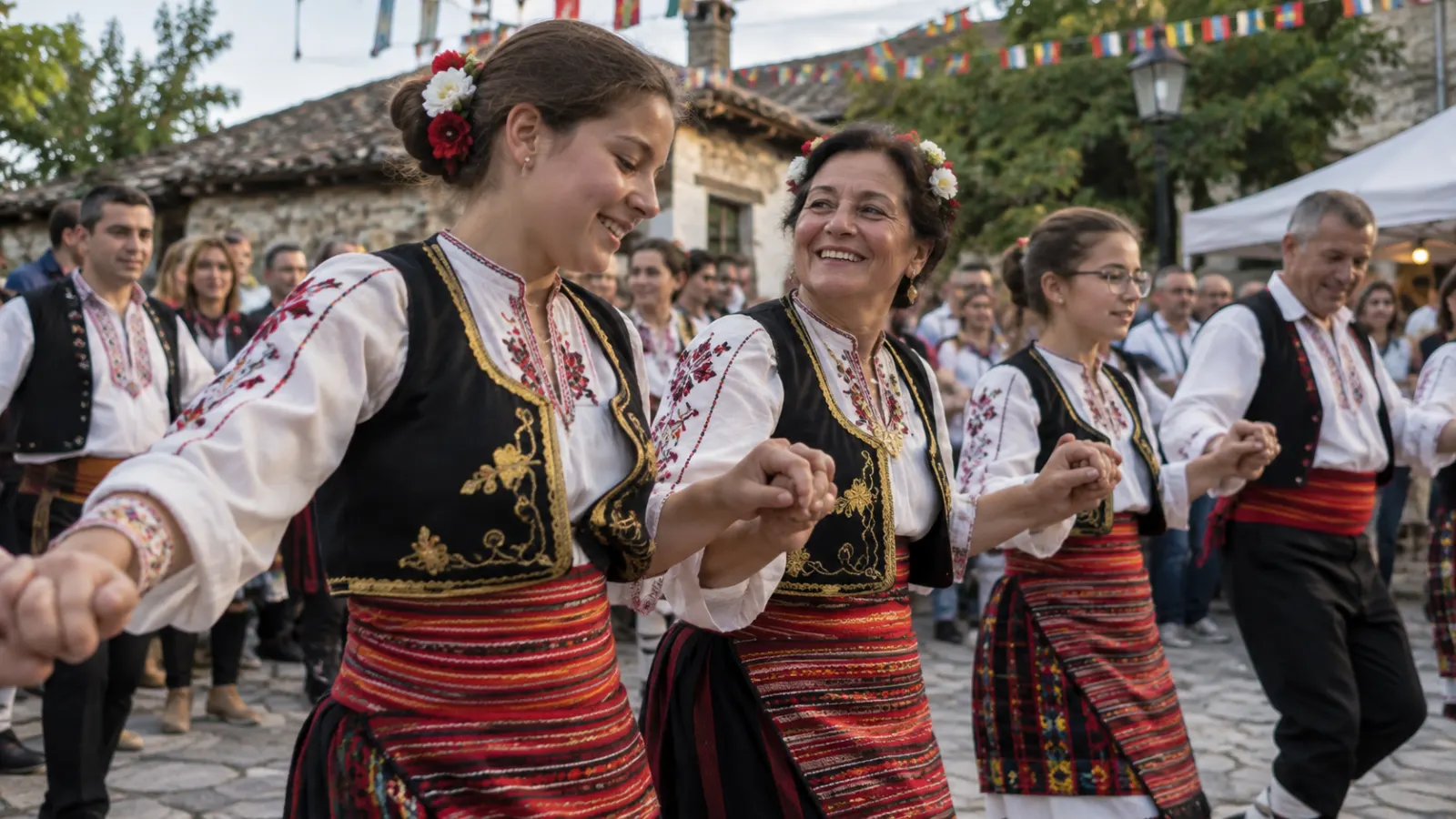
Group dancers monitor rhythm, distance, direction and timing. Partners respond to weight, gesture or movement. Circle and line dances make connection physically visible because each participant’s movement partly depends on what surrounding dancers do. Ensemble improvisation requires something different but equally social: participants contribute their own material while remaining responsive enough to maintain a common structure.
Research on synchronised movement helps explain why this can feel powerful. In three experiments, Paul Reddish, Ronald Fischer and Joseph Bulbulia found that cooperation was strongest when participants synchronised their movements and understood themselves to be intentionally coordinating with one another. The important mechanism was therefore not merely accidental movement at the same time; shared intentionality mattered too.
That distinction maps well onto cultural dance.
A crowd walking in the same direction is not automatically performing a collective ritual. A circle of people deliberately adjusting their steps to one another has a shared task. Successful participation produces repeated evidence that individual action can be coordinated into a collective result.
Other research suggests that synchronised movement can influence social affiliation across group boundaries. Work by Bahar Tunçgenç and Emma Cohen, including research involving children, found evidence that moving in synchrony could strengthen social bonds and reduce some existing group divisions under experimental conditions. The authors were careful to note that the strength, duration and real-world generalisability of such effects still require further research.
This is useful evidence, but it should not be romanticised into the claim that dancing together eliminates prejudice or political conflict.
A shared dance workshop may create a lower-risk first interaction between people who otherwise have little contact. Participants can coordinate physically before they possess enough shared language or trust for complex discussion. Music and movement can therefore open a social door.
They cannot resolve structural inequality by themselves.
The same mechanism can also strengthen boundaries. A dance identified strongly with a nation, religion, ethnicity, caste, club or political movement can intensify solidarity among insiders while making outsiders more visible. Collective coordination is socially powerful whether the group’s values are inclusive or exclusionary.
This is why dance reveals more than harmony.
It can reveal who belongs, who may participate, who watches, who leads and who remains outside the formation.
Gender, hierarchy and power are often written into movement
Many dance traditions assign different movements, clothing, positions or responsibilities according to gender, age, status, religious role or initiation.
A society’s expectations about masculinity and femininity may become visible in how bodies are expected to move. Men may perform movements associated with strength, combat or public display while women are expected to emphasise restraint, grace or modesty. Partner dances may define who is permitted to initiate contact, how closely people may stand and which person leads.
These patterns reveal social norms, but dance can also become a place where those norms change.
Women may enter forms historically dominated by men. Mixed-gender participation may expand. LGBTQ+ dancers may reinterpret partner roles. Younger performers may challenge costume rules or expectations about acceptable movement. Inclusive companies may develop wheelchair dance, seated choreography and adaptive performance that contest assumptions about which bodies qualify as dancers.
The cultural importance lies partly in this ability to make social expectations visible enough to be negotiated.
Courtship dances are especially revealing. Social dancing has historically provided structured opportunities for interaction between potential partners while surrounding the encounter with rules. Who may invite whom, what level of physical contact is acceptable, how partners rotate and which gestures are considered respectable all tell us something about the society organising the dance.
New forms of social dance have therefore repeatedly produced moral anxiety. When acceptable bodily distance changes, critics often describe the new dance as indecent, dangerous or socially disruptive. The controversy may be about choreography on the surface while underneath it lies a disagreement about gender, sexuality and control of public bodies.
Hierarchy operates in similar ways. Some ritual dances are restricted to initiated members. Others may historically have belonged to royal courts, military groups, hereditary specialists or particular castes. Age may determine who leads. Religious status may determine who is permitted to wear certain objects or perform particular movements.
Respecting a cultural tradition does not require pretending these systems do not exist.
At the same time, outsiders should be cautious about assuming every restriction is merely arbitrary oppression. Participants may understand some limits as part of ritual responsibility, sacred obligation or specialist training.
Good cultural analysis documents both the rule and its consequences.
Who controls access? How do practitioners explain the restriction? Do community members contest it? Has it changed over time? What happens when the dance moves into a public festival or educational institution where the original restrictions are harder to maintain?
These questions show why choreography alone cannot explain cultural meaning.
Living traditions survive by changing
The phrase traditional dance can create the misleading impression that authenticity means performing exactly what ancestors performed centuries ago.
In reality, every living tradition exists in the present.
Teachers forget and reconstruct material. Musicians change instruments. Performance spaces become smaller or larger. Costumes use new fabrics. Communities migrate. Religious practices weaken or strengthen. Competitions create technical standards. Video makes comparison between regional styles easier. Young performers bring new aesthetics.
UNESCO’s safeguarding framework explicitly recognises this dynamic quality. Its emphasis is on transmission from generation to generation and maintaining the circumstances that allow communities to continue interpreting and recreating heritage, rather than preserving one immutable object.
Migration makes this especially visible.
A community moving from one country to another may no longer have access to the original village square, temple courtyard, musicians or seasonal calendar. A ritual dance may be adapted to a community hall. Costumes may be made with available materials. A performance once embedded in everyday life may become concentrated into an annual cultural festival.
That adaptation can still preserve meaningful continuity.
A dance school in London, Toronto, Johannesburg or Melbourne may become a small institutional homeland where children learn not only steps but language, etiquette, music and stories associated with family origins. At the same time, younger performers may combine inherited movement with hip-hop, contemporary dance or other forms from the society in which they are growing up.
This does not necessarily represent cultural loss.
It can represent diaspora culture becoming its own historical reality.
Urban and popular dance forms demonstrate the same principle in the opposite direction. A style does not need to be centuries old to become culturally important. Street and club dances can emerge in particular neighbourhoods, racial communities or youth scenes and develop recognisable histories within a generation. Once transmitted, named, debated and associated with collective identity, they too become cultural practices worthy of historical attention.
Technology accelerates these processes.
Video has transformed dance education because learners can slow down choreography, replay difficult movement and access teachers thousands of kilometres away. Archives can preserve performances that previously survived only through direct memory. Social platforms can renew interest in forms that had declining local participation.
But a video records only part of a dance.
It shows the visible movement but may not explain when the dance should be performed, who traditionally teaches it, what ritual restrictions apply, why a costume matters or how dancers relate to musicians and audiences. Someone can reproduce the steps perfectly while misunderstanding the cultural practice almost completely.
That is why embodied transmission remains important even in the age of digital archives.
The teacher transmits not only how to move but often how to interpret the movement.
Preservation can support dance—and transform it at the same time
Institutions frequently become involved when communities worry that a dance tradition is disappearing.
Schools create courses. Cultural ministries establish festivals. Academies develop syllabi. Governments recognise national heritage. Competitions attract young performers. Museums and archives record older practitioners. Tourism creates paid opportunities.
All of these interventions can support survival.
They can also change what survives.
Once a dance enters an academy, teachers need names for movements, levels of progression and assessment standards. A historically flexible practice may therefore become codified. One regional version may be selected as the official form because it is easiest to teach or because its practitioners possess stronger institutional influence.
Over time, students may begin to assume that the standardised version is the ancient original even though the standard itself is relatively recent.
Competitions create similar pressure. Judges need criteria, so precision, synchrony, costume, difficulty and stage impact become measurable qualities. Those criteria can encourage extraordinary technical skill and give performers incentives to practise.
But competition may also transform a participatory community activity into a specialist performance.
A dance once valued because almost everyone could join can gradually become something that ordinary community members watch elite competitors perform.
Tourism creates another complicated exchange. UNESCO notes that tourism can provide income, visibility and renewed interest in performing traditions, but it can also encourage performances to be shortened, standardised or converted into culturally simplified “highlights” designed for visitors.
The important question is not whether tourists should ever watch traditional dance.
It is who controls the representation.
Can performers decide which parts are appropriate for public display? Are sacred or restricted elements protected? Are practitioners paid fairly? Does the community continue to perform the dance for its own purposes, or has the tourist version replaced community use?
Commercialisation is not automatically cultural destruction.
Control matters.
The same principle applies to borrowing across cultures. Dance travels easily because movement can be observed and imitated without linguistic fluency. This makes dance an unusually effective medium of cultural exchange, but it also creates questions about attribution and power.
Who receives credit when a movement enters commercial choreography? Who profits? Does the original community still receive recognition? Is a sacred or restricted form being used outside conditions practitioners regard as appropriate?
These are more useful questions than trying to decide whether cultural exchange itself is good or bad.
Keeping a dance alive requires more than preserving the dancers
Dance depends on an entire cultural system.
Costumes may require specialist weaving, embroidery or jewellery-making. Masks may depend on particular carving traditions. Musicians need instruments and knowledge of repertoire. Performance spaces may have religious or historical significance. Teachers need time and income. Audiences need enough cultural knowledge to recognise what they are watching.
UNESCO’s definition of performing arts as intangible cultural heritage therefore includes associated instruments, objects, costumes and cultural spaces rather than treating choreography as isolated movement.
This has an important implication for safeguarding.
If a community trains excellent performers but loses the craftspeople who make traditional instruments, part of the dance ecology disappears. If performances continue but nobody understands the ritual context, the movement may survive while some of its meaning weakens. If only professionals perform and younger community members never participate, the tradition may remain technically impressive but socially narrow.
Audiences themselves are part of this ecology.
An experienced audience recognises difficult sequences, humorous gestures, entrances, ritual transitions and moments requiring a particular response. Outsiders may see only movement because they lack the cultural codes that make the performance intelligible.
This is why documentation alone is never complete preservation.
A recording can show what happened.
It cannot fully preserve the network of expectations that made the event meaningful.
One of the strongest safeguarding models is therefore not simply perform, record and archive but teach, participate, watch, adapt and repeat. UNESCO’s recognition of Hungary’s Táncház method, for example, praises a participatory approach in which people learn folk dance and music directly in communal settings rather than encountering heritage only as stage performance. The model is valued precisely because transmission remains active, flexible and participatory.
This returns us to the central cultural importance of dance.
The body is not merely an instrument that reproduces choreography.
It is one of the places where culture continues to be negotiated.
Why dance matters in culture
Dance matters because human societies do not communicate only through propositions and written records. They also communicate through bodies moving in recognised ways at recognised moments.
A dance can remember ancestry without writing a history book. It can tell a community who may enter a ritual, who leads and who follows. It can create temporary equality in a circle or display hierarchy in a procession. It can convert a wedding, funeral, protest or religious ceremony into a public social event. It can give migrants a bodily connection with places they no longer live and give younger generations something inherited that they are still free to reinterpret.
Dance also demonstrates that tradition and change are not opposites.
A living practice survives because people keep finding reasons to perform it. Those reasons may change. A ritual can become heritage. A court dance can become theatre. A village form can become a national symbol. A neighbourhood style can become global popular culture. A once gender-restricted practice can develop new participation rules.
The important question is not whether the dance has remained untouched.
No living culture does.
The better question is whether communities still possess enough knowledge, authority and opportunity to recognise the practice as meaningful and transmit it on terms they can influence.
That is why cultural analysis of dance should go beyond asking:
What are the steps?
It should ask how those steps became meaningful, who is allowed to perform them, what relationships they create, what changes when the dance travels and who gets to decide which changes still belong to the tradition.
Dance makes social life visible in motion.
Its choreography can carry memory, but its deeper significance lies in the relationships surrounding the choreography: teacher and student, performer and audience, individual and group, sacred and secular, inherited rule and contemporary reinterpretation.
A monument preserves culture by remaining in place.
Dance preserves culture by being performed again—and becoming slightly different every time another generation learns how to move it forward.