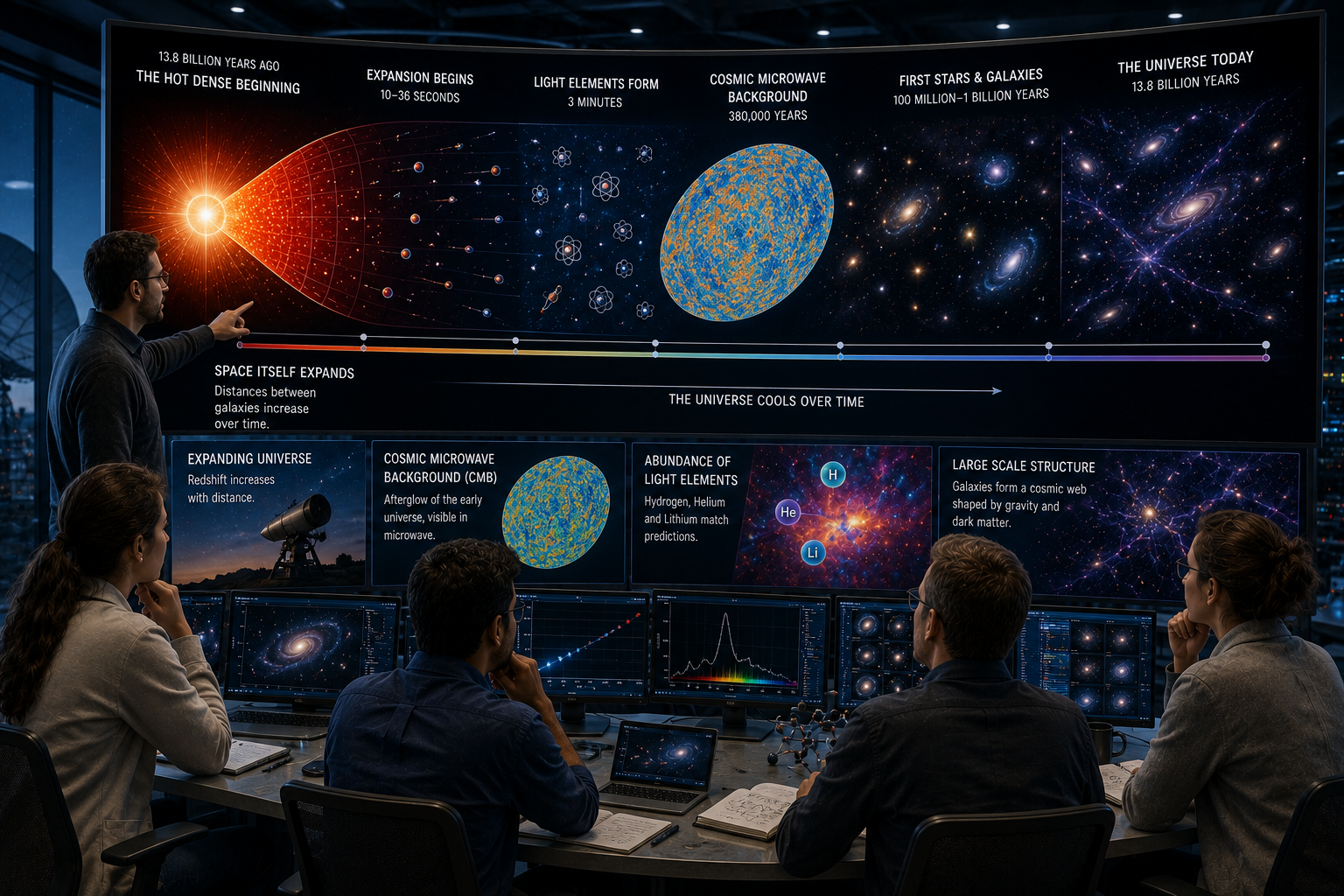
The Big Bang theory is one of the most misunderstood ideas in science. The phrase sounds like a dramatic explosion, as if matter burst outward from one point into a dark empty room. That image is memorable, but it is not accurate. The Big Bang theory is better understood as a model of cosmic expansion: the universe was once much hotter, denser and more compressed, and space itself has been stretching and cooling over billions of years.
What the Theory Actually Says
The Big Bang theory explains the early history and large-scale evolution of the universe. It says that the observable universe began in an extremely hot, dense state and has expanded over time. As the universe expanded, it cooled. Energy formed particles, particles formed atoms, gravity gathered matter into stars and galaxies, and over immense periods the universe became the structured cosmos we observe today. The theory is not a complete answer to every question about existence. It does not fully explain why there is something rather than nothing, nor does it give a simple picture of what came before the earliest moments science can describe.
Why It Was Not a Normal Explosion
A normal explosion happens inside space. A bomb, firework or volcanic eruption throws material outward from a location into surrounding space. The Big Bang is different. It is not matter expanding through a pre-existing cosmic room. It is the expansion of space itself. Every distant galaxy is not flying away from a special central point in the way fragments fly away from a blast. Instead, the distances between widely separated regions of space increase as the universe expands.
The Evidence From Expanding Space
One of the strongest clues comes from the light of distant galaxies. When astronomers observe faraway galaxies, the light is often redshifted, meaning its wavelength has been stretched. This indicates that the space between us and those galaxies has expanded while the light travelled. In broad terms, more distant galaxies tend to show greater redshift. This does not mean Earth is at the centre. In an expanding universe, observers in other galaxies would also see distant galaxies moving away on average.
The Oldest Light in the Universe
Another major line of evidence is the cosmic microwave background. In the early universe, matter and light were tightly coupled in a hot plasma. As the universe expanded and cooled, electrons and nuclei combined into atoms, allowing light to travel more freely. That ancient light has been stretched by expansion until it is now detected as microwave radiation coming from all directions. It is often described as afterglow from the early universe, carrying information about the universe when it was very young.
From Particles to Atoms to Stars
The Big Bang model also helps explain why the universe contains large amounts of hydrogen and helium. In the first minutes, conditions allowed light atomic nuclei to form. Much later, when the universe had cooled enough for atoms to exist and gravity had time to work, gas collected into the first stars and galaxies. Stars then created heavier elements through nuclear fusion and stellar explosions. The atoms in planets, oceans and living bodies therefore belong to a much longer cosmic sequence that began with the early universe.
What Cosmic Inflation Adds
Many cosmologists think that a very early phase called inflation occurred, when the universe expanded extraordinarily fast for a tiny fraction of a second. Inflation helps explain why the universe looks so uniform on large scales and why its geometry appears close to flat. It is still an active area of research because scientists continue to test how inflation happened and what powered it. For a general reader, the key idea is that the earliest universe may have changed at a speed and scale far beyond everyday intuition.
Common Misconceptions
The Big Bang theory does not say that galaxies formed instantly. It does not say the universe has a known edge that matter is approaching. It does not prove that science knows everything about the beginning. It also does not mean every mystery is solved. Dark matter, dark energy, cosmic inflation and the earliest quantum conditions remain areas of investigation. The strength of the Big Bang theory is not that it answers every philosophical question, but that it connects multiple observations into a coherent scientific model.
Final Takeaway
The Big Bang theory is the best scientific framework for understanding the universe’s early hot, dense state and its long expansion into the cosmos we see today. It is not a cartoon explosion. It is a story of space stretching, energy cooling, matter forming, gravity building structure and light preserving clues from deep time. To understand the Big Bang is to see the universe not as a fixed stage, but as a changing physical system with a history.