Which Cooking Oil Is Healthiest? Fat Quality, Heat and What Actually Matters
Which cooking oil is healthiest? The question sounds as though there should be one winning bottle, but nutrition evidence does not support a universal ranking. Olive oil may be useful for salads and everyday cooking, while sunflower, soybean, canola, peanut, corn, mustard, sesame or other oils may fit different cuisines, budgets and cooking methods. Health advice becomes misleading when this diversity is reduced to claims that one oil is uniquely protective while another is inherently toxic.
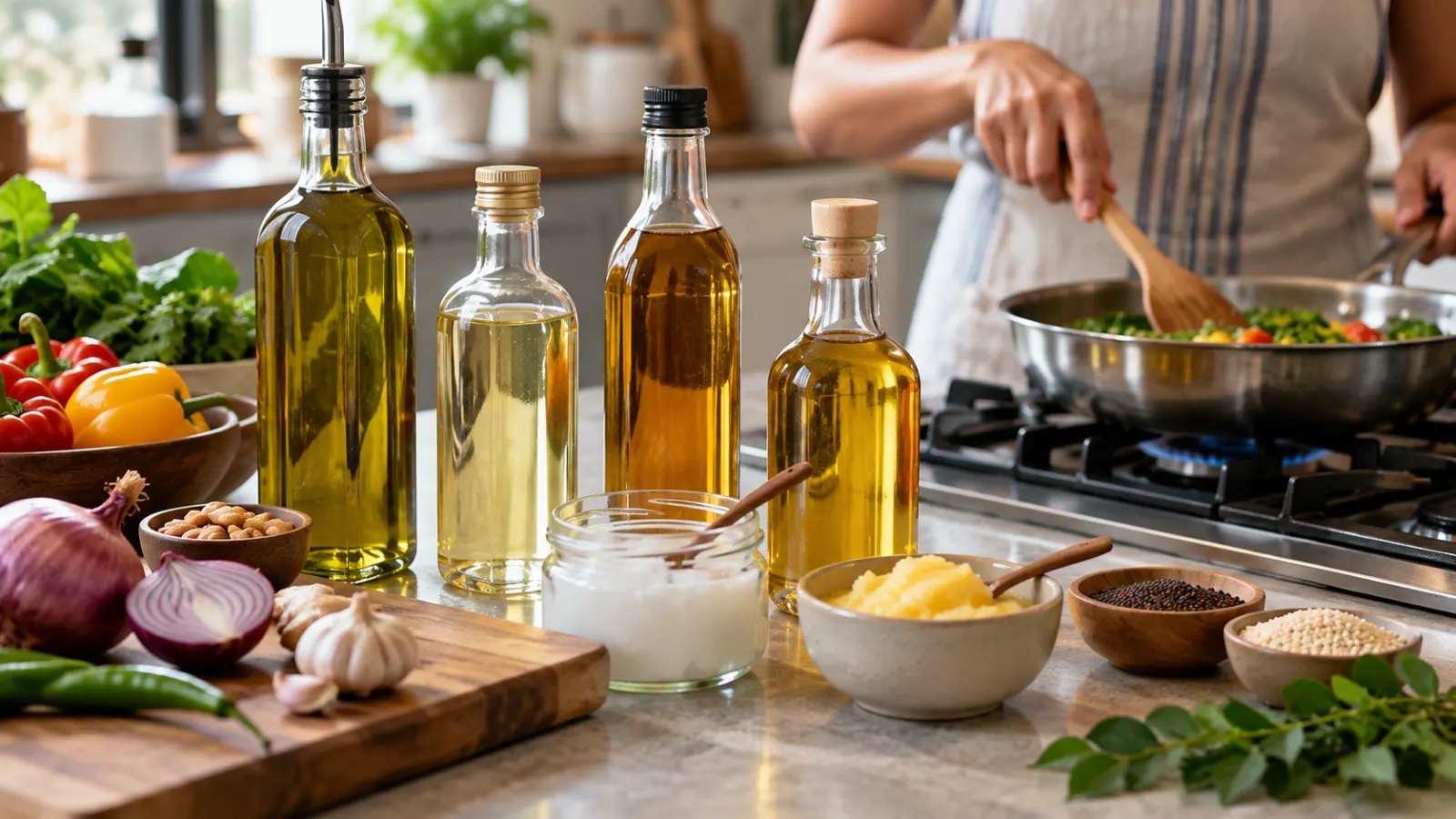
The stronger general principle is simpler: fat quality, substitution, quantity and cooking method matter more than the marketing identity of an oil. WHO's 2026 healthy-diet guidance recommends that dietary fats come primarily from unsaturated sources, with saturated fat limited to no more than 10% of total energy and trans fat to no more than 1%. It specifically lists oils such as sunflower, soybean, canola and olive as unsaturated-fat sources and recommends replacing fats such as butter, ghee, lard, coconut oil and palm oil with oils richer in unsaturated fats where appropriate.
That does not mean butter, ghee or coconut oil must never be eaten, nor that an unsaturated plant oil becomes healthy in unlimited quantities. Oils are concentrated sources of energy, and cooking practices such as repeatedly heating frying oil create a different exposure from using a modest amount once in ordinary home cooking. The useful questions are therefore: What fat is this replacing? Is the oil suitable for the cooking method? How much is being used?
Fat Quality Matters More Than the Name on the Bottle
Cooking oils are mixtures of fatty acids rather than single substances. Monounsaturated and polyunsaturated fats are the main unsaturated categories, while oils and fats differ substantially in how much saturated fat they contain. Olive, canola, sunflower, soybean, corn, peanut and several other liquid plant oils provide substantial amounts of unsaturated fat. Butter, ghee, coconut oil, palm oil and many animal fats generally contain higher proportions of saturated fat, although their exact profiles differ.
This distinction matters most when one fat replaces another. Nutrition cannot evaluate a reduction in saturated fat without asking what replaces it. If butter is removed and replaced primarily with refined carbohydrate or added sugar, the result is different from replacing it with a plant oil rich in unsaturated fatty acids. WHO therefore recommends replacing saturated fat with polyunsaturated fat, plant-derived monounsaturated fat or carbohydrates from foods naturally rich in fibre.
The American Heart Association takes a similar approach. Its current guidance recommends replacing saturated-fat sources with monounsaturated and polyunsaturated fats and lists canola, corn, olive, peanut, safflower, soybean and sunflower oils among suitable liquid plant oils.
This replacement principle explains why labelling an oil “healthy” in isolation is often misleading. Adding several tablespoons of an expensive olive oil to an already energy-dense diet is not equivalent to replacing butter or shortening with olive or canola oil in the same meal. The benefit arises partly from what disappears when the unsaturated fat is introduced.
The original draft captures this well: oil choice makes most sense when considered through substitution, suitability and restraint, rather than treating the bottle itself as a health product.
The Seed-Oil Debate Often Turns a Real Biochemical Pathway Into an Unsupported Conclusion
Sunflower, soybean, corn, canola and several other plant oils are frequently grouped online under the label “seed oils.” Critics often argue that their omega-6 fatty acids—particularly linoleic acid—promote inflammation and therefore contribute directly to obesity, cardiovascular disease or other chronic illnesses.
There is a biochemical reason this argument sounds plausible. Linoleic acid is an omega-6 polyunsaturated fatty acid, and omega-6 fatty acids participate in pathways that produce signalling molecules involved in inflammatory responses. But moving from that biochemical pathway to the claim that ordinary dietary linoleic acid causes chronic inflammation in humans requires clinical evidence.
Randomised controlled trials have not supported that simple conclusion. A systematic review of 15 trials found virtually no evidence that increasing dietary linoleic acid raised common markers of inflammation in healthy people. A later meta-analysis of 30 randomised trials similarly found no significant overall effect on several inflammatory biomarkers.
The American Heart Association likewise rejects the broad claim that seed oils should be avoided because their omega-6 content is inherently inflammatory. It continues to recommend several of these oils as sources of unsaturated fat.
This does not mean every food containing seed oil is healthy. Many fried and ultra-processed foods contain plant oils alongside refined starches, large amounts of sodium, added sugars and high energy density. Deep-frying and repeated heating can also change the oil. A diet dominated by such foods can be poor for health without proving that linoleic acid itself is uniquely responsible.
It is therefore important to distinguish the oil from the food containing it. French fries, packaged snacks and a home-cooked vegetable dish may all contain a plant oil, but their nutritional profiles and patterns of consumption are very different.
Smoke Point Matters, but It Is Not a Health Ranking
The smoke point is the temperature at which an oil begins visibly producing smoke as components break down and volatile compounds are released. It is useful culinary information because excessively heating an oil can produce unpleasant flavours and accelerate degradation. It is not, however, a complete health score.
Online charts sometimes rank oils almost entirely by smoke point, implying that the oil with the highest number is automatically safest and the oil with a lower smoke point should never be heated. Real cooking is more complicated. Stability is influenced by fatty-acid composition, antioxidants, refining, temperature, heating duration and whether the oil is repeatedly reused.
The practical distinction between ordinary cooking and prolonged repeated frying matters especially. Heating a small quantity of oil once during sautéing or roasting is different from keeping a fryer hot for hours and repeatedly reusing the same oil. Extended heating and reuse promote oxidation, polymerisation and other chemical changes.
The American Heart Association advises avoiding oil once it begins smoking, discarding rancid-smelling oil and not reusing or reheating cooking oil. It also notes that common liquid plant oils can generally be used across ordinary cooking methods, while deep-fat frying is not recommended as a routine healthy cooking method.
This gives home cooks a much simpler rule than memorising competing smoke-point tables: do not repeatedly overheat oil, do not keep using oil that has noticeably degraded, and choose an oil that suits the food and cooking temperature.
Oxidation itself is real, but ordinary home cooking should not be described as a chemical catastrophe. All fats can oxidise under the right conditions. Polyunsaturated fats contain more double bonds and are chemically more susceptible to oxidation than more saturated fats, but laboratory measurements of oxidation cannot be translated directly into the claim that normally cooked vegetable oil is poisonous. Temperature, duration, oxygen exposure, storage and naturally occurring antioxidants all influence what actually happens.
Storage matters as well. Keeping oil tightly closed and away from strong light and heat, and discarding it when it develops an obviously rancid odour, is more useful than fearing any oil that contains polyunsaturated fat. The original draft correctly distinguishes these normal kitchen considerations from exaggerated claims about oxidation.
Refined, Cold-Pressed and Extra-Virgin Describe Processing, Not Moral Value
Terms such as cold-pressed, refined, virgin and extra-virgin tell consumers something about how an oil was produced. They should not be translated automatically into “healthy” and “unhealthy.”
Refining can remove odours, flavours, pigments, free fatty acids and other components, creating a more neutral and sometimes more stable product for particular culinary uses. Cold-pressed and extra-virgin oils retain more characteristic flavour and some naturally occurring compounds because they undergo less intensive processing.
That difference can matter nutritionally and gastronomically, but the best choice still depends on what the oil is being used for. Extra-virgin olive oil can work well for dressings, finishing foods and many ordinary cooking applications. A relatively neutral refined oil may be preferable when flavour, affordability or large-volume cooking matters. The American Heart Association includes both olive oil and several conventional refined vegetable oils among appropriate unsaturated cooking oils.
The idea that less processing automatically means better health is too simplistic. Refining can reduce some desirable compounds while also removing unwanted flavours or impurities and changing culinary performance. A household does not need to purchase the most expensive cold-pressed oil available in order to follow sound dietary-fat guidance.
Affordability matters because nutrition advice has to survive ordinary household economics. An affordable unsaturated oil used consistently is generally more useful than a premium product that strains the food budget while providing relatively small practical advantage.
Coconut Oil and Ghee Can Fit a Diet, but Their Saturated Fat Still Counts
Coconut oil and ghee occupy particularly complicated positions because they are surrounded by both cultural significance and strong health claims.
Neither should be described as poison. They are foods that can be incorporated into diets. But traditional use does not change their fatty-acid composition.
WHO's current healthy-diet guidance identifies coconut oil, ghee, butter, palm oil and lard among important saturated-fat sources and recommends shifting dietary fat toward unsaturated alternatives. The American Heart Association similarly recommends nontropical liquid plant oils in place of coconut oil, butter and other major saturated-fat sources.
Coconut oil is sometimes promoted because it contains fatty acids described as medium-chain fats. However, ordinary coconut oil is not nutritionally identical to purified medium-chain triglyceride products used in some research and clinical contexts. Using evidence about concentrated MCT preparations to claim that ordinary coconut oil provides the same metabolic effects can therefore be misleading.
Ghee presents a similar issue. It has culinary and cultural value, particularly in South Asian diets, but it remains a concentrated source of saturated fat. The relevant question is not whether ghee should be declared either sacred or dangerous. It is whether it is one flavouring fat used alongside substantial sources of unsaturated fat or whether it supplies a large proportion of the household's total fat intake every day.
This makes proportion more useful than prohibition. Someone can use a small amount of ghee for flavour while relying predominantly on unsaturated oils and other unsaturated-fat foods across the overall diet. That is very different from using large quantities of ghee as the primary cooking fat at most meals.
Quantity Still Matters Even When the Oil Has a Favourable Fat Profile
Changing from a saturated fat to an unsaturated oil can improve the quality of dietary fat, but it does not make quantity irrelevant.
All cooking oils are energy dense. The calorie difference between common oils is relatively small because they are composed almost entirely of fat. A generous pour of olive oil therefore adds substantial energy just as a generous pour of sunflower or canola oil does.
This becomes relevant when otherwise nutritious foods are prepared in very large quantities of oil. Vegetables do not stop providing vitamins and fibre because they were cooked with oil, but a dish can become considerably more energy dense depending on how much oil is absorbed or added.
There is no need for most people to count every teaspoon permanently. Measuring occasionally can simply reveal how large an habitual pour actually is. The objective is awareness rather than fear of dietary fat.
WHO's guidance reflects the same balance: both fat quality and quantity matter. For adults, it states that limiting total fat to about 30% or less of daily energy may help prevent unhealthy weight gain, while emphasising that the fats consumed should predominantly be unsaturated.
What matters across the week is therefore not only which bottle sits beside the stove but how much added fat appears in meals and what the rest of the dietary pattern looks like.
You Do Not Need a Complicated Oil Rotation
Some nutrition advice recommends rotating several cooking oils to obtain an ideal balance of different fatty acids. Households can certainly rotate oils for flavour and culinary variety, but there is no requirement to maintain a complicated collection of bottles in order to eat well.
Fatty acids come from the entire diet, not only cooking oil. Nuts, seeds, fish and other foods can contribute unsaturated fats and essential fatty acids. A household using one or two affordable plant oils rich in unsaturated fat can build a perfectly reasonable dietary pattern without calculating an exact weekly oil rotation.
Different cuisines may naturally favour different choices. Mustard oil may suit one household, groundnut another, sesame another and olive or canola another. No evidence-based principle requires every culture to cook with the same product.
This is particularly important when nutrition advice begins equating high price with high quality. A premium imported oil is not necessary if a locally available unsaturated oil performs the required culinary role and fits the household budget.
The original article's practical conclusion is therefore worth preserving: healthy oil choice should work within the whole diet and within real household economics, rather than requiring a collection of expensive speciality oils.
The Best Cooking Oil Depends on What You Are Replacing and How You Use It
There is no single healthiest cooking oil for every household and every dish.
For most people, the strongest evidence-based starting point is to rely mainly on unsaturated fat sources, limit saturated fat and avoid industrial trans fat. WHO's 2026 guidance specifically recommends replacing saturated fats such as butter, ghee, lard, coconut oil and palm oil with plant oils richer in polyunsaturated or monounsaturated fats.
From there, practical differences matter. An oil used to dress a salad does not need the same flavour characteristics as one used for high-volume cooking. Cost, availability and cultural preference matter. Repeated deep-frying is a different exposure from ordinary sautéing. An oil that has begun smoking heavily or smells rancid should not continue being used.
The increasingly popular claim that ordinary seed oils are inherently inflammatory is not supported by human randomised-trial evidence on linoleic acid, and major cardiovascular guidance continues to include several of these plant oils among appropriate unsaturated-fat choices.
At the same time, describing any unsaturated oil as “heart healthy” should not be interpreted as permission to use unlimited quantities or deep-fry most meals. Fat quality and total dietary pattern still matter.
The most practical cooking-oil rule therefore comes down to three questions: What is this replacing? Is it suitable for how I am cooking? How much am I using?
If an unsaturated plant oil replaces a major source of saturated or trans fat, that is generally a favourable substitution. If the same oil is repeatedly overheated, used in large quantities or added on top of an already excessive-energy diet, its healthy reputation does not erase those factors.
No cooking oil needs to be worshipped.
No commonly used plant oil supported by mainstream dietary guidance needs to be feared because of an internet label.
Choose an affordable oil rich in unsaturated fat, use it appropriately, avoid repeatedly overheating and reusing it, keep saturated fats proportionate and judge the bottle as one part of the entire diet.
That approach is less dramatic than searching for a miracle oil.
It is also much closer to what the evidence supports.
Medical Note
This article provides general nutrition information and is not a substitute for individual medical or dietetic advice. People with cardiovascular disease, lipid disorders, diabetes, gastrointestinal conditions, food allergies or other medical conditions may require dietary guidance tailored to their health status, medications and overall nutritional needs.