Whole Grains vs Refined Grains: Nutrition, Benefits and Better Choices
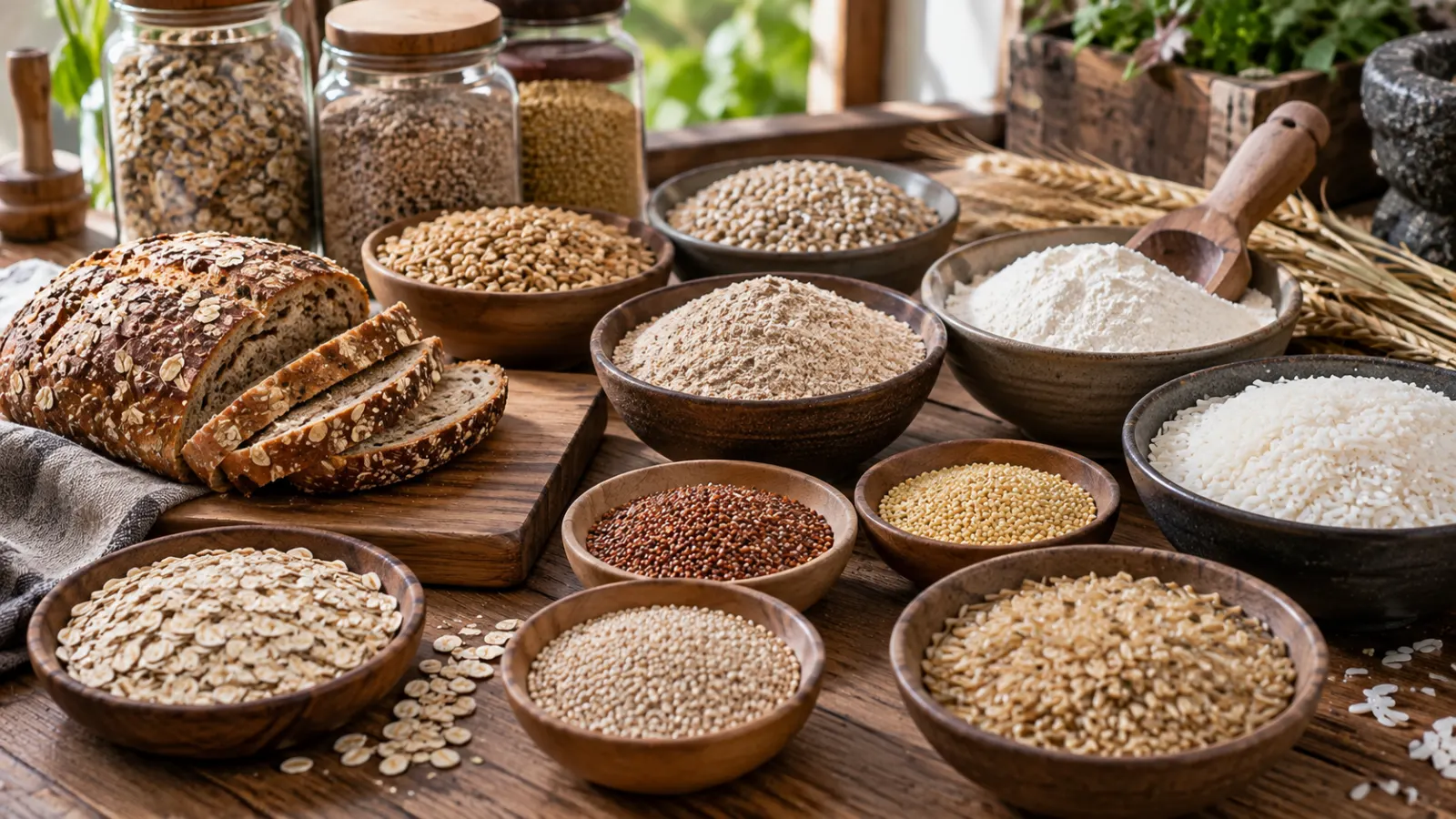
Grains are often discussed as though they were simply sources of carbohydrate. An intact cereal grain, however, is a seed with several edible parts. Wheat, rice, oats, barley, maize and similar grains contain a fibre-rich outer bran, a nutrient-containing germ and a starch-rich endosperm. What happens to those layers during processing helps explain much of the nutritional difference between whole and refined grains.
A whole grain retains the bran, germ and endosperm in roughly their original proportions. It can still be cracked, rolled or milled into flour and remain whole grain if all three parts are retained. Refining removes much of the bran and germ, leaving a larger proportion of the starchy endosperm. The resulting food can have a smoother texture and longer shelf life, but some fibre, vitamins, minerals, oils and plant compounds are lost in the process.
This does not mean refined grains are nutritional poison or that every whole-grain product is automatically healthy. White rice and refined flour can fit into balanced diets, particularly where they are long-established staple foods. At the same time, making a larger share of grain intake whole can improve carbohydrate quality and increase fibre without requiring people to abandon familiar meals.
That broader emphasis now appears directly in World Health Organization guidance. WHO recommends that carbohydrate intake for people aged two years and older come primarily from whole grains, vegetables, fruits and pulses, placing the emphasis on carbohydrate quality rather than simply reducing carbohydrate as a nutrient category.
What refining changes
The bran contains much of a grain's fibre along with minerals and various plant compounds. The germ contains fats, vitamins and other substances involved in the seed's growth, while the endosperm is dominated by starch and also provides some protein. Removing the bran and germ therefore changes more than the colour or texture of the grain.
Many countries enrich refined flour by adding back selected nutrients, commonly including iron, folic acid and certain B vitamins. Enrichment has major public-health value, especially where deficiencies are common, but it does not reconstruct the original grain. The full fibre content and range of plant compounds removed during milling are not simply restored by adding several vitamins and minerals back.
This makes the distinction between whole and refined grain partly structural. Two products can provide similar calories while delivering those calories in different food matrices.
Fibre is one of the clearest differences. Naturally occurring dietary fibre can increase stool bulk and support bowel regularity. Different fibres can also influence digestion, fullness, blood glucose responses and microbial fermentation in the gut. FDA recognises several physiological effects associated with dietary fibre, including improved bowel function and effects on blood glucose, cholesterol and energy intake, depending on the type of fibre.
But “whole grain” should not be treated as one uniform metabolic category. Steel-cut oats, whole-wheat bread and intact barley do not behave identically simply because each retains the whole grain. The physical form of the food matters too.
Processing does not automatically make a grain refined
Rolling oats, cracking wheat or grinding whole wheat into flour can all preserve whole-grain status. The key question is whether the bran, germ and endosperm remain present in the appropriate proportions, not whether the grain still looks intact.
Processing can nevertheless change how the food behaves during digestion. Smaller particles expose more surface area to digestive enzymes, so finely milled whole-grain flour may be digested more rapidly than a largely intact grain. Texture, particle size, cooking method and other ingredients can all influence the final food.
This is why the useful comparison is not simply “processed” versus “unprocessed”. Processing exists on a continuum.
A bowl of intact barley, rolled oats, whole-wheat chapati and a highly sweetened breakfast cereal made partly from whole grain can all technically involve whole grains while differing considerably in fibre density, added sugar, sodium, processing and how quickly they are eaten and digested.
The grain label therefore tells us something important, but not everything.
WHO's current healthy-diet guidance follows this more nuanced approach. It recommends a significant contribution from relatively unrefined carbohydrate foods and identifies whole grains such as maize, millet, oats, wheat and brown rice alongside vegetables, fruit and pulses as preferred carbohydrate sources.
The message is not that carbohydrate itself is the problem. A bowl of oats, a serving of lentils and a sugar-sweetened drink all contain carbohydrate, but their structure, fibre, nutrient content and effects on appetite are very different.
Whole grains are associated with better long-term health outcomes
Large observational studies and meta-analyses have repeatedly associated higher whole-grain intake with lower risks of cardiovascular disease, type 2 diabetes and premature mortality. These findings support recommendations to make whole grains a regular component of healthy dietary patterns, although they should not be interpreted as proof that one serving of brown rice or oats independently prevents disease.
Diet works as a pattern.
Someone who replaces refined grains with whole grains may also eat more fibre, legumes, vegetables, nuts and minimally processed foods. Researchers attempt to account for these differences statistically, but long-term nutrition outcomes rarely depend on one food in isolation.
The practical conclusion is therefore stronger when expressed as substitution rather than cure.
Replacing part of the refined grain in a diet with a whole-grain version generally raises fibre and retains more of the original kernel's nutrients without necessarily increasing the amount of food consumed. Adding extra whole-grain bread on top of an already sufficient meal is less useful than changing the grain source itself.
This also makes gradual improvement easier. A household can mix brown and white rice, combine whole and refined flour, rotate oats or millet into breakfast, or choose whole-grain bread more often without redesigning its entire cuisine.
Whole grain does not mean unlimited or automatically healthy
Whole-grain foods still contain energy. Bread, pasta, rice and cereal can all contribute substantial calories when portions are large, and the presence of whole grain does not cancel large quantities of sugar, sodium or saturated fat elsewhere in a product.
This matters particularly for packaged foods.
A sweet biscuit or breakfast cereal may advertise whole grains prominently while still containing substantial added sugar. A packaged bread can contain whole-grain flour alongside refined flour, sodium and other ingredients. A product label therefore needs to be interpreted as a whole rather than by one health-related phrase on the front.
Marketing language can also be misleading.
“Made with whole grains” does not necessarily mean that every grain ingredient is whole. “Multigrain” means only that multiple types of grain are present; those grains may still be refined. Seeds sprinkled on the surface and a rustic brown appearance also tell us very little about the flour underneath.
Colour is particularly unreliable. Some whole-grain breads are fairly light, while refined breads can be darkened using ingredients such as caramel or molasses.
The ingredient list generally provides better evidence. Terms such as whole wheat, whole oats, whole rye or another clearly named whole grain near the beginning of the list are more informative than package colour or imagery. FDA's whole-grain health-claim framework also demonstrates why precise ingredient content matters rather than simply whether a product contains some whole grain somewhere in the formulation.
The best choice therefore comes from combining the whole-grain claim with the rest of the label: ingredients, fibre, added sugars where listed, sodium and the overall role of the product in the diet.
Traditional grains make whole-grain eating more flexible
Whole grains do not mean only oats, brown bread and imported speciality foods.
Millet, sorghum, barley, whole maize, rye, brown or less-polished rice and other traditional grains can all contribute. Some foods commonly described as grains, such as buckwheat and quinoa, are botanically different but are used in similar dietary roles and can provide useful alternatives.
For Indian diets, this makes whole-grain guidance much more practical. Wheat, millets such as bajra and ragi, jowar, maize and less-polished rice can all fit within familiar food cultures. Improving grain quality does not require abandoning roti, rice or other staple meals for expensive packaged “health foods”.
The principle is to retain more of the grain where practical.
This matters economically as well. Nutrition advice becomes less useful when it implies that healthy eating requires imported or premium-branded products. Locally familiar grains may be cheaper, culturally easier to prepare and more sustainable as everyday staples.
WHO's guidance itself uses foods such as unprocessed maize, millet, oats, wheat and brown rice as examples of whole grains, reinforcing that whole-grain eating can take very different regional forms.
Refined grains can still have a place
It is easy for health advice to become unnecessarily absolute.
White rice, white bread and foods made from refined flour do not become harmful simply because they have been refined. In many cuisines, these foods are important sources of energy and are eaten as part of meals containing vegetables, pulses, dairy, fish, meat or other nutritious foods.
The concern is mainly about proportion and displacement.
A diet dominated by refined grains may provide less fibre and can crowd out whole grains, pulses and other nutrient-dense foods. But replacing every familiar staple immediately is neither medically necessary for most people nor always realistic.
A gradual shift may work better. Mix brown and white rice initially. Replace part of refined flour with whole-grain flour. Add oats or millet to breakfast several times per week. Use whole-grain bread for some meals while retaining other traditional foods.
This approach avoids turning diet quality into a purity test.
A simple refined-grain food eaten with vegetables and pulses may also form a better overall meal than a heavily processed product that happens to carry a whole-grain label.
The entire plate still matters.
Whole grains are not appropriate for everyone in the same form
General dietary recommendations always have exceptions.
People with coeliac disease must avoid gluten-containing wheat, barley and rye regardless of whether those grains are refined or whole. Depending on individual guidance and contamination controls, alternatives can include certified gluten-free oats, brown rice, maize, millet, sorghum, quinoa and buckwheat.
People with some gastrointestinal conditions may also need individual adjustments in fibre amount or grain choice. A person with irritable bowel symptoms, inflammatory bowel disease or another digestive condition may temporarily tolerate some foods better than others.
Increasing fibre very quickly can also produce bloating or gas even in people without a gastrointestinal disorder. Someone moving from a low-fibre diet directly to large quantities of bran, whole grains, pulses and vegetables may find the change uncomfortable.
Increasing fibre gradually and maintaining adequate fluid intake is often easier to tolerate.
This does not weaken the population recommendation for fibre-rich foods. It simply recognises that the digestive system may need time to adapt and that individual medical conditions sometimes require different advice.
The useful goal is better carbohydrate quality, not grain perfection
Whole grains are valuable because they retain more of the original kernel and generally provide more naturally occurring fibre and other nutrients than their refined equivalents. That makes them a strong default grain choice for many people.
But they should be understood in context.
Whole grain does not mean calorie-free. Brown colour does not prove a food is whole grain. “Multigrain” does not guarantee that any grain is whole. Milling can preserve whole-grain status while still changing digestion. Refined grains do not have to disappear completely for diet quality to improve.
The strongest practical strategy is usually substitution.
Move a greater proportion of regular grain intake toward whole-grain forms. Keep familiar foods where useful. Compare packaged foods beyond their marketing claims. Use traditional local grains rather than assuming healthy eating requires specialty products.
The WHO's carbohydrate guidance captures the underlying principle well: the focus should be on carbohydrate quality, with carbohydrate coming primarily from whole grains, vegetables, fruits and pulses rather than treating all carbohydrate-rich foods as nutritionally equivalent.
For most people, the change does not need to be dramatic.
One regular breakfast moved from a highly refined cereal to oats, one bread choice shifted toward whole grain, or part of a household's rice or flour gradually replaced with a less-refined alternative can improve the overall pattern.
Whole grains are best understood not as a superfood and not as a rigid dietary rule, but as a practical upgrade in the quality of the carbohydrates people already eat.
Medical Note
This article provides general nutrition and health information and is not a substitute for individual medical or dietetic advice. People with coeliac disease, gastrointestinal disorders, diabetes, kidney disease, food allergies, pregnancy-related nutritional needs, eating disorders or other medical conditions may require personalised dietary guidance from an appropriately qualified healthcare professional.