Drought often begins without a clear starting moment.
There is no single thunderclap announcing its arrival. Instead, expected rain fails to appear. Soil becomes progressively drier. Crops begin to struggle. Streams weaken. Reservoir levels drop. Wells may eventually have to reach deeper for water.
Weeks or months later, what initially looked like an unusually dry season may be recognised as a drought.
The World Meteorological Organization defines drought broadly as a prolonged dry period in the natural climate cycle, typically developing slowly because of a lack of rainfall. The U.S. Geological Survey similarly describes drought as a period of drier-than-normal conditions that creates water-related problems.
The phrase drier than normal is essential.
A desert receiving very little rain every year is not automatically experiencing drought. Drought occurs when water availability falls significantly below what is normal or expected for a particular place and period.
The first ingredient: a rainfall deficit
Most droughts begin with below-normal precipitation.
Atmospheric circulation patterns determine where moist air travels, where storms develop and where rain or snow eventually falls. When these patterns persistently divert precipitation away from a region, rainfall can remain below average for weeks, months or longer.
USGS explains the basic progression: reduced rainfall dries soils and damages vegetation; if the deficit continues, streamflow declines, reservoirs and lakes fall and groundwater becomes more difficult to reach.
But lack of precipitation alone does not determine how severe the drought will become.
Temperature, evaporation, soil conditions, vegetation, water storage and human demand can either soften or amplify the effects.
Meteorological drought: when the atmosphere stays dry
The earliest stage is often called meteorological drought.
This refers to a significant shortage of precipitation compared with the normal climate of a region.
Because normal rainfall varies enormously across the world, meteorological drought cannot be defined by one universal rainfall number. What counts as a serious precipitation deficit in a humid tropical region may be completely normal in an arid climate.
Meteorologists therefore compare observed rainfall with long-term local patterns.
USGS notes that meteorological drought generally precedes hydrological drought and can be tracked using indices that measure precipitation or precipitation combined with evapotranspiration.
At this stage, reservoirs may still be full enough and groundwater may remain available. The weather is already unusually dry, but society may not yet feel the full consequences.
Agricultural drought: when the soil no longer supports crops
Agriculture often reveals drought sooner than cities do.
Plants depend on moisture stored in the soil. A prolonged rainfall deficit reduces that reserve, and high temperatures can accelerate the loss.
Shallow-rooted crops can become stressed even while deeper groundwater or major reservoirs remain relatively stable.
This gives rise to what is commonly described as agricultural drought: there is no longer enough soil moisture to support normal crop or pasture growth.
Its severity depends on more than rainfall. Soil type, crop choice, irrigation, planting season, temperature and farming practices all matter.
A short dry period at a critical stage of crop development may be more damaging than a longer deficit occurring at another time.
That is why drought is not simply a meteorological problem. It is an interaction between climate and the system depending on water.
Hydrological drought: when rivers, reservoirs and groundwater decline
If dry conditions persist, the effects move through the wider water system.
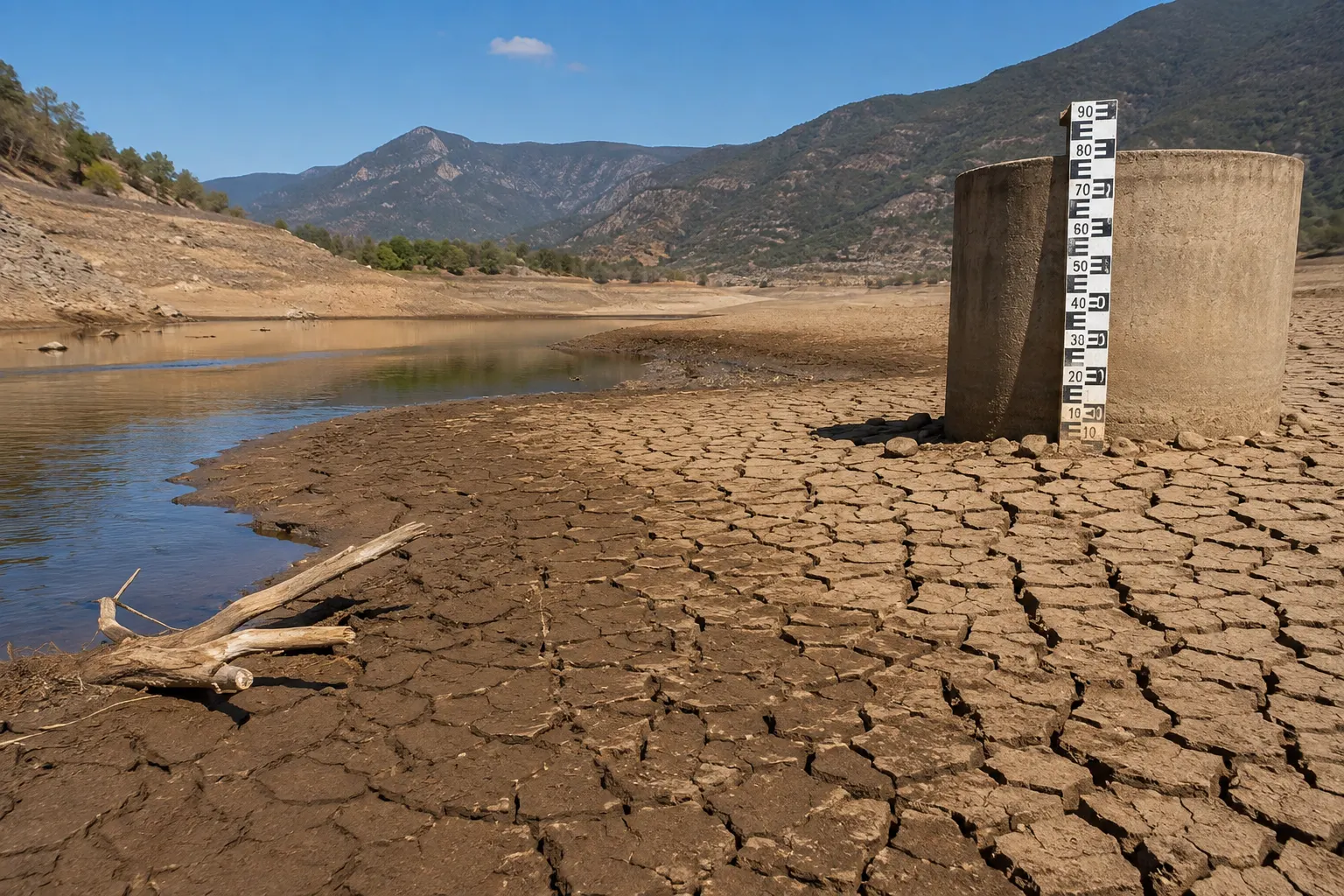
Rivers receive less runoff. Lakes and reservoirs shrink. Groundwater recharge may decline. Wells can become less productive.
USGS defines hydrological drought as unusually low flow in rivers and streams together with low levels in lakes, reservoirs or groundwater, and notes that it normally develops after meteorological drought.
This delay can create a misleading sense of security.
A city may experience months of below-normal rainfall while reservoirs still appear adequate because stored water buffers the immediate impact. But if inflows remain weak and consumption continues, that reserve progressively disappears.
By the time water restrictions are imposed, the drought may have been developing for a long period.
Why heat can make drought worse
Rainfall tells only part of the story.
Higher temperatures increase evaporation from soils, rivers, reservoirs and vegetation. Plants also release water through transpiration. Together, evaporation and transpiration are often considered as evapotranspiration.
A hot dry period can therefore remove available moisture faster than a cooler dry period with a similar rainfall deficit.
WMO explains that rising temperatures intensify evaporation and can worsen soil drying, while a changing climate is making the water cycle more erratic in many regions.
This means two years receiving similarly low rainfall may produce different drought severity if one is substantially hotter.
Ocean and atmospheric patterns matter
Climate naturally varies from year to year and decade to decade.
Large-scale interactions between the oceans and atmosphere can shift rainfall around the world. Phenomena such as El Niño and La Niña alter atmospheric circulation and can produce unusually wet conditions in some regions while contributing to dryness elsewhere.
WMO identifies naturally occurring climate drivers including El Niño and La Niña as important influences on the global water cycle alongside human-induced climate change.
Drought therefore often results from persistent climate patterns rather than a local failure of cloud formation.
Human activity can turn dryness into crisis
A drought is a physical hazard, but its consequences depend heavily on how water and land are managed.
Consider two regions experiencing the same rainfall deficit.
One has diversified water sources, healthy watersheds, efficient irrigation, groundwater monitoring and reservoirs managed with drought contingency plans.
The other relies heavily on one aquifer, grows water-intensive crops, loses large volumes through inefficient irrigation and has rapidly expanding urban demand.
The meteorological event may be similar. The social outcome can be radically different.
WMO explicitly notes that poverty and inappropriate land use increase drought vulnerability and that drought impacts can extend through agriculture, food security, hydropower, infrastructure, ecosystems and the wider economy.
Over-pumping groundwater is particularly important because aquifers are often used as a reserve when surface water becomes scarce.
That can help communities survive one drought while weakening their resilience to the next.
Is drought the same as water scarcity?
No.
Drought is a climatic or hydrological condition involving unusually low water availability.
Water scarcity is a broader imbalance between available water and demand.
A region can face water scarcity even without drought if demand from households, agriculture and industry consistently approaches or exceeds sustainable supply.
Conversely, a well-managed region may experience drought without immediately reaching severe water scarcity because storage, conservation and diversified supplies provide resilience.
The distinction matters because drought eventually ends, whereas structural water scarcity can continue indefinitely unless consumption or supply systems change.
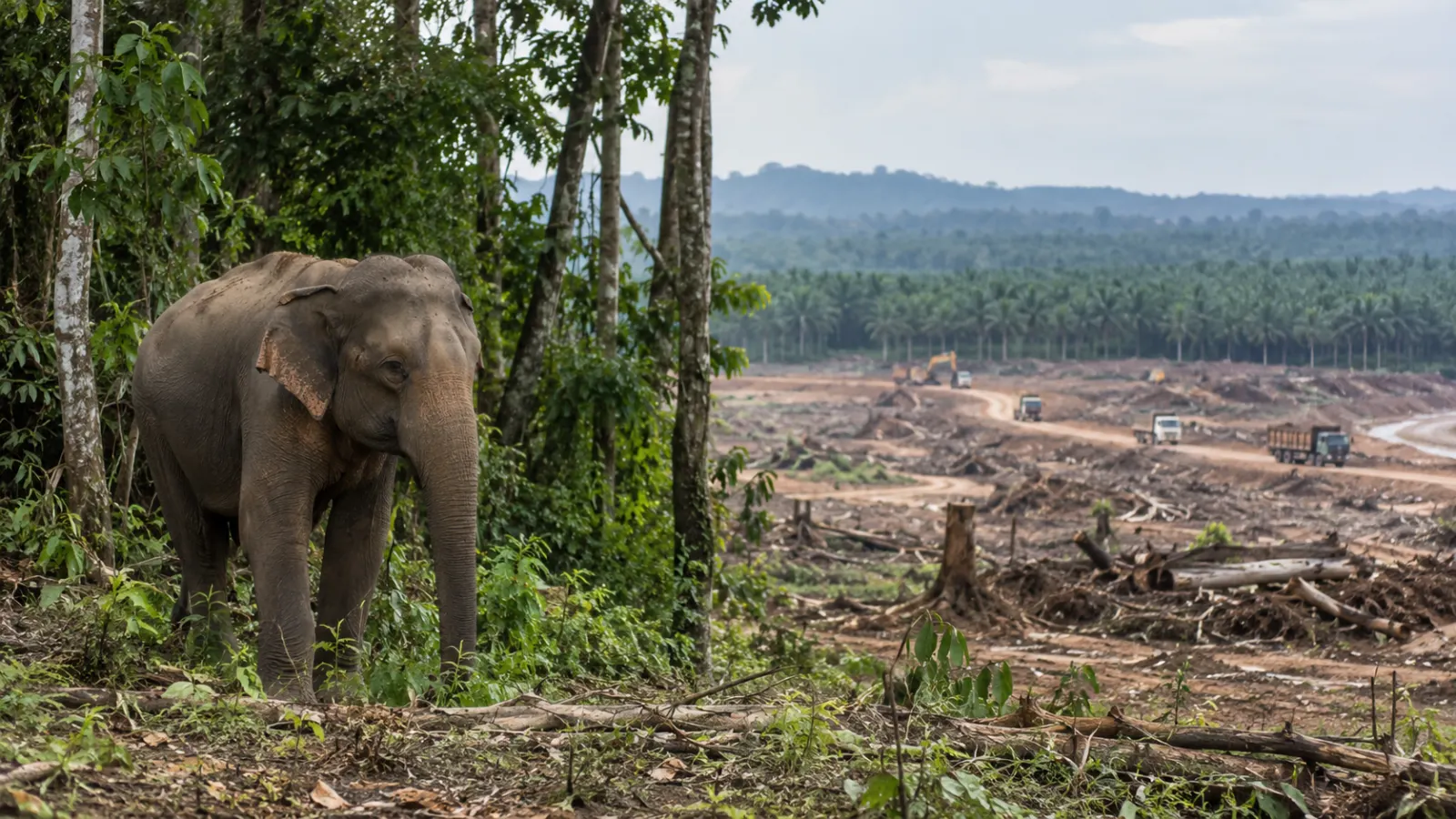
Can deforestation and land degradation affect drought?
Land management can influence how landscapes store and cycle water.
Healthy soils with good organic matter and vegetation can absorb and retain rainfall better than badly degraded ground. Wetlands, forests and functioning watersheds can moderate runoff and support water storage.
By contrast, soil degradation can reduce infiltration and resilience.
This does not mean deforestation automatically causes every drought; atmospheric precipitation remains central. But land degradation can make communities and ecosystems more vulnerable to rainfall deficits and can alter local water processes.
The Convention on Biological Diversity and UN agencies increasingly treat land, ecosystem and water management as connected environmental issues rather than isolated problems.
What role does climate change play?
Drought has always occurred naturally.
That remains important because attributing every drought entirely to climate change would be inaccurate.
However, WMO states that climate change is expected to increase the frequency, intensity or duration of drought in several parts of the world. Rising temperatures can increase evaporation, while shifting rainfall patterns can change where and when water is available.
Climate change can therefore alter drought risk through both the supply side - precipitation - and the loss side - evaporation and soil drying.
The effect is not uniform everywhere. Some regions may become wetter overall while still experiencing more intense dry periods or greater variability.
Why drought can last after rain returns
One heavy rainstorm does not necessarily end a drought.
It may wet the surface soil while doing little to refill reservoirs or groundwater.
Hydrological recovery can require sustained precipitation over a large catchment. Snowpack may need to rebuild. Aquifers may take years to recharge.
If rain falls too intensely onto hard, dry or degraded soil, much of it may run off rather than infiltrate.
This explains why drought monitoring looks at multiple indicators: precipitation, soil moisture, streamflow, groundwater, vegetation and reservoir storage. WMO specifically highlights these indicators in drought monitoring and early-warning systems.
Managing drought before the emergency
Because drought develops slowly, it offers something many disasters do not: time to observe deterioration.
WMO's integrated drought-management approach centres on three broad pillars - monitoring and early warning, vulnerability and impact assessment, and mitigation, preparedness and response.
That shifts policy away from waiting for reservoirs to empty.
Long-term drought resilience may involve efficient irrigation, better crop selection, groundwater regulation, leak reduction, wastewater reuse, watershed restoration, diversified supplies and realistic contingency plans.
The objective is not to prevent every dry period. No government can do that.
It is to prevent a natural climate fluctuation from automatically becoming a humanitarian, agricultural or economic emergency.
Drought is a chain, not a single event
The clearest way to understand drought is as a sequence.
Rainfall falls below normal.
Soils lose moisture.
Vegetation experiences stress.
Streamflow declines.
Reservoirs and groundwater come under pressure.
Human demand continues.
Whether this chain becomes a catastrophe depends on climate, temperature, ecosystems, infrastructure, governance and vulnerability.
The absence of rain may begin the story.
It rarely explains the whole story.