Why Species Go Extinct: The Causes of Extinction Explained
Extinction is the final outcome of a process, not usually a single event.
Species have always disappeared. Evolution produces new lineages while environmental change, competition, predation, disease and chance eliminate others. What distinguishes the modern biodiversity crisis is the unusually rapid pace of change and the scale of human pressures acting on ecosystems.
The U.S. Geological Survey identifies habitat loss as the primary cause of today's elevated extinction rates and also lists overexploitation, harmful introduced species, pollution and disease among important drivers. At the global level, IPBES identifies five major direct drivers of biodiversity decline: changes in land and sea use, direct exploitation of organisms, climate change, pollution and invasive alien species.
These pressures frequently operate together. A forest species may first lose habitat, then become isolated into small populations, suffer declining genetic diversity and finally be pushed over the edge by disease, hunting, drought or fire.
The death of the last individual is therefore only the final visible moment.
To understand why species go extinct, it is more useful to ask what happened to the population long before that last individual disappeared.
Extinction can happen locally before it happens globally
A species does not have to disappear from Earth to be lost from a particular place.
When a population disappears from a specific region while the species survives elsewhere, ecologists usually describe this as local extinction or extirpation. Global extinction occurs only when no surviving population remains anywhere.
The difference matters for conservation.
Imagine an animal historically distributed across ten separate regions. It disappears from six but remains in four. The species is not globally extinct, yet its position has become much more precarious.
Its remaining populations may now be smaller and farther apart. Genetic exchange can decline. A wildfire, disease outbreak or extreme drought affecting one surviving region represents a much larger fraction of the entire species.
Local extinction also removes sources from which previously occupied habitat might later be recolonised.
Extinction risk therefore increases not only as the number of animals or plants falls but as their geographic options disappear.
This is one reason the IUCN Red List evaluates geographic range and population trends alongside total population size. The system assesses species against five criteria involving population reduction, geographic range, small or declining populations, extremely restricted populations and quantitative estimates of extinction probability.
Two species with similar numbers can therefore face very different risks if one is distributed widely while the other survives on a single island.
Habitat loss removes the conditions a species needs to exist
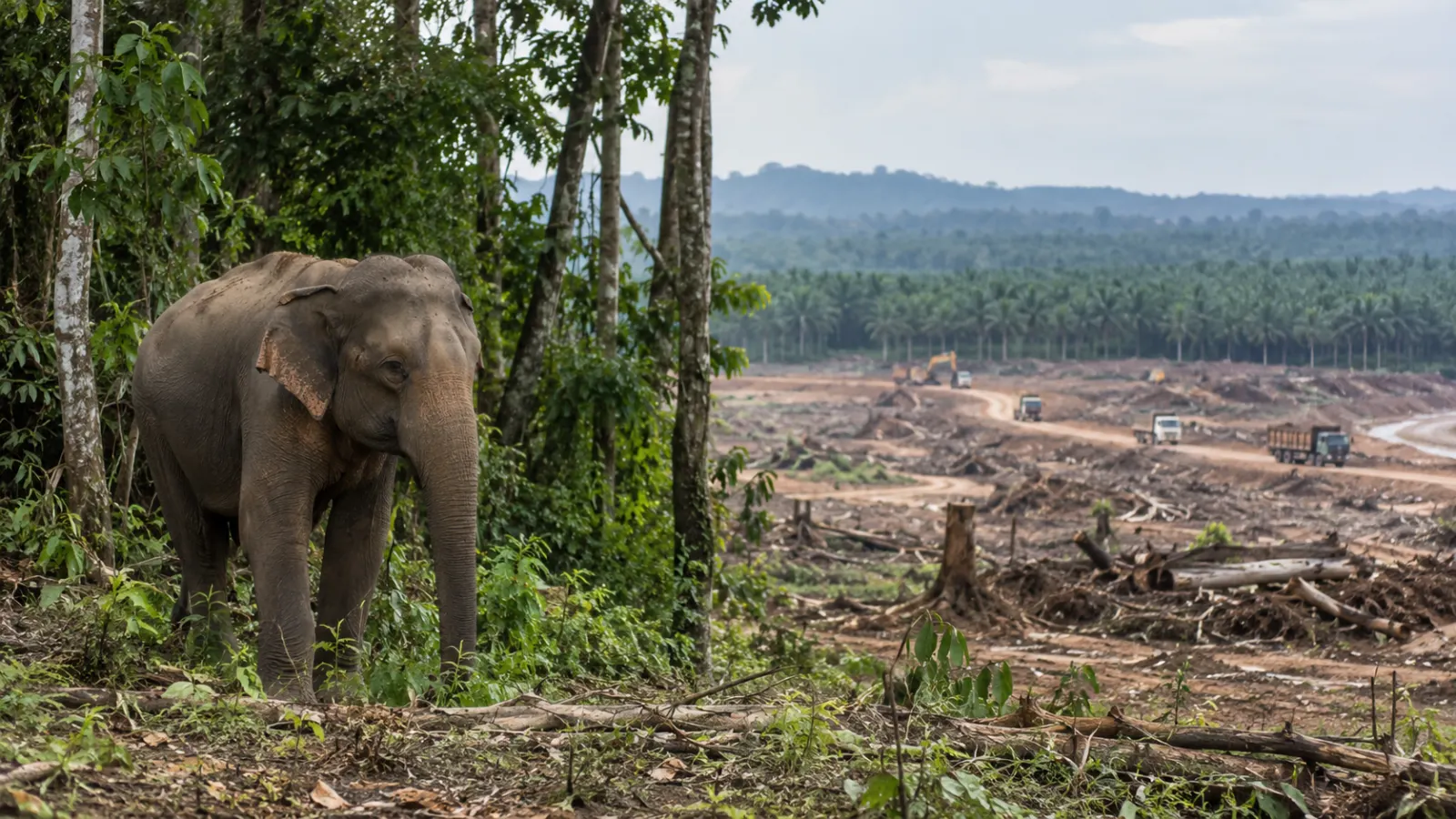
For many species, the most important pressure is habitat loss.
Forests can be converted to farms or cities. Wetlands can be drained. Rivers can be dammed or redirected. Grasslands can become roads, mines or industrial areas. Coastal habitat can disappear beneath construction.
The consequences extend beyond the physical disappearance of vegetation.
Animals need breeding sites, nesting areas, food, shelter, water and routes between seasonal habitats. Plants need suitable soils, pollinators, dispersal mechanisms and climatic conditions.
A species may therefore decline long before every hectare of habitat disappears.
Destroying a small but essential breeding area can matter more than losing a much larger area the species rarely uses. Blocking a migration route may disconnect feeding and breeding grounds. Removing old trees may eliminate nesting cavities even if younger forest remains.
USGS identifies habitat loss as the primary cause of elevated modern extinction rates, while IPBES ranks changes in land and sea use as the largest direct driver of biodiversity loss globally in terrestrial and freshwater environments.
Habitat should therefore be understood as a functional system, not simply an area coloured green on a map.
The important question is whether the remaining environment can still support reproduction and long-term survival.
Fragmentation can make remaining habitat far less useful
Habitat does not have to disappear completely to become less capable of supporting wildlife.
A formerly continuous forest may be divided by roads, farms and settlements. A river system can be interrupted by dams. Fences can block animal movement across grasslands.
This process is called habitat fragmentation.
A fragmented landscape may retain substantial habitat in total while functioning very differently ecologically.
Each patch may support fewer individuals. Populations can become isolated. Young animals may be unable to disperse into new territories. Migratory routes may break down. Individuals may need to cross roads or other dangerous environments to find mates.
IPBES treats changes in the spatial configuration of landscapes, including fragmentation, as an important component of land-use change affecting biodiversity.
Connectivity is particularly important when local populations occasionally disappear.
In a connected landscape, animals or seeds from neighbouring populations may recolonise an empty area.
When populations are isolated, a local extinction may become permanent.
Fragmentation can therefore reduce the ecological resilience of a species even before its total habitat area becomes critically small.
Overexploitation removes organisms faster than populations can replace them
Hunting, fishing, logging and harvesting are not inherently incompatible with conservation.
The decisive question is whether removal exceeds the population's ability to replace what has been lost.
A population remains viable only if reproduction and recruitment can compensate for mortality over time.
Species with slow growth, late maturity, long generation times or few offspring can be especially vulnerable. Removing a substantial number of breeding adults from such populations can create effects lasting decades.
Commercial value can intensify the pressure.
Rare animals may become more valuable as they become harder to find. High-value timber species may continue to be harvested even after populations decline. Fishing technologies can locate and remove organisms much more efficiently than traditional methods.
IPBES identifies direct exploitation of organisms as the second-largest direct global driver of biodiversity decline overall and the largest in marine ecosystems, where fishing is particularly important.
The biological effect depends on demography.
Removing 1,000 individuals from a rapidly reproducing insect population is completely different from removing 1,000 individuals from a whale population.
The number taken matters only in relation to how quickly the species can replace them.
Invasive species can introduce predators, competitors and diseases that native species never evolved to handle
Species naturally disperse, but human transport has allowed organisms to cross geographic barriers at unprecedented rates.
Ships, aircraft, trade, agriculture, ornamental plants and the movement of animals can introduce species into regions they could not easily reach on their own.
Most introduced species do not necessarily become major ecological threats.
Some, however, establish and spread rapidly enough to become invasive alien species, producing harmful impacts on native ecosystems and human societies.
IPBES identifies invasive alien species as one of the five major direct drivers of biodiversity loss. Its global assessment of biological invasions reports more than 37,000 recorded alien species worldwide, including more than 3,500 classified as invasive.
Island ecosystems can be particularly vulnerable.
Birds that evolved without mammalian predators may nest on or near the ground. Introducing rats, cats or other predators can suddenly expose eggs and chicks to a threat for which the species has little evolutionary defence.
Invasive plants can change fire regimes or displace native vegetation. Introduced pathogens can devastate species with little resistance. New competitors can take food or habitat.
The IPBES invasive-species assessment explicitly notes that biological invasions can contribute to both local and global extinction.
The problem is therefore not simply that a foreign organism has arrived.
It is what happens when that organism alters ecological relationships faster than native species can respond.
Pollution can leave habitat standing while making it unusable
Environmental destruction is sometimes obvious.
A forest is cut down. A wetland is filled. A river is dammed.
Pollution can be harder to see because the habitat may remain physically present.
Agricultural nutrients entering lakes or coastal waters can trigger algal growth and oxygen depletion. Pesticides can harm organisms they were never intended to target. Heavy metals and industrial chemicals can accumulate in tissues and food webs. Plastics can cause ingestion, entanglement or other injuries.
Pollution can therefore reduce survival or reproduction even when the landscape still appears intact.
IPBES includes pollution among the five largest direct drivers of biodiversity loss and notes substantial impacts from agricultural, industrial, mining and waste-related pollutants across freshwater, marine and terrestrial ecosystems.
This illustrates an important conservation principle:
habitat quantity and habitat quality are not the same thing.
A lake can still appear on a map while no longer supporting the organisms that historically depended on it.
Climate change moves the conditions species depend on
Every species exists within some range of environmental conditions.
Temperature, rainfall, snow cover, ocean chemistry, fire frequency, seasonal timing and water availability influence where organisms can survive and reproduce.
Climate change alters those conditions.
In some cases, suitable climatic zones shift toward the poles or higher elevations. Species capable of dispersing may follow them.
Others cannot.
A mountain species already living near the summit cannot continue moving upward indefinitely. A coral cannot relocate quickly enough to escape repeated marine heatwaves. A plant population surrounded by farmland or urban development may be unable to migrate even if suitable climate appears farther north.
Climate change can also magnify existing pressures.
A fragmented population has fewer pathways through which to shift its range. A wetland already degraded by pollution may tolerate drought poorly. A species reduced by hunting may have too few individuals to recover after an extreme weather event.
IPBES currently ranks climate change among the five major direct drivers of biodiversity decline and expects its relative importance to increase as warming continues.
The interaction is crucial.
Climate change often does not act on an untouched population.
It acts on species already coping with habitat loss, exploitation, pollution or invasive organisms.
Disease can become decisive when populations are already vulnerable
Pathogens are part of natural ecosystems, but disease can become a major extinction pressure under particular conditions.
Human transport can move pathogens across geographic barriers. Environmental change can alter transmission. Dense or stressed populations may become more vulnerable.
The consequences can be especially serious when a population is already small.
A large population can lose many individuals and still retain enough survivors to reproduce. A small population has less biological margin for error.
Genetic diversity matters too. When populations shrink or become isolated, they may lose genetic variants that could help some individuals survive a particular disease.
Disease therefore often operates as part of a chain.
Habitat loss reduces population size. Fragmentation limits genetic exchange. A novel pathogen arrives. The remaining population lacks enough resistant individuals to recover.
USGS includes disease among the recognised causes contributing to modern species endangerment.
The final cause may appear to be infection.
The deeper cause may be decades of declining resilience.
Small populations can enter an extinction spiral
Once a population becomes sufficiently small, threats arise that were less important when it was abundant.
Randomness itself becomes dangerous.
A large population may absorb a bad breeding season without long-term consequences. In a population of twenty animals, the same event may remove much of an entire generation.
Sex ratios can become skewed by chance. Individuals may struggle to locate mates. Genetic diversity can decline. Inbreeding can increase the probability that harmful genetic variants are expressed.
Low population density can also reduce reproductive success through what ecologists describe as Allee effects. Some organisms reproduce, hunt, defend themselves or modify habitat more successfully when enough individuals are present.
These mechanisms can reinforce one another.
Lower population → fewer breeding opportunities → reduced reproduction → even lower population.
This is why conservation becomes more difficult as a species approaches extinction.
The IUCN Red List specifically incorporates population size, decline and geographic restriction into extinction-risk assessments rather than relying on a simple census of surviving individuals.
A species can therefore become biologically endangered before its numbers appear spectacularly low.
Life history determines whether recovery takes months or decades
Species do not replace losses at the same rate.
Some insects mature quickly and produce several generations in one year. If habitat improves, their populations may recover rapidly.
Large mammals often follow a very different demographic strategy.
They may take years to reach maturity, produce only one young at a time and invest substantial resources in parental care. Even after hunting or habitat loss stops, rebuilding a severely depleted population can take decades.
Long-lived plants create another variation.
Adult trees may survive for decades while young plants disappear. The forest may therefore look healthy even when regeneration has effectively stopped.
Conservationists need to understand these demographic differences because identical mortality can produce dramatically different consequences.
A level of hunting that one fast-reproducing species can sustain may drive another steadily toward extinction.
Generation length, reproductive output, age at maturity and adult survival are therefore fundamental to extinction risk.
Specialists can have fewer alternatives when environments change
Species also differ in ecological flexibility.
A generalist may eat many foods, use several habitats or breed under a broad range of environmental conditions.
A specialist may depend on one plant, one prey species, one pollinator, one nesting habitat or a narrow climatic zone.
Specialisation can be highly successful while the required conditions remain stable.
It becomes dangerous when the key resource disappears.
A plant dependent on one pollinator becomes vulnerable if that insect declines. A frog restricted to one mountain climate has nowhere else to go if the suitable temperature zone shifts beyond the summit. A turtle nesting on a limited number of beaches may be disproportionately affected when those beaches are developed or altered.
Specialisation alone does not doom a species.
Many specialists persist for millions of years.
It acts instead as a vulnerability factor that can amplify environmental disruption.
Different species can disappear together
Species do not live independently.
They form ecological networks.
A parasite depends on its host. A flowering plant may rely on a pollinator. A predator depends on prey. Seeds may be dispersed by a particular animal.
When one species disappears, another can therefore become endangered even if the original pressure did not affect it directly.
This phenomenon is known as coextinction.
The risk can be especially high in highly specialised relationships. A parasite found only on one host has no future if the host becomes extinct unless it can shift to another species.
Coextinction is difficult to measure globally because scientists have not documented every ecological interaction.
That uncertainty itself is important.
Known extinction numbers may not capture all the secondary losses initiated when ecological networks unravel.
Biodiversity is not simply a collection of independent species.
It is also the relationships among them.
Extinction can occur long after the original damage
Environmental destruction and extinction do not always happen at the same time.
Imagine a long-lived tree species whose forest has been reduced to small isolated fragments. Mature trees may survive for another century.
To an observer, the species still appears present.
But perhaps seedlings no longer survive, pollinators have disappeared and the fragments are too isolated for genetic exchange.
The population may already be on a trajectory toward disappearance even though the final adults will live for decades.
Ecologists describe this delayed response as extinction debt.
Time lags are well recognised in biodiversity science. IPBES notes that direct drivers can have prolonged and delayed ecological consequences, meaning present biodiversity can partly reflect environmental conditions that no longer exist.
This creates a difficult problem for conservation.
Visible survival can produce false reassurance.
Counting remaining organisms is not enough. Conservationists also need to know whether those organisms are breeding successfully and whether the environment can sustain future generations.
Multiple pressures are usually more dangerous than one pressure alone
Real ecosystems rarely experience one disturbance at a time.
Habitat destruction may concentrate wildlife into smaller areas. Greater density can increase disease transmission or competition.
Climate change can intensify drought within already degraded habitat.
Overexploitation can reduce a population until an invasive predator or severe storm becomes disproportionately important.
Pollution can weaken organisms already stressed by warming.
IPBES explicitly warns that the compounding effects of land-use change, climate change, exploitation, pollution and invasive species can intensify biodiversity decline.
This helps explain why assigning one cause to an extinction can be misleading.
The final event may have been a cyclone.
But why did the cyclone destroy the population?
Perhaps there were only fifty individuals remaining because most habitat had already disappeared.
The cyclone was the trigger.
The extinction process began much earlier.
Conservation works best before a species reaches the last few individuals
The dramatic image of extinction is the last surviving animal.
By that point, conservation has become extraordinarily difficult.
The population may contain little genetic diversity. Suitable habitat may be fragmented. Breeding partners may be difficult to find. The remaining animals may require intensive protection or captive breeding.
The most effective conservation generally occurs earlier.
Protect habitat before most of it disappears.
Maintain ecological corridors before populations become isolated.
Manage fishing and hunting before abundance collapses.
Prevent invasive species from establishing where possible.
Reduce pollution before reproduction fails.
Protect climate refuges and restore degraded ecosystems.
For critically depleted populations, captive breeding, genetic management, assisted reproduction or reintroduction may sometimes be necessary.
But those techniques cannot permanently substitute for an environment capable of sustaining the species.
A breeding programme can produce animals.
It cannot make a vanished forest reappear.
Extinction risk is ultimately about whether a population remains viable
The IUCN Red List exists because extinction risk cannot be understood from one number.
Its categories range from Least Concern through Vulnerable, Endangered and Critically Endangered to Extinct in the Wild and Extinct. Assessments consider population trends, range, population size and quantitative extinction probability rather than simply asking how many individuals remain today.
That framework reflects the biology of extinction.
A population must continually replace individuals that die.
Young organisms must survive long enough to reproduce. Breeding individuals must find one another. Habitats must continue supplying food and shelter. Populations need enough range and connectivity to survive ordinary environmental variation.
Extinction becomes increasingly likely when births, survival and movement can no longer compensate for mortality and environmental change.
The last individual therefore represents the end of the process, not its beginning.
The original draft captures this well: a species can be losing populations, range, connectivity and recovery capacity long before it disappears globally.
This is also why extinction prevention is fundamentally about preserving ecological options.
Enough habitat.
Enough individuals.
Enough genetic diversity.
Enough connectivity.
Enough reproductive success.
Enough room to move as environments change.
The modern extinction crisis is driven largely by human alteration of these conditions. IPBES identifies land- and sea-use change, exploitation, climate change, pollution and invasive alien species as the dominant direct global pressures, while USGS similarly identifies habitat loss and several related human-driven pressures behind contemporary endangerment.
Species rarely vanish simply because the final individual dies.
They vanish because, somewhere earlier in the chain, the population lost enough of the conditions that made another generation possible.