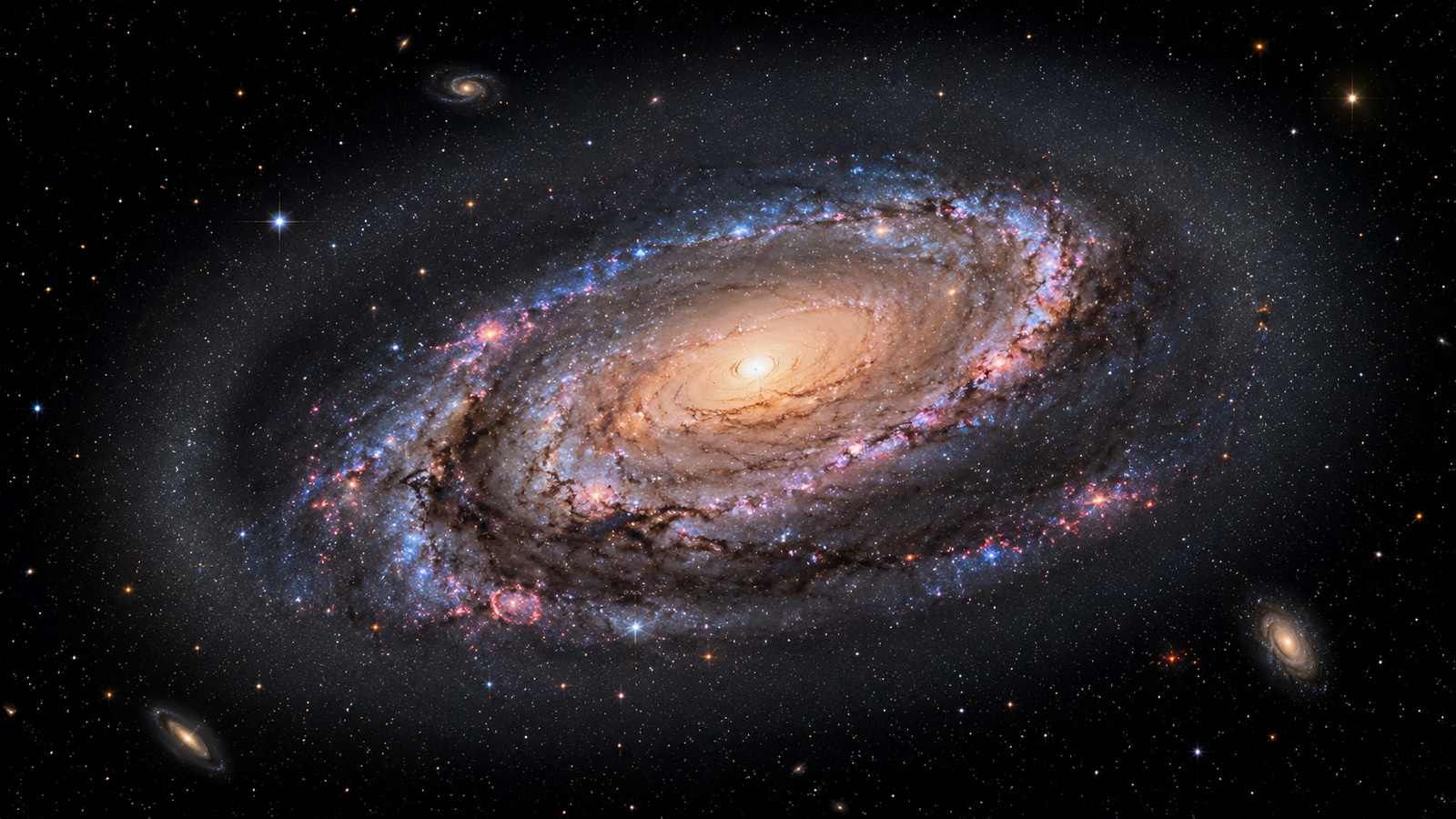
A galaxy is often imagined as a glittering island of stars. That image is beautiful, but incomplete. Galaxies are not only made of visible stars. They contain gas, dust, planets, stellar remnants, magnetic fields, black holes and large amounts of unseen mass inferred through gravity. A galaxy is not a static picture. It is a living gravitational system where material circulates, stars are born, stars die and structures evolve over billions of years.
Stars: The Brightest Component
Stars are the most visible part of most galaxies. In a spiral galaxy, bright young stars may trace graceful arms, while older stars gather in the central bulge and halo. In elliptical galaxies, older reddish stars dominate the smooth glow. Stars make galaxies visible across cosmic distances because they emit light. But brightness should not be confused with total importance. Stars are only one part of the galactic system.
Gas: The Raw Material of New Stars
Gas is crucial because it is the fuel from which new stars form. Much of this gas is hydrogen, sometimes mixed with helium and heavier elements created by earlier generations of stars. When gas clouds become cold and dense enough, gravity can pull regions inward and form new stars. Galaxies rich in cold gas can have active star-forming regions. Galaxies with little available gas may form fewer new stars and appear older and redder.
Dust: Small Grains With Big Effects
Cosmic dust is made of tiny solid particles, including carbon-rich and silicate materials. Though dust may sound insignificant, it shapes what telescopes see. Dust absorbs and scatters visible light, creating dark lanes in galaxies and hiding star-forming regions. At infrared wavelengths, dust can glow, revealing hidden nurseries of stars. Dust also contributes to the chemistry that eventually helps form planets and complex molecules.
Planets, Moons and Smaller Bodies
Where there are stars, there may also be planets, moons, asteroids, comets and debris disks. These objects are too small and faint to account for a galaxy’s main glow, but they matter because they are the places where complex environments can develop. The Milky Way alone contains enormous numbers of stars, and exoplanet discoveries suggest planets are common. A galaxy is therefore not only a star system; it is a vast collection of planetary possibilities.
Black Holes and Galactic Centres
Many large galaxies are thought to contain supermassive black holes at their centres. These objects can have millions or billions of times the mass of the Sun. When gas falls toward them, it can heat up and release tremendous energy, producing active galactic nuclei or quasars. Even when quiet, central black holes influence the story of galaxies. Their growth and feedback may affect star formation and the evolution of galactic centres.
Dark Matter Halos
A major part of the modern galaxy picture is dark matter. Galaxies rotate in ways suggesting that visible stars and gas do not provide enough gravity. Astronomers therefore infer that galaxies sit inside extended halos of dark matter. This invisible mass does not shine like stars, but its gravity helps shape galactic structure and motion. If a galaxy were judged only by what glows, we would miss much of its mass story.
Different Shapes, Different Histories
Galaxies come in different forms: spirals, ellipticals, irregulars and many transitional types. Their shapes reflect formation history, collisions, mergers, gas content and star formation. Spiral arms are not fixed solid arms but patterns where stars and gas move through changing density waves. Elliptical galaxies may be the result of mergers and often contain older stars. Irregular galaxies show that cosmic structure can be messy, especially after gravitational interactions.
Final Takeaway
Galaxies are made of far more than stars. They are gravitational ecosystems containing luminous stars, star-forming gas, light-blocking dust, planets, stellar remnants, central black holes and invisible dark matter. Their visible beauty is only the surface. To understand a galaxy, we must see it as a layered system where ordinary matter and unseen gravity interact across immense distances and deep time.