The Window Is Not the Whole Planet
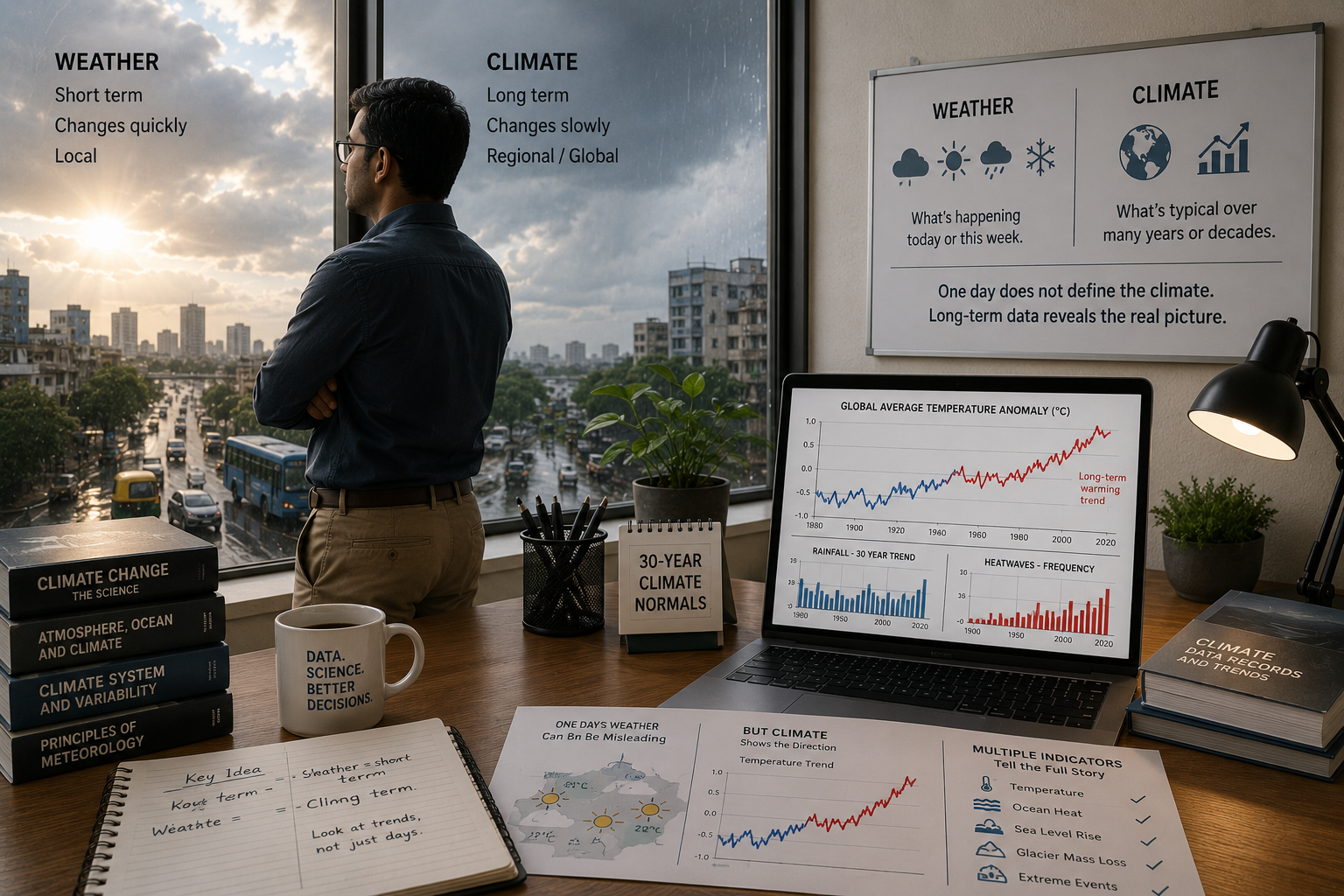
The easiest way to confuse the climate debate is to look out of the window and treat today as proof of everything. A hot afternoon can make global warming feel obvious. A cold morning can make people ask whether the planet is warming at all. Both reactions are understandable, and both miss the central distinction. Weather is what the atmosphere is doing around us now. Climate is the larger pattern that emerges when thousands of weather events are measured, averaged, compared and studied over long periods.
This difference sounds simple, but it is one of the most important ideas in environmental literacy. Without it, every storm becomes an argument, every cold spell becomes a contradiction, and every heatwave becomes a slogan. With it, climate science becomes clearer. We can understand how a city may have unusually heavy rain in one week while the region is still becoming drier over decades. We can understand how one winter can feel harsh while the global average temperature keeps rising. We can also understand why climate change is not a claim about every single day becoming warmer, but a claim about the shifting baseline of the whole system.
Weather refers to short-term atmospheric conditions. It includes temperature, rainfall, humidity, wind speed, cloud cover, air pressure, storms, fog, hail and other immediate conditions. It changes quickly. A morning can begin clear, become humid by afternoon, and turn stormy by evening. Weather can be local: one side of a city may receive rain while another remains dry. A weather forecast therefore deals with the near future - today, tomorrow, the coming week, or sometimes the coming season in broad probability terms.
The Core Difference
Climate refers to the long-term pattern of weather in a place or across the planet. It is built from averages, ranges, frequencies and extremes. When we say a desert climate is dry, we do not mean it never rains there. We mean that, over many years, rainfall is low compared with other regions. When we say a coastal city has a humid climate, we do not mean every day is humid. We mean humidity is a recurring feature of the long-term pattern. Climate is therefore not one event. It is the statistical personality of a place.
The most practical difference is timescale. Weather is measured in minutes, hours, days and weeks. Climate is measured across decades. Meteorological agencies often use 30-year climate normals to describe typical conditions, because a single year is too noisy and a decade may still be shaped by temporary natural variation. A 30-year average smooths out many short-term fluctuations and gives a more stable baseline against which today’s weather can be compared. That is why a forecast may say tomorrow will be warmer than normal. The word normal does not mean morally correct or permanent. It means compared with the long-term reference period.
A useful analogy is the difference between a person’s mood and personality. A person can be cheerful one day and irritated the next; that is mood. Over months and years, we may notice that the person is generally calm, impatient, optimistic or reserved; that is closer to personality. Weather is the mood of the atmosphere. Climate is its long-term personality. The analogy is imperfect, but it helps explain why one day does not overturn the long-term picture.
This distinction matters because climate change is detected through trends, not through isolated events. Scientists do not claim that every day must be hotter than every earlier day. They look at global and regional temperature records, ocean heat content, glacier mass, sea level, rainfall patterns, snow cover, heatwave frequency, drought risk and many other indicators. When multiple independent indicators move in a consistent direction over decades, the evidence becomes much stronger than any one event could provide.
Why One Cold Day Does Not Disprove Warming
The confusion becomes especially visible during winter. Someone may say, If the climate is warming, why is it cold today? The answer is that a warming climate does not abolish winter, cold fronts or natural variability. It changes the probability distribution. Imagine rolling dice that have been slightly weighted. You can still roll low numbers, but high numbers become more common. In a warming world, cold days can still occur, but record heat, warmer nights, earlier springs and more intense heatwaves become more likely in many regions. The signal appears in the pattern, not necessarily in every single observation.
The reverse confusion also happens. A single heatwave should not be used carelessly as proof of climate change by itself. Heatwaves happened before industrial emissions rose sharply. What climate science asks is a more precise question: has human-caused warming changed the probability, intensity, duration or geography of such events? Event attribution studies use climate models and observations to estimate whether a particular kind of extreme event has become more likely or more severe in the present climate compared with a world without the same level of human greenhouse gas emissions. This is more careful than saying every hot day is climate change.
Weather and climate also operate at different spatial scales. Weather is often intensely local. A thunderstorm may form over a small area because of local humidity, wind patterns and surface heating. Climate can be local too, but it is often discussed regionally or globally. The climate of the Himalayas differs from the climate of coastal Tamil Nadu; the climate of the Indian monsoon region differs from the climate of the Sahara. Global climate refers to the integrated condition of Earth’s atmosphere, ocean, land, ice and living systems.
This spatial difference is why climate change does not look identical everywhere. The planet as a whole is warming, but some regions warm faster than others. Land areas often warm faster than oceans. The Arctic has warmed especially rapidly. Rainfall patterns do not simply increase uniformly; some places become wetter, some drier, and many experience heavier downpours separated by longer dry spells. Local weather remains variable, but the larger background conditions change.
Another common misunderstanding is the difference between climate variability and climate change. Climate variability refers to natural fluctuations that occur within the climate system. El Nino and La Nina, volcanic eruptions, solar variation and ocean circulation patterns can influence weather and climate from year to year. Climate change refers to a persistent shift in the long-term state of the system. Natural variability can temporarily speed up, slow down or mask the warming trend, but it does not erase the underlying influence of rising greenhouse gas concentrations.
Forecasts, Projections and Public Policy
The greenhouse effect helps explain why climate can change while weather remains variable. Earth receives energy from the sun and emits heat back toward space. Greenhouse gases in the atmosphere absorb and re-emit some of that outgoing heat. This natural greenhouse effect keeps Earth warm enough for life. Human activities, especially burning coal, oil and gas, have increased concentrations of carbon dioxide, methane and other greenhouse gases. This strengthens the heat-trapping effect and shifts the planet’s energy balance. The result is not a uniform warming of every day, but a broad warming of the climate system.
Weather forecasting and climate projection also use different methods, even though both rely on observations, physics and models. Weather forecasts are highly sensitive to initial conditions. Small differences in the starting state of the atmosphere can produce large differences after several days. That is why forecasts become less reliable as they extend farther into the future. Climate projections do not try to predict the exact weather on a specific day in 2050. They estimate how average conditions and risk patterns may change under different greenhouse gas emission pathways. It is similar to how we cannot predict the exact age at which one person will fall ill, but we can estimate how smoking changes disease risk across a population.
This distinction is useful for public policy. A city government needs weather forecasts to manage immediate risks such as storms, floods, heat alerts and air-quality warnings. It needs climate information to design drainage systems, zoning rules, water storage, crop planning, public health systems and disaster resilience. If rainfall extremes are becoming more intense, a drain designed for the past climate may fail more often in the future. If heatwaves are becoming more frequent, hospitals, schools and workplaces need adaptation plans. Weather tells us what to prepare for this week. Climate tells us what kind of future we are building infrastructure for.
Agriculture provides a simple example. A farmer cares deeply about tomorrow’s weather because sowing, irrigation, pesticide spraying and harvesting often depend on immediate conditions. But crop choice, water investment and long-term soil planning depend on climate. If a region’s rainfall season becomes less reliable, a farmer may need drought-resistant varieties, improved water harvesting or different cropping patterns. Weather affects the day’s decisions. Climate shapes the strategy.
Insurance is another example. An insurer cannot price risk by looking at one storm alone. It studies long-term records of floods, cyclones, fires and heat-related damage. If climate change shifts the frequency or severity of extreme events, insurance models must change. The same applies to urban planning, energy demand and public health. Heat increases electricity demand for cooling. Changing rainfall affects hydropower and water supply. More intense storms affect housing and transport. These are climate questions because they concern long-term risk.
How to Read Climate Claims Carefully
The media often blurs the difference between weather and climate because weather is dramatic and immediate, while climate is gradual and statistical. A flooded street is easier to photograph than a 30-year rainfall trend. A heatwave headline is easier to understand than a probability distribution. Good climate communication must therefore connect the visible event to the underlying pattern without overstating the connection. It should say: this event is weather, but it may be consistent with a changing climate, and scientists can study whether climate change made events like this more likely.
The distinction also protects public debate from bad-faith arguments. Climate denial often uses local weather as a distraction: it is snowing here, therefore global warming is false. But local snow is not a global climate trend. On the other side, careless climate advocacy may use every disaster as definitive proof without explaining evidence. A scientifically sound discussion avoids both errors. It separates event, trend, mechanism and attribution.
For students, the simplest way to remember the difference is this: weather is the condition; climate is the pattern. Weather asks, What is happening now? Climate asks, What usually happens, how often, and how is that changing? Weather can be felt directly on the skin. Climate has to be measured through records. Weather changes quickly. Climate changes slowly, but once it shifts, the consequences can last for generations.
The difference between weather and climate is not a minor vocabulary issue. It is the gateway to understanding global warming, extreme events, climate adaptation and environmental decision-making. When we confuse the two, we turn science into argument by anecdote. When we separate them clearly, we can see the real picture: daily weather will always vary, but the long-term climate system is now being altered by human activities. The question is not whether tomorrow will be hot or cold. The question is what kind of baseline tomorrow’s weather will be occurring against.
In that sense, weather is the story we experience day by day, while climate is the book being written over decades. One chapter may look surprising, but the plot is visible only when enough pages are read together. The climate challenge requires that longer view. It asks societies to look beyond the window, beyond the season, and beyond the temporary comfort of isolated examples. It asks us to read the pattern.
This long-term view is especially important for countries with monsoons, mountains, deserts and long coastlines. India, for example, experiences local weather through heatwaves, fog, cyclones, thunderstorms, dust storms and monsoon bursts, but its climate questions involve larger patterns: the reliability of seasonal rainfall, the warming of nights, the intensity of extreme rain, the stress on glaciers and the rising risk to coastal settlements. Citizens may experience climate change through weather, but scientists understand it through records. That is why climate literacy begins with patience: do not treat one day as the verdict, and do not ignore decades because one day feels normal.
Key Takeaways
Weather is short-term atmospheric condition; climate is long-term pattern and probability.
A cold day or a single heatwave does not settle the climate question by itself.
Climate change is detected through long-term trends across many indicators.
Weather forecasting predicts near-term conditions; climate projection studies future risk patterns.