The speed of light is one of the most famous numbers in science, but its importance is not only that light is fast. It is that the speed of light in vacuum is woven into the structure of physics. It links space and time, defines modern measurement, sets a limit for information and makes astronomy a record of the past. To understand light speed is to understand why the universe cannot be treated as if signals move instantly.
How Fast Is Light
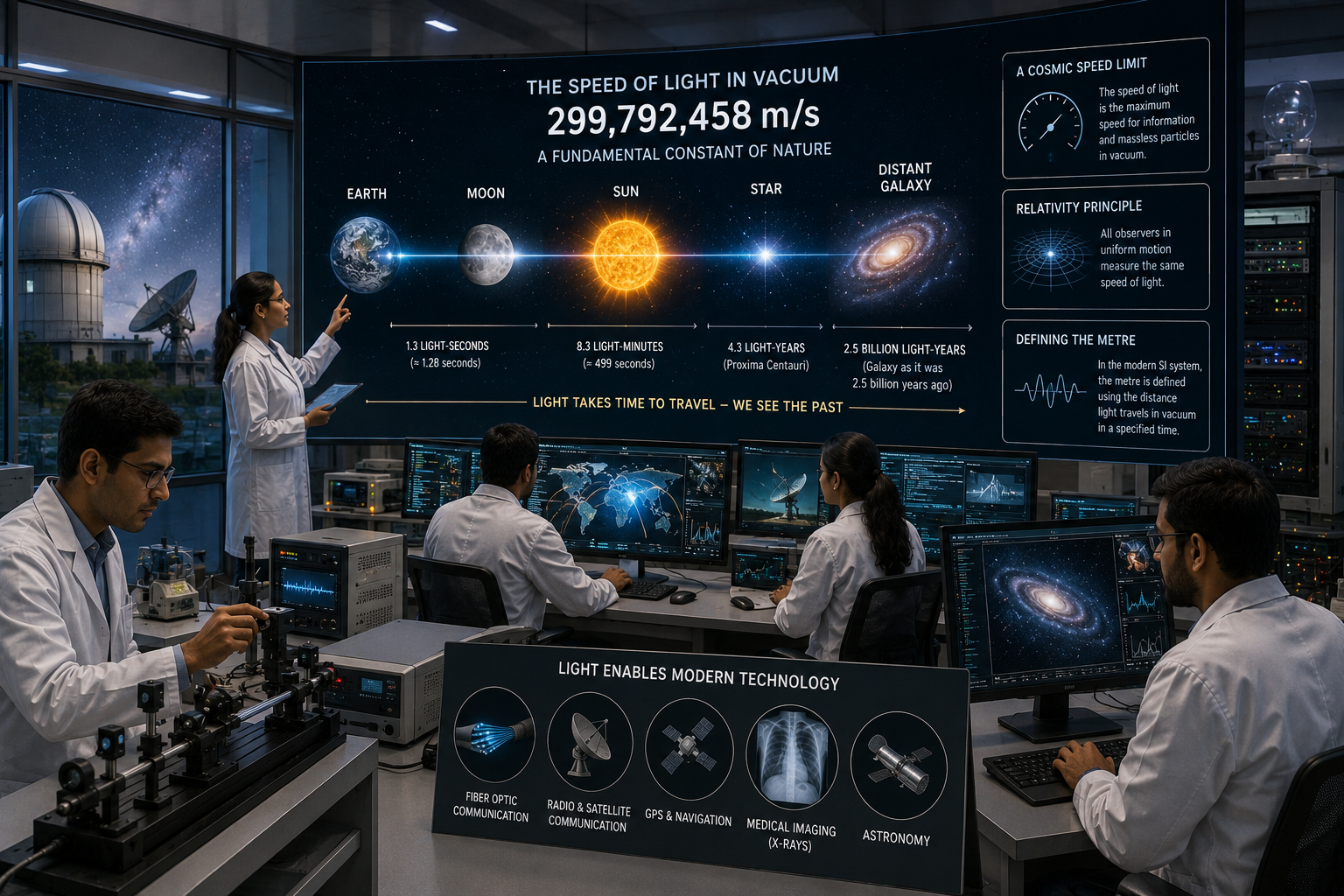
In vacuum, light travels at exactly 299,792,458 metres per second. That is about three hundred thousand kilometres per second. At this speed, light can travel around Earth several times in a single second. Moonlight reflected from the Moon reaches Earth in a little over a second. Sunlight takes several minutes to travel from the Sun to Earth. These comparisons show both sides of the number: light is extraordinarily fast locally, yet cosmic distances are so large that light still takes meaningful time to cross them.
Why Scientists Say In Vacuum
The phrase in vacuum matters. Light travels at its maximum speed in empty space. When it moves through glass, water or air, its effective speed is lower because it interacts with the material. This slowing is connected with refraction, the bending of light at boundaries between materials. The fundamental constant used in relativity and measurement is not the speed of light through glass or fibre, but the speed of light in vacuum.
The Speed of Light as a Constant
In everyday life, speeds add in ordinary ways. If a person throws a ball from a moving train, an outside observer combines the trains speed and the balls speed. Light does not behave that way. Special relativity states that observers moving at constant speed relative to one another still measure the same vacuum speed of light. This strange fact forces space and time to adjust. Time dilation and length contraction are not optional add-ons; they follow from the constancy of light speed.
A Cosmic Speed Limit
The speed of light is often called the cosmic speed limit. More precisely, it is the maximum speed at which massless particles and information can travel through vacuum. Objects with mass cannot be accelerated to light speed because doing so would require increasing energy without limit. This does not mean science forbids imagination about warp drives or wormholes, but within established physics, ordinary motion through space cannot carry a massive object faster than light.
Light Speed and Astronomy
Because light speed is finite, looking far away means looking into the past. The Sun is seen as it was minutes ago. Nearby stars are seen as they were years ago. Distant galaxies are seen as they were millions or billions of years ago. This delay is not a weakness of telescopes; it is a feature of the universe. Light carries historical information. The deeper astronomers look into space, the further back in cosmic time they can observe.
Light Speed in Technology
Modern communication systems also face the limit of light speed. Signals through fibre-optic cables and radio links are fast but not instantaneous. Financial networks, satellite communication, deep-space missions and global internet routing all deal with signal delay. For a spacecraft near Mars, commands can take minutes to arrive depending on planetary positions. Light speed therefore matters not only to physics textbooks but also to engineering decisions about timing, control and communication.
Measurement and the Metre
The speed of light is so central that it helps define the metre. In the modern SI system, the metre is defined using the distance light travels in vacuum during a specified fraction of a second. This reverses the older intuition that we first define distance and then measure light speed. Today, the fixed value of light speed supports precise measurement across science and technology. A cosmic constant becomes a practical tool for metrology.
Final Takeaway
The speed of light is not merely a record for fast movement. It is a fundamental constant that connects distance, time, information and causality. It explains why distant astronomy sees the past, why relativity changes our ideas of time and space, and why signals across the universe are never instantaneous. Light is fast enough to shape everyday technology and finite enough to reveal cosmic history.