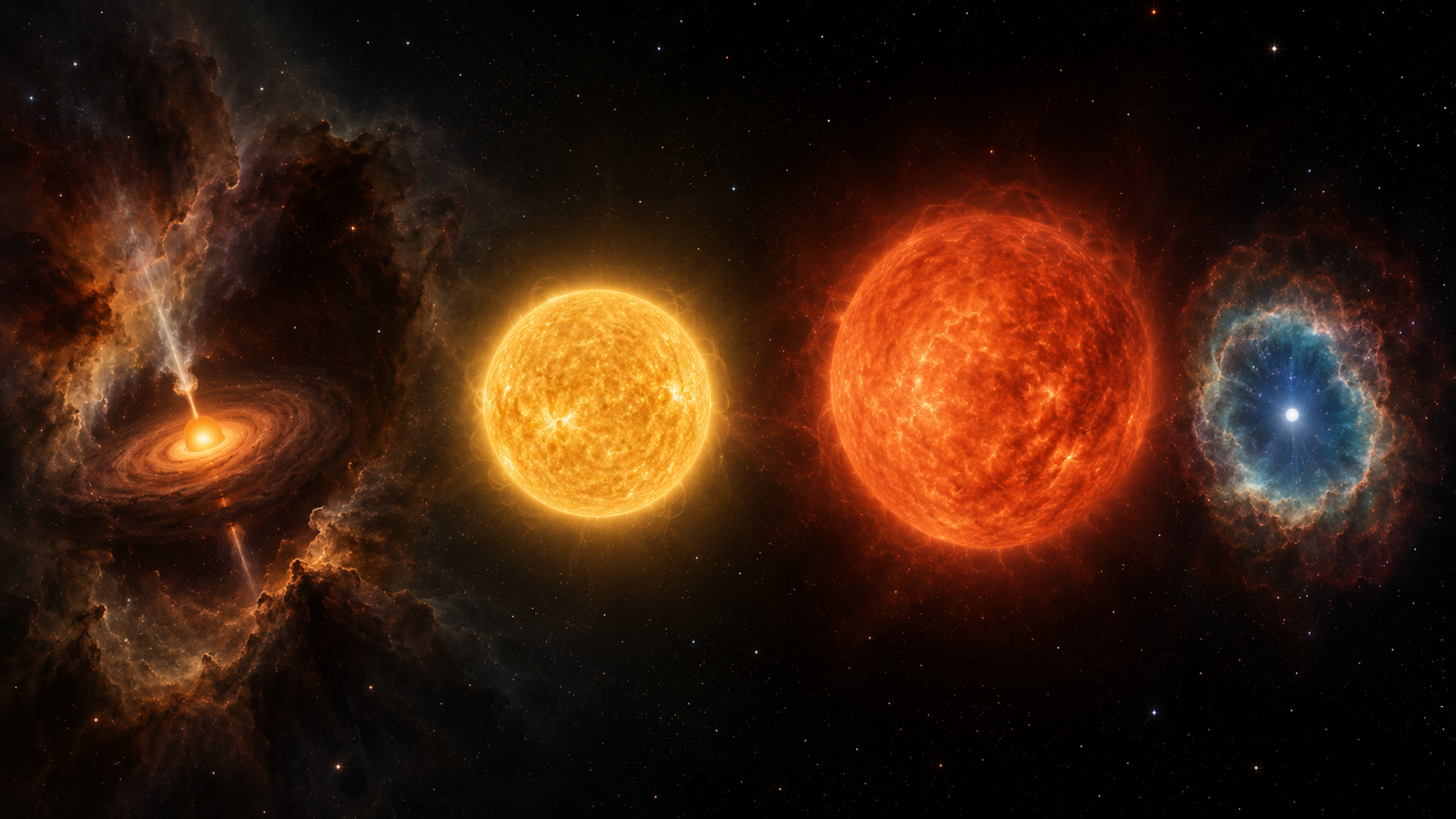
The Sun feels permanent because every human civilisation has lived beneath it. It rises, sets, warms the planet and anchors the solar system. Yet the Sun is not eternal in its current form. It is a star with a beginning, a middle age and a future ending. Understanding the Sun’s life cycle turns daylight into a cosmic story about gravity, fusion and time.
How the Sun Was Born
The Sun formed about 4.6 billion years ago from a cloud of gas and dust in space. Gravity pulled material inward, creating a dense central region surrounded by a rotating disk. As the centre became hotter and denser, it eventually reached conditions where hydrogen fusion could begin. The young Sun ignited as a star, while leftover material in the surrounding disk formed planets, moons, asteroids and other bodies of the solar system.
Why the Sun Shines Today
The Sun shines because of nuclear fusion in its core. Hydrogen nuclei combine to form helium, releasing energy. That energy gradually makes its way outward through the Sun’s interior and eventually escapes as sunlight and heat. The Sun’s gravity tries to compress it inward, while pressure from the hot interior pushes outward. The present Sun is stable because these forces are balanced.
The Main-Sequence Stage
The Sun is now in the main-sequence stage, the long middle phase of a star’s life when hydrogen fusion in the core is the main source of energy. This stage lasts billions of years. The Sun is already about halfway through its main-sequence lifetime. It changes slowly, so slowly that human history cannot easily notice the difference, but over astronomical time its brightness and internal structure evolve.
The Solar Cycle Is Different From the Life Cycle
The Sun also has a shorter activity cycle, often discussed as the solar cycle. This cycle is linked to changes in the Sun’s magnetic field and includes periods of higher and lower activity, with more or fewer sunspots and solar storms. This is not the same as the Sun’s life cycle. The solar cycle happens over roughly years; stellar evolution happens over billions of years. Both matter, but they describe different kinds of change.
What Happens When Core Hydrogen Runs Low
In the far future, the Sun will use up much of the hydrogen available for fusion in its core. The core will contract and heat, while fusion will continue in a shell around it. The outer layers will expand enormously and cool at the surface, turning the Sun into a red giant. This phase will radically transform the inner solar system and make Earth uninhabitable long before the Sun’s final remnant stage.
The Red Giant Future
As a red giant, the Sun will be much larger than it is today. Its outer layers will extend far outward, and its surface will be cooler and redder even though its total energy output may be much greater. The details of how the Sun’s expansion will affect specific inner planets are complex, but the larger point is clear: the solar system will not remain as it is now. The Sun’s stable present is temporary on cosmic timescales.
From Planetary Nebula to White Dwarf
After the red giant stage, the Sun will shed its outer layers into space. These expanding layers may form a planetary nebula, a glowing shell of gas around the exposed core. The remaining core will become a white dwarf: hot, dense and Earth-sized, but no longer powered by ordinary hydrogen fusion. Over vast stretches of time, it will cool slowly.
Final Takeaway
The Sun’s life cycle is the life cycle of a Sun-like star. It was born from a collapsing cloud of gas and dust, entered a long stable phase powered by hydrogen fusion, and will eventually expand into a red giant before becoming a white dwarf. The Sun feels constant because human lives are short. Astronomy reveals the larger truth: even the star that makes life possible is part of a changing cosmic process.