The greenhouse effect is one of the most important ideas in climate science, yet it is often misunderstood. Many people hear the term and imagine something artificial, dangerous or optional. In reality, the greenhouse effect is a natural process that makes life on Earth possible. Without it, our planet would be far colder and far less suitable for humans, animals, plants and the ecosystems that support them. The climate problem begins not because the greenhouse effect exists, but because human activity has made it stronger.
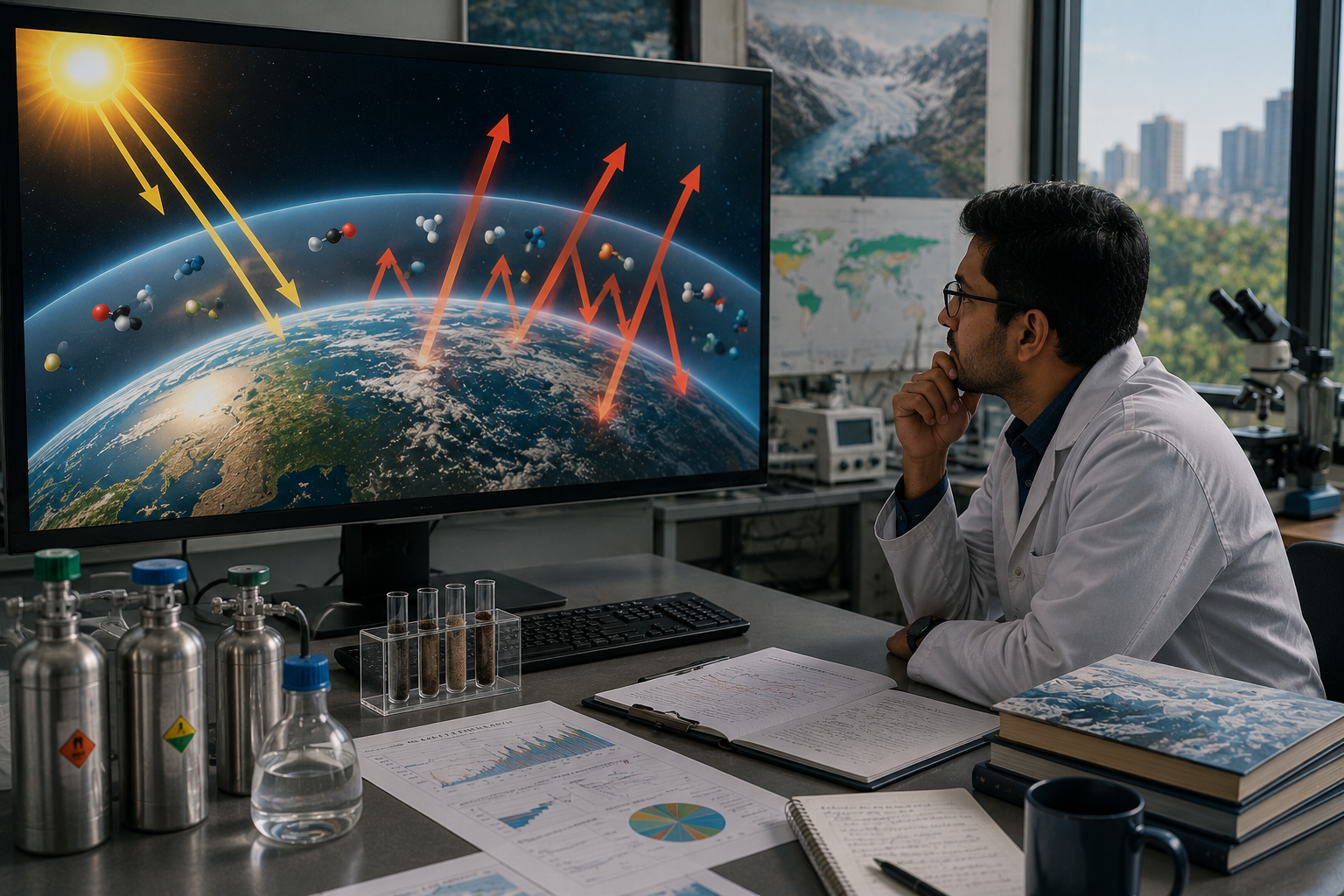
The simplest way to understand the greenhouse effect is to think of Earth’s atmosphere as a selective layer around the planet. Sunlight arrives from the Sun mostly as shortwave radiation. Much of it passes through the atmosphere and reaches Earth’s surface. Land, water, forests, buildings, soil and ice absorb energy from this sunlight. After absorbing energy, the surface warms and releases energy back upward as infrared heat. Some of that heat escapes to space. Some of it is absorbed by greenhouse gases and emitted again in different directions, including back toward the surface. This slows the escape of heat and keeps the lower atmosphere warmer than it would otherwise be.
This is not a theory invented for politics. It is basic physics. Certain gases interact strongly with infrared radiation because of their molecular structure. Carbon dioxide, methane, nitrous oxide, ozone, water vapour and some industrial gases can absorb and emit infrared energy. Nitrogen and oxygen, which make up most of the atmosphere, do not have the same heat-trapping effect in the same way. That is why gases present in relatively small quantities can have a large influence on climate. In climate, importance is not only about volume; it is about radiative behaviour.
A common analogy compares greenhouse gases to a blanket. The analogy is useful, but it must be used carefully. A blanket does not create heat by itself; it slows the loss of body heat. Similarly, greenhouse gases do not create sunlight. They slow the loss of heat from Earth to space. If the blanket becomes thicker, more heat is retained. The planet then warms until a new balance is reached between incoming energy and outgoing energy. Human activities have effectively thickened the atmospheric blanket by adding more heat-trapping gases.
NASA explains that the greenhouse effect is the process through which heat is trapped near Earth’s surface by greenhouse gases, and that these gases include carbon dioxide, methane, ozone, nitrous oxide, chlorofluorocarbons and water vapour. NASA also notes that Earth’s natural greenhouse effect helps maintain a life-supporting average temperature, while the buildup of additional greenhouse gases disrupts the planet’s energy balance.
The word “greenhouse” can also mislead because an actual greenhouse works partly by physically trapping warm air inside glass walls. Earth’s atmospheric greenhouse effect works differently. It is not mainly about air being unable to escape. It is about radiation: sunlight entering, infrared heat leaving, and greenhouse gases absorbing and re-emitting some of that infrared energy. The analogy remains helpful for beginners, but the scientific mechanism is radiative absorption and emission.
To see why the greenhouse effect matters, imagine Earth without greenhouse gases. The planet receives sunlight, but much more of the surface’s heat would escape directly to space. NASA’s explanation notes that without carbon dioxide, the terrestrial greenhouse effect would collapse and Earth’s surface temperature would drop dramatically, by around 33°C. That does not mean carbon dioxide is bad by nature. It means the right amount of greenhouse gases is essential. The danger is excess.
The natural greenhouse effect creates a habitable planet. The enhanced greenhouse effect creates global warming. This distinction is crucial. When people say “greenhouse gases cause climate change,” they are using a shorthand. More precisely, extra greenhouse gases from human activities intensify the greenhouse effect, causing the planet to retain more energy and warm over time. The problem is the human-driven increase, not the existence of greenhouse gases.
Carbon dioxide is the most discussed greenhouse gas because it is central to modern industrial emissions and can remain influential in the climate system for a long time. It is released when coal, oil and natural gas are burned. It is also released when forests are cleared or burned, because carbon stored in trees and soils moves into the atmosphere. Carbon dioxide is not the strongest greenhouse gas molecule-for-molecule, but it is abundant, long-lived and closely linked to energy systems, transport, industry and land use.
Methane is another major greenhouse gas. It has a stronger warming effect per molecule over shorter time frames, although it remains in the atmosphere for a shorter period than carbon dioxide. Methane comes from wetlands naturally, but human sources include livestock, rice cultivation, landfills and leaks from fossil fuel extraction and transport. Reducing methane can slow near-term warming because methane is powerful and relatively short-lived.
Nitrous oxide is produced from agricultural soils, fertiliser use, manure management, industrial processes and combustion. It is long-lived and powerful. Industrial gases such as chlorofluorocarbons and some substitutes are also greenhouse gases, though many are controlled under international agreements because of their role in ozone depletion or climate forcing. Each gas differs in lifetime, warming strength and source, which is why climate policy cannot focus only on one sector.
Water vapour is often mentioned in climate debates, but it needs careful explanation. Water vapour is the most abundant greenhouse gas, yet it is usually treated as a feedback rather than the main initial driver of modern climate change. Warmer air can hold more water vapour. As carbon dioxide and other long-lived gases warm the planet, the atmosphere can contain more water vapour, which amplifies warming. But humans do not control global atmospheric water vapour directly in the same way that they control carbon dioxide emissions from fossil fuels. This is why cutting carbon dioxide and methane remains central.
The greenhouse effect also explains why small percentage changes can matter. People sometimes argue that carbon dioxide is a tiny part of the atmosphere, so it cannot be important. That reasoning is flawed. Many powerful substances operate at small concentrations. A small amount of poison can affect a body. A small amount of a catalyst can change a chemical reaction. In the atmosphere, what matters is whether a gas absorbs infrared radiation at important wavelengths and how long it remains. Carbon dioxide may be measured in parts per million, but its radiative role is large enough to influence the planetary energy balance.
The greenhouse effect works continuously, not only during hot weather. It affects nights, winters, oceans, mountains and polar regions. It changes the baseline temperature from which daily weather develops. This is why climate change can influence not only heatwaves but also rainfall, snow, sea ice, ecosystems and evaporation. A warmer atmosphere changes the behaviour of water and energy across the whole Earth system.
One useful way to understand the enhanced greenhouse effect is through the idea of energy imbalance. Earth receives energy from the Sun and emits energy back to space. For a stable climate, incoming and outgoing energy must roughly balance over time. When greenhouse gas concentrations increase, outgoing heat is reduced relative to incoming sunlight. The Earth system gains energy. Most of this extra heat goes into the oceans, while some warms the atmosphere and land and some melts ice. Global warming is the visible result of an energy accounting problem.
The greenhouse effect also connects local actions to global outcomes. When a car burns petrol, a power plant burns coal, a factory burns gas or a forest is cleared, carbon that was stored underground or in living biomass becomes part of the atmosphere. The atmosphere mixes globally, so emissions from one region can affect climate risks elsewhere. This is why climate change cannot be managed only as a local pollution problem. Local air pollution may concentrate near sources, but greenhouse gases accumulate in the shared atmosphere.
Another common misconception is that cold weather disproves the greenhouse effect. It does not. Climate change does not eliminate winter, clouds, storms or natural variability. It changes long-term averages and probabilities. A warming planet can still have cold days, just as a person with a fever can still feel cold in a cold room. The greenhouse effect sets the broader energy balance; weather still varies within that balance. The real question is whether the distribution of weather is shifting, and the evidence says it is.
Understanding the greenhouse effect also helps explain why climate solutions focus so heavily on energy. Fossil fuels contain carbon formed from ancient organic material. When burned, they release carbon dioxide that adds to the atmospheric stock. If societies replace fossil combustion with low-carbon electricity, efficiency, electrified transport and cleaner industry, they slow the thickening of the greenhouse blanket. If forests, wetlands and soils are protected, they can continue storing carbon and regulating water. The science points directly toward the policy agenda.
The greenhouse effect is therefore not a slogan. It is the mechanism linking emissions to warming. It explains why the climate can change even when the Sun is not the main cause. It explains why carbon dioxide matters despite being a small share of air. It explains why emissions today can affect conditions for decades. It explains why the same planet that needs greenhouse gases for life can be harmed by too much of them.
The clearest summary is this: the natural greenhouse effect is Earth’s life-support system; the enhanced greenhouse effect is the climate problem. The first keeps the planet warm enough to live on. The second, driven by the rapid human addition of greenhouse gases, pushes that warmth beyond the stable conditions under which human civilisation developed. Once this distinction is understood, climate change becomes easier to grasp. The debate is not about whether warmth is good or whether greenhouse gases are natural. The issue is balance. A stable climate depends on a stable energy balance, and greenhouse gases are central to that balance.
The greenhouse effect also helps explain why climate change is gradual but persistent. The atmosphere does not respond like a switch that turns on and off instantly. The oceans absorb enormous amounts of heat, delaying some warming at the surface while storing energy that can later influence weather and climate. Ice sheets respond slowly but powerfully. Forests may absorb carbon for years and then release it through fire or drought. This delayed response means society can underestimate danger: by the time every effect is obvious, a great deal of warming may already be built into the system.
Another useful idea is altitude. Greenhouse gases do not form a single solid layer. They are mixed through the atmosphere, and their effects depend on how radiation moves upward through different layers. When greenhouse gas concentrations increase, heat escaping to space effectively comes from higher, colder layers of the atmosphere. Colder layers emit less energy, so the planet must warm until outgoing energy again balances incoming sunlight. This is why climate scientists speak of radiative forcing: greenhouse gases alter the flow of energy.
Aerosols add another layer of complexity. Some particles from pollution can reflect sunlight and temporarily cool the planet, while others such as black carbon can absorb heat and darken snow or ice. This does not cancel the greenhouse effect; it complicates the total human influence. In fact, reducing air pollution is essential for health, but it can also reveal warming that had been partially masked by reflective particles. Good climate policy therefore must cut greenhouse gases while also protecting air quality.
The greenhouse effect is also why climate change is global even though emissions are local. A tonne of carbon dioxide released in one country mixes into the atmosphere and influences the global energy balance. This shared atmosphere is what makes climate cooperation necessary. No city, company or country can place a wall around its sky. Local action matters, but the physical system is planetary. Understanding the greenhouse effect turns climate change from a vague fear into a clear mechanism: add heat-trapping gases, reduce heat loss, warm the system, change the risks.