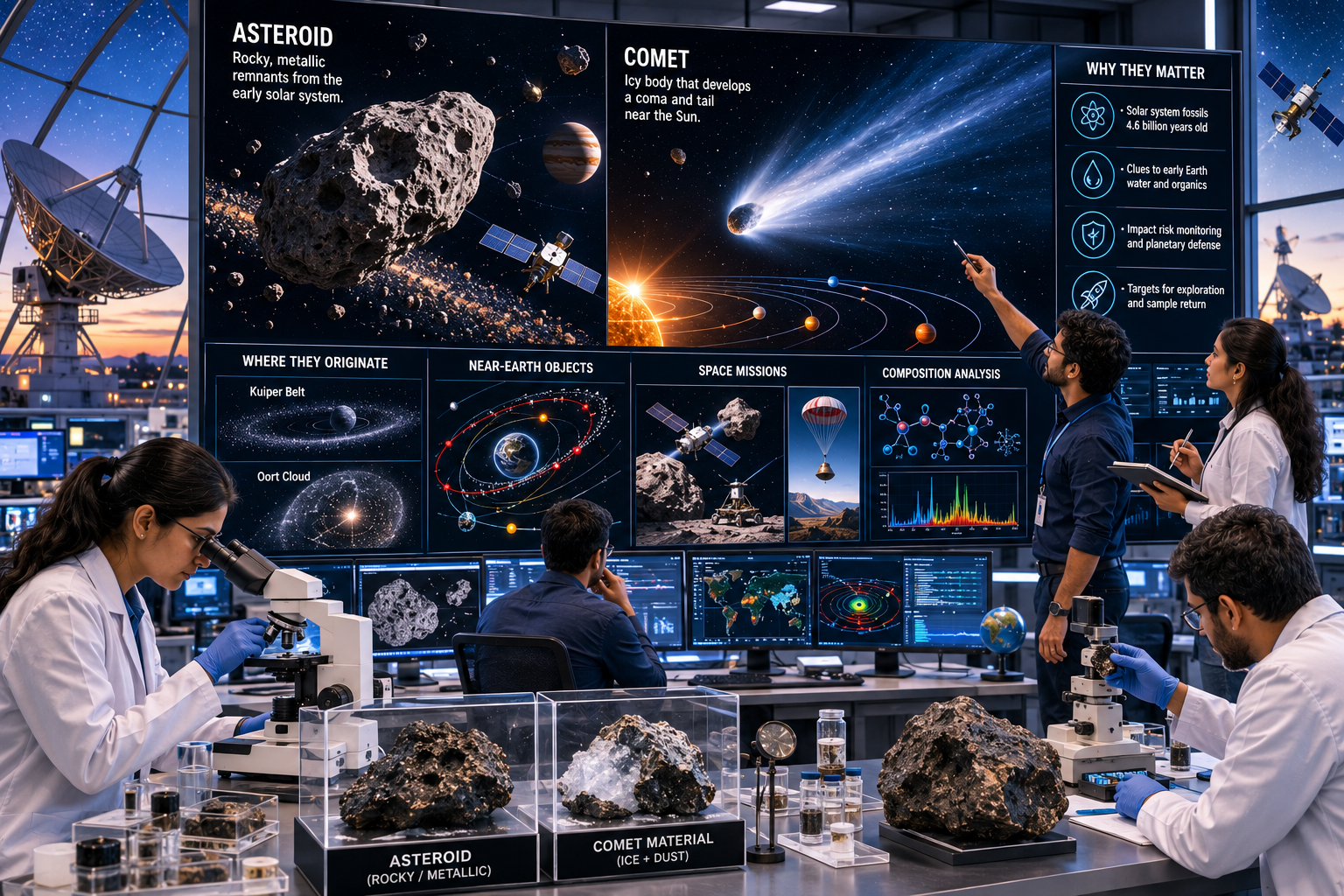
Comets and asteroids look small compared with planets, but they carry a large scientific story. They are leftovers from the construction of the solar system, pieces that never became full planets. Some move quietly in distant regions. Some cross Earths orbital neighbourhood. Some produce beautiful meteor showers. Some become targets for spacecraft because they preserve clues from a time before Earth had oceans, continents or life.
What Asteroids Are
Asteroids are rocky, metallic or carbon-rich bodies that orbit the Sun. Many are found in the asteroid belt between Mars and Jupiter, but asteroids also exist in other orbital groups. They vary enormously in size, from small boulders to dwarf-planet-sized bodies such as Ceres. Most are irregular in shape because they are too small for gravity to pull them into a sphere. Their surfaces can be cratered, dusty and ancient, showing a long history of impacts.
What Comets Are
Comets are often described as icy bodies mixed with dust and rock. Far from the Sun, a comet can remain frozen and dark. As it comes closer, solar heating causes some of its ice to turn into gas. This releases dust and creates a fuzzy atmosphere called a coma. Solar radiation and the solar wind can push material away from the comet, forming tails that point generally away from the Sun. The tail is not smoke from burning; it is gas and dust released by warming ice.
Where They Come From
Asteroids are commonly associated with the inner solar system, especially the asteroid belt, though some orbit near Earth or share orbital regions with planets. Comets are often linked with colder reservoirs such as the Kuiper Belt beyond Neptune and the distant Oort Cloud. These regions preserve icy objects because temperatures are low. When gravitational interactions disturb a comet, it can be sent inward, where sunlight transforms it into a visible object with a coma and tail.
Why They Are Solar System Fossils
Planets have been reshaped by heat, geology, atmospheres and erosion. Small bodies often preserve older material. That makes comets and asteroids valuable scientific archives. Their chemistry can reveal what ingredients were present in the early solar system. Some contain organic molecules. Some may help scientists test ideas about how water and carbon-bearing compounds reached early Earth. This does not mean a single comet created life, but it shows that small bodies were part of Earths chemical history.
The Impact Question
Comets and asteroids also matter because impacts have shaped planetary surfaces. The Moon is visibly covered with craters. Earth has fewer visible craters because weather, plate tectonics and erosion erase many older scars. Large impacts are rare, but they can be severe. This is why planetary defense programs track near-Earth objects and calculate their orbits. The goal is not panic; it is early detection, accurate measurement and, if needed, long-term mitigation.
Space Missions and Samples
Modern missions have turned comets and asteroids from distant dots into physical worlds. Spacecraft have flown past comets, landed on small bodies, changed asteroid orbits and returned samples to Earth. Samples are especially powerful because laboratories can examine them with instruments too large or delicate to fly in space. Each mission adds detail to the story of how dust, ice, gravity and collisions built the solar system.
How to Tell Them Apart
The simple rule is that asteroids are mostly rocky or metallic and comets are ice-rich. But nature can blur categories. Some asteroids may contain water-bearing minerals. Some objects behave like asteroids for years and then show comet-like activity. Scientists classify them by orbit, composition and observed behaviour. The difference is still useful, but the solar system is not always tidy enough to fit perfectly into simple textbook boxes.
Final Takeaway
Comets and asteroids are not just space debris. They are ancient records, potential hazards, sources of meteor showers and targets for exploration. Asteroids show the rocky construction material of planets. Comets reveal the icy outer solar system and the chemistry of ancient cold regions. Together, they help explain how the solar system formed, evolved and continues to change.