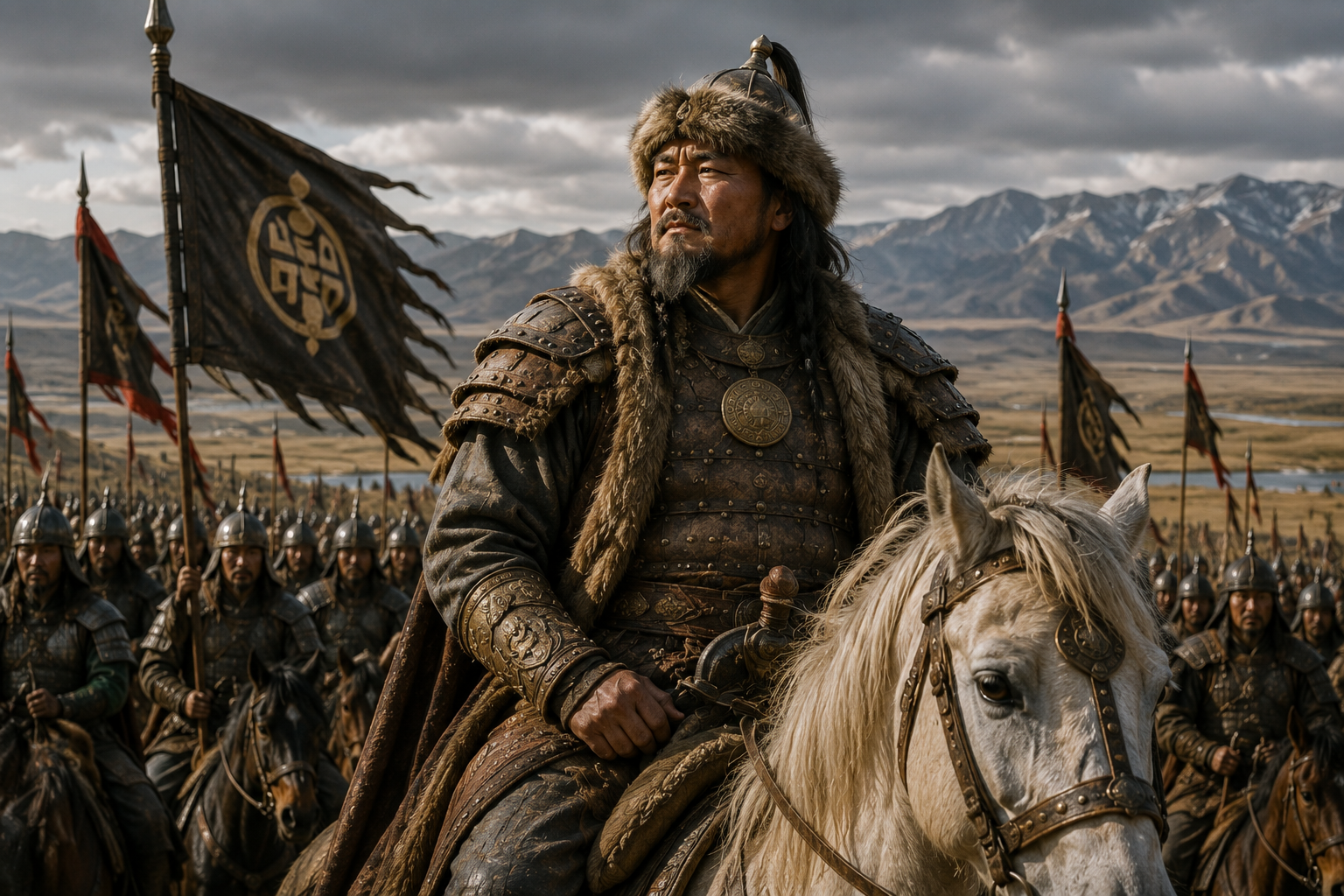
Genghis Khan’s story is often reduced to brutality, and brutality was undeniably central to Mongol conquest. Cities were destroyed, populations massacred, and terror was used deliberately as a weapon of war. Yet to understand the Mongol Empire only as destruction is historically incomplete. Genghis Khan was also a state-builder, military organiser, lawgiver, alliance-maker and strategist of mobility. He transformed steppe politics from tribal fragmentation into imperial discipline.
The Mongol Empire’s rise reveals how nomadic power could defeat wealthy sedentary states. It shows the military value of speed, intelligence, communication and psychological warfare. It also shows the fragility of settled civilisations when confronted by a force that did not fight according to their expectations. Under Genghis Khan, the steppe became not the edge of civilisation but the centre of world history.
Time, Place and the Steppe World
The Mongol Empire emerged from the grasslands of Inner Asia, especially the Mongolian steppe. This environment shaped everything: economy, warfare, politics and mobility. Pastoral nomads depended on horses, sheep, goats, cattle and seasonal movement. Wealth was measured not in walled estates but in herds, followers and access to pasture. Survival required discipline, endurance and the ability to move quickly across harsh terrain.
The steppe was not empty wilderness. It was a political world of clans, confederations, rival chiefs, marriage alliances, tribute relations and warfare. Sedentary states often saw nomads as raiders, but nomadic societies had their own institutions and strategies. The Mongols inherited traditions of mounted archery, tribal diplomacy and seasonal campaigning. Genghis Khan’s genius was to turn these flexible steppe practices into a disciplined imperial machine.
Before Genghis: Fragmentation and Competition
Before Temujin’s rise, the Mongol tribes were divided among competing lineages and confederations. Groups such as the Tatars, Kereits, Naimans, Merkits and others fought, allied and betrayed one another. Leadership depended on charisma, generosity, marriage ties and success in war. A chief who could not reward followers lost them. A family without allies became vulnerable.
This political fragmentation produced insecurity but also trained leaders in ruthless flexibility. Temujin learned early that survival required alliance-building, loyalty and revenge. His world punished weakness. It also created opportunities for someone who could build a broader identity beyond narrow kinship. The future Genghis Khan did not inherit a unified nation. He constructed one by breaking the old tribal aristocracy and replacing it with loyalty to himself and his imperial project.
Temujin’s Early Life: Hardship as Political Education
Temujin was born into a noble but vulnerable family. Traditional accounts say his father Yesugei was poisoned when Temujin was still young. After his father’s death, the family was abandoned by followers and forced into poverty. This early humiliation became part of the political memory of Genghis Khan: the boy who had known exclusion later built a system in which loyalty could matter more than birth.
His early life was marked by capture, escape, family conflict and the struggle to gather followers. These experiences taught him that kinship alone was unreliable. Blood relatives could betray; unrelated companions could become sworn brothers. This lesson shaped his later politics. He promoted men of ability, rewarded loyalty and punished betrayal severely. The empire he built was not free of hierarchy, but it weakened older clan privileges by making service to the khan the central path to power.
Alliance, Betrayal and the Making of a Leader
Temujin’s rise depended on alliances with powerful figures, including Toghrul of the Kereits and his anda, or sworn brother, Jamukha. These relationships gave him military support and legitimacy. But steppe alliances were unstable. Jamukha eventually became a rival, representing an older aristocratic vision of steppe leadership, while Temujin attracted followers through redistribution, discipline and opportunity.
The conflict between Temujin and Jamukha was more than personal rivalry. It symbolised two models of power. Jamukha drew on traditional elite networks; Temujin built a broader coalition of dependents, warriors and loyalists. By defeating rivals and absorbing their followers, Temujin gradually transformed fragmented tribes into a unified political body. Leadership was no longer merely the ability to win raids. It became the capacity to reorganise society after victory.
1206: The Kurultai and the Birth of Genghis Khan
In 1206, a great assembly or kurultai proclaimed Temujin as Genghis Khan, often translated as universal or oceanic ruler. This moment marked the formal unification of the Mongol tribes under his leadership. It was not a ceremonial detail; it was the creation of a new political identity. The Mongols were no longer only a cluster of competing groups. They became the core of an expanding imperial force.
The title mattered because it transformed personal power into institutional authority. Genghis Khan could now reorganise military units, distribute rewards, impose law and command campaigns as supreme ruler. The steppe had produced many successful warriors before him, but he created a durable structure. The kurultai of 1206 stands as the turning point where tribal politics became imperial politics. From this base, the Mongols would challenge some of the most powerful states of Eurasia.
Military Organisation: Decimal Discipline and Mobility
The Mongol army’s success rested on organisation as much as courage. Genghis Khan arranged forces into decimal units: groups of ten, hundred, thousand and ten thousand. This system cut across tribal divisions and created military loyalty to commanders and the khan rather than only to kin. It made command clearer and discipline stronger.
Mobility was the Mongols’ greatest battlefield advantage. Mounted archers could move rapidly, shoot accurately from horseback and retreat without disintegrating. Each warrior often had multiple horses, allowing long-distance movement at speeds sedentary armies struggled to match. Mongol forces used feigned retreats, encirclement, intelligence networks and coordinated attacks. They were not chaotic hordes; they were disciplined cavalry armies that turned the steppe way of life into military science.
Law, Loyalty and the Yasa Tradition
Genghis Khan is associated with the Yasa, a body of law or customary regulations whose exact content remains debated because later accounts are fragmentary and sometimes legendary. Even if the Yasa cannot be reconstructed as a fixed legal code, the tradition points to an important truth: Genghis Khan sought to impose order on the steppe. Theft, betrayal, disobedience and internal conflict had to be controlled if expansion was to continue.
The new order rewarded loyalty and merit. Commanders such as Subutai and Jebe rose through ability. Defeated enemies could be incorporated if they submitted. Skilled artisans, administrators and engineers were often spared and redistributed across the empire. This pragmatic approach made conquest more than destruction. The Mongols killed brutally when resisted, but they also absorbed talent. Their empire grew because it could turn enemies into resources.
First Campaigns: Breaking Steppe Rivals
Before conquering great sedentary states, Genghis Khan secured dominance over the steppe. He defeated or absorbed rival tribes including the Tatars, Merkits, Kereits and Naimans. These campaigns were essential because no external conquest could succeed while the steppe rear remained unstable. Unity at home was the precondition for expansion abroad.
The destruction of rival elites also served a political purpose. Old tribal aristocracies could challenge the khan’s authority. By breaking them and redistributing followers into new military units, Genghis Khan reduced the power of inherited rivals. This was state formation through war. Each victory expanded his manpower and strengthened the new imperial identity. The Mongol Empire was built first by conquering the Mongols’ own political world.
Against the Jin: Steppe Power Meets North China
The Jin dynasty ruled northern China and represented a wealthy, fortified, sedentary power. For the Mongols, the Jin offered both danger and opportunity. Its cities, agriculture and resources were far richer than the steppe, but its defences were formidable. Campaigns against the Jin forced the Mongols to learn siege warfare, logistics and the use of captured specialists.
The war against the Jin showed how Mongol methods evolved. Mounted archery could defeat armies in the field, but walled cities required engineers, siege machines and patient strategy. The Mongols adapted by employing Chinese, Khitan, Muslim and other specialists. This capacity to learn from conquered peoples was one of their greatest strengths. The steppe army became an imperial army by absorbing the technologies of settled civilisation.
The Khwarazmian War: Terror and Transcontinental Expansion
The conflict with the Khwarazmian Empire was one of the decisive episodes of Genghis Khan’s career. After a Mongol trade mission was attacked and envoys were mistreated, Genghis launched a massive campaign into Central Asia. Cities such as Bukhara, Samarkand and Urgench faced devastating consequences. The campaign carried Mongol power deep into the Islamic world.
This war displayed the Mongol use of terror as strategy. Cities that resisted could be destroyed to warn others. Populations were killed, enslaved or redistributed. Yet the Mongols also valued artisans, scribes and administrators. The conquest shattered existing political structures while incorporating skilled people into Mongol service. The Khwarazmian campaign made clear that the Mongols were no longer a regional steppe force. They had become a Eurasian power capable of overturning empires.
Intelligence, Communication and Psychological Warfare
Mongol success depended heavily on intelligence. Scouts, spies, merchants, defectors and local informants supplied information about roads, water, defences, political rivalries and resources. Before attacking, the Mongols often knew more about their enemies than their enemies knew about them. Information reduced uncertainty across vast distances.
Communication also mattered. The later Mongol yam system of relay stations became famous under Genghis’s successors, but the foundations lay in the need for rapid imperial messaging. Psychological warfare amplified military power. By publicising the fate of cities that resisted and rewarding those that surrendered, the Mongols tried to make fear travel ahead of armies. Terror was cruel, but it was also calculated. The Mongol Empire conquered minds before it conquered walls.
Administration: Ruling What the Horsemen Conquered
A cavalry army can win territory quickly, but an empire must rule. Genghis Khan and his successors relied on administrators from conquered societies, including Uighur scribes, Chinese officials, Muslim tax experts and other literate specialists. The Mongols themselves had limited bureaucratic tradition at first, so they borrowed aggressively.
This administrative pragmatism was central to Mongol durability. They did not require every conquered people to become Mongol. They required submission, taxes, labour, skills and military cooperation. Religious communities were often tolerated if they did not resist. Merchants could receive protection because trade enriched the empire. The Mongols combined violent conquest with practical governance. Their empire was therefore both destructive and integrative, a contradiction that defines its historical legacy.
Social Transformation of the Steppe
Genghis Khan’s empire transformed Mongol society itself. Tribal loyalties did not disappear, but they were reorganised under imperial command. Military units mixed lineages. Spoils flowed through the khan’s system. Women of elite families played significant roles in alliance, regency and household politics. The imperial family became the organising centre of steppe aristocracy.
The new empire also created a broader Mongol identity. People who had once identified primarily by clan or tribal federation now participated in a common project of conquest. This identity was linked to loyalty, military service and shared success. The steppe was no longer merely a zone between settled empires. It became the source of an empire that forced China, Central Asia, Persia and Europe to respond. Mongol society was remade by its own expansion.
Peak Under Genghis: Power Before Completion
At Genghis Khan’s death in 1227, the empire was already enormous but not yet at its later maximum. He had unified the Mongol steppe, conquered the Xixia, devastated the Khwarazmian Empire, fought the Jin and opened the path for further expansion. His sons and grandsons would extend Mongol rule across China, Russia, Persia and beyond.
This distinction matters. Genghis Khan did not personally rule the entire later Mongol Empire, but he created the structures and momentum that made it possible. His achievement was foundational. He turned mobile warfare into imperial expansion, tribal loyalty into state discipline and local steppe politics into world-historical force. The peak under Genghis was not territorial maximum; it was organisational breakthrough.
Death, Succession and the Problem of Imperial Scale
Genghis Khan died in 1227 during a campaign against the Tangut kingdom of Xixia. Before his death, he arranged succession within the ruling family, with Ogedei eventually becoming Great Khan. Succession was crucial because steppe empires often fragmented after charismatic founders. The Mongols managed to continue expansion, but tensions among branches of the family never disappeared.
The empire’s scale created both glory and danger. It stretched across environments too diverse for easy central control. Communication was faster than in many rival states, but still limited by distance. Different branches of the royal family developed interests in different regions. After later generations, the empire divided into khanates. The unity Genghis created was powerful, but imperial expansion made permanent unity difficult.
Impact: Destruction, Exchange and the Pax Mongolica
The Mongol impact was devastating in many regions. Cities were destroyed, irrigation systems damaged, populations killed or displaced, and older states shattered. The human cost of conquest must never be softened. For many communities, Mongol arrival meant catastrophe. The empire’s birth was written in fire, fear and mass violence.
Yet Mongol rule also created new connections across Eurasia. Under the broader Mongol Empire, merchants, envoys, missionaries and technologies moved through transcontinental networks. The Pax Mongolica, though uneven and built on conquest, helped connect China, Central Asia, Persia and Europe. Paper money, gunpowder knowledge, printing ideas, textiles, medicines and geographical information circulated more widely. The Mongols destroyed worlds and connected worlds at the same time.
Historical Debates: Barbarism, Statecraft and Climate
Historians debate how to interpret Genghis Khan. Older accounts often portrayed him as a barbarian destroyer. Modern scholarship has complicated that image by emphasising military organisation, legal reforms, religious tolerance, trade protection and administrative pragmatism. The challenge is to avoid both demonisation and romanticisation. Genghis Khan was neither a mindless savage nor a modern liberal reformer. He was a ruthless imperial founder shaped by steppe politics.
There is also debate over environmental factors in the Mongol rise. Some studies suggest that favourable climate conditions may have supported pasture growth and horse herds during key decades. Such arguments do not replace human agency, but they remind us that empires depend on ecology. Genghis Khan’s genius mattered, but so did horses, grass, weather and mobility. The Mongol Empire was a human and environmental phenomenon.
Legacy Conclusion
The Mongol Empire under Genghis Khan changed world history because it proved that the steppe could conquer the city. Pastoral nomads, long treated by sedentary states as frontier raiders, became the architects of a transcontinental empire. Genghis Khan united divided tribes, broke aristocratic rivals, reorganised society into disciplined military units and used mobility, intelligence and terror to defeat wealthier powers.
His legacy is morally difficult. The empire he founded caused immense suffering. Cities were destroyed, populations massacred and fear became a deliberate instrument of rule. Any celebration of Mongol efficiency must confront that violence. Yet historical understanding also requires recognising the empire’s organisational brilliance. Genghis Khan built institutions that outlived him, promoted talent, absorbed specialists and created conditions for unprecedented Eurasian exchange under his successors.
The Mongol story remains powerful because it overturns civilisational arrogance. Great walls, old dynasties and wealthy cities could fall before disciplined mobility. Marginal landscapes could produce central power. A boy abandoned on the steppe could become the founder of the largest contiguous land empire the world had ever known. Genghis Khan’s empire was born from hardship, sharpened by violence and expanded through strategy. Its legacy is the terrible reminder that history is often remade not from the settled centre, but from the moving frontier.
Extended Historical Analysis: Why the Mongols Won
The Mongols won because they combined social discipline with strategic flexibility. They were not tied to slow infantry formations, fixed supply lines or aristocratic battlefield codes. They could scout, retreat, regroup and strike where enemies were weakest. Their commanders coordinated across distance and adapted rapidly to unfamiliar enemies.
But their victories also came from politics. Genghis Khan created loyalty by distributing spoils, promoting merit and punishing betrayal. He gave ambitious men a reason to follow him beyond tribal limits. The Mongol war machine was therefore not only cavalry skill. It was a political system that converted personal loyalty into imperial expansion.
Horse Culture and the Ecology of Conquest
The Mongol military revolution was inseparable from horse culture. Steppe children learned riding early, and mounted archery required years of practice embedded in daily life. Horses provided transport, food, wealth, status and military advantage. Multiple mounts allowed warriors to travel long distances without exhausting a single animal. This gave Mongol armies operational speed that sedentary enemies often could not match.
Ecology made this possible. Grasslands fed herds, and herds sustained warriors. Campaign planning depended on pasture, seasons and water. A Mongol army was not a modern supply train; it was a moving pastoral-military organism. This made it flexible but also dependent on environmental conditions. Understanding the empire therefore requires looking at grass as well as strategy. The horse was the bridge between steppe ecology and world conquest.
Siegecraft and the Absorption of Specialists
The Mongols were masters of open-field cavalry warfare, but their empire could not expand without capturing cities. Walled urban centres in China, Central Asia and Persia required siege machines, engineers, miners, artillery specialists and logistical planning. The Mongols solved this problem by absorbing experts from conquered societies. Chinese engineers, Muslim technicians and other specialists were compelled or rewarded to serve Mongol campaigns.
This ability to learn from enemies made the Mongols especially dangerous. They were not trapped by their original way of war. They adapted. A city that resisted one campaign might reveal techniques used against the next city. Siege knowledge became cumulative. The Mongol army therefore evolved from a steppe cavalry force into a hybrid imperial machine. Its success came from mobility plus borrowed technology, terror plus administration, and horse archers plus engineers.
Religious Pragmatism and Imperial Flexibility
Genghis Khan and his successors are often noted for a degree of religious pragmatism. The Mongols did not initially seek to impose one universal faith on conquered peoples. Shamans, Buddhists, Muslims, Christians and Daoists could all find space within Mongol rule if they accepted imperial authority. Religious specialists might receive privileges because they prayed for the khan, provided legitimacy or helped govern communities.
This tolerance was not modern liberalism. It was imperial practicality. A vast empire could not afford endless religious rebellion. By allowing different communities to maintain traditions, the Mongols reduced resistance and gained administrative cooperation. At the same time, religious groups competed for patronage at Mongol courts. The empire became a meeting place of faiths because conquest brought them under one political umbrella. Diversity was managed not by equality, but by subordination to the khan’s power.
Women, Household Power and the Mongol Elite
Elite Mongol women played important roles in politics, succession and alliance. Marriages connected lineages, secured loyalties and redistributed influence. Royal women could manage camps, advise rulers, act as regents and protect the interests of their sons. In a mobile empire where the royal household itself was a political institution, women’s authority could be substantial even within patriarchal structures.
This dimension is often hidden by battlefield narratives. Yet imperial continuity depended on households as much as campaigns. After a ruler’s death, widows and mothers could shape succession. The politics of the Mongol imperial family involved negotiation among wives, sons, brothers and branches of descent. To understand Genghis Khan’s empire, one must see the camp as a political arena. The steppe palace was mobile, familial and strategic.
Merchants, Tax Farmers and the Business of Empire
The Mongols valued merchants because merchants could turn conquest into revenue. Trade supplied luxury goods, information, credit and diplomatic contact. Under Mongol rule, merchant associations and long-distance traders sometimes received protection and privileges. The empire’s vast scale created opportunities for commerce across regions that had previously been divided by hostile states.
But Mongol fiscal practices could also be harsh. Tax farming, tribute demands and irregular exactions burdened settled populations. The desire for revenue sometimes conflicted with sustainable governance. This tension was common in conquest empires: the ruling elite wanted wealth quickly, while administrators understood that excessive extraction could ruin the tax base. Mongol economic history therefore contains both commercial expansion and fiscal violence. The empire connected markets, but it also consumed them.
Violence, Memory and the Problem of Judgment
The memory of Genghis Khan differs sharply across regions. In Mongolia he is often remembered as a founder and national hero. In parts of Central Asia, Persia and the Islamic world, Mongol conquest long carried memories of devastation. In European imagination, the Mongols became terrifying horsemen from the east. These different memories reflect different historical experiences.
Judging Genghis Khan requires moral clarity and historical precision. His armies committed atrocities, and terror was part of strategy. At the same time, reducing him to savagery prevents understanding how he built institutions, reorganised society and reshaped Eurasian exchange. The task of history is not to excuse violence by explaining it, nor to avoid explanation because violence occurred. The Mongol Empire must be understood as both a catastrophe for many and a force of integration in world history.
Fragmentation Into Khanates
After Genghis Khan, the empire continued expanding under his successors, but unity became harder to maintain. The ruling family divided authority among branches that eventually formed major khanates: the Yuan in China, the Ilkhanate in Persia, the Chagatai Khanate in Central Asia and the Golden Horde in the western steppe. These states shared Mongol heritage but developed different regional interests.
Fragmentation was not simple failure. It was partly the result of scale. An empire from East Asia to Eastern Europe could not remain easily governed from one centre. Local conditions demanded adaptation. Mongol rulers in China became emperors of the Yuan; in Persia they became patrons within an Islamic cultural world; in the steppe they maintained more pastoral traditions. Genghis Khan’s legacy therefore multiplied. His empire did not remain one body, but its political DNA spread across Eurasia.
The Psychology of Surrender
Mongol strategy often worked before battle began. Envoys demanded submission and promised safety to those who accepted Mongol authority. Resistance could bring annihilation, while surrender could preserve local elites, artisans and religious institutions. This created a brutal calculation for cities: fight and risk destruction, or submit and enter the Mongol order. Fear became a political technology.
This psychology was effective because the Mongols made examples. News of destroyed cities travelled faster than armies. Some communities surrendered because they had heard what happened elsewhere. The method was terrifying, but from the Mongol perspective it conserved resources by reducing sieges. The empire’s reputation became a weapon. Genghis Khan understood that power is not only physical force; it is also expectation. If enemies believed resistance was hopeless, conquest became easier.
Genghis Khan as Institution Builder
The most lasting achievement of Genghis Khan was not any single victory but the institutions that survived him. He created military units that crossed tribal lines, promoted commanders by ability, established norms of discipline, encouraged written administration through borrowed scripts and specialists, and developed a ruling ideology centred on the khan’s universal authority. These structures allowed expansion to continue after his death.
This is why Genghis Khan cannot be understood only as a raider. Raiders take; institution builders reorganise. He took violently, but he also reorganised the political world of the steppe. His successors could conquer on a larger scale because he had created a system that made conquest repeatable. The empire was personal in origin, but institutional in consequence. That distinction explains why his impact lasted far beyond his lifetime.
The Steppe and the Sedentary World
The Mongol Empire exposed the deep interdependence between nomads and settled societies. Steppe peoples needed grain, metal, textiles and manufactured goods; settled states needed horses, frontier intelligence and sometimes military alliances. Conflict was frequent, but exchange was constant. The boundary between nomad and farmer was therefore not a wall. It was a zone of trade, diplomacy, raiding, tribute and cultural borrowing.
Genghis Khan changed the balance by forcing sedentary states to confront a unified steppe. Previously, Chinese, Central Asian and Islamic rulers could often exploit divisions among nomadic groups. After 1206, that strategy became far harder. The steppe spoke with one military voice. The result was a reversal of historical perspective: lands that considered themselves centres of civilisation suddenly faced conquest from a world they had treated as peripheral.
Memory of Law, Order and Fear
Mongol rule rested on fear, but it also cultivated the reputation of order. Travellers under Mongol protection could sometimes cross distances that had previously been fragmented by hostile powers. Merchants valued security even when they feared taxation. Religious figures valued tolerance even under domination. This mixture of fear and order made Mongol power difficult to categorise.
Genghis Khan’s memory therefore remains divided because his empire produced opposite experiences. For a resisting city, Mongol order meant annihilation. For a merchant caravan under protection, it could mean safer passage. For a skilled artisan, it might mean forced relocation but survival. For a rival aristocrat, it meant loss of inherited status. The empire’s legacy was not one thing. It was a system that redistributed security and violence according to submission, usefulness and imperial need.
Why Genghis Khan Still Matters
Genghis Khan still matters because his career forces historians to take nomadic statecraft seriously. He did not come from the urban centres that usually dominate world history textbooks. He came from a mobile society whose political intelligence was carried through memory, oath, horse culture and battlefield discipline. His rise proves that literacy, cities and agriculture were not the only foundations of imperial power.
His empire also matters because it compressed Eurasian history. China, Central Asia, Persia, Russia and Europe became more aware of one another through the shock of Mongol expansion. The cost was terrible, but the consequences were global. Genghis Khan remains unavoidable because he turned the steppe into a force that no settled civilisation could ignore.
The Final Historical Takeaway of Mongol Power
The final takeaway is that Mongol power was not an accident of savagery. It was the result of organisation, ecology, leadership and adaptation. Genghis Khan transformed hardship into discipline and mobility into strategy. He built a system in which loyalty could cross tribal lines and conquest could be repeated across continents.
That system was violent, but it was not chaotic. Its danger lay precisely in its order. The Mongol Empire under Genghis Khan reminds us that world history can be redirected by societies that outsiders underestimate. From the grasslands came a force that remade the map of Eurasia.