A holy war that remade three worlds
The Crusades began as armed pilgrimages and became one of the most contested episodes in world history. To medieval Latin Christians, they were wars for the recovery of holy places, acts of penance and demonstrations of religious devotion. To many Muslims, they were invasions by foreign armies who seized cities, killed civilians and established unstable states in the eastern Mediterranean. To Byzantines, they were at first potential military assistance and later a disaster that helped destroy the Christian empire of the East. The Crusades cannot be understood from one viewpoint alone.
Their lasting impact came from the fact that they joined religion, violence, politics and economy into one movement. Popes claimed authority to call warriors to holy war. Knights sought salvation, land, honour and wealth. Italian merchants found opportunity in transport and trade. Muslim rulers gradually transformed fragmented resistance into counter-crusading politics. The Crusades were therefore not merely battles for Jerusalem. They were a long civilisational encounter that reshaped the Mediterranean, deepened Christian-Muslim hostility, weakened Byzantium, strengthened papal ambition and left memories that still echo in modern political language.
Time, place and the world of crusading
The Crusades are usually dated from the late eleventh century onward, beginning with Pope Urban II’s call at Clermont in 1095 and the First Crusade that captured Jerusalem in 1099. The main eastern crusades unfolded between the eleventh and thirteenth centuries, though crusading as an institution extended far beyond the Holy Land. Campaigns were also directed against Muslims in Iberia, pagans in the Baltic, heretics in southern France and political enemies of the papacy.
The central geography of the best-known Crusades lay in the eastern Mediterranean: Jerusalem, Antioch, Edessa, Tripoli, Acre, Constantinople, Egypt, Syria and Anatolia. But the crusading movement connected this region to France, Germany, England, Italy, Sicily, Hungary and the Byzantine world. The Mediterranean became a theatre in which religious imagination and military logistics met. Pilgrimage routes became invasion routes. Ports became strategic assets. Islands, fortresses and coastal cities became nodes of power. To understand the Crusades, one must see them as movements across land and sea, not as isolated battles.
Background: pilgrimage, reform and medieval violence
Before the Crusades, Christian pilgrimage to Jerusalem had long existed. The Holy Sepulchre and other sacred sites mattered deeply to medieval Christians. At the same time, western Europe was undergoing religious reform, population growth, aristocratic militarisation and papal ambition. The Church was trying to discipline knightly violence through movements such as the Peace and Truce of God, while also asserting independence from secular rulers in the Investiture Controversy.
The crusading idea emerged from this world. It did not reject violence; it redirected violence. Knights who had fought private wars could now be offered a sacred cause. The papacy could claim leadership over warriors across kingdoms. Pilgrimage could become armed service. This fusion was historically explosive because it turned war into a penitential act. A knight could fight, kill and still imagine himself engaged in spiritual discipline. The Crusades therefore grew from medieval Christianity’s attempt to control violence by sanctifying it for selected purposes.
The call of Urban II and the First Crusade
In 1095, Pope Urban II called for a military expedition to aid eastern Christians and recover Jerusalem. His speech at Clermont survives in different versions, but the core message is clear: warriors were urged to take the cross and journey east. The promise of spiritual reward gave the movement extraordinary emotional force. Nobles, knights, peasants and preachers responded. Some were driven by devotion, others by honour, adventure, land hunger, debt, pressure or expectation.
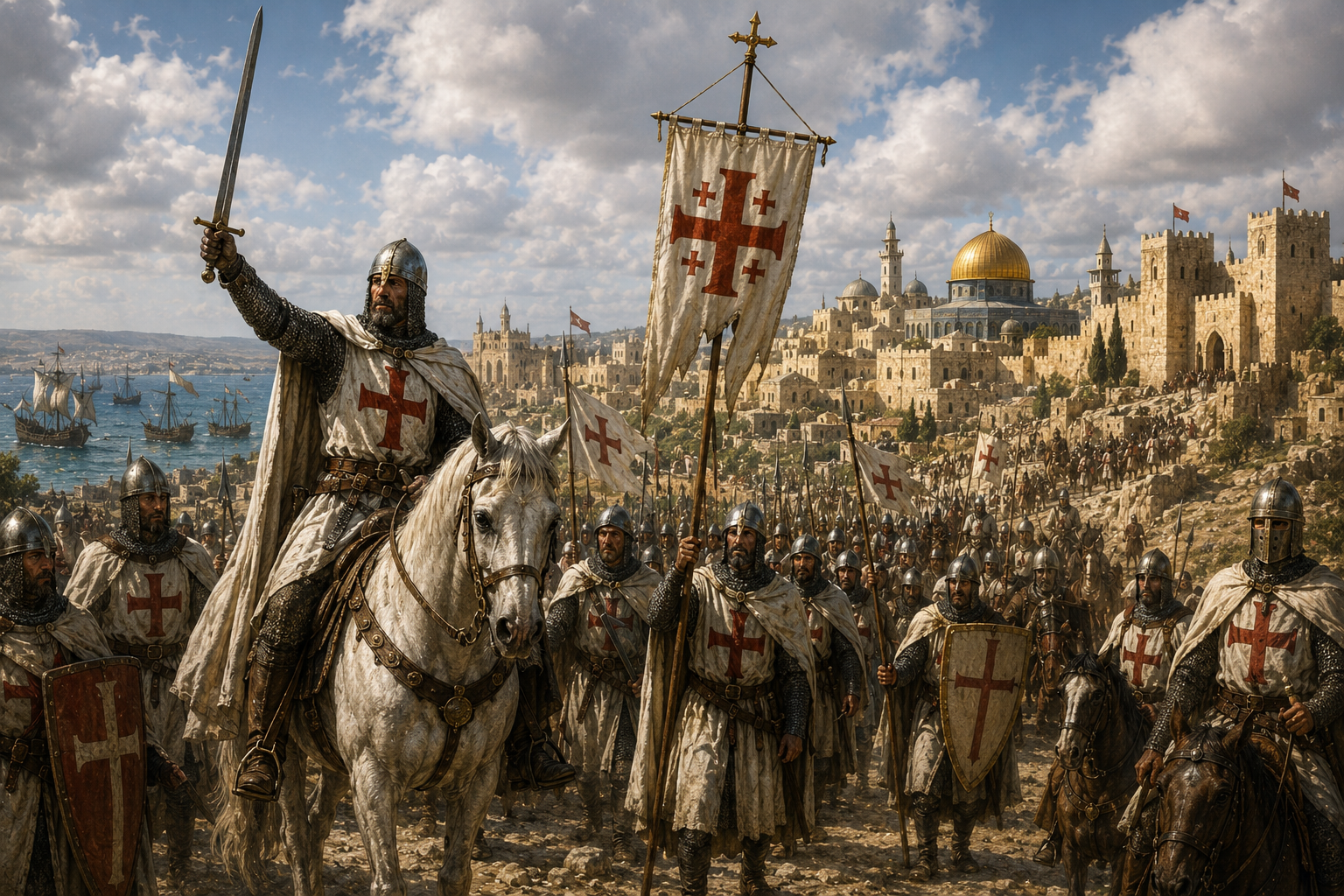
The First Crusade was chaotic but successful in military terms. Crusader armies crossed Byzantine territory, fought through Anatolia, captured Antioch after a brutal siege and took Jerusalem in 1099. The capture of Jerusalem was followed by massacre, a fact that became central to Muslim memory of the Crusades. For Latin Christians, the victory seemed miraculous. For the region’s inhabitants, it was violent conquest. The First Crusade established crusader states, including the Kingdom of Jerusalem, but it also created a permanent frontier of insecurity. The movement had won its sacred city, but it had opened a long age of war.
Crusader states: fragile kingdoms in a hostile landscape
After 1099, the crusaders established Latin polities in the Levant: the Kingdom of Jerusalem, the County of Edessa, the Principality of Antioch and the County of Tripoli. These states were politically ambitious but demographically fragile. Latin settlers were a minority ruling over diverse populations of Eastern Christians, Muslims, Jews and others. Their survival depended on fortifications, alliances, military orders, maritime supply and divisions among neighbouring Muslim powers.
The crusader states were not simply European colonies copied onto eastern soil. They adapted to local conditions, used existing administrative practices, negotiated with neighbours and depended heavily on Italian maritime cities such as Venice, Genoa and Pisa. Castles became central to defence. Military orders such as the Templars and Hospitallers combined monastic discipline with warfare. Yet fragility remained constant. The crusader states needed reinforcements from Europe and disunity among their enemies. When Muslim political unity increased, their position became increasingly vulnerable.
The Second Crusade and the limits of enthusiasm
The fall of Edessa in 1144 shocked Latin Christendom and triggered the Second Crusade. Preached by Bernard of Clairvaux and joined by major rulers such as Louis VII of France and Conrad III of Germany, the expedition carried immense expectations. Yet it failed badly, especially in its unsuccessful attack on Damascus. The failure damaged confidence and revealed that crusading zeal did not guarantee strategic wisdom.
This episode is important because it exposed the gap between sacred language and military reality. Armies needed supplies, discipline, local knowledge and coherent objectives. A crusade could be spiritually charged and still strategically disastrous. The Second Crusade also deepened tensions between western crusaders and Byzantines, who often saw each other through suspicion. It showed that crusading was not a simple united Christian project. Latin kings, Byzantine emperors, local Christian communities and crusader nobles had different interests. The idea of crusade was powerful, but the practice was fractured.
Saladin and the Third Crusade
The rise of Saladin transformed the crusading world. By uniting Egypt and Syria under Ayyubid leadership, he overcame the fragmentation that had helped the crusader states survive. In 1187, Saladin defeated the crusaders at the Battle of Hattin and captured Jerusalem. This was the great turning point of the crusading era. The loss of Jerusalem shook Latin Christendom as deeply as its capture had once inspired it.
The Third Crusade brought some of Europe’s most famous rulers east, including Richard I of England, Philip II of France and Emperor Frederick Barbarossa, who died before reaching the Holy Land. Richard captured Acre and won military victories, but Jerusalem was not recovered. The eventual settlement allowed Christian pilgrims access to the city while leaving it under Muslim control. The Third Crusade became legendary because of the reputations of Richard and Saladin, but its deeper significance lies in the changed balance of power. The crusaders could still fight effectively, but they could no longer easily dominate the region.
The Fourth Crusade and the sack of Constantinople
The Fourth Crusade was one of the most disastrous and revealing episodes in the history of crusading. Intended originally to strike at Egypt, it became entangled in Venetian commercial interests, crusader debt and Byzantine dynastic politics. In 1204, crusading armies captured and sacked Constantinople, the greatest Christian city of the eastern Mediterranean. Latin Christians attacked fellow Christians in the name of a movement supposedly dedicated to sacred war.
The sack of Constantinople shattered trust between Greek and Latin Christianity. It weakened the Byzantine Empire severely, even though Byzantine rule was restored in 1261. The empire never fully recovered its former strength. This turning point exposes the contradiction within crusading ideology. A movement that claimed to defend Christendom helped cripple one of Christendom’s oldest empires. Economic interest, political opportunism and religious rhetoric became inseparable. The Fourth Crusade remains one of the strongest arguments against romantic interpretations of crusading.
Later crusades and the loss of the Holy Land
After the Fourth Crusade, further expeditions attempted to regain or secure Christian control in the eastern Mediterranean. The Fifth Crusade targeted Egypt but failed. Frederick II negotiated the temporary return of Jerusalem in the Sixth Crusade without major battle. Louis IX of France led later crusades to Egypt and Tunis, both ultimately unsuccessful. Meanwhile, the crusader states contracted around coastal strongholds.
The final major blow came with the fall of Acre in 1291, which ended the principal Latin Christian presence on the mainland of the Holy Land. Crusading did not end as an idea, but the dream of permanent Latin control over Jerusalem and the Levant had failed. The long arc from 1099 to 1291 reveals the limits of religious militarism when not matched by demographic depth, stable logistics and political adaptation. The crusaders could capture cities, build castles and inspire generations, but they could not permanently control a region where they remained vulnerable outsiders.
Muslim responses and counter-crusading memory
At first, Muslim responses to the First Crusade were fragmented. Local rulers competed with one another, and the crusaders benefited from political division. Over time, however, leaders such as Zengi, Nur al-Din and Saladin framed resistance in religious and political terms. Jihad became an increasingly important language of mobilisation, though it interacted with dynastic ambition and regional strategy.
The Muslim response is essential because it corrects a Europe-centred narrative. The Crusades were not simply European expeditions; they were wars experienced by Muslim societies with their own politics, memory and intellectual life. Muslim chroniclers recorded the shock of invasion, the brutality of conquest and the eventual recovery of Jerusalem. The counter-crusading tradition helped unify political action at key moments, but it also became a memory of defence against foreign aggression. The Crusades therefore contributed to a long historical vocabulary of encounter, resistance and mistrust between Christian and Muslim worlds.
Byzantium: ally, rival and casualty
The Byzantine Empire played a central role in the early Crusades. Emperor Alexios I Komnenos sought western military assistance against Turkish pressure in Anatolia, but the mass crusading movement that arrived was far larger and less controllable than expected. Byzantines and westerners cooperated at times, yet suspicion quickly grew. Western crusaders often viewed Byzantines as duplicitous; Byzantines often viewed crusaders as undisciplined, greedy and dangerous.
The tragedy is that both sides had reason to fear each other. The Byzantine Empire needed help but feared losing control. Western armies needed passage and supply but distrusted Byzantine diplomacy. The Fourth Crusade turned suspicion into catastrophe. By weakening Byzantium, the crusading movement helped alter the eastern Mediterranean balance and indirectly opened space for later Ottoman expansion. The Byzantine experience shows that the Crusades were not a simple Christian-Muslim conflict. They also deepened fractures within Christianity itself.
Trade, cities and economic consequences
The Crusades stimulated Mediterranean commerce, especially for Italian maritime cities. Venice, Genoa and Pisa transported crusaders, supplied armies, received privileges and expanded commercial networks. Ports, shipping contracts, credit arrangements and colonial quarters grew in importance. Crusading war and trade were closely linked, even when religious rhetoric tried to present the movement as purely spiritual.
Economic consequences were uneven. The Crusades did not single-handedly create European capitalism or the Renaissance, but they strengthened commercial contacts, increased demand for eastern goods and expanded maritime experience. Spices, textiles, sugar, glassware and other commodities moved through networks shaped partly by crusading conditions. European elites developed new tastes. Merchant cities gained influence. The economic history of the Crusades therefore reveals a familiar pattern: war can be destructive and profitable at the same time, depending on where one stands within its networks.
Culture, knowledge and the problem of exchange
The Crusades brought western Europeans into closer contact with the eastern Mediterranean, where Byzantine, Islamic, Jewish and Eastern Christian cultures possessed rich traditions of scholarship, medicine, architecture and administration. Some knowledge moved through translation, trade, diplomacy and observation. Europeans encountered new products, techniques and ideas, though much intellectual transmission also occurred through Spain, Sicily and other zones independent of crusading warfare.
It is important not to exaggerate the Crusades as a simple bridge of civilisation. They produced violence and suspicion as much as exchange. Yet contact did matter. Europeans learned from the wider Mediterranean world even while fighting within it. Castles, military techniques, medicine, luxury consumption and geographic knowledge were affected by encounter. The legacy of the Crusades is therefore morally mixed: cultural contact grew through structures of aggression. Civilisations can learn from one another even in conflict, but such learning does not redeem the suffering caused by war.
The papacy, kingship and the militarisation of faith
The Crusades strengthened the medieval papacy by allowing popes to claim authority over international military action. The ability to grant indulgences, define holy war and mobilise warriors across kingdoms gave the papal office extraordinary ideological power. Crusading became one of the clearest expressions of papal monarchy in the high Middle Ages.
At the same time, monarchs learned to use crusading for prestige, taxation and political legitimacy. Crusade taxes helped develop fiscal systems. Royal participation enhanced status. The language of crusade could be redirected toward enemies far from Jerusalem. This militarisation of faith had dangerous flexibility. Once the Church could sacralise war against one enemy, the category could expand. Crusading against heretics, pagans or political opponents showed how a movement born around Jerusalem became a general instrument of religious warfare.
Historical debates: faith, greed, colonialism and memory
Historians debate how to interpret crusader motives. Were crusaders mainly pious pilgrims, land-hungry nobles, younger sons seeking opportunity, debtors escaping problems, merchants seeking profit or violent men seeking salvation? The answer varies by person and expedition. Medieval people could hold mixed motives without seeing contradiction. A knight might seek both penance and land, both honour and forgiveness.
There is also debate over whether the Crusades should be called colonialism. The crusader states involved settlement, conquest and minority rule over local populations, so colonial comparison is useful. Yet medieval structures differed from modern colonial empires. The most careful interpretation recognises both resemblance and difference. Another debate concerns memory. In modern politics, the word crusade often carries emotional weight far beyond medieval history. This makes historical precision essential. The Crusades should neither be romanticised as noble adventure nor flattened into a single modern slogan.
Decline of the crusading ideal
By the later Middle Ages, the crusading ideal did not vanish, but its central eastern project had failed. The loss of Acre, the rise of stronger Muslim powers, the weakening of Byzantine and Latin positions, European political conflicts and changing economic priorities all reduced the possibility of restoring the crusader states. Crusading rhetoric continued, but practical outcomes diminished.
The decline of the crusading movement reveals a gap between ideology and capacity. Europe could still dream of Jerusalem, but dreams require ships, money, unity and strategy. Those were often lacking. The papacy itself faced crises, including conflicts with monarchs and later the Avignon period and Great Schism. As Europe moved toward new political forms, crusade remained a memory and language, but no longer the organising centre of Mediterranean history. The age of crusading did not end in one moment; it faded through failure, adaptation and exhaustion.
Legacy: a wound, a bridge and a warning
The Crusades left a legacy that cannot be described as purely negative or positive. They caused massacres, displacement, religious hatred and political destruction. They deepened divisions between Latin and Greek Christianity and left painful memories in Muslim societies. They strengthened papal power, military orders, Mediterranean commerce and western Europe’s awareness of the wider world. They also showed how religious conviction can become entangled with ambition, profit and brutality.
Their deepest legacy is the warning they offer about sacred violence. When war is presented as holy, ordinary restraints weaken. Enemies become obstacles to salvation rather than human beings. Yet the Crusades also reveal the complexity of civilisational contact: conflict can produce exchange, and exchange can occur without mutual respect. The Crusades shaped Europe, the Middle East and Byzantium because they transformed pilgrimage into war, war into institution, and memory into identity. Their lasting impact lies not only in what happened between 1095 and 1291, but in the fact that societies still argue over what the word crusade means.
Military orders and the institutionalisation of holy war
The military orders were among the most distinctive creations of the crusading age. The Templars, Hospitallers and Teutonic Knights combined monastic vows with armed service, creating institutions that were religious, military and financial at the same time. They defended castles, escorted pilgrims, managed estates, handled money and built international networks of property and influence. Their members were monks in discipline but warriors in function.
These orders show how crusading moved beyond temporary enthusiasm into permanent structures. A crusade might end, but the orders remained. They professionalised frontier warfare and created transregional institutions answerable to the Church rather than ordinary local lordship. Their wealth and autonomy later made them controversial, especially the Templars, who were suppressed in the early fourteenth century. The orders reveal the deeper institutional legacy of the Crusades: holy war became not only an event but a way of organising land, finance, identity and military service.
Castles, siege warfare and frontier society
Crusader rule in the Levant depended heavily on fortifications. Castles such as Krak des Chevaliers, Kerak and many smaller strongholds allowed relatively small Latin forces to control roads, defend territory and monitor movement. These castles were not romantic backdrops; they were instruments of survival. In a region where manpower was limited and enemies could mobilise quickly, stone architecture became strategic policy.
Siege warfare shaped the emotional and material life of crusading. Cities such as Antioch, Jerusalem, Acre and Constantinople were defined by sieges that involved starvation, negotiation, assault, massacre and surrender. Frontier society lived under the shadow of sudden attack and prolonged blockade. The castle therefore symbolised both security and insecurity. It protected crusader power while reminding everyone that this power was always contested. The built landscape of the Crusades was a map of fear, ambition and military adaptation.
Violence inside Europe: Jews, heretics and the expanding target
The crusading movement also produced violence within Europe. During the First Crusade, some crusading bands attacked Jewish communities in the Rhineland, claiming religious zeal while committing massacre and robbery. Later crusading language was used against heretics, most famously in the Albigensian Crusade against Cathars in southern France. The sacred war once aimed at Jerusalem could be redirected toward neighbours.
This internal violence is essential to the history of crusading. It shows that the movement’s danger lay not only in Christian-Muslim conflict but in the broader logic of sacralised aggression. Once enemies were defined as obstacles to divine order, the category could expand. Jews, heretics, pagans and political rivals could all become targets. The Crusades therefore helped create a habit of religious violence that turned inward as well as outward. Their legacy includes not only distant campaigns but persecution within Latin Christendom itself.
Law, indulgence and the bureaucracy of salvation
Crusading required legal and spiritual innovation. Those who took the cross received privileges: protection of property, delay of debts, spiritual rewards and the promise of indulgence. The Church developed procedures for vows, preaching, taxation and recruitment. Salvation became linked to a legally recognised military journey. This created a powerful bureaucracy of sacred obligation.
The importance of this development is often underestimated. The Crusades helped the medieval Church organise mass mobilisation across political borders. Preachers, letters, councils, legates and financial systems connected village churches to international war. The promise of indulgence did not simply inspire individuals; it became an administrative technology. The papacy learned how to convert spiritual authority into organised action. This strengthened ecclesiastical power but also created moral dangers, especially when spiritual rewards were tied to violence, money and obedience.
Women and the crusading world
Women participated in the crusading world in multiple ways. Some accompanied expeditions; others managed estates while husbands or sons were away; noblewomen funded religious institutions, negotiated inheritances or supported crusading families. Women in the eastern Mediterranean also experienced crusading as inhabitants of besieged cities, captives, refugees, rulers, merchants and members of local communities affected by war.
Their history complicates the image of crusading as only a male military enterprise. The movement depended on households, inheritance, property management and devotional culture, all of which involved women. Queens such as Melisende of Jerusalem played political roles in the crusader states. At the same time, women could suffer acutely from siege, enslavement and displacement. A full history of the Crusades must therefore move beyond battlefield narratives to include family, property, gendered violence and the social labour that made crusading possible.
Memory in the modern world
The Crusades occupy a dangerous place in modern memory. They are invoked by extremists, nationalists, polemicists and popular culture, often with little historical precision. In some western narratives, crusaders become heroic defenders of faith. In some Middle Eastern narratives, they become symbols of foreign invasion. Both memories draw from real historical experiences but simplify a complex past.
Responsible history must resist using the Crusades as a weapon. Medieval crusaders were not modern Europeans, and medieval Muslim polities were not modern nation-states. Yet the suffering, conquest and memory were real. The Crusades endure because they created symbols powerful enough to survive their context. Their modern afterlife is itself part of their legacy: a medieval movement continues to shape how communities imagine conflict, identity and victimhood. That makes careful historical explanation not academic luxury but civic necessity.
A timeline of crusading power
The history of the Crusades can be read as a sequence of changing momentum. The First Crusade created shock and success by capturing Jerusalem. The Second Crusade revealed the difficulty of sustaining enthusiasm. The rise of Saladin and the Third Crusade showed that Muslim political unity could reverse Latin gains. The Fourth Crusade exposed the movement’s corruption and its capacity to destroy Christian Constantinople. Later crusades showed persistence without decisive success.
This timeline matters because crusading was not static. Its meaning changed from generation to generation. In 1099, it could appear as miraculous victory; by 1204, as moral contradiction; by 1291, as strategic failure; and later, as a language that could be redirected elsewhere. The movement’s history is therefore not only rise and fall. It is expansion, adaptation, distortion and afterlife. That complexity is why the Crusades remain so difficult to judge through a single moral or political lens.
The human cost behind grand strategy
Maps of crusader routes and states can make the Crusades look like strategic chess. But the human cost was immense. Sieges brought starvation, disease and massacre. Civilians were killed, enslaved, displaced or taxed by rulers they did not choose. Soldiers died far from home. Pilgrims who imagined salvation sometimes encountered hunger, debt and brutality. Local communities lived under repeated military pressure.
This human cost must remain visible because crusading language often elevated violence into sacred purpose. When a war is described as holy, suffering can be hidden behind ideals. Yet Jerusalem, Antioch, Acre and Constantinople were not symbols alone; they were inhabited cities. The legacy of the Crusades cannot be measured only by trade, diplomacy or political change. It must also be measured by bodies, homes, sanctuaries and communities destroyed in the name of salvation.
The crusades and the making of European identity
The Crusades contributed to a stronger sense of Latin Christian identity. Warriors from different kingdoms could imagine themselves part of a common religious project, even when they quarrelled over leadership, spoils and strategy. Taking the cross created a shared symbol that transcended local lordship. Sermons, songs, chronicles and relics helped build a culture in which distant Jerusalem became emotionally central to western Europe.
Yet this identity was built through exclusion. It defined itself against Muslims, Jews, heretics and sometimes Greeks. The Crusades therefore helped sharpen boundaries between communities. They made Latin Christendom more conscious of itself, but they did so through conflict. This is one of the movement’s lasting contradictions. It generated unity by producing enemies. In the long run, such identity formation could strengthen solidarity within Europe while deepening hostility beyond and within it.
The balance sheet of consequences
The consequences of the Crusades cannot be reduced to one balance sheet, but several broad effects are clear. They strengthened papal claims, expanded Mediterranean commerce, created military orders, weakened Byzantium, intensified Christian-Muslim hostility, changed aristocratic culture and left enduring memories of violence. They also exposed the gap between religious ideal and political practice.
A careful conclusion must avoid both triumphalism and simplification. The Crusades did not single-handedly create the modern West, nor were they meaningless medieval fanaticism. They were a major institution of high medieval society, shaped by faith, law, aristocratic violence, commerce and geopolitics. Their lasting impact lies in how deeply they joined salvation to warfare. Once that connection became thinkable, European and Mediterranean history changed.
Why the Crusades remain contested
The Crusades remain contested because they sit at the intersection of memory and identity. For some, they represent courage and sacrifice; for others, invasion and massacre. Academic history tries to reconstruct context, but public memory often seeks moral weapons. This tension makes the topic especially sensitive.
The best historical approach is neither denial nor anachronism. Medieval people must be understood within their own religious world, but understanding is not absolution. The Crusades were products of their age, yet they caused real suffering. They were sincere and strategic, devotional and violent, institutional and chaotic. Their complexity is precisely why they matter. They show how civilisations can sanctify ambition and remember violence as virtue.
Historical synthesis: what the crusading age reveals
The crusading age reveals how medieval societies could convert anxiety into movement. Latin Christians feared Muslim power, worried about access to holy places, sought forgiveness for sin and lived within an aristocratic culture that honoured armed courage. The crusade combined all these pressures into one institution. It gave warriors a sacred destination, gave popes a language of leadership and gave merchants routes through which war and commerce could meet.
That synthesis explains both the movement’s strength and its danger. Crusading could inspire sacrifice, discipline and endurance, but it could also excuse brutality, greed and self-deception. The same cross that marked pilgrimage could mark conquest. The same sermon that promised salvation could release violence against civilians. The Crusades therefore remain historically important because they show how ideals become institutions, and how institutions can carry ideals into actions their founders may not fully control.
Civilisational impact beyond the battlefield
The long-term impact of the Crusades extended beyond military results. They changed how western Europe imagined the eastern Mediterranean, how the papacy organised authority, how aristocrats pursued honour, how ports profited from war and how communities remembered religious enemies. Even failure left consequences because failed expeditions still moved people, money, stories and expectations across Europe and the Mediterranean.
This broader impact makes the Crusades a civilisational subject rather than a narrow military topic. Their history belongs to religion, economy, diplomacy, law, architecture, literature and memory. They did not unite all Christians, defeat all Muslim powers or permanently hold Jerusalem, but they altered the mental and institutional landscape of the medieval world. Their most enduring result may be that they made sacred war seem administratively possible and emotionally compelling for generations.