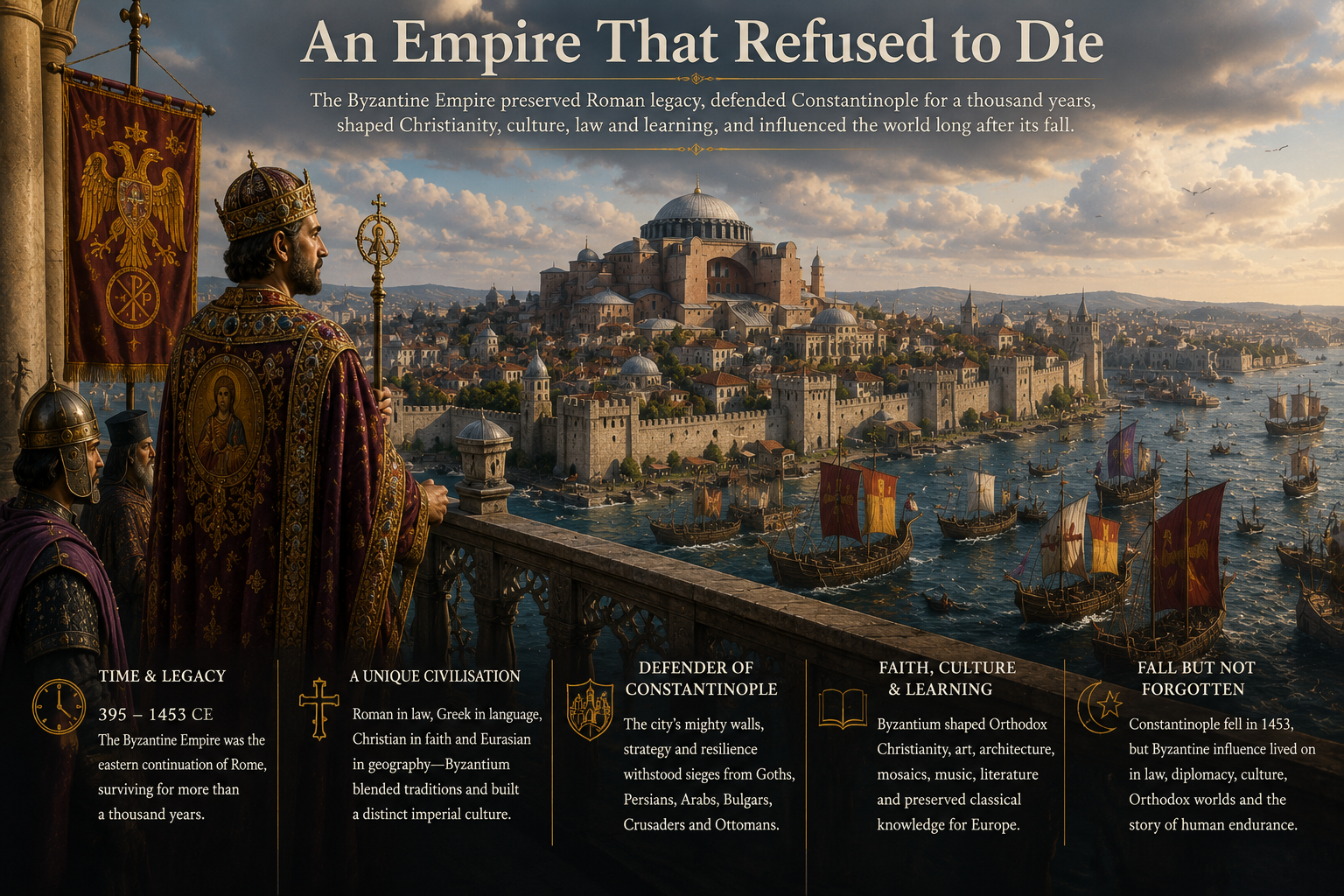
An Empire That Refused to Die
The Byzantine Empire is often described as a survival, but that word is too small for what it achieved. It was not merely the remnant of Rome, not merely a Christian kingdom clinging to old glory, and not merely a defensive wall between Europe and Asia. For more than a thousand years, it preserved Roman political identity, transformed Christianity into imperial culture, defended Constantinople against repeated sieges, influenced Slavic and Orthodox worlds, transmitted classical learning, and shaped the medieval Mediterranean. Its story is one of adaptation: Roman law in a Greek-speaking world, Christian theology within imperial politics, ancient urban traditions under medieval pressures, and strategic survival between Persians, Arabs, Bulgars, Crusaders and Ottomans.
The phrase “Byzantine Empire” is modern. The people we call Byzantines generally thought of themselves as Romans. Their empire was the eastern continuation of the Roman Empire, centred on Constantinople, the city founded by Constantine on the site of Byzantium. Britannica places the Byzantine Empire from roughly 395 CE, after the division of the Roman Empire, to 1453, when Constantinople fell to the Ottomans. That span itself is astonishing. While western Roman imperial authority collapsed in the fifth century, the eastern empire endured, changed and repeatedly reinvented itself. Its thousand-year reign was not a straight line of power. It was a long argument with catastrophe.
Time, Place and the Roman East
The Byzantine Empire’s geographical heart was Constantinople, positioned between Europe and Asia and between the Black Sea and the Mediterranean. This location made the city one of the most strategic capitals in world history. It controlled movement through the Bosporus, linked maritime and land routes, and stood behind massive defensive walls. Geography gave Byzantium both opportunity and danger. It could tax trade and project influence, but it also attracted enemies.
The empire’s territory changed constantly. At different moments it controlled the Balkans, Asia Minor, Syria, Egypt, North Africa, parts of Italy, the Aegean, Cyprus and the eastern Mediterranean. At other moments it shrank to a handful of territories around Constantinople. Its history must therefore be understood as a shifting map rather than a fixed state.
Culturally, Byzantium combined Roman, Greek, Christian and Near Eastern elements. Latin remained important in early administration and law, but Greek became the dominant language of government and culture. Christianity moved from persecuted faith to imperial identity. The emperor was not only a political ruler; he was expected to defend orthodoxy, convene councils, support the church and protect the Christian commonwealth.
This combination made Byzantium distinctive. It was Roman in name and law, Greek in language, Christian in ideology and Eurasian in geography. Its survival depended on the ability to hold these identities together while confronting enemies on every frontier.
Before Byzantium: Rome, Constantine and the New Capital
The Byzantine story begins inside Roman history. By the third and fourth centuries CE, the Roman Empire had become too large and complex to govern easily from one centre. Political instability, military pressure, economic strain and administrative needs encouraged division of authority. Constantine the Great transformed the old city of Byzantium into Constantinople, formally dedicating it in 330 CE as a new imperial capital.
Constantinople was chosen with strategic genius. It was easier to defend than Rome, closer to the wealthy eastern provinces, near major trade routes and well positioned to respond to threats from the Danube, the Balkans, Persia and the eastern Mediterranean. The city became the hinge of empire.
The conversion of Constantine and the later Christianisation of imperial life also changed the meaning of Roman power. The empire was no longer simply the protector of pagan civic religion; it became entangled with Christian doctrine, church authority and theological debate. This gave the later Byzantine Empire its central ideological character.
When the western Roman Empire weakened and eventually lost its imperial structure in the fifth century, the eastern empire survived. This survival was not accidental. The East had stronger cities, richer tax bases, more defensible geography and deeper administrative continuity. Byzantium was therefore not a ghost of Rome. It was the part of Rome that adapted most successfully to the new medieval world.
Justinian and the Dream of Restoration
The reign of Justinian I in the sixth century represents one of Byzantium’s great peaks. Justinian attempted to restore Roman authority across the Mediterranean. His generals Belisarius and Narses reconquered North Africa from the Vandals, Italy from the Ostrogoths and parts of southern Spain. For a time, the empire seemed to revive the old Roman Mediterranean vision.
Justinian’s achievements were not only military. His legal codification, the Corpus Juris Civilis, became one of the most important legal projects in world history. It preserved and organised Roman law in a form that would later influence European legal traditions. His building programme reshaped Constantinople, most famously through Hagia Sophia, whose vast dome and sacred architecture embodied imperial Christianity.
Yet Justinian’s reign also revealed the cost of restoration. Wars were expensive. The plague that struck during his reign devastated populations and economies. Italy, though reconquered, was exhausted. The empire expanded dramatically but inherited new burdens. Justinian’s dream of restoring Rome stretched resources and left successors facing dangerous pressures.
This is a recurring Byzantine pattern: brilliance accompanied by strain. Justinian showed the empire’s ambition, administrative sophistication and cultural power, but also the danger of overextension. His reign was both a golden moment and a warning that restoration could consume the strength needed for survival.
Persians, Arabs and the Crisis of the Seventh Century
The seventh century nearly destroyed Byzantium. Long wars with the Sasanian Persian Empire exhausted both great powers. The Persians captured major eastern territories, including Syria, Palestine and Egypt, and even threatened Constantinople. Emperor Heraclius eventually counterattacked and defeated the Persians, but the victory came at enormous cost.
Almost immediately, a new force emerged from Arabia. The rise of Islam transformed the political map of the Near East. Arab Muslim armies defeated Byzantine forces and took Syria, Palestine and Egypt. These were not marginal provinces. Egypt was a major grain source; Syria and Palestine were wealthy and religiously significant. Their loss fundamentally changed the empire.
The Byzantine Empire survived this crisis by becoming smaller, more militarised and more Anatolian in focus. It reorganised defence and administration, especially through systems often associated with the themes, military-administrative districts that helped support frontier defence. The empire could no longer claim easy control of the old eastern Mediterranean. It had to become a fortress civilisation.
This turning point is central to the thousand-year reign. Byzantium survived because it accepted transformation. It ceased to be the broad eastern Roman Mediterranean empire of late antiquity and became a medieval Christian empire centred on Constantinople and Asia Minor. Survival required contraction, discipline and strategic patience.
Constantinople: City of Walls, Faith and Wealth
Constantinople was the empire’s greatest asset. Its walls, especially the Theodosian land walls, made it one of the hardest cities in the world to capture before the age of large cannon. Its harbours connected it to maritime trade. Its palaces, churches, markets and ceremonial routes made it the stage on which imperial authority was performed.
The city was not merely a military stronghold. It was a sacred capital. Hagia Sophia stood as the architectural and spiritual heart of imperial Christianity. Processions, relics, icons and liturgies tied the city to divine protection. The emperor’s authority was displayed through ceremony that fused Roman political inheritance with Christian symbolism.
Economically, Constantinople benefited from its position between seas and continents. Goods moved through its markets from the Black Sea, Mediterranean, Balkans, Anatolia and beyond. Even when the empire’s territory shrank, the capital could retain disproportionate influence because of its location and prestige.
The city’s symbolic power was so great that enemies repeatedly sought it. Persians, Arabs, Bulgars, Rus, Crusaders and Ottomans all understood that Constantinople was more than a city. It was the key to imperial legitimacy. As long as Constantinople stood, Byzantium remained more than a regional state. It remained Rome in the East.
Iconoclasm and the Battle Over Sacred Images
One of the most intense internal struggles in Byzantine history was iconoclasm, the controversy over religious images in the eighth and ninth centuries. Iconoclast emperors opposed the veneration of icons, arguing that it could become idolatrous and that divine favour required purification of religious practice. Icon defenders insisted that images of Christ, Mary and the saints were legitimate because the incarnation made representation possible.
This was not a small artistic dispute. It touched theology, imperial authority, monastic power and popular devotion. Icons were central to Byzantine religious life. They were carried in processions, placed in churches and homes, and treated as windows to the holy. To attack them was to reshape the emotional and visual world of the empire.
Iconoclasm also shows how Byzantine emperors understood their role. They did not see religion as separate from politics. The emperor was expected to defend true belief and preserve divine favour for the empire. Religious error could be imagined as a political danger.
The eventual restoration of icon veneration in 843, celebrated as the Triumph of Orthodoxy, became a defining moment in Byzantine identity. It strengthened the visual culture of Eastern Christianity and reinforced the importance of icons in Orthodox spirituality. The conflict revealed Byzantium’s inner intensity: an empire fighting not only enemies outside its walls, but also arguments about how God should be seen.
Mission, Slavs and the Orthodox Commonwealth
Byzantium’s influence extended far beyond its changing borders through religion, diplomacy and culture. One of its most enduring achievements was the Christianisation and cultural shaping of Slavic worlds. Missionaries such as Cyril and Methodius, associated with the ninth century, helped bring Christianity and literacy to Slavic peoples. Their work contributed to the development of Slavic liturgical culture and scripts connected to the later Cyrillic tradition.
This was not conquest in the simple military sense. It was civilisational projection. Through Christianity, liturgy, law, art and court models, Byzantium influenced Bulgaria, Serbia, Rus and other regions. Rulers who adopted Orthodox Christianity entered a symbolic world in which Constantinople was a spiritual and cultural reference point.
The conversion of Kievan Rus in the late tenth century was especially significant. It helped transmit Byzantine religious and artistic traditions into eastern Europe and laid foundations for later Russian Orthodox identity. Even when Byzantine armies were weak, Byzantine culture could travel.
This soft power was one of the empire’s greatest strengths. It shows that a civilisation’s influence cannot be measured only by territory. Byzantium shaped alphabets, churches, icons, laws and political imagination across eastern Europe. Its thousand-year reign therefore continued outside the imperial map. The empire’s frontiers moved, but its cultural radiation endured.
The Macedonian Renaissance and Imperial Recovery
From the ninth to the eleventh centuries, Byzantium experienced a major recovery often associated with the Macedonian dynasty. The empire strengthened its administration, expanded militarily, revived learning and produced impressive artistic and literary works. This period is sometimes called the Macedonian Renaissance, though the term should be used carefully. It was not a Renaissance in the later Italian sense, but it did involve renewed interest in classical texts, scholarship and imperial culture.
Byzantine armies pushed back against Arab frontier powers and expanded into the Balkans and eastern Anatolia. Emperor Basil II, remembered as one of the strongest Byzantine rulers, defeated Bulgaria after a long struggle and restored imperial dominance in the Balkans. The empire once again appeared formidable.
The recovery shows that Byzantium was not simply declining for a thousand years. It experienced repeated cycles of contraction and revival. Its institutions could regenerate. Its military system could adapt. Its culture could preserve old learning while producing new forms.
Yet success again contained danger. Expansion required resources and strong leadership. The empire depended on capable emperors, disciplined armies and a balance between central authority and provincial elites. After Basil II, internal tensions grew. Aristocratic landholding, court politics and military pressures weakened the system. Byzantium had recovered, but recovery did not make it invulnerable.
The Seljuks, Manzikert and the Loss of Anatolia
The Battle of Manzikert in 1071 was one of the major turning points in Byzantine history. Emperor Romanos IV Diogenes was defeated by the Seljuk Turks, and although the battle itself did not immediately destroy the empire, its political consequences were severe. Civil conflict after the defeat weakened Byzantine ability to defend Anatolia, the empire’s core recruiting and tax base.
The loss of much of Anatolia changed everything. Byzantium had survived earlier by making Asia Minor its fortress. When Turkish powers established themselves there, the empire lost strategic depth, manpower and revenue. The capital remained strong, but the land behind it was no longer securely imperial.
Manzikert also contributed indirectly to the Crusades. Byzantine appeals for western military assistance helped set in motion events that became the First Crusade. For a time, the Crusades seemed to offer help against Islamic powers. But cooperation between Byzantines and western crusaders was filled with mistrust, cultural difference and competing political goals.
The deeper lesson of Manzikert is that empires can survive battlefield defeat but struggle with political fragmentation afterward. The battle exposed military weakness, but civil conflict magnified it. Byzantium’s decline was not caused by one defeat alone. It was caused by the inability to convert crisis into unity.
The Fourth Crusade and the Wound of 1204
If Manzikert weakened Byzantium, the Fourth Crusade nearly destroyed it. In 1204, western crusaders captured and sacked Constantinople, establishing a Latin Empire and dividing Byzantine territories among crusader and Venetian interests. This was one of the most traumatic events in Byzantine history. A crusade originally directed toward the eastern Mediterranean turned against the greatest Christian city of the East.
The sack damaged not only buildings and wealth but also trust between eastern and western Christians. Relics, artworks and treasures were taken. Political authority was shattered. Byzantine successor states emerged, including Nicaea, Epirus and Trebizond. In 1261, the empire was restored in Constantinople under Michael VIII Palaiologos, but it was a weakened restoration.
The Fourth Crusade reveals how external enemies and internal Christian divisions combined to undermine Byzantium. The empire had long balanced diplomacy with western powers, Italian merchants and crusader states. But commercial rivalries, dynastic disputes and religious tensions created a lethal situation.
After 1204, Byzantium was never again the same imperial power. It recovered the capital but not the full economic and military base that had sustained its earlier greatness. The wound remained. The empire survived for two more centuries, but increasingly as a shadow of its old self, rich in culture and legitimacy but poor in resources.
The Final Centuries and the Ottoman Advance
The final centuries of Byzantium were marked by cultural brilliance and political weakness. The Palaiologan period produced important art, theology and scholarship, but the empire’s territory shrank. Civil wars, economic dependence on Italian maritime powers and the rise of Ottoman power left Constantinople increasingly isolated.
The Ottomans emerged in northwestern Anatolia and expanded into the Balkans, surrounding Byzantine territories. By the fifteenth century, Constantinople was an imperial capital with very little empire left. Its walls still stood, and its symbolic prestige remained immense, but the material foundations of resistance had eroded.
In 1453, Sultan Mehmed II besieged Constantinople. Britannica notes that the city fell on May 29, 1453, after the Ottomans breached its ancient land walls following a long siege supported by cannon. The fall ended the Byzantine Empire as a political state. For contemporaries, it was a world-historical moment: the old Roman capital of the East had passed into Ottoman hands.
Yet the end was not simply military. It was the conclusion of centuries of contraction, fiscal weakness, geopolitical encirclement and failed western aid. Constantinople fell because courage and walls could no longer compensate for lost territory, reduced manpower and Ottoman artillery. The empire that had survived so many disasters finally met a power it could not outlast.
Historical Debates: Roman, Greek or Byzantine?
Historians continue to debate how best to describe the Byzantine Empire. Was it Roman? Greek? Medieval? Eastern Christian? The answer is that it was all of these in different ways. Its people called themselves Romans, and its emperors claimed Roman continuity. Its administrative and legal traditions came from Rome. Yet its language became Greek, its religion Orthodox Christian, and its cultural world distinct from the Latin West.
The term “Byzantine” can sometimes distort understanding by making the empire seem separate from Rome. In reality, Byzantium was Rome’s eastern continuation. The western Roman Empire fell, but Roman imperial identity survived in Constantinople. At the same time, it changed so much that simply calling it Roman can hide its medieval Greek Christian character.
Another debate concerns decline. Older narratives often portrayed Byzantium as decadent, bureaucratic and stagnant. Modern scholarship rejects this caricature. The empire was adaptive, resilient and culturally productive. It preserved learning, innovated in diplomacy, shaped Orthodox Christianity and survived conditions that destroyed many other states.
The better question is not why Byzantium declined, but how it lasted so long. It endured because of strategic geography, administrative continuity, diplomacy, religious identity, military adaptation and cultural prestige. Its fall was dramatic, but its survival was the greater historical achievement.
Law, Bureaucracy and the Administrative Memory of Rome
One reason Byzantium lasted so long was its administrative memory. It inherited from Rome the conviction that rule required law, records, taxation, officials and hierarchy. Even when territory shrank, the empire retained a sophisticated political culture. Imperial commands, legal traditions, fiscal offices and court ranks gave structure to power. This bureaucracy could be frustrating, expensive and faction-ridden, but it also gave Byzantium continuity that many medieval states lacked.
Roman law remained one of the empire’s great inheritances. Justinian’s codification preserved legal material that later shaped European legal thought. Within Byzantium itself, law expressed the emperor’s role as guardian of order. Justice was not merely private morality; it was part of imperial legitimacy. A ruler who failed to protect law endangered the harmony of the Christian commonwealth.
The bureaucracy also connected the capital to provinces. Tax assessment, military supply, landholding records and judicial processes allowed the state to mobilise resources. This did not always work smoothly. Corruption, aristocratic pressure and local resistance existed. Yet the very survival of such systems over centuries reveals institutional depth.
Byzantium’s thousand-year reign cannot be explained by walls alone. Walls protected Constantinople, but administration sustained the empire behind those walls. The Roman genius for law and bureaucracy continued in Greek and Christian form, giving Byzantium a memory of governance that outlived crises.
Art, Icons and the Visual Language of Empire
Byzantine civilisation spoke through images as powerfully as through armies. Mosaics, icons, illuminated manuscripts, church domes, gold backgrounds and solemn frontal figures created a visual world of sacred authority. Byzantine art was not designed mainly to imitate natural appearance. It aimed to reveal spiritual order. The emperor, Christ, the Virgin and the saints appeared within a universe where hierarchy and holiness were visually organised.
Icons were central to this culture. They were not ordinary pictures for believers; they were objects of veneration, presence and prayer. Their importance explains the intensity of the iconoclastic controversy. To attack icons was to attack a way of seeing the sacred. To defend them was to defend the belief that matter could carry divine meaning because God had become visible in Christ.
Imperial art also served diplomacy. Byzantine silks, enamels, manuscripts and ceremonial objects travelled as gifts. Foreign rulers who received them encountered not only luxury but a vision of order. The empire projected prestige through beauty. Even when its armies weakened, its art continued to command admiration.
This visual legacy deeply shaped Orthodox Christianity and influenced medieval art beyond Byzantine borders. The empire’s images survived political collapse. They became one of the main ways Byzantium continued to rule the imagination after it had lost the map.
Diplomacy, Intelligence and the Strategy of Survival
Byzantium survived because it mastered diplomacy as much as warfare. Surrounded by powerful enemies and unstable neighbours, it could not rely on force alone. It used treaties, marriages, subsidies, titles, religious missions, intelligence networks and ceremonial prestige to manage danger. Byzantine diplomacy was often subtle because the empire understood that enemies could sometimes be divided, delayed, converted, bribed or absorbed.
The court at Constantinople used ceremony as political theatre. Foreign envoys were impressed by processions, mechanical devices, golden ornaments, guarded access and carefully staged audiences with the emperor. Such rituals were not empty decoration. They communicated hierarchy. They told visitors that Constantinople stood at the centre of a divinely ordered world.
Diplomacy also allowed Byzantium to compensate for military weakness. When one frontier was threatened, the empire might encourage pressure on another enemy from a different direction. It could use trade privileges to secure alliances or manipulate rival groups beyond its borders. These techniques did not always succeed, but they bought time. Time was one of Byzantium’s greatest weapons.
This strategic culture is part of the meaning of the word Byzantine in later political language, though often unfairly reduced to intrigue. In historical reality, Byzantine diplomacy was the art of survival under pressure. It allowed the empire to endure long after brute strength alone would have failed.
Economy, Coinage and the Material Base of Survival
Byzantium’s survival also depended on money. The empire inherited and maintained a sophisticated fiscal tradition in which taxation, coinage and state expenditure were central. The gold solidus, introduced in late Roman times, became one of the most trusted currencies of the Mediterranean for centuries. Stable coinage helped support trade, pay soldiers and express imperial credibility. A state whose coin was trusted possessed a form of power that outlasted battlefield victories.
Agriculture remained the foundation of wealth. Peasants, estates and provincial taxation supplied the resources that maintained armies and bureaucracy. When the empire lost rich provinces such as Egypt and Syria, its fiscal base narrowed. When Anatolia was weakened, the state lost another major pillar. Byzantine history can therefore be read as a struggle to preserve the economic base required for imperial politics.
Trade mattered as well, especially through Constantinople. Silk, grain, wine, oil, metals, slaves, spices and luxury goods moved through Byzantine routes and markets. Italian maritime republics such as Venice and Genoa later gained increasing commercial privileges, which helped Byzantine trade but also reduced imperial control over economic life.
The empire’s decline was not only military. It was fiscal. Once Byzantium could no longer reliably tax, pay, provision and command, its walls defended memory more than power.
Monasticism, Learning and Everyday Piety
Beyond emperors and battles, Byzantine civilisation was sustained by monasteries, churches, schools, families and rituals of everyday piety. Monastic communities preserved manuscripts, produced theological writing, cultivated land, cared for pilgrims and served as centres of spiritual authority. Monks could support emperors, oppose them or become voices of conscience during theological disputes.
Education also mattered. Byzantine elites studied grammar, rhetoric, philosophy, scripture and classical texts. The empire preserved much ancient Greek literature because scholars copied, taught and commented upon it. This preservation was not passive storage. Byzantine intellectuals interpreted classical inheritance through Christian frameworks and used it in administration, theology and literature.
Everyday religion shaped identity more deeply than imperial ideology alone. Baptism, icons, saints’ days, fasting, liturgy, relics and pilgrimage gave ordinary people a sense of belonging to a sacred order. The empire was not just ruled from the palace; it was lived through the church calendar and the rhythms of worship.
This social and spiritual world explains Byzantium’s resilience. Even when territories were lost, communities remained attached to Orthodox practice and Roman-Christian memory. The empire survived as culture before and after it survived as state.
Why Byzantium Matters to the History of Europe and Asia
Byzantium matters because it prevents history from being divided too neatly into East and West. It was European and Asian, Roman and Greek, ancient and medieval, imperial and religious. It stood at the crossroads of worlds that modern categories often separate. Through Constantinople, the empire connected the Black Sea, Mediterranean, Balkans, Anatolia and Near East. Through Orthodoxy, it connected Greek, Slavic and later Russian religious histories. Through law and learning, it connected classical antiquity to medieval and early modern Europe.
Its history also corrects the idea that the Middle Ages were only a western European story. While many western kingdoms were still developing stable institutions, Byzantium maintained an imperial court, tax system, diplomatic service, theological culture and monumental capital. It negotiated with Islamic caliphates, steppe peoples, crusaders and Italian merchants. It belonged to the same world as Baghdad, Damascus, Venice, Kiev, Cairo and Rome.
For modern readers, Byzantium’s value lies in its complexity. It shows that civilisations survive not by remaining pure but by adapting. It absorbed, resisted, translated and transformed influences. Its thousand-year reign was never static. It was a long exercise in strategic memory: remembering Rome while becoming something Rome had never been.
A Civilisation of Endurance
The simplest measure of Byzantium is endurance, but endurance here does not mean passive survival. It means rebuilding after plague, reorganising after invasion, negotiating after defeat, defending walls after economic exhaustion and preserving identity after territorial loss. The empire lasted because it repeatedly found new forms for old legitimacy. It could be Roman without Rome, Greek without abandoning Roman memory, Christian without becoming merely a church, and imperial even when reduced to fragments. This capacity to redefine continuity is the heart of Byzantine history.
A Final Analytical Layer
The subject also deserves one final analytical layer. A historical narrative is never only a sequence of events; it is an explanation of how structures, choices and memories interact. In the case of The Byzantine Empire’s Thousand Year Reign, the central story is not only about personalities or dates. It is about how geography, institutions, belief, economy and communication create durable historical change. Routes matter because they move people and ideas. Capitals matter because they concentrate authority. Texts matter because they turn experience into memory. Religious and political institutions matter because they outlive individual rulers. This is why the topic continues to matter for modern readers: it shows that civilisation is not made by one force alone. It emerges when material conditions and human imagination reinforce each other.
The topic also shows the need for balanced interpretation. Historical actors did not live inside the categories later generations impose upon them. They acted within their own worlds of faith, ambition, fear, duty, profit and honour. To understand them properly, one must avoid both blind admiration and easy dismissal. The past is most useful when it is treated neither as propaganda nor as a museum of dead facts, but as a living field of human choices. That is why the legacy of The Byzantine Empire’s Thousand Year Reign remains powerful. It invites us to see history as continuity, conflict and transformation at the same time.
Legacy: The Empire After the Empire
The Byzantine Empire ended in 1453, but its legacy did not. Orthodox Christianity continued across Greece, the Balkans, Russia and the eastern Mediterranean. Byzantine art shaped icons, mosaics, church architecture and sacred aesthetics. Byzantine law and political ideas influenced later states. Greek scholars fleeing or travelling west contributed to the transmission of classical learning, especially in the context of the Italian Renaissance. The Ottoman Empire inherited Constantinople and transformed it into Istanbul, but the city’s Byzantine past remained visible in stone, memory and sacred architecture.
The empire’s most powerful legacy may be its demonstration that civilisation is continuity through change. Byzantium preserved Roman identity while becoming something new. It defended Christianity while arguing constantly about doctrine. It lost provinces yet retained influence. It suffered catastrophes yet repeatedly recovered.
Its thousand-year reign also challenges western-centred historical narratives. Medieval history was not only feudal Europe and Latin Christendom. Constantinople was, for centuries, one of the world’s great capitals, a centre of diplomacy, theology, art and imperial ceremony. To ignore Byzantium is to misunderstand the bridge between antiquity and the modern world.
The Byzantine Empire refused to die quickly because it possessed more than armies. It possessed memory, institutions, faith, walls, diplomacy and a capital that embodied destiny. Its fall was an end, but its legacy became a form of afterlife. Byzantium survived by adaptation, and after 1453 it survived as inheritance.