Why Indian Stocks Are Falling: How Rising Oil Prices Affect India
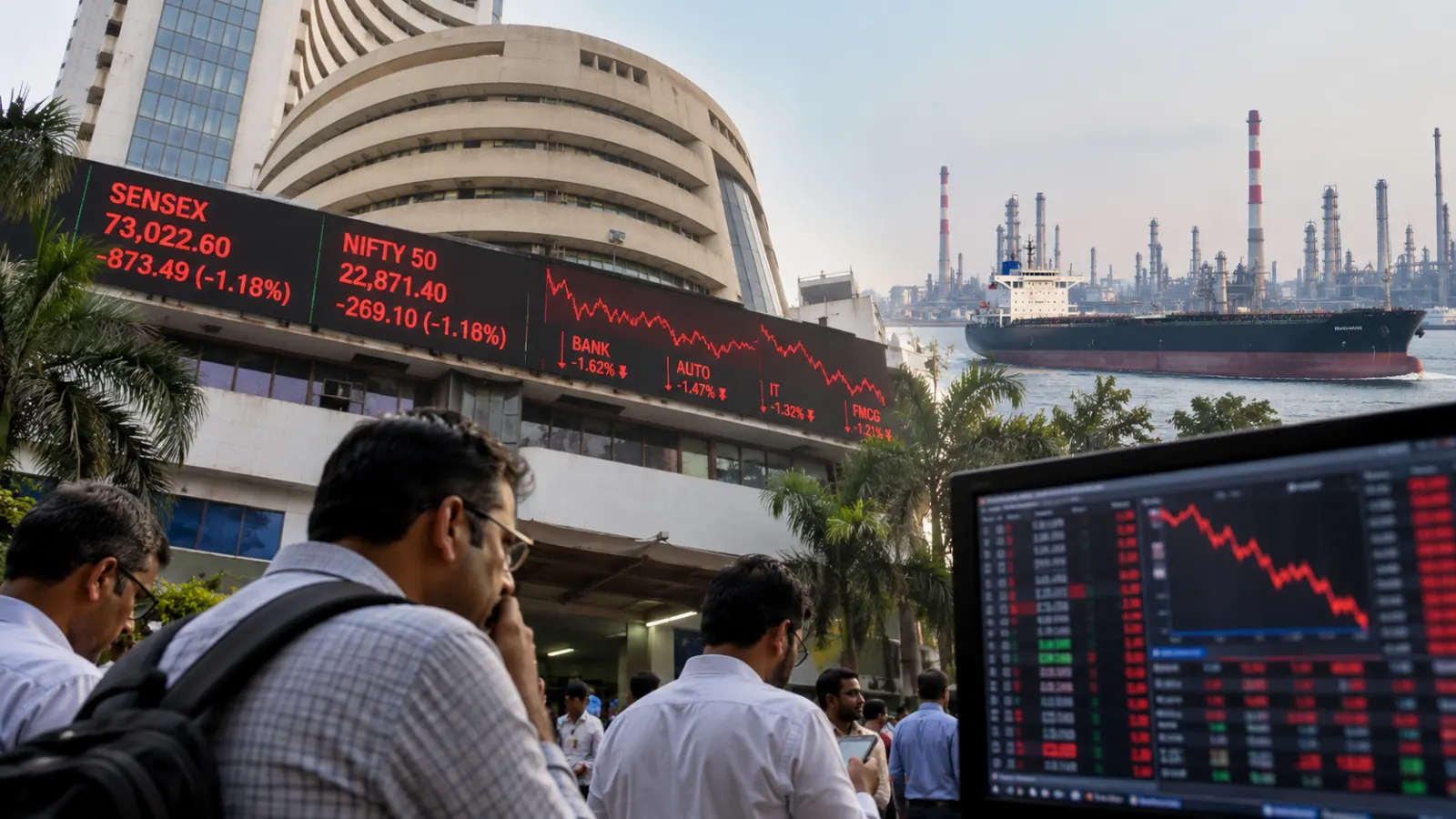
Indian stock markets came under renewed pressure on September 28, with the Sensex and Nifty falling to nearly six-month lows as rising crude-oil prices, persistent foreign selling and geopolitical uncertainty weakened investor sentiment. The decline extended a seven-week losing streak that has already erased nearly 6% from the benchmark indices. By around 10 am, the Nifty 50 was down 1.16% at 22,871.40, while the BSE Sensex had fallen 1.18% to 73,022.60. All 16 major sectoral indices were trading lower. Reuters
The immediate trigger was another rise in global crude prices after efforts to ease tensions involving the United States and Iran failed to produce a breakthrough. Brent crude climbed around 2.3% to approximately $106.70 a barrel, reviving concerns about supplies passing through the Strait of Hormuz. For India, which imports most of the crude oil it consumes, expensive oil affects far more than petrol and diesel prices. It can influence inflation, the rupee, interest rates, corporate profits and eventually household spending. Reuters
Why rising crude oil hurts India more than many economies
India is one of the world's largest crude-oil consumers but produces only a fraction of what it requires domestically. This means a large part of India's energy requirement must be purchased from overseas suppliers and generally paid for in US dollars.
When crude rises from $80 to above $100 a barrel, India must spend substantially more foreign currency to purchase roughly the same amount of oil. This increases the country's import bill and can widen the current-account deficit—the gap created when the value of goods and services India imports exceeds what it exports.
The pressure does not stop at the national balance sheet. Higher international oil prices affect the cost of petrol, diesel, aviation fuel, petrochemicals, plastics, paints, tyres, synthetic fibres and transportation. Even businesses that do not directly consume large quantities of crude can be affected because virtually every physical product needs to be transported.
India is particularly sensitive to this transmission because energy is embedded throughout the economy. A truck carrying vegetables to Delhi uses diesel. Airlines consume aviation turbine fuel. A logistics company operating thousands of vehicles sees fuel costs increase. Manufacturers face more expensive freight and raw materials. Companies then have to decide whether to absorb those costs or pass them to customers.
This is why oil can transform from an energy-market issue into an economy-wide inflation problem.
Reuters noted that India is the world's third-largest crude importer and that higher oil prices risk increasing inflation, widening the import bill and squeezing corporate margins. Reuters
Why stocks fall when oil rises
Stock prices represent expectations about companies' future profits. When investors believe costs are likely to rise faster than revenues, they may reduce the price they are willing to pay for those companies.
Consider an airline. Fuel represents one of its largest operating expenses. A sharp rise in oil can substantially increase costs. Unless ticket prices rise sufficiently, profit margins can fall.
The same principle applies to cement manufacturers, logistics companies, paint producers, tyre manufacturers, chemical companies and many consumer-goods businesses.
Banks may appear less directly connected to crude oil, but the effect can reach them through interest rates and economic growth. On September 28, the Nifty financial-services and banking indices were both down about 1.6% in morning trade. HDFC Bank fell approximately 1.8%, ICICI Bank around 1.7% and Reliance Industries about 1.4%. Reuters
The weakness across all 16 major sectors showed that investors were not simply selling energy-sensitive companies. They were reassessing the broader economic consequences of sustained high oil prices.
Small-cap and mid-cap indices also fell approximately 1.1%, suggesting risk aversion had spread beyond India's biggest companies. Reuters
Oil can weaken the rupee as well
Higher oil prices create another problem because crude is typically purchased internationally in dollars.
Indian refiners need dollars to pay overseas suppliers. When the value of India's oil imports increases, demand for dollars can increase as well. If dollar demand rises faster than supply, the rupee can come under depreciation pressure.
A weaker rupee then makes imported crude even more expensive in rupee terms.
This creates a potentially uncomfortable cycle:
oil becomes expensive → India needs more dollars → the rupee faces pressure → imported oil becomes even more expensive in rupee terms.
The effect can extend to other imports as well. Electronics, machinery, chemicals and many industrial inputs purchased internationally become more expensive when the rupee weakens.
Currency markets have already been sensitive to movements in crude. Earlier in September, Reuters reported that oil-price fluctuations and expectations of Reserve Bank of India intervention were major drivers of the rupee. Reuters
For equity investors, a weaker currency can have mixed effects. Export-oriented IT and pharmaceutical companies may benefit because they earn substantial revenue in foreign currencies. But companies dependent on imports can experience higher costs.
The broader market may still react negatively if currency weakness raises concerns about inflation and monetary policy.
Higher oil can complicate RBI's interest-rate decisions
The Reserve Bank of India faces another challenge when crude remains expensive: inflation.
If transportation, manufacturing and imported goods become more expensive, consumer prices can eventually rise. Persistent inflation can make it difficult for the RBI to reduce interest rates and, in extreme circumstances, may strengthen the case for higher rates.
Higher interest rates affect stocks in several ways.
Borrowing becomes more expensive for households and businesses. Home loans, vehicle loans and corporate financing can become costlier. Consumers may postpone large purchases. Companies may delay investments. Economic growth can slow.
At the same time, bonds and fixed-income investments become relatively more attractive when interest rates rise, potentially reducing investors' willingness to pay high valuations for equities.
The pressure is already visible in India's bond market. Reuters reported recently that the RBI has been draining excess liquidity through bond sales and foreign-exchange operations as policymakers respond to high oil prices, inflation risks and a weaker rupee. Reuters
So when stock-market investors react to crude oil, they are not simply predicting higher petrol prices. They are attempting to estimate a chain reaction involving inflation, currency markets, interest rates and corporate earnings.
Why the US-Iran situation matters to Indian investors
The latest jump in crude came after renewed uncertainty surrounding efforts to reduce tensions involving the United States and Iran.
US President Donald Trump said he had rejected an Iranian proposal linked to reopening the Strait of Hormuz and ending the fighting, while Iran continued to argue for a diplomatic solution. The failure to achieve a breakthrough revived fears over oil supplies moving through the strategically important shipping route. Reuters
The Strait of Hormuz is important because a significant share of internationally traded oil passes through it.
Markets do not necessarily need actual supply disruption to push oil prices higher. If traders believe there is a meaningful risk that tankers could face delays, attacks or restrictions, they may build a geopolitical risk premium into crude prices.
That can make oil expensive even before physical shortages occur.
For India, developments thousands of kilometres away can therefore have immediate consequences for domestic financial markets.
A diplomatic breakthrough can push oil prices down and support Indian stocks. A deterioration in the conflict can produce the opposite reaction.
This explains why Indian equity markets have recently become unusually sensitive to every development involving Iran, the United States and the Strait of Hormuz.
Foreign investors are adding another layer of pressure
Oil is not the only reason Indian markets have been weak.
Foreign institutional investors have also been selling Indian equities. According to NSDL data cited by Upstox, foreign investors had sold around ₹17,131 crore of Indian shares during September, after purchasing approximately ₹49,831 crore over July and August combined. Upstox - Online Stock and Share Trading
Foreign investors can reduce exposure to emerging markets when global uncertainty rises, US bond yields increase or the dollar strengthens.
India can become particularly vulnerable because its stock-market valuations have historically traded at premiums to several other emerging markets. When global investors become more cautious, high valuations can make profit-taking easier to justify.
The combination becomes especially difficult when several pressures occur simultaneously:
rising crude prices, a weaker rupee, foreign selling, higher bond yields and uncertainty about corporate earnings.
That combination helps explain why the Sensex and Nifty have now declined for seven consecutive weeks, one of their longest losing streaks in years. Reuters
Which sectors are most vulnerable to expensive oil?
Not every company reacts to oil in the same way.
Airlines are among the most directly exposed because aviation fuel is a major expense. Paint manufacturers depend heavily on crude-derived raw materials. Tyre, plastic and chemical companies can face similar cost pressures.
Transport and logistics businesses can see diesel expenditure increase. Consumer companies may experience higher packaging and distribution costs. Automobile companies can also face indirect pressure if inflation and higher interest rates make consumers less willing to make expensive purchases.
Oil refiners and producers are more complicated.
A higher crude price can benefit companies involved in domestic oil production because the product they sell becomes more valuable. But refining companies may face pressure depending on government pricing policies, refining margins and how rapidly higher raw-material costs can be passed to customers.
Information-technology exporters are less directly affected by crude, although they remain sensitive to global economic conditions and currency movements.
This is why investors need to avoid treating a market-wide fall as though every company faces the same underlying risk.
The benchmark can fall because the economic environment becomes less favourable while individual businesses still perform very differently.
Should investors panic when Sensex falls 1,000 points?
A sharp headline such as “Sensex crashes 1,000 points” naturally attracts attention, but the point figure alone can exaggerate how dramatic a move actually is.
Because the Sensex currently trades above 70,000, a 1,000-point decline represents roughly 1.3% to 1.4%. That is significant for one trading session but well within the kind of volatility equity markets can experience during periods of geopolitical uncertainty.
The more meaningful development is not one individual day's decline.
It is the persistence of the weakness.
The Sensex and Nifty have now fallen for seven consecutive weeks and lost nearly 6% over that period. Reuters
A prolonged decline suggests investors are reassessing economic conditions rather than merely reacting to one headline.
That still does not mean the market will necessarily continue falling. Markets often turn before the underlying news improves because investors attempt to anticipate future conditions.
If crude falls sharply, diplomatic negotiations improve, foreign capital returns or inflation expectations ease, sentiment can reverse quickly.
Trying to predict the precise bottom is therefore extremely difficult.
Why cheaper oil could rapidly change the picture
The same mechanisms currently hurting India can work in reverse.
If Brent crude falls materially, India's import bill decreases.
Lower energy costs can reduce inflation pressure.
A lower import bill can support the rupee.
Reduced inflation can give the RBI greater flexibility on interest rates.
Companies may experience lower freight, fuel and raw-material costs.
Consumers may retain more disposable income.
Investors may consequently become more willing to own Indian equities again.
This helps explain why stock markets sometimes rally sharply after diplomatic developments that reduce geopolitical risk even if nothing has immediately changed in company earnings.
Investors are pricing the future rather than merely measuring the present.
The September market decline is therefore closely tied to the assumption that elevated crude prices could persist.
If that assumption changes, market expectations can change with it.
What should investors watch next?
The most important variable in the short term is Brent crude.
Oil sustaining levels significantly above $100 a barrel would keep concerns about India's inflation, import bill and corporate margins alive. Brent was trading around $106.70 on September 28 after rising approximately 2.3%. Reuters
The second variable is the US-Iran situation, particularly anything affecting the Strait of Hormuz.
The third is foreign investor activity. Continued heavy FII selling can keep markets under pressure even when domestic investors remain active.
Investors should also watch the rupee, Indian bond yields and upcoming RBI policy signals because these indicators reveal whether high oil prices are beginning to affect broader financial conditions.
Finally, corporate earnings will determine whether the market's concerns are justified. Companies capable of passing higher costs to customers without damaging demand may prove more resilient than businesses operating on narrow margins.
The market decline is really an India oil story
India's current stock-market weakness demonstrates how global energy markets can influence almost every part of the domestic economy.
A geopolitical disagreement affects the Strait of Hormuz.
The possibility of supply disruption pushes crude prices higher.
More expensive crude raises India's import bill.
That pressures inflation and the rupee.
Inflation affects expectations for RBI policy.
Higher financing and input costs affect companies.
And those expectations are ultimately reflected in the Sensex and Nifty.
This is why a movement in Brent crude can wipe hundreds of points from the Sensex before anything has changed at an Indian factory, bank or shopping centre.
For investors, the important question is therefore not simply “Why did the market fall today?”
It is whether expensive oil becomes a temporary geopolitical shock or a sustained economic burden.
If crude remains above $100 for an extended period, pressure on Indian equities may persist. If geopolitical tensions ease and energy prices retreat, several of the forces currently working against India could begin reversing simultaneously.
For now, markets are pricing the risk that oil stays expensive—and India, as a major importer, has more at stake than most.