A disease that broke open the medieval world
The Black Death did not merely kill Europeans; it exposed how deeply medieval society depended on fragile systems of food, trade, belief, labour and trust. It arrived in the middle of the fourteenth century as a disease, but it became a civilisational event because it struck every layer of life at once. Ports became gateways of terror. Roads carried both commerce and infection. Villages watched neighbours vanish within days. Town councils tried to regulate burial, movement and markets while priests, physicians and families struggled to understand a catastrophe for which they had no language adequate to the scale of loss.
Its historical power lies in the fact that it was both biological and social. The bacterium now identified as Yersinia pestis moved through ecological networks of rodents, fleas, ships, grain, markets and human settlement. But once it reached human communities, the pandemic became a test of institutions. Did towns have public health systems? Could churches comfort people when priests also died? Could manorial economies continue when labourers disappeared? Could Christian Europe preserve moral order when fear turned into scapegoating? The Black Death changed Europe because it did not attack one kingdom or one class; it attacked the structure of medieval life itself.
Time, place and the scale of the catastrophe
The main European wave of the Black Death is usually dated from 1347 to 1351. It entered Europe through Mediterranean and Black Sea trading systems and spread with alarming speed across Italy, France, Spain, England, the German lands, Scandinavia and eastern Europe. The pandemic was not confined to Europe; it belonged to a wider Afro-Eurasian crisis connected to Central Asia, the Black Sea, the Middle East, North Africa and long-distance commercial networks. Europe became one of its most documented theatres, but not its only theatre.
The death toll remains debated because medieval demographic records are uneven. A common estimate is that around 25 million people died in Europe between 1347 and 1351, though some regions suffered losses that may have reached a third or even half of the population. Such numbers must not be treated as statistics alone. They represent empty farms, unworked fields, abandoned children, lost clergy, broken guilds, collapsed rents, hurried burials and villages whose social memory was cut in two. In demographic terms, the Black Death was a collapse. In civilisational terms, it was a forced reorganisation of Europe.
Background: a crowded, hungry and connected Europe
The Black Death struck a Europe already under strain. The high medieval centuries had seen population growth, agricultural expansion, urban development, trade revival and the growth of universities, guilds and monarchies. Yet this expansion had limits. Many peasants lived near subsistence. Land was divided among growing populations. Harvest failures in the early fourteenth century, especially during the Great Famine of 1315-1317, weakened bodies and economies. War, taxation and local conflict added further pressure.
The very success of medieval growth created vulnerability. More towns meant denser populations. More trade meant faster transmission. More movement meant wider exposure. Ships connected the Mediterranean; caravans connected inland markets; pilgrimage routes and fairs brought strangers together. Europe was not isolated or static. It was increasingly connected, and connection carried risk. The Black Death therefore arrived in a world that was commercially alive but biologically exposed. The pandemic did not fall on a simple rural society; it struck a complex medieval system whose arteries were roads, ports, markets and rivers.
Origins and routes: from Eurasian ecology to European ports
The exact origin of the Black Death remains debated, but most scholarship places its wider emergence in Eurasian plague reservoirs before it reached the Black Sea and Mediterranean. Medieval accounts connect its arrival in Europe with the Genoese trading post of Kaffa in Crimea, where plague reportedly struck during conflict involving the forces of the Mongol-linked Kipchak khan Janibeg. From the Black Sea, ships carried infection toward Constantinople, Sicily, Genoa, Venice and other ports. Trade was the vehicle through which disease crossed water faster than armies could march.
This route is historically significant because it reveals how deeply medieval Europe had entered the world economy of its time. Italian merchants, Black Sea colonies, grain routes, maritime insurance, cargo movement and port cities formed the infrastructure of profit. That same infrastructure became the infrastructure of contagion. The plague was not a punishment that descended outside history; it moved through human systems. The ships that carried goods also carried rats, fleas, grain dust, cloth, sailors and vulnerability. The Black Death teaches that every network has a shadow.
The disease itself: terror in the body
Medieval people recognised the Black Death through symptoms before they understood its cause. Buboes appeared in the groin, armpit or neck. Fever, vomiting, weakness, delirium and dark blotches terrified families and physicians alike. Some forms of plague attacked the bloodstream or lungs, making death even faster. Modern medicine identifies bubonic, septicemic and pneumonic forms of plague, but fourteenth-century observers saw mainly the speed and horror of physical breakdown.
The psychological shock was intensified by uncertainty. Physicians inherited ideas from Galenic medicine, humoral theory, astrology and miasma explanations. Many believed corrupted air, planetary conjunctions or divine anger played a role. Such explanations were not irrational within their intellectual world; they were attempts to order terror through available knowledge. Yet they could not stop the disease. The failure of existing medical frameworks created a crisis of confidence. When learned medicine, prayer and local remedies all seemed powerless, society faced not only death but the collapse of explanation.
Spread across cities, villages and courts
The Black Death spread through Europe with uneven but devastating speed. Port cities were often early victims because ships linked them to infected zones. From ports, the disease moved inland along trade routes, roads and river systems. Urban density made towns especially vulnerable, but villages were not safe. Rural communities could be infected through travellers, markets, soldiers, clergy, merchants or returning relatives. The disease did not respect the boundary between city and countryside.
This spread changed the geography of fear. A town might hear rumours from another region, then see strangers avoided, then witness the first households die, then watch burial systems break. Authorities sometimes tried quarantine, movement restrictions or sanitation measures, but systematic public health was still undeveloped. Some people fled, unknowingly spreading infection. Others stayed out of duty, poverty or disbelief. The pandemic moved faster than coordinated governance. In this sense, the Black Death revealed the limits of medieval administration: kingdoms could wage war and collect taxes, but they could not yet manage a continent-wide health emergency.
Key actors: merchants, priests, physicians and labourers
The Black Death had no single hero or villain, but it forced many social groups into historic roles. Merchants carried goods through the networks that spread the disease, yet they also kept economies alive. Priests administered last rites, buried the dead and comforted the living, often at enormous personal risk. Physicians observed symptoms, wrote plague treatises and prescribed regimens, even when their remedies failed. Town officials tried to regulate burial, markets, waste, movement and public order.
Labourers became key historical actors after the first wave passed. Because so many workers died, surviving peasants, artisans and servants found their bargaining power changed. Landlords needed hands. Wages rose in many places despite attempts to control them. The pandemic therefore shifted attention from noble lineage to labour scarcity. In the long run, ordinary workers helped reshape post-plague Europe not through ideology but through demographic leverage. Death gave survivors new negotiating power, and that power unsettled the old social order.
Peak of the crisis: when death became social disorder
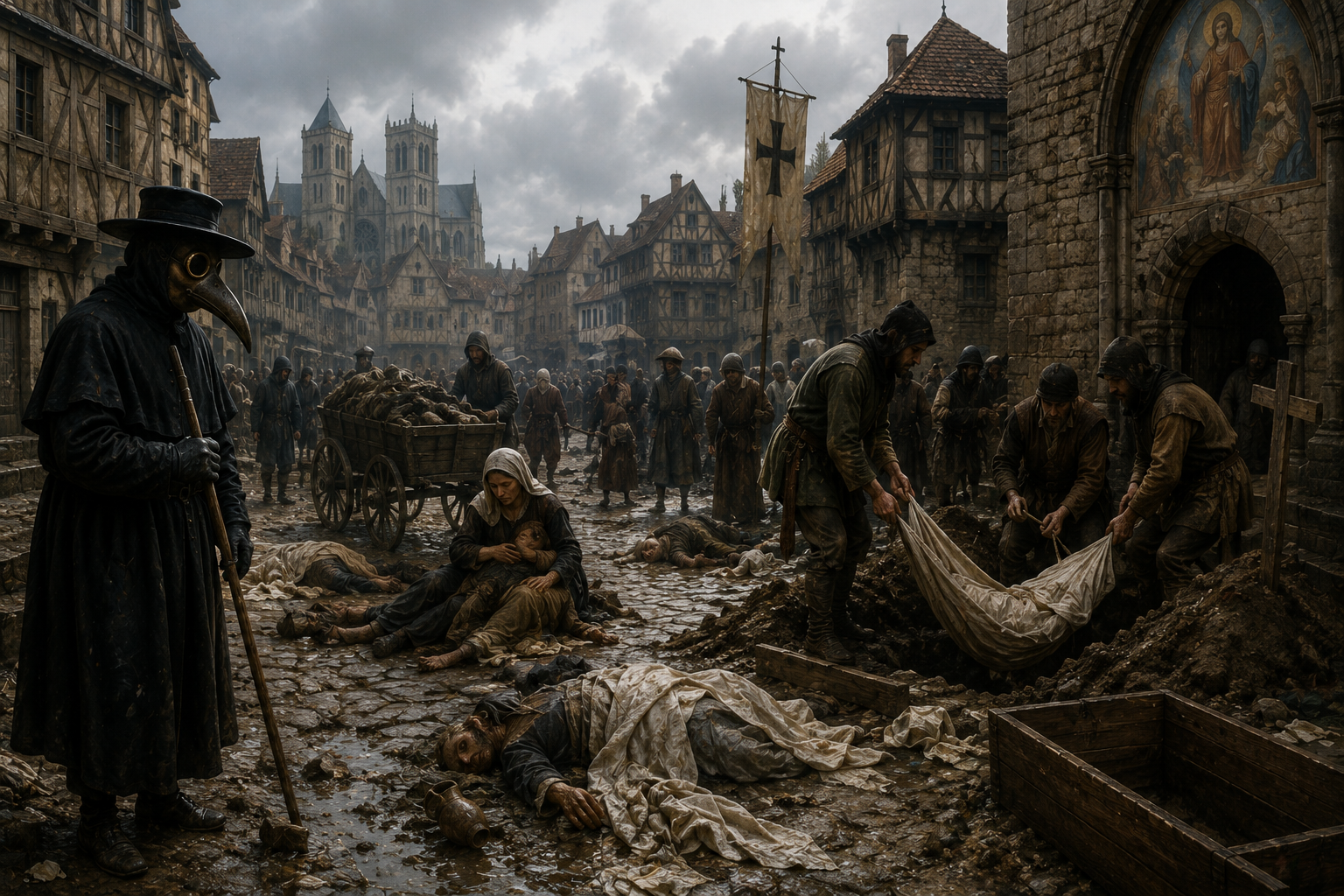
At the height of the pandemic, death overwhelmed normal rituals. Burial grounds filled. Families could not always provide proper funerals. In some towns, mass graves replaced individual remembrance. Priests, monks and nuns died while caring for others, leaving communities spiritually exposed. Chroniclers described deserted streets, silent bells, abandoned homes and the breakdown of ordinary affection under fear of contagion.
The peak of the Black Death was not only a medical emergency. It was a crisis of meaning. Medieval Christianity had taught people to understand suffering through sin, providence, penance and salvation. But the scale and randomness of death raised unbearable questions. Why did the righteous die with the wicked? Why did children die before sinners? Why did prayer not stop the plague? Some responded with repentance and processions; others with fatalism, indulgence or flight. The disease turned theology into lived anguish. A civilisation that had explained the cosmos through divine order now confronted an event that seemed to mock order itself.
Turning point: labour scarcity and the collapse of old balances
After the worst waves passed, Europe did not simply return to normal. The demographic shock transformed economic relations. With fewer workers available, surviving labourers could demand higher wages, better terms or mobility. Landlords tried to preserve pre-plague obligations, but scarcity gave peasants leverage. In England, the Ordinance and Statute of Labourers attempted to freeze wages and restrict worker movement, showing how frightened elites were by the new labour market.
This turning point was revolutionary because it changed the practical value of human labour. Before the plague, population pressure had often favoured landowners. After the plague, labour became precious. Some peasants acquired more land; some commuted labour services into rent; some moved to towns; some challenged seigneurial authority. These changes did not end feudalism overnight, but they accelerated its erosion in several regions. The Black Death therefore became an economic turning point: catastrophe weakened the old manorial balance and opened space for a more mobile, monetised and contested society.
Religious fear, scapegoating and moral violence
The Black Death also produced moral catastrophe. Fear searched for enemies. Jewish communities in parts of Europe were falsely accused of poisoning wells and spreading plague. These accusations led to massacres, expulsions and forced conversions in several regions. Such violence did not arise from disease alone; it drew on older anti-Jewish prejudice, economic resentment and theological hostility. Plague gave hatred a deadly opportunity.
This aspect of the Black Death must remain central to its history. Pandemics do not automatically make societies compassionate. They can deepen solidarity, but they can also intensify suspicion. When people cannot control a crisis, they may try to control a scapegoat. The persecution of Jews during the Black Death shows how public fear can become collective crime. It also reminds us that the legacy of a pandemic includes not only the dead from disease but those killed by social panic. The Black Death changed Europe partly by exposing the violence already embedded within medieval Christian society.
Public health and the birth of new civic habits
The Black Death forced European communities to think more systematically about disease management. Some cities developed quarantine practices, health boards, burial regulations, inspection systems and restrictions on movement. The famous forty-day quarantine associated with later Mediterranean practice did not solve plague, but it marked an important shift: disease became a matter of civic administration, not only private misfortune or divine judgement.
This shift was uneven and slow, yet historically important. Urban governments learned that survival required records, rules and enforcement. Ports became sites of inspection. Officials monitored travellers, ships and goods. Public health emerged from fear, commerce and administrative necessity. The plague did not create modern medicine, but it helped create the idea that collective health could be governed. That idea would become one of the foundations of later European state capacity. In the Black Death’s aftermath, the city began to imagine itself as a body whose health required management.
Cultural responses: death, art and memory
The Black Death left marks on European culture. Art, sermons, poetry and popular imagination became filled with images of death, judgement, skeletons, decay and the equality of all before mortality. The danse macabre, or dance of death, captured a world in which pope, king, merchant, peasant and child could all be led away by the same skeletal figure. Such imagery did not mean medieval people had never thought about death before; Christianity had always placed death at the centre of salvation. But after the plague, death felt closer, more democratic and more unpredictable.
Culture became a way of processing trauma. Chroniclers wrote to preserve memory. Preachers interpreted the disaster. Families endowed masses for the dead. Guilds and towns rebuilt rituals around loss. The plague sharpened awareness of life’s fragility and may have influenced devotional practices, charity, artistic patronage and attitudes toward the body. Its cultural legacy was not simply gloom; it was an intensified consciousness of mortality. Europe learned that civilisation could be interrupted suddenly, and that memory had to fight against disappearance.
Political consequences and the unrest of survivors
The post-plague world was politically unstable. Governments tried to restore old controls, especially over wages and labour obligations, but many subjects no longer accepted the old terms. In England, tensions over labour regulation, taxation and social inequality contributed to the Peasants’ Revolt of 1381. Elsewhere, urban unrest, rural bargaining and class conflict reflected the changed demographic landscape.
The plague did not cause every later revolt directly, but it altered the conditions under which people resisted. When survivors knew that labour was scarce, demands for obedience sounded different. When landlords tried to force pre-plague obligations onto a changed world, resentment deepened. The Black Death therefore weakened the aura of inevitability around social hierarchy. Nobles remained powerful, monarchies continued and the Church survived, but the old order no longer seemed as natural. A civilisation had learned, through horror, that structures could break.
Decline of the first wave and recurrence of plague
The first great wave of the Black Death declined after the early 1350s, but plague did not disappear. It returned repeatedly in later decades and centuries, striking towns and regions in recurrent outbreaks. This recurrence shaped European life long after the initial catastrophe. Communities learned to live with the possibility that death could return by season, ship or rumour.
The long afterlife of plague matters because the Black Death was not a single isolated event. It inaugurated a second plague pandemic that haunted Europe for centuries. Repeated outbreaks encouraged administrative vigilance, changed family strategies, shaped urban planning and sustained religious anxieties. Population recovery was slow in many regions. The initial shock weakened old systems, but recurrence prevented easy reconstruction. Europe after 1351 was not simply post-plague; it was plague-conscious. That consciousness influenced governance, economy and culture over the long term.
Historical debates: cause, scale and transformation
Historians continue to debate several aspects of the Black Death. The role of rats and fleas, the importance of pneumonic transmission, the precise route from Eurasian reservoirs, and regional variations in mortality remain subjects of research. Medieval sources are vivid but uneven, while archaeological, genetic and climatic evidence has expanded modern understanding. The identification of Yersinia pestis in ancient DNA has strengthened the biological explanation, but the social history remains complex.
There is also debate over how far the Black Death caused Europe’s later transformation. Older interpretations sometimes linked it directly to the decline of feudalism, the rise of wages, the Renaissance or modernity. More careful history avoids simple cause-and-effect claims. The plague accelerated some changes, delayed others and affected regions differently. It did not create the Renaissance by itself, nor did it end medieval society overnight. Its importance lies in forcing changes already latent within Europe to unfold under extreme demographic pressure.
Impact beyond Europe: a connected catastrophe
Although this article focuses on Europe, the Black Death must be understood within a wider Afro-Eurasian context. Plague affected the Middle East, North Africa and parts of Asia. Trade routes, imperial networks and ecological zones connected regions in ways that made the pandemic transcontinental. Europe was not the centre of the world; it was one damaged zone within a larger crisis.
This wider perspective matters because it prevents a narrow European story. The same forces that enriched medieval societies through trade and exchange also allowed pathogens to travel. The pandemic belonged to the history of global connection before modern globalisation. It reminds us that interconnected worlds existed long before steamships, railways and airplanes. The Black Death was a medieval event, but its logic was recognisably global: ecology, commerce and human mobility combined to create shared vulnerability across distance.
Legacy: the plague as a warning about civilisation
The Black Death changed Europe because it forced society to confront the fragility beneath its institutions. It weakened manorial structures, shifted labour relations, challenged religious confidence, encouraged public health measures, intensified cultural reflection on death and exposed the cruelty of scapegoating. It did not destroy Europe, but it changed the terms on which Europeans lived, worked, prayed and governed.
Its legacy is powerful because it refuses easy interpretation. The plague was not a divine lesson, a simple economic reset or a direct road to modernity. It was mass suffering. Any legacy must begin there. Yet from that suffering came historical transformation. Survivors negotiated differently. Cities governed disease differently. Artists imagined mortality differently. States learned new responsibilities. The Black Death reminds every civilisation that systems built for prosperity may become channels of disaster. It asks a question that remains urgent: when a society faces mass death, does it become more humane, or does fear make it more violent? Medieval Europe answered in both ways. That is why the Black Death remains not only a historical event, but a mirror of civilisation under stress.
Regional differences across Europe
The Black Death did not strike every region with identical force. Some towns lost a devastating share of their population, while other districts suffered less or recovered more quickly. Geography, climate, trade intensity, housing density, timing of arrival and local administrative response all shaped mortality. Coastal cities and commercial centres were often exposed early because shipping connected them to infected zones, but isolation did not guarantee safety. Mountain valleys, inland villages and northern regions could be affected through market circuits, travellers or later waves.
These variations matter because they prevent a single European story. In some regions, labour scarcity transformed rural relations sharply; in others, elites retained more control. Some cities created stronger public health institutions; others collapsed into panic. Some communities scapegoated minorities brutally; others did so less visibly or under different local pressures. The plague was continental in scope but local in experience. Historical analysis must therefore hold two truths together: Europe faced a shared demographic catastrophe, yet every town, manor, monastery and kingdom lived through it according to its own social structure and ecological exposure.
Family, gender and the intimate history of loss
The plague was not only a public event measured in mortality tables. It was an intimate disaster that entered households. Parents buried children, children lost parents, spouses died within days of one another and inheritance patterns changed suddenly. Wills, property transfers and local records show families trying to organise memory, assets and spiritual care in the face of unpredictable death. The family became one of the main theatres in which the Black Death was experienced.
Gender shaped this experience. Women served as caregivers, mourners, servants, household managers, widows and inheritors in ways that varied by class and region. Labour scarcity sometimes opened opportunities for surviving women in service, craft or property management, but patriarchal structures remained strong. Widows might gain temporary control over resources yet also face vulnerability. The Black Death therefore did not produce simple liberation or simple decline for women. It disrupted domestic life so violently that gender roles had to be renegotiated under pressure, grief and economic necessity.
The manorial order under pressure
The medieval manor depended on predictable relationships between land, labour and obligation. Peasants owed rents, dues or labour services; landlords expected harvests and income; local courts regulated custom. The Black Death shattered the demographic assumptions beneath this order. When tenants died and workers became scarce, landowners could not easily maintain old levels of extraction. Vacant holdings, abandoned fields and competition for labour changed the balance between lord and peasant.
This pressure did not abolish lordship immediately, but it weakened its confidence. In western Europe especially, labour services increasingly gave way to money rents or negotiated arrangements. Some peasants improved their position by moving, bargaining or taking abandoned land. Elites responded with laws trying to control wages and mobility, revealing that the old order now required coercive repair. The plague therefore accelerated the long transformation from a tightly bound manorial economy toward more flexible, market-oriented rural relations. Its economic impact came less from one reform than from millions of disrupted obligations.
Medicine, observation and the limits of inherited knowledge
Medieval physicians were not ignorant caricatures. Many were trained in university medicine, read Galen and Avicenna, understood humoral theory and paid close attention to air, diet, regimen and bodily balance. Their problem was that the plague exceeded the explanatory and therapeutic power of their intellectual framework. Treatises advised flight, fumigation, bloodletting, diet, prayer, aromatic substances and avoidance of corrupted air, but none could reliably stop the disease.
Still, the failure of medicine had consequences for knowledge. Physicians recorded symptoms, compared outbreaks and discussed contagion, miasma and environment. Municipal authorities increasingly turned medical observation into policy. The Black Death did not create modern bacteriology, but it encouraged habits of documentation and civic health management. It exposed the weakness of inherited authority while pushing observers to describe disease as a social and environmental phenomenon. In that sense, medical failure became part of a longer history of medical questioning.
Trade, capitalism and the debate over long-term change
Some historians have connected the Black Death to the rise of more commercial and capitalist forms of European economy. This argument must be handled carefully. The plague did not create capitalism, and many commercial developments had begun earlier. Yet the demographic shock did alter the relationship between land, labour, wages and consumption. Survivors sometimes had access to better wages, more land or inherited goods, which could increase demand for certain products.
The more cautious interpretation is that the plague accelerated tendencies already present in medieval Europe. Monetisation, urban trade, wage labour and rural bargaining existed before 1347. After the plague, they gained new force in some regions because labour scarcity weakened older restraints. The Black Death therefore belongs to the prehistory of Europe’s economic transformation, not as a single cause but as a pressure that pushed societies toward new arrangements. Its long-term economic legacy was uneven, but it made the old balance between people and resources impossible to restore fully.
Memory, monuments and the ethics of remembrance
The Black Death left behind fewer grand monuments than wars or dynasties, yet its memory survived in chronicles, parish records, plague pits, sermons, art and legal change. Some communities remembered the disaster through religious foundations; others through stories of deserted villages or miraculous survival. Archaeology has added another layer by studying mass burials, skeletal evidence and pathogen DNA, allowing modern historians to connect written memory with biological evidence.
Remembering the plague ethically requires resisting two temptations. One is to reduce it to a dramatic horror story; the other is to treat it merely as a turning point that helped Europe modernise. The dead were not instruments of progress. They were human beings whose suffering became part of history. The plague’s legacy must therefore be told with analytical clarity and moral seriousness. It changed Europe, but it did so through grief on a scale that no economic or cultural consequence can make acceptable.
A short timeline of transformation
A clear timeline helps explain the Black Death’s historical force. Before 1347, Europe had already suffered famine, war and economic pressure. In 1347, plague reached Mediterranean ports through Black Sea and maritime routes. Between 1348 and 1351, it moved across much of Europe, killing on a scale that shattered normal burial, labour and religious systems. After 1351, the disease recurred repeatedly, creating a long plague era rather than a single closed episode.
This sequence matters because it shows transformation in stages. The first stage was biological invasion. The second was social panic. The third was demographic collapse. The fourth was economic renegotiation. The fifth was institutional adaptation through public health, law and memory. The Black Death changed Europe not through one mechanism but through a chain reaction. Each stage produced the conditions for the next, and together they made the pandemic one of the great turning points of medieval history.
Cities after plague: rebuilding trust
After the first wave, cities faced the problem of rebuilding trust. Markets had to reopen, property had to be transferred, apprenticeships had to be resumed and local offices had to be filled. Death had removed not only people but also knowledge: the notary who knew contracts, the priest who knew families, the master artisan who trained apprentices, the merchant who managed credit. Urban recovery required social memory to be reconstructed.
This rebuilding was uneven, but it made cities more conscious of administration. Records, ordinances and civic offices gained importance because chaos had shown what happened when ordinary routines failed. Urban governments had to manage orphans, inheritance disputes, sanitation, labour shortages and renewed outbreaks. In that sense, the post-plague city became more bureaucratic and more self-aware. The disaster taught towns that survival depended not only on walls and markets but on information, regulation and collective discipline.
The countryside after plague: deserted villages and new bargaining
In the countryside, the Black Death could leave visible scars for generations. Some villages shrank; some fields returned to pasture; some marginal lands were abandoned because there were no longer enough workers to cultivate them profitably. Land use changed as demographic pressure eased. In places where grain cultivation became less profitable, livestock and wool production could expand. The landscape itself recorded the demographic shock.
Rural bargaining changed because peasants were no longer as easily replaceable. Lords might offer better terms to attract tenants, while authorities tried to prevent movement. This tension created a new politics of labour. The peasant was still subordinate, but less silent. Custom, rent and service became negotiable in ways that elites often resented. The Black Death therefore altered the moral economy of rural Europe: what had once appeared fixed by tradition could now be contested because death had changed the value of work.
Why the Black Death still speaks to modern readers
Modern readers return to the Black Death not only because it was deadly but because it feels structurally familiar. It shows how disease travels through connection, how misinformation spreads under fear, how authorities struggle to balance economy and health, how minorities can become scapegoats and how labour markets can change after demographic shock. The medieval world was very different from the modern one, but the social logic of crisis remains recognisable.
The value of studying the Black Death is therefore not to force easy comparisons with modern pandemics. It is to learn how societies reveal themselves under pressure. The plague exposed medieval Europe’s dependencies, prejudices, inequalities and capacities for adaptation. Every civilisation has such hidden structures. Catastrophe makes them visible. That is why the Black Death remains more than a medieval disaster. It is a historical lesson in the fragility and resilience of organised life.