Small Ingredients, Enormous Consequences
A clove weighs almost nothing. A peppercorn can disappear under a fingertip. A pinch of saffron barely changes the weight of a dish.
Yet spices have moved ships, enriched ports, shaped agricultural landscapes and helped motivate imperial expansion.
Their importance comes from an unusual combination of qualities. Many are intensely aromatic, compact, durable enough for long-distance trade and culturally versatile. They can season food, perfume spaces, enter ritual practice, signal hospitality, mark status and become agricultural commodities.
This made spices much more than ingredients.
What Counts as a Spice?
The word is culturally convenient but botanically loose.
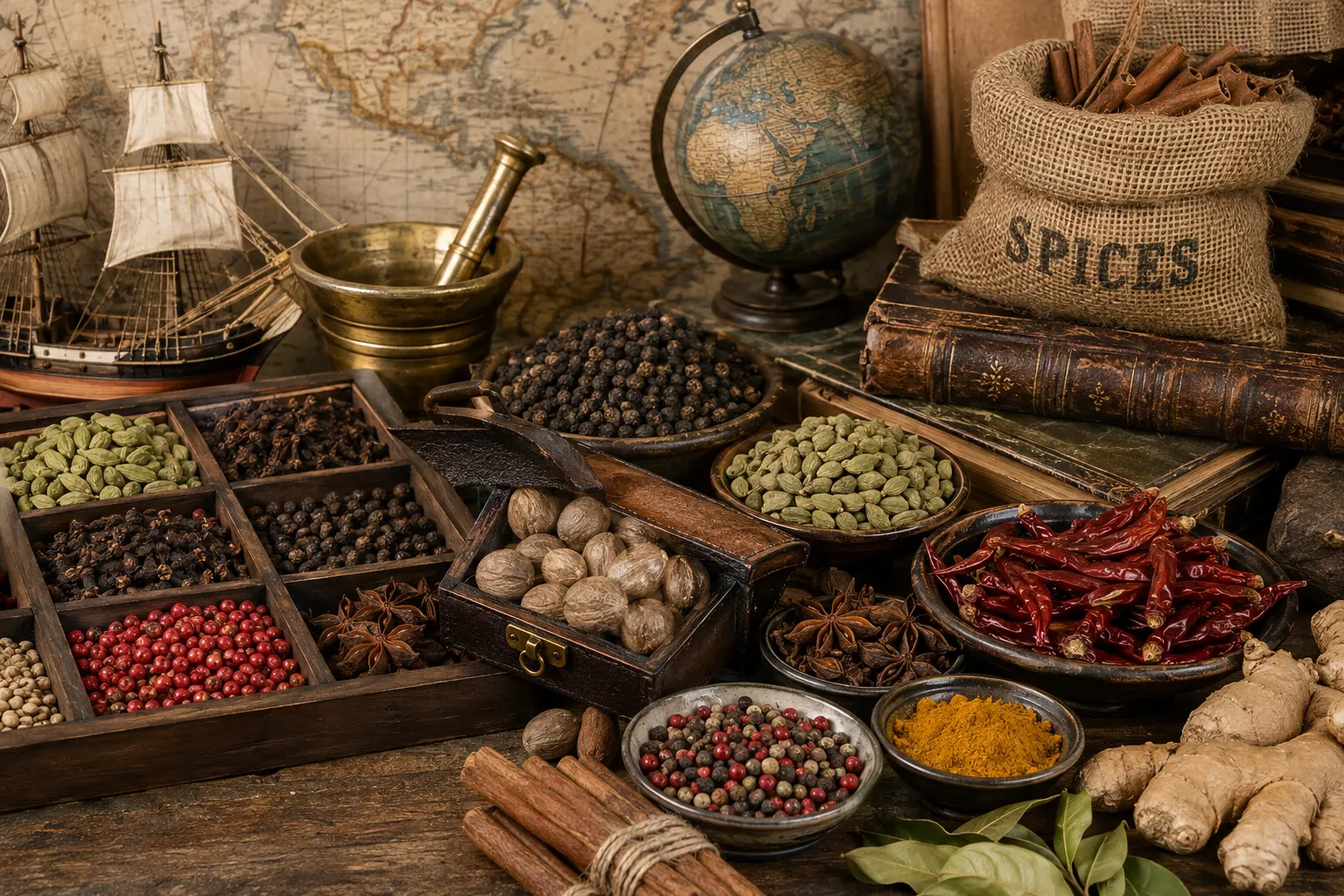
Spices may come from seeds, bark, roots, rhizomes, fruits, flower buds or other plant parts. Pepper is a fruit. Cinnamon is bark. Clove is a dried flower bud. Turmeric and ginger are rhizomes. Cumin and coriander are used as seeds.
Culinary herbs are often distinguished as leafy plant parts, but everyday usage varies.
India’s Spices Board operates under legislation covering 52 scheduled spices and promotes research, quality, development and trade related to them. Its catalogue also reflects India’s unusually wide range of spice-growing climates.
Spices Turn Geography Into Flavour
Spice traditions emerge from ecology.
Different plants thrive in different rainfall, altitude and temperature conditions. Communities living near those growing zones develop preservation methods, market systems and cuisines that use them intensely.
This is one reason spices become regional identity markers. Malabar pepper, Alleppey Green Cardamom, Coorg Green Cardamom, Guntur Sannam Chilli and Byadagi Chilli, for example, have all received geographical recognition in India through systems connecting product qualities with place.
The culinary effect is deeper than branding. A local spice variety can shape what “correct” flavour tastes like to a community.
The Spice Trade Connected Distant Societies
Long before modern container ships, spices were travelling across vast networks.
The Metropolitan Museum’s material on trade in the Islamic world describes merchants carrying spices from India and other goods across routes connecting South and Southeast Asia with West Asia and the Mediterranean.
Venice later became a major European intermediary for Eastern goods. Venetian merchants travelled to ports such as Alexandria, Damascus and Aleppo, purchasing spices and luxury materials for resale.
Spice exchange therefore linked farmers who might never see Europe with merchants, port workers, financiers and consumers thousands of kilometres away.
A kitchen ingredient became part of an international economic system.
Why Were Spices So Valuable?
Older popular stories often claim that medieval Europeans prized spices mainly because they hid the taste of rotten meat. That explanation is too simple and often misleading.
People who could afford expensive imported spices generally had access to better-quality food. Spices were desirable because they were rare, aromatic, prestigious and embedded in elite culinary and medicinal traditions.
Their high value relative to weight also made them attractive long-distance commodities.
When a small quantity could command a high price, merchants could profit despite transport risks.
Flavour Can Signal Status
Food communicates wealth partly through ingredients that are difficult to obtain.
Historically, imported aromatics could demonstrate access to trade networks and purchasing power. Elaborate spicing in elite kitchens might signal sophistication in the same way rare textiles, porcelain or jewellery did.
But status changes over time.
A spice once reserved for elites can become an inexpensive supermarket item. Another may remain costly because of labour-intensive harvesting or limited geography.
When that happens, the social meaning of flavour changes even if the chemical properties do not.
Spices Enter Ritual and Medicine
Spices have been used in religious offerings, incense, perfumes, household remedies and medical systems as well as food.
These overlapping uses helped increase their cultural significance. An aromatic plant could belong simultaneously to kitchen, temple, pharmacy and marketplace.
However, traditional medicinal use should not be confused with proven clinical effectiveness. Historical importance is a cultural fact; modern health claims require separate scientific evidence.
That distinction is especially important today because spice marketing often turns historical association into unsupported medical promise.
The Search for Spices Became Entangled With Empire
European maritime expansion cannot be reduced to one cause, but access to Asian commodities—including spices—was a major commercial incentive.
Portuguese, Dutch and English trading powers sought routes that could bypass existing intermediaries and give them greater control over high-value trade.
In island Southeast Asia, competition over cloves, nutmeg and mace became particularly violent. Monopoly was pursued through military force and colonial rule.
The history of spices is therefore not only a romantic story of caravans and markets. It includes coercion, conquest and the reorganisation of local economies around foreign demand.
Spices Helped Build Colonial Companies
The global spice trade was tied to the rise of powerful chartered companies.
The Dutch VOC and English East India Company were not ordinary merchants. They received state-backed privileges and operated within systems that combined commerce with military and political power.
The Metropolitan Museum’s timeline of global trade shows the English East India Company competing in Asian spice networks in the early seventeenth century before its activities increasingly focused on India.
The desire to control profitable commodities helped create institutions that later acquired territorial power.
Everyday seasonings can therefore be connected to the history of the modern corporation and empire.
Chilli Demonstrates How Fast Culture Can Reassign Origin
Few ingredients illustrate culinary adoption more clearly than chilli peppers.
Capsicum species originated in the Americas. After transoceanic exchange began, chillies spread through Portuguese and other trade networks into Africa and Asia.
They became so deeply integrated into South and Southeast Asian cuisines that many people now intuitively associate chilli with those regions.
This is not historical confusion so much as cultural naturalisation.
A plant can be foreign in botanical origin yet local in culinary identity after centuries of cultivation and use.
Spice Blends Are Cultural Grammars
Cultures rarely use spices only as isolated substances.
They develop combinations.
A blend is a system of proportion, sequence and technique. Whole spices may be toasted before grinding. Seeds may be fried in oil to release aroma. Some spices are added early, others at the end. The same ingredient behaves differently depending on heat, fat and preparation.
This knowledge is often transmitted informally rather than through written recipes.
A cook learns by smell: enough cumin has toasted; the mustard seeds have popped; the masala has cooked until the raw aroma disappears.
Spice practice is therefore embodied knowledge.
Markets Preserve Cultural Knowledge
Traditional spice markets are not merely retail spaces.
Vendors advise customers about freshness, origin, grinding, storage and combination. Customers compare colour, aroma and price. Regional names survive through commerce.
Markets also reveal changing demand. Imported spices become more common. Packaged blends replace home grinding. Health trends create sudden demand for particular products. Restaurants standardise mixtures.
The spice market is a cultural archive in motion.
India’s Spice Diversity Reflects Ecological Diversity
India provides an especially clear example of the relationship between spice cultivation and regional cuisine.
The Spices Board notes that India’s tropical, subtropical and temperate zones allow a wide range of spices to be cultivated across states and union territories.
Different regions developed strong associations with different crops: black pepper and small cardamom in the southwest, chillies in several southern and central regions, large cardamom in the Himalayan and northeastern belt, cumin and coriander in drier western and northwestern zones, and turmeric across multiple states.
These agricultural patterns influence cuisine, trade and regional identity.
Spices Remain a Major Economic Commodity
Their historical significance did not end with the age of sail.
According to the Spices Board, India exported 17.34 lakh tonnes of spices and spice products in 2025–26, valued at about ₹39,140 crore, or US$4.43 billion. Chilli, cumin, spice oils and oleoresins, cardamom, mint products and turmeric were among the major contributors to export earnings.
These figures demonstrate continuity and transformation at once.
The commodities are ancient; the modern trade uses quality laboratories, processing facilities, global standards, e-auctions and industrial extracts.
Standardisation Changes Traditional Spice Use
Modern commerce prefers consistency.
Industrial food manufacturers require predictable flavour, colour and chemical composition. Export systems impose residue and quality standards. Packaged masalas provide uniform blends.
This can make cooking faster and safer at scale, but it may also reduce local variation.
A household mixture adjusted by season and taste becomes a branded formula.
Neither system is inherently superior. They serve different needs. But the shift is culturally important because it changes who holds flavour knowledge—from households and local grinders towards companies and standardised supply chains.
Words for Spices Also Travel
The movement of spices can be traced not only through cargo but through language. Commodity names often move between trading communities, changing pronunciation as they pass through ports and empires. A borrowed word can preserve evidence that people encountered a spice through a particular commercial network.
This linguistic history matters because cuisine is communicated before it is standardised. Traders need names for goods. Cooks need names for unfamiliar aromatics. Markets create shared vocabularies. Over time, the foreign word may become so ordinary that speakers no longer experience it as borrowed. Language, like flavour, naturalises what once arrived from elsewhere.
Spice Production Also Organises Labour and Landscape
A spice is experienced by consumers as a small packet, but production can reshape entire landscapes. Plantations, smallholder farms, curing yards, drying sheds, warehouses, grinding units and export facilities create specialised labour systems. Harvest timing can organise seasonal work, while quality grades influence farmer income and market access.
Historically, high external demand sometimes encouraged monoculture or coercive control. In modern systems, the issues include farmer bargaining power, traceability, pesticide standards, processing technology and climate resilience. Cultural history therefore continues into contemporary political economy: the flavour in a kitchen depends on people and landscapes that consumers may never see.
Climate Change Threatens More Than Supply
Spices depend on particular ecological conditions.
Changes in temperature, rainfall, pests and extreme weather can affect yields and quality. If a region can no longer reliably grow a crop closely associated with its cuisine, the loss would be cultural as well as economic.
Adaptation may involve new varieties, altered farming practices or geographic shifts in production.
This is another reminder that culinary heritage depends on living agricultural systems.
The Meaning of “Spicy” Is Cultural
People often talk as though spice tolerance were simply biological.
In reality, taste is learned. Children become accustomed to the flavours common in their households. Communities develop expectations about balance, heat and aroma.
What one culture considers mildly seasoned another may experience as intense. What one diner calls bland another may call delicate.
Spice preference therefore becomes part of cultural sensory training.
Spices Can Become National Symbols—but Their Histories Are Transnational
Countries often use spices in tourism and national branding. India is strongly associated internationally with spice-rich cuisines. Indonesia’s Maluku islands are remembered in global history as the “Spice Islands.” Sri Lankan cinnamon and other regional products carry similar associations.
Yet the history of spices constantly crosses borders.
Plants moved. Merchants moved. Empires moved. Recipes travelled. Words for spices migrated between languages.
National identities are real, but spice history is rarely national in origin.
Why Everyday Availability Can Hide Historical Importance
Modern supermarkets make spices appear ordinary because global logistics have compressed distance. A consumer can buy pepper, cinnamon, cumin or cardamom without seeing the farms, ports and trading systems behind them. That convenience can obscure how exceptional such access would have been in earlier centuries. The modern spice shelf is therefore a quiet monument to global agriculture, processing, transport and standardisation. Its very normality is evidence of how thoroughly once-distant commodities have been absorbed into everyday life.
More Than Flavour
Spices matter because they connect several histories at once.
They are agricultural products rooted in specific ecologies.
They are cultural tools through which communities learn taste.
They are ritual and medicinal substances.
They are commodities that created wealth and competition.
They are evidence of migration and exchange.
And they are reminders that world history can be hidden in the smallest objects.
The pepper grinder on a table, the cardamom in tea, the chilli in a curry or the cinnamon in a dessert may seem ordinary now.
Their ordinariness is the final stage of an extraordinary historical process: centuries of cultivation, trade, adaptation and cultural memory compressed into flavour.