Reforestation: Meaning, Benefits, Methods and Why Planting Trees Is Not Enough
Reforestation means bringing forest back to land where forest has been lost or severely reduced.
That sounds simple.
A forest disappears.
Trees are planted.
The forest returns.
But ecology does not work that quickly.
A functioning forest is much more than a collection of tree trunks. It contains soils, roots, fungi, insects, birds, mammals, shrubs, dead wood, water flows and relationships that develop over years, decades and sometimes centuries.
That is why successful reforestation is not measured only by the number of seedlings put into the ground.
The more important questions are:
Did the trees survive?
Are the right species returning?
Is wildlife habitat recovering?
Are soils becoming healthier?
Is water being affected positively or negatively?
Will the forest still exist decades from now?
And in many places, the best way to restore forest may involve planting fewer trees and allowing more natural regeneration.
Reforestation is therefore better understood as a process of forest recovery rather than a tree-counting exercise.
Reforestation at a glance
| Question | Short answer |
|---|---|
| What is reforestation? | Re-establishing forest on land where forest previously existed. |
| Is reforestation the same as afforestation? | No. Afforestation generally establishes forest on land that was not previously forested, or had not been forest for a long period. |
| Does reforestation always involve planting trees? | No. Forests can recover through natural or assisted natural regeneration. |
| Is planting one million trees the same as restoring a forest? | No. Survival, species diversity, ecosystem function and long-term protection matter. |
| Does reforestation help climate change? | It can increase carbon storage, but benefits depend on location, permanence, species and management. |
| Does reforestation always increase water availability? | No. Forests can improve water quality and erosion control while sometimes reducing downstream water yield. |
| Are plantations forests? | Some technical definitions classify plantations as forests, but plantations and natural forests can have very different ecological functions. |
| Are native trees always preferable? | Native or locally appropriate species are generally important for ecological restoration, but objectives and local conditions matter. |
| How long does reforestation take? | Tree cover can return relatively quickly, but rebuilding mature forest structure and ecological relationships can take decades or longer. |
| What determines success? | Site choice, species, natural regeneration potential, land rights, climate, management, monitoring and long-term protection. |
What Is Reforestation?
A practical definition is:
Reforestation is the re-establishment of forest on land where forest previously existed but was lost, severely damaged or reduced.
The exact technical definition varies among organisations and reporting systems.
The IPCC generally distinguishes:
reforestation — returning forest to land that previously contained forest;
from
afforestation — establishing forest on land that historically did not contain forest.
FAO terminology can be more technical because its Forest Resources Assessment treats “forest” partly as a land-use category. Under some FAO reporting definitions, reforestation specifically refers to re-establishing forest through planting or deliberate seeding on land still classified as forest.
FAO's broader forest-and-landscape restoration guidance also uses reforestation in the practical sense of returning tree cover to previously deforested land.
The terminology therefore varies slightly depending on whether the context is:
-
international forest statistics,
-
climate accounting,
-
ecological restoration,
-
forestry,
-
or landscape management.
For ordinary readers, the main distinction is simple:
Reforestation puts forest back where forest belonged before.
Reforestation vs Afforestation
These terms are frequently confused.
| Reforestation | Afforestation |
|---|---|
| Forest previously existed | Forest was not historically present, or had been absent for a long period |
| Restores lost forest cover | Creates new forest cover |
| Often follows clearing, wildfire or degradation | Converts another land type toward forest |
| May use natural regeneration or planting | Usually involves deliberate establishment |
| Often aims to recover former forest functions | May serve carbon, timber, erosion-control or other objectives |
The distinction matters environmentally.
A deforested tropical landscape may be an appropriate place for reforestation.
A naturally treeless grassland is different.
Planting dense forest across a native grassland does not necessarily restore nature. It can instead replace one valuable ecosystem with another land cover.
That is why the slogan “plant trees everywhere” is ecologically weaker than:
“restore the right ecosystem in the right place.”
Reforestation vs Forest Restoration
Reforestation and forest restoration overlap, but they are not identical concepts.
Reforestation focuses primarily on returning forest cover.
Forest restoration puts greater emphasis on recovering:
-
ecosystem structure,
-
native biodiversity,
-
ecological processes,
-
resilience,
-
soil function,
-
wildlife habitat,
-
and other characteristics of a healthy forest.
The IPCC describes forest restoration as a form of reforestation that gives greater priority to ecological integrity.
That distinction helps explain why two landscapes containing the same number of trees can have completely different ecological value.
A uniform plantation may qualify as forest under a statistical definition.
A regenerating native forest may contain:
-
more plant species,
-
several canopy layers,
-
dead wood,
-
more wildlife habitat,
-
greater structural complexity,
-
and more natural ecological processes.
Both contain trees.
They are not ecologically equivalent.
A Forest Is More Than Trees
This is the central misconception surrounding reforestation.
A natural forest is a system.
Above ground, there may be:
-
large trees,
-
younger trees,
-
shrubs,
-
vines,
-
grasses,
-
epiphytes,
-
birds,
-
mammals,
-
reptiles,
-
insects,
-
and decomposing wood.
Below ground there are:
-
roots,
-
fungi,
-
bacteria,
-
soil animals,
-
stored carbon,
-
nutrients,
-
water,
-
and complex biological interactions.
Trees interact with:
-
pollinators,
-
seed dispersers,
-
predators,
-
herbivores,
-
microorganisms,
-
and neighbouring plants.
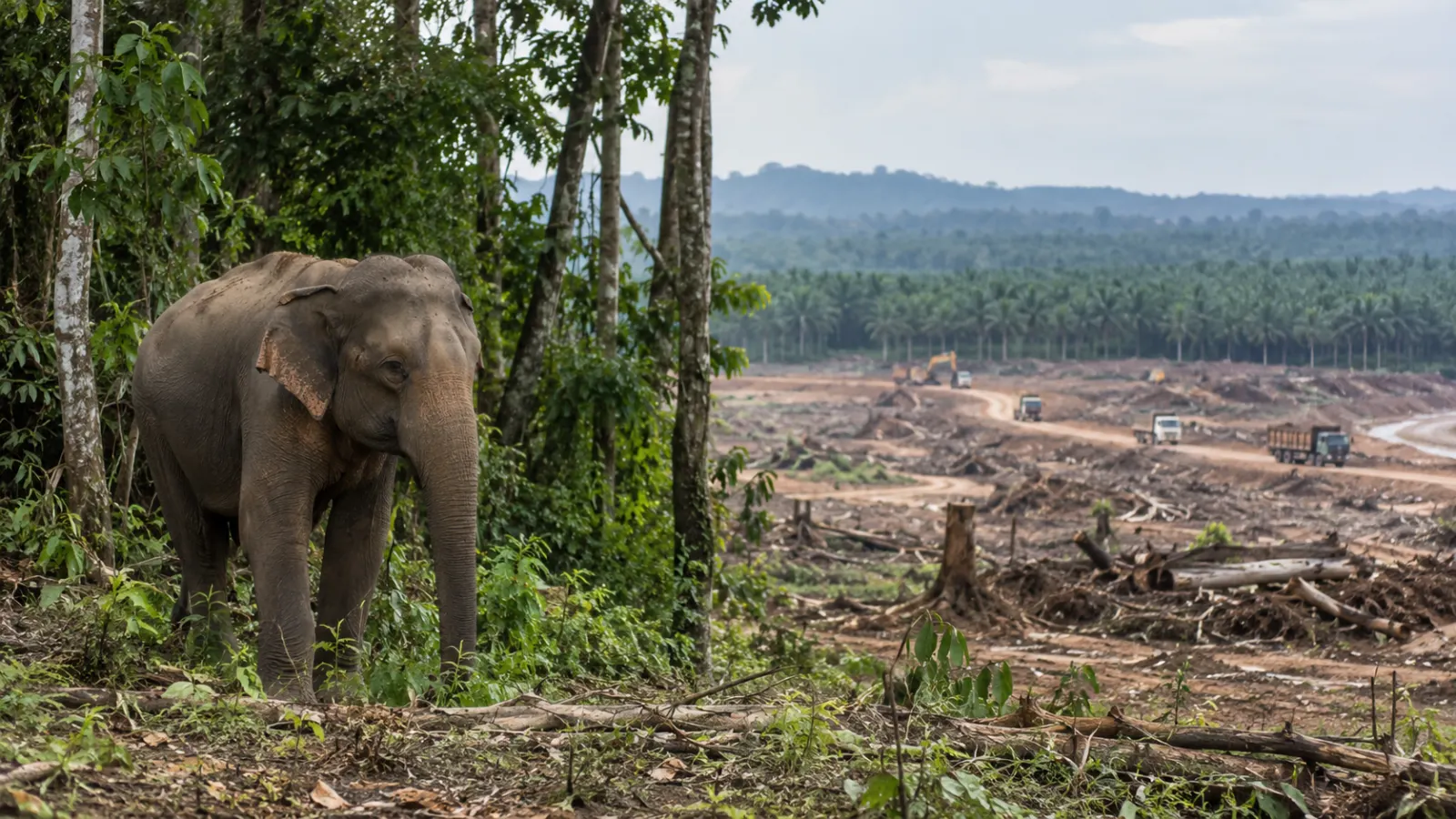
When an old forest is destroyed, much more disappears than standing timber.
Restoration therefore cannot be evaluated simply by asking whether something green appears again in satellite imagery.
Why Is Reforestation Important?
Reforestation can serve several objectives simultaneously.
A restored forest may help:
store carbon,
provide wildlife habitat,
reduce erosion,
protect soils,
reconnect fragmented forests,
support livelihoods,
provide timber or non-timber products,
and
improve landscape resilience.
But different projects prioritise different outcomes.
A timber company may primarily want future wood production.
A conservation organisation may prioritise endangered species.
A watershed authority may focus on sediment and erosion.
A community may care most about:
-
fuelwood,
-
fruit,
-
medicines,
-
shade,
-
or reliable livelihoods.
The appropriate restoration design depends on the objective.
There is no single ideal reforestation plan for every landscape.
Why Reforestation Matters Now
Forest restoration has become increasingly important because forest loss remains substantial while governments are simultaneously making climate and biodiversity commitments.
WRI reports that 4.3 million hectares of tropical primary forest were lost in 2025, illustrating why restoration cannot be separated from the continuing problem of forest destruction.
At the same time, the UN Decade on Ecosystem Restoration runs from 2021 to 2030, and major international initiatives have encouraged restoration of degraded landscapes at very large scales.
The important policy lesson is:
restoration cannot compensate for unlimited destruction.
Protecting an intact forest is generally not equivalent to destroying it and attempting to recreate it somewhere else.
How Does Reforestation Work?
There are several approaches.
They exist along a spectrum from allowing nature to recover almost independently to intensive human planting and management.
Three broad methods are particularly important:
natural regeneration,
assisted natural regeneration,
and
active planting.
The correct method depends on how degraded the site is and whether the biological ingredients for recovery still exist.
1. Natural Regeneration
Forests often possess a remarkable ability to return.
After clearing or disturbance, new trees may appear because:
-
seeds remain in the soil,
-
surviving trees produce seeds,
-
nearby forests provide seed sources,
-
birds and mammals disperse seeds,
-
roots survive,
-
or stumps resprout.
If the cause of degradation disappears, succession can begin.
This is natural regeneration.
People may not need to plant every tree.
Sometimes the most important intervention is simply to stop repeatedly destroying the seedlings already trying to grow.
Natural Regeneration Can Be Surprisingly Powerful
Global research on naturally regrowing forests shows enormous potential for carbon accumulation, although growth rates vary dramatically according to climate and location.
A Nature study compiled more than 13,000 measurements of forest carbon accumulation and found over 100-fold variation in potential rates across locations.
That variation is an important reminder.
There is no universal number for:
“how much carbon one hectare of reforestation captures.”
The answer depends heavily on:
-
climate,
-
forest type,
-
age,
-
soil,
-
disturbance,
-
and local ecology.
2. Assisted Natural Regeneration
Sometimes a forest can recover naturally but needs help.
This is known as assisted natural regeneration, or ANR.
People may intervene by:
-
excluding livestock,
-
reducing repeated burning,
-
controlling invasive plants,
-
protecting naturally occurring seedlings,
-
preventing unnecessary clearing,
-
managing competing vegetation,
-
or adding selected species through enrichment planting.
FAO describes ANR as a cost-effective restoration approach that works by removing barriers preventing natural succession.
It is particularly useful where:
-
seedlings are already present,
-
viable roots or stumps survive,
-
or nearby forests can provide seeds.
Why Assisted Natural Regeneration Is Often Overlooked
Tree-planting campaigns are easy to communicate.
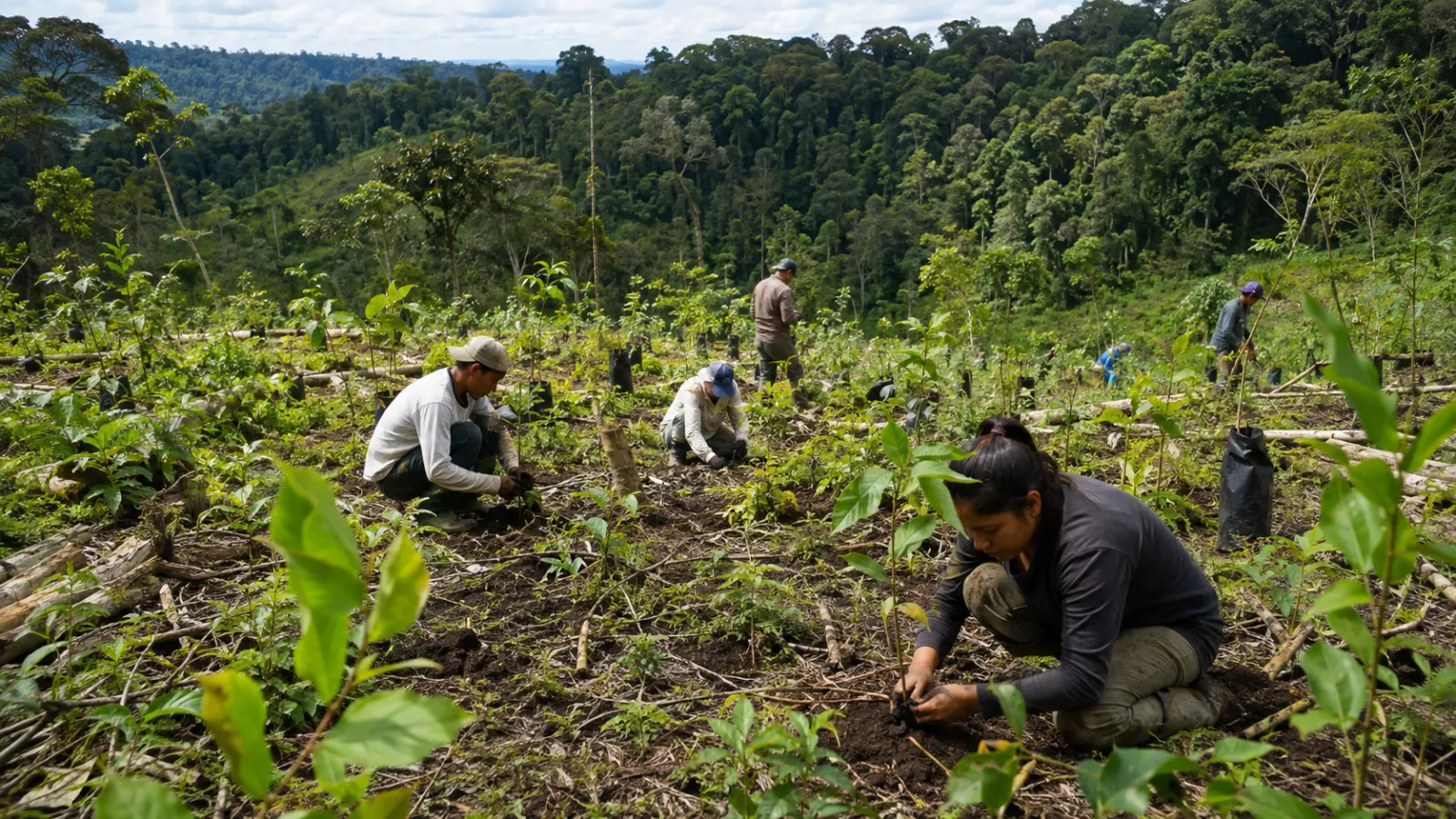
A photograph can show hundreds of volunteers putting seedlings into the ground.
Natural regeneration is less visually dramatic.
Success may look like:
a field that nobody clears anymore.
But ecological impact does not depend on how impressive the launch event looks.
WRI estimates that assisted natural regeneration can, in suitable contexts, cost substantially less than planting every tree manually.
The important qualification is in suitable contexts.
Natural regeneration cannot solve every restoration problem.
When Natural Regeneration May Fail
A degraded landscape may have lost too much ecological memory.
Problems can include:
-
no nearby seed source,
-
severely damaged soils,
-
invasive vegetation,
-
repeated fire,
-
intense livestock browsing,
-
extreme erosion,
-
mining damage,
-
altered hydrology,
-
or climate conditions no longer suitable for former species.
In such places, waiting may achieve very little.
Active intervention becomes necessary.
3. Active Tree Planting
Planting is appropriate when natural regeneration cannot recover the forest fast enough or cannot supply the species needed.
A planting project may involve:
-
collecting seed,
-
raising seedlings in nurseries,
-
preparing the site,
-
choosing species,
-
determining planting density,
-
planting,
-
controlling competing vegetation,
-
replacing dead seedlings,
-
and protecting young trees.
The U.S. Forest Service summarises the key principle as getting reforestation in the right place, at the right time, with the right species and at appropriate scales.
Planting is therefore only one stage of a much longer process.
Tree Planting Is a Tool, Not a Success Metric
The easiest statistic to report is:
“We planted one million trees.”
But that number tells us surprisingly little.
A serious evaluation needs to know:
How many survived after one year?
How many survived after five years?
Which species survived?
Were they native or ecologically appropriate?
Did natural regeneration occur between planted trees?
Were trees later burned, harvested or cleared?
Did wildlife return?
Did local communities benefit?
Ten million dead seedlings produce a larger planting statistic than one million surviving trees.
They do not produce the better forest.
Seedling Survival Matters
Young trees face numerous risks.
They can die from:
-
drought,
-
flooding,
-
heat,
-
fire,
-
insects,
-
disease,
-
grazing,
-
poor planting,
-
unsuitable species selection,
-
competition,
-
or lack of maintenance.
Climate change makes this harder because a species well adapted to the historic climate may not necessarily thrive under future conditions.
Restoration planners therefore increasingly have to ask not only:
“What grew here before?”
but also:
“What is likely to survive here several decades from now?”
What Makes a Good Reforestation Project?
Successful projects usually begin with diagnosis rather than seedlings.
Managers need to understand:
What forest existed here?
Why was it lost?
What is preventing recovery?
Are seed sources still present?
Who owns or uses the land?
What does the community need from it?
What will happen to water?
Which species are appropriate?
How will climate change affect survival?
Who will manage the site after funding ends?
A project that ignores the cause of deforestation may simply recreate conditions for the forest to disappear again.
Native Species vs Exotic Species
Native species generally deserve strong consideration when the objective is ecological restoration.
They are more likely to have long-standing relationships with:
-
native insects,
-
birds,
-
fungi,
-
herbivores,
-
pollinators,
-
and other local organisms.
But species selection is not as simple as saying:
native = always good
and
exotic = always bad.
Forestry projects may deliberately use introduced species for:
-
timber,
-
fuel,
-
erosion control,
-
or other purposes.
The relevant questions include:
Is the species invasive?
What ecosystem is being restored?
What biodiversity does it support?
How much water does it use?
What is the project's objective?
How will it behave under future climate conditions?
Why Monocultures Can Be a Problem
A monoculture consists primarily of one tree species.
Monoculture plantations can be efficient for producing:
-
timber,
-
pulp,
-
fibre,
-
or fuel.
They can therefore have legitimate economic roles.
But when presented as replacements for diverse natural forests, problems appear.
A monoculture may provide:
-
fewer habitats,
-
lower plant diversity,
-
reduced structural complexity,
-
and potentially greater vulnerability to particular pests or diseases.
FAO notes that monoculture plantations can provide high levels of forest products while their capacity to restore original biodiversity and environmental services is more limited than natural regeneration or ecological restoration.
Plantation Forests Are Not Automatically Bad
It is equally misleading to claim all plantations are environmentally harmful.
Well-designed planted forests can supply wood and other products and provide ecosystem services.
FAO recognises planted forests as potentially contributing to:
-
timber supply,
-
carbon sequestration,
-
degraded-land restoration,
-
and watershed functions.
The key is not to confuse their purpose.
A commercial plantation should be evaluated partly according to productive forestry objectives.
A biodiversity-restoration project should be judged according to ecological recovery.
Calling both “trees” does not make their functions identical.
Primary Forest and Restored Forest Are Not Interchangeable
Perhaps the most important principle in forest restoration is this:
A newly restored forest is not an instant replacement for an old natural forest.
Mature forests can contain:
-
large old trees,
-
complex soils,
-
dead wood,
-
specialised wildlife,
-
accumulated carbon,
-
long-established fungal networks,
-
and ecological relationships that take decades or centuries to develop.
Regrowth matters enormously.
But some characteristics return slowly.
Others may never fully return after severe degradation.
This is why conservation and restoration should complement one another.
Protect what remains. Restore what has been lost.
Reforestation and Climate Change
Trees remove carbon dioxide from the atmosphere through photosynthesis.
Carbon becomes stored in:
-
trunks,
-
branches,
-
roots,
-
leaves,
-
litter,
-
and soils.
Reforestation can therefore increase carbon stocks on formerly forested land.
The IPCC identifies reforestation and forest ecosystem restoration among important land-based climate-mitigation options. Well-planned projects can simultaneously support biodiversity and climate resilience.
But the phrase “trees absorb carbon” is only the beginning of the calculation.
Carbon Storage Must Be Permanent Enough to Matter
Suppose a forest grows for 25 years and stores substantial carbon.
Then it is:
-
burned,
-
logged,
-
cleared,
-
or killed by drought.
Some of that stored carbon can return to the atmosphere.
Climate value therefore depends on permanence.
A credible carbon-focused restoration project needs to consider future risks such as:
-
wildfire,
-
drought,
-
pests,
-
illegal clearing,
-
land-use change,
-
and climate change itself.
Planting is an event.
Carbon storage is a long-term process.
Reforestation Does Not Replace Emissions Reduction
Another misconception is that planting enough forests can allow fossil-fuel emissions to continue indefinitely.
Reforestation can contribute to climate mitigation.
It cannot substitute for deep reductions in greenhouse-gas emissions.
Land is finite.
Forests can burn.
Carbon accumulation slows as forests mature.
Restoration also competes with legitimate land needs such as food production.
Forests are an important climate solution.
They are not permission to avoid decarbonisation elsewhere.
Why Protecting Existing Forests Comes First
An intact forest already contains carbon.
It already contains biodiversity.
It already has soil structure.
It already has ecological relationships.
Destroying it creates immediate losses.
Reforestation starts a recovery process that may take decades.
For that reason, the IPCC emphasises both protection and restoration rather than treating them as interchangeable climate strategies.
A sensible hierarchy is:
avoid unnecessary forest loss,
protect remaining natural forest,
improve degraded forests,
and
restore forest where loss has already occurred.
Reforestation and Biodiversity
Reforestation can provide major biodiversity benefits when designed around ecological recovery.
It can:
-
recreate habitat,
-
expand surviving forest patches,
-
reconnect isolated populations,
-
provide food resources,
-
create nesting sites,
-
and allow species to move through landscapes.
Connectivity matters particularly in fragmented landscapes.
The IPCC notes that reforestation can improve connections among surviving forest patches and support species movement and gene flow.
This means where restoration occurs can be as important as the number of hectares restored.
Forest Corridors Can Be Especially Valuable
Imagine two forest reserves separated by farmland.
Each contains wildlife populations.
But animals cannot move easily between them.
Restoring a strip of forest connecting the two patches can create a wildlife corridor.
That corridor may allow:
-
movement,
-
mating,
-
seed dispersal,
-
migration,
-
and responses to climate change.
A strategically located smaller restoration project may therefore provide greater biodiversity benefits than a larger isolated plantation.
Reforestation and Soil
Trees influence soil through:
-
roots,
-
litter,
-
shade,
-
organic matter,
-
and interactions with microorganisms.
In degraded landscapes, reforestation can help:
-
stabilise slopes,
-
reduce erosion,
-
increase organic material,
-
protect soil from heavy rainfall,
-
and gradually rebuild soil processes.
But severe degradation can limit recovery.
Mining areas, badly eroded slopes or compacted soils may require substantial rehabilitation before forest species can establish effectively.
Reforestation and Water
The common claim:
“More trees always mean more water”
is too simple.
Forests can provide important water-related benefits.
Tree roots and forest soils can:
-
reduce erosion,
-
increase soil stability,
-
reduce sediment entering rivers,
-
and influence infiltration and water quality.
But trees also use water.
Through transpiration and interception, increased forest cover can reduce total downstream water yield in some catchments, especially in dry regions.
FAO has long emphasised that forest-water relationships are highly context dependent.
The correct question is therefore not:
“Will trees improve water?”
but:
“How will this forest type affect this watershed?”
Reforestation Can Create Water Trade-Offs
A project might simultaneously:
reduce erosion
while
reducing streamflow.
Or it might:
improve water quality
while
increasing evapotranspiration.
These are not contradictions.
They reflect different parts of the water cycle.
This is why large-scale tree planting in dry or water-stressed landscapes requires hydrological planning.
Reforestation and Local Climate
Trees can influence local conditions through:
-
shade,
-
evapotranspiration,
-
wind reduction,
-
and changes to surface temperature.
In suitable contexts, restored forests can help moderate local heat and improve landscape resilience.
Urban tree planting can also provide cooling benefits.
But urban forestry, agroforestry and forest ecosystem restoration are different interventions.
The word “trees” should not erase those distinctions.
Reforestation and People
Restoration maps can create the illusion that degraded land is empty land.
Often it is not.
It may already be used for:
-
farming,
-
livestock,
-
fuelwood,
-
hunting,
-
gathering,
-
cultural practices,
-
or settlement.
People may hold:
-
formal title,
-
customary rights,
-
communal ownership,
-
seasonal use rights,
-
or disputed claims.
A restoration project that ignores those relationships can create conflict.
Land Rights Can Determine Success
Who benefits from the new forest?
Who loses access to the land?
Who can harvest products?
Who receives carbon payments?
Who protects the forest from fire?
Who decides which trees are planted?
These are governance questions, not merely ecological ones.
Research has highlighted the importance of prioritising local communities because hundreds of millions of people live in areas identified as potential restoration landscapes.
Forest restoration therefore involves questions of rights and incentives as much as seedlings and soil.
Local Communities Are Not an Obstacle to Restoration
Poorly designed projects sometimes treat local people as the reason forests need protection.
That can be a serious mistake.
Communities may possess detailed knowledge about:
-
local species,
-
fire,
-
grazing,
-
water,
-
seed sources,
-
traditional management,
-
and historical land conditions.
Restoration can become stronger when local people:
-
participate in planning,
-
receive economic benefits,
-
have secure rights,
-
and possess long-term incentives to protect the recovering forest.
A forest that communities value is often easier to maintain than one imposed from outside.
Reforestation and Livelihoods
Forests provide more than climate and biodiversity benefits.
Depending on the landscape, they can supply:
-
timber,
-
fuelwood,
-
fruits,
-
nuts,
-
fodder,
-
fibres,
-
medicines,
-
honey,
-
and other non-timber forest products.
Restoration programmes can also create work in:
-
nurseries,
-
seed collection,
-
planting,
-
monitoring,
-
fire management,
-
invasive-species control,
-
and forest management.
The challenge is designing livelihood benefits without recreating the degradation that caused forest loss.
Agroforestry Can Be Part of Landscape Restoration
Not every hectare of a restoration landscape needs to become closed forest.
Agricultural land may remain agricultural while incorporating trees.
Agroforestry integrates trees with:
-
crops,
-
livestock,
-
or both.
This can provide:
-
shade,
-
fruit,
-
fodder,
-
soil protection,
-
timber,
-
habitat,
-
and carbon storage.
Forest and landscape restoration therefore works at a larger scale than simply converting every available field back into dense forest.
FAO's approach explicitly seeks a balance among forests, agriculture and local livelihoods.
“Right Tree, Right Place” Matters
A tree can be beneficial in one ecosystem and harmful in another.
Before planting, restoration managers should ask:
Was this site naturally forested?
What species belong here?
How much water is available?
Could the species become invasive?
What habitat already exists?
How will climate change alter conditions?
What do local people need from the land?
That is why serious restoration increasingly uses the principle:
the right tree, in the right place, for the right purpose.
Places Where Trees Should Not Simply Be Planted
Not every open landscape is degraded.
Naturally treeless ecosystems include:
-
grasslands,
-
savannas,
-
wetlands,
-
peatlands,
-
tundra,
-
and some shrublands.
These ecosystems can contain unique biodiversity and store substantial carbon of their own.
Planting forest where forest does not naturally belong can damage them.
Afforestation therefore requires more caution than the slogan “unused land should have trees” suggests.
Open does not mean empty.
Treeless does not mean degraded.
Fire Complicates Reforestation
Fire can destroy forests.
But fire is also a natural ecological process in some forest and savanna systems.
The restoration response therefore cannot always be:
“prevent every fire.”
Some ecosystems evolved with periodic burning.
Problems arise when:
-
fire becomes too frequent,
-
too severe,
-
occurs in the wrong season,
-
or disappears from a fire-dependent ecosystem for too long.
Forest restoration may therefore involve both:
fire prevention
and, in some systems,
carefully managed prescribed fire.
Climate Change Makes Restoration Harder
Restoration planning once relied heavily on historical conditions.
Climate change complicates that strategy.
Future forests will experience different combinations of:
-
heat,
-
drought,
-
wildfire,
-
storms,
-
insects,
-
disease,
-
and rainfall.
A tree species perfectly adapted to a location in 1950 may face considerably different conditions by 2070.
This means restoration increasingly needs to think about resilience, not simply historical replication.
The IPCC stresses that restoration and conservation planning will increasingly need to respond to changing ecosystem structures and species distributions.
Should Reforestation Copy the Exact Historical Forest?
Ecological restoration often uses historical ecosystems as reference points.
But perfect reconstruction may be impossible.
Some species may have disappeared locally.
Climate may have changed.
Soils may be permanently altered.
Human land use may prevent complete return.
The aim may therefore become:
recover ecological integrity and function as far as realistically possible
rather than:
recreate an exact photograph of the past.
Restoration is recovery under present and future conditions.
Examples of Reforestation Approaches
Different landscapes require different interventions.
| Situation | Likely approach |
|---|---|
| Former forest with abundant natural seedlings | Natural regeneration |
| Seedlings present but grazing prevents survival | Assisted natural regeneration |
| Degraded land near surviving native forest | Protection plus enrichment planting |
| Severe wildfire with seed sources destroyed | Active planting may be required |
| Production forestry area | Managed replanting or planted forest |
| Fragmented wildlife habitat | Native corridor restoration |
| Farm landscape | Agroforestry plus strategic forest restoration |
| Severely mined or eroded site | Soil rehabilitation followed by active restoration |
The table illustrates why “reforestation” is a category of strategies rather than one operation.
How Long Does Reforestation Take?
There is no universal timeline.
In favourable tropical conditions, vegetation can return visibly within a few years.
But a young recovering forest is not equivalent to a mature forest.
Different features recover at different rates.
Tree canopy may return relatively quickly.
Large old trees take much longer.
Soil carbon may rebuild slowly.
Specialist wildlife may require mature habitat.
Complex forest structure can take decades.
Some ecological characteristics may take centuries.
Restoration should therefore be measured on ecological time rather than campaign time.
How Do We Know Whether Reforestation Worked?
Monitoring must match the project's objective.
Useful indicators can include:
Tree survival
How many planted or naturally regenerating trees remain alive?
Species diversity
Are multiple appropriate species establishing?
Native regeneration
Are local species reproducing without constant replanting?
Forest structure
Is the recovering forest developing different sizes and layers?
Biodiversity
Are insects, birds, mammals or other organisms returning?
Soil
Are erosion and soil condition improving?
Water
Are intended watershed outcomes occurring?
Carbon
Are carbon stocks increasing and remaining secure?
Livelihoods
Are promised community benefits actually being delivered?
Permanence
Is the site protected from renewed clearing, fire or degradation?
This is far more informative than counting seedlings on planting day.
Monitoring Should Continue for Years
Forest restoration programmes often operate on short funding cycles.
Forests do not.
A plantation launched in year one may look successful when inspected after six months.
Failure may become obvious only after:
-
several dry seasons,
-
fire,
-
grazing,
-
pest outbreaks,
-
or project funding ends.
Long-term monitoring is therefore essential.
A restoration project should ideally know not only:
how many trees were planted
but
what happened to them later.
What Are the Main Benefits of Reforestation?
Well-designed reforestation can provide a combination of benefits:
| Benefit | How reforestation may contribute |
|---|---|
| Climate | Stores carbon in vegetation and soils |
| Biodiversity | Restores and reconnects habitat |
| Soils | Reduces erosion and adds organic material |
| Water quality | Can reduce sediment and protect catchments |
| Local climate | Provides shade and can influence temperature |
| Livelihoods | Provides forest products and employment |
| Resilience | Can improve ecosystem ability to cope with disturbance |
| Landscape connectivity | Helps species move between surviving habitat patches |
None of these benefits is guaranteed simply because trees were planted.
Design determines outcome.
What Can Go Wrong With Reforestation?
Poorly designed projects can create serious problems.
Wrong species
Trees may fail or become invasive.
Wrong ecosystem
Native grassland or wetland may be converted unnecessarily.
Monoculture
Tree cover increases while biodiversity remains low.
Water pressure
Water-intensive trees may reduce water availability.
Low survival
Large planting targets hide high mortality.
Land conflict
Projects restrict land used by local communities.
Carbon reversal
Fire or clearing releases stored carbon.
No maintenance
Seedlings die after initial funding ends.
Continued deforestation
Restoration becomes a public-relations exercise while natural forest continues to disappear elsewhere.
The lesson is not that reforestation is bad.
It is that bad reforestation is possible.
Reforestation Should Not Become Greenwashing
Tree planting is attractive to governments and companies because it produces a clear public claim:
“We planted X million trees.”
But environmental accountability requires harder questions.
Was natural forest destroyed elsewhere?
Were the trees suitable?
Did they survive?
Was the land available ethically?
Were local communities consulted?
Is the forest protected?
Was biodiversity restored?
Does the carbon claim include future risks?
A planting pledge should not automatically be treated as ecological achievement.
Reforestation and Carbon Offsets
Some carbon-offset projects rely on establishing or restoring forests.
The basic logic is that growing forests remove atmospheric carbon dioxide.
But carbon accounting raises difficult questions.
Additionality
Would the forest have grown anyway?
Permanence
How long will the carbon remain stored?
Leakage
Does protecting or restoring one area shift deforestation somewhere else?
Measurement
How accurately can carbon gains be quantified?
Rights
Who owns the carbon benefit and who controls the land?
These issues do not make forest-carbon projects inherently invalid.
They show why credible carbon claims require more than planting records.
Natural Regeneration Is Increasingly Important for Climate Policy
The climate value of forests is often discussed as though people must physically plant every tree.
That overlooks enormous areas where forests are already trying to return naturally.
WRI highlighted this issue again in 2025, arguing that naturally regrowing secondary forests are an important but under-recognised carbon-removal opportunity.
Protecting young naturally regenerating forests may therefore be as important in some landscapes as launching new planting campaigns.
A forest that has already started recovering needs time more than another publicity event.
Reforestation Is Also a Governance Project
Successful restoration requires ecological knowledge.
But ecology alone cannot resolve:
-
land ownership,
-
enforcement,
-
agricultural needs,
-
community benefits,
-
funding,
-
political incentives,
-
and long-term management.
A project can select perfect tree species and still fail if nobody has an incentive to keep them alive.
Conversely, relatively simple ecological interventions may succeed where communities possess secure land rights and long-term motivation.
Forest restoration is therefore simultaneously:
ecology,
economics,
land-use planning,
and
governance.
Reforestation vs Deforestation
The relationship sounds obvious:
deforestation removes forest;
reforestation brings it back.
But they should not be treated as exact opposites.
Deforestation can destroy a mature ecosystem very quickly.
Reforestation takes years or decades to rebuild even part of what disappeared.
One hectare deforested today is therefore not automatically “cancelled” by one hectare planted tomorrow.
The age, type, carbon stock, biodiversity and ecological function of the forests matter.
Can Reforestation Reverse Deforestation?
It can reverse some effects of forest loss.
It cannot necessarily reproduce everything that was destroyed.
Reforestation can restore:
-
tree cover,
-
carbon storage,
-
habitat,
-
soil protection,
-
and ecosystem functions.
But extinct local populations may not return automatically.
Soils may remain altered.
Old-growth features take long periods to develop.
This is why restoration is better described as recovery rather than perfect replacement.
Reforestation and Forest Landscape Restoration
Modern restoration increasingly works at landscape scale.
Instead of asking:
“How do we cover this one field in trees?”
forest-landscape restoration asks:
“What combination of forests, farms, communities and other land uses will restore ecological function across this landscape?”
FAO's approach may combine:
-
restoration of degraded forest,
-
natural regeneration,
-
planted forest,
-
agroforestry,
-
and improved management.
The goal is not maximum tree density everywhere.
It is a diverse, productive and resilient landscape.
Ten Principles for Better Reforestation
A serious reforestation programme should generally ask whether it is:
-
Restoring forest where forest is ecologically appropriate.
-
Protecting remaining natural forest first.
-
Using natural regeneration where it can succeed.
-
Planting appropriate species when planting is needed.
-
Considering biodiversity, not just carbon.
-
Understanding water and soil trade-offs.
-
Respecting land rights and local livelihoods.
-
Planning for climate change and disturbance.
-
Monitoring survival and ecosystem recovery for years.
-
Measuring outcomes rather than publicity-friendly planting totals.
These principles do not produce one universal restoration recipe.
They improve the questions asked before intervention begins.
Frequently Asked Questions
What is reforestation?
Reforestation is the process of re-establishing forest on land where forest previously existed but was removed, destroyed or severely degraded.
What is the difference between reforestation and afforestation?
Reforestation returns forest to land that previously contained forest. Afforestation establishes forest on land that historically did not contain forest or had been without forest for a long period.
Is reforestation just planting trees?
No. Reforestation can occur through natural regeneration, assisted natural regeneration or active planting.
What is natural regeneration?
Natural regeneration occurs when forest returns through existing seeds, surviving roots, resprouting trees or seeds dispersed from nearby forests without people planting every tree.
What is assisted natural regeneration?
Assisted natural regeneration helps natural forest recovery by removing barriers such as grazing, repeated fire, invasive vegetation or other disturbances.
What are the benefits of reforestation?
Potential benefits include carbon storage, biodiversity recovery, habitat connectivity, soil protection, improved water quality, forest products, livelihoods and greater landscape resilience.
Does reforestation help climate change?
Yes. Growing forests remove carbon dioxide from the atmosphere and store carbon. However, climate benefits depend on location, species, growth, management and how long the forest survives.
Does planting trees reduce global warming?
Tree growth can contribute to climate mitigation, but tree planting cannot replace rapid reductions in greenhouse-gas emissions.
Is a tree plantation the same as a forest?
A plantation may satisfy some technical definitions of forest, but a uniform plantation and a diverse natural forest can differ greatly in biodiversity, structure and ecosystem function.
Why are native trees important in reforestation?
Native species often support local ecological relationships involving insects, wildlife, fungi and other organisms. Species choice should nevertheless consider project goals, site conditions and future climate.
Can reforestation harm the environment?
Poorly planned projects can damage native grasslands, reduce water availability, introduce invasive species, create monocultures or conflict with food production and local land rights.
Does reforestation increase rainfall?
Forest cover can influence local and regional water cycles, but it is too simplistic to claim that planting trees automatically increases rainfall. Effects vary strongly by climate, scale and location.
Does reforestation increase water supply?
Not necessarily. Forests can improve erosion control and water quality while increased tree cover can reduce annual water yield in some catchments.
How long does reforestation take?
Tree cover may return within years under favourable conditions, but mature forest structure, biodiversity and soil processes may require decades or longer.
Is natural regeneration better than planting?
Neither is universally better. Natural regeneration can be inexpensive and ecologically effective where seed sources and suitable conditions remain. Severely degraded sites may require active planting.
Why do tree-planting projects fail?
Common reasons include unsuitable species, drought, grazing, fire, poor maintenance, land disputes, inadequate monitoring and focusing on planting numbers rather than survival.
Should forests be planted on grasslands?
Not automatically. Many grasslands, savannas and other naturally open ecosystems are valuable ecosystems in their own right and should not be treated as empty land waiting for trees.
Is reforestation better than preventing deforestation?
Both are necessary, but protecting an intact natural forest avoids immediate losses that may take decades or longer to recover through restoration.
How is reforestation success measured?
Success should be measured using outcomes such as tree survival, native regeneration, biodiversity, forest structure, soil and water conditions, carbon storage, community benefits and long-term permanence.
Why Reforestation Matters
Reforestation matters because forest loss damages far more than tree cover.
It can affect:
carbon,
wildlife,
water,
soil,
local climate,
livelihoods,
and
the ecological relationships that make forests resilient.
Bringing those functions back requires more than putting seedlings in holes.
Sometimes the best restoration project involves planting thousands of trees.
Sometimes it involves planting selected native species.
Sometimes it involves fencing livestock out.
Sometimes it involves controlling invasive vegetation.
And sometimes it means recognising that the forest is already returning and simply giving it the time and protection required to continue.
That is why the most useful question is not:
“How many trees did we plant?”
It is:
“What kind of forest is coming back, what functions are recovering, who benefits from it, and will it still be there decades from now?”
A seedling is the beginning of a possibility.
A functioning forest is the actual goal.