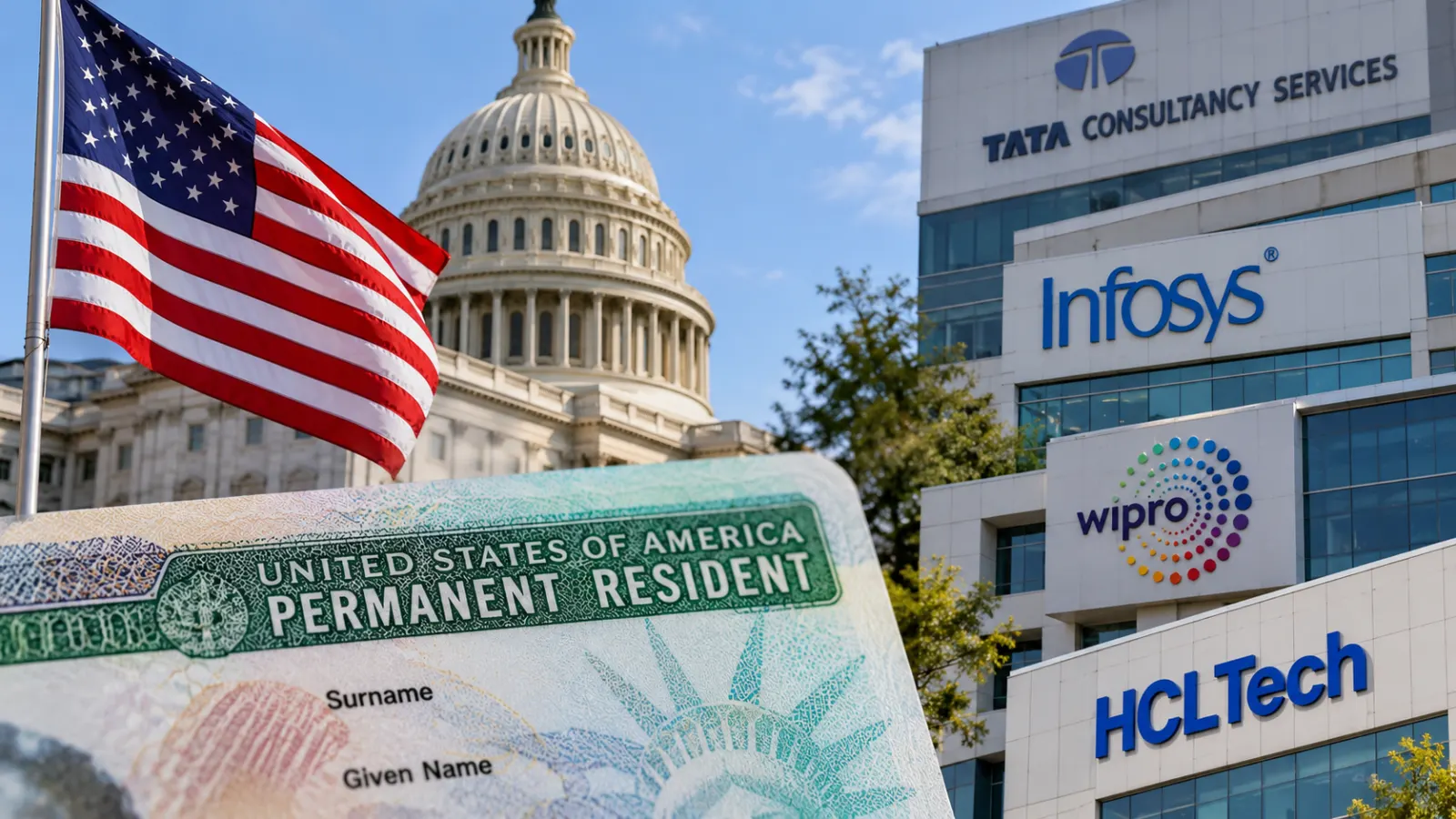
US Suspends PERM Green Card Filings for TCS, Infosys, Wipro and Other Tech Firms
The United States has suspended several major technology companies from using the Permanent Labor Certification, or PERM, process, disrupting one of the principal employment-based routes through which companies sponsor foreign workers for permanent residency. The action affects some of the biggest names employing Indian technology professionals in the US, including Tata Consultancy Services, Infosys, Wipro and HCLTech, alongside Cognizant, Capgemini, Microsoft and Adobe.
The decision has immediately drawn attention in India because PERM is an important stage in the employment-based green card process for many skilled foreign workers. However, the action does not amount to a blanket cancellation of H-1B visas, nor does it mean that employees of the affected companies automatically lose their right to work in the United States. The immediate consequences are narrower, but the longer-term implications for permanent residency sponsorship and talent mobility could be significant.
What the US action actually changes
PERM is a labour-certification process administered by the US Department of Labor. Before many employers can sponsor a foreign worker for employment-based permanent residency, they must generally demonstrate that there are no sufficient, qualified and available US workers for the position and that employing the foreign worker will not adversely affect wages and working conditions for American workers.
The latest action prevents the affected companies from proceeding normally with new and, according to US reporting, certain pending PERM applications while the enforcement action remains in place. That matters because PERM is often one of the earliest and most important stages in a long green-card journey for skilled professionals.
The Trump administration has presented the action as part of a wider crackdown on what it describes as abuse of employment-based immigration programmes. US labour authorities have intensified scrutiny of both the H-1B and PERM systems during 2026, arguing that fraudulent recruitment practices, misrepresentation and other abuses can undermine protections intended for American workers. Earlier enforcement actions had already targeted individual employers before the latest move expanded the focus to several major technology companies.
For employees, an important distinction is that PERM and H-1B are not the same programme. H-1B is a temporary work-visa category that allows eligible foreign professionals to work in specialised occupations. PERM, by contrast, is generally part of an employer-sponsored permanent-residency process. An employee can therefore hold valid H-1B status while facing delays or uncertainty in a separate green-card process.
Why Indian technology workers are watching closely
Indian professionals form a major part of the skilled technology workforce in the United States, and many spend years navigating employment-based immigration processes. Workers born in India can face particularly long waits for permanent residency because of numerical limits within the US immigration system.
For an employee whose employer was preparing or processing a PERM case, the suspension could therefore matter even if the person's current H-1B status remains unaffected. A delayed PERM filing can push back later stages of the green-card process, potentially extending the period during which an employee remains dependent on temporary immigration status and employer sponsorship.
That does not mean every Indian employee at TCS, Infosys, Wipro, HCLTech or the other affected companies is suddenly at risk. The consequences depend heavily on the individual's immigration status, whether a PERM application has already been filed, where it sits in the process and whether alternative sponsorship arrangements are available.
The announcement has nevertheless created a new layer of uncertainty for companies competing for skilled international talent. Permanent residency can be an important retention tool, particularly for experienced employees who may otherwise choose employers capable of providing a more predictable long-term immigration pathway.
Will this seriously hurt TCS, Infosys and Wipro?
The initial business impact may be considerably smaller than the headline suggests.
Indian technology companies have changed their US workforce strategies substantially over the past decade. Large IT services groups have increased local hiring, expanded recruitment of US citizens and permanent residents, and reduced some of their historical dependence on employees moving from India on temporary work visas.
Analysts cited after the announcement said Indian IT companies represented less than 2% of PERM applications over the previous year, suggesting that the immediate operational effect of the suspension could be limited. TCS has also said the development is not expected to materially affect its workforce strategy or ability to serve clients.
That assessment helps explain why investors did not respond as though the companies had lost access to the US labour market altogether. Indian IT shares actually rallied on October 9, with TCS gaining strongly after its quarterly results, despite continuing discussion around the US immigration action.
The more significant risk may emerge over time rather than immediately. If restrictions on permanent-residency sponsorship become broader or more persistent, companies could face greater difficulty retaining some foreign professionals in the United States. They might also have to rely more heavily on local hiring, potentially increasing employment costs, or move additional work offshore.
For an industry already adjusting to artificial intelligence, slower discretionary technology spending and changing global delivery models, prolonged immigration uncertainty would add another strategic variable.
India responds as the wider immigration debate grows
The Indian government has also reacted to the US measures. India's Ministry of External Affairs said steps affecting the permanent labour certification programme do not advance the shared ambitions of the two countries and stressed that mobility of skilled professionals produces substantial mutual benefits.
The dispute therefore reaches beyond individual green-card applications. India and the United States have developed increasingly deep economic and technology ties, while Indian-origin professionals occupy important roles across the American technology sector. Restrictions that make long-term employment less predictable can influence where highly skilled workers choose to build careers, where companies locate teams and how multinational businesses organise their operations.
US officials, however, argue that enforcement is necessary to ensure foreign-worker programmes operate as intended and do not disadvantage American employees. That tension — between attracting global talent and protecting domestic labour markets — has shaped US immigration politics for years and is likely to remain central to the debate.
For now, the key point for Indian technology professionals is that the latest measure is not a blanket cancellation of H-1B visas or existing green cards. It is a restriction on the PERM labour-certification pathway for specific employers, and its practical effect will differ from worker to worker.
The bigger question is whether this remains a targeted enforcement action or becomes part of a broader tightening of employment-based immigration. If restrictions spread to more employers or remain in place for an extended period, the consequences could become far more significant for both Indian technology companies and thousands of professionals hoping to make the United States their permanent home.