The Carbon Footprint of the Internet: Where Digital Emissions Come From
The carbon footprint of the internet can be difficult to see because digital services feel almost weightless. A search result appears instantly. A photograph moves to the cloud. A film starts streaming. An AI system generates an answer. Nothing obvious is burned, transported or manufactured at the moment the user clicks.
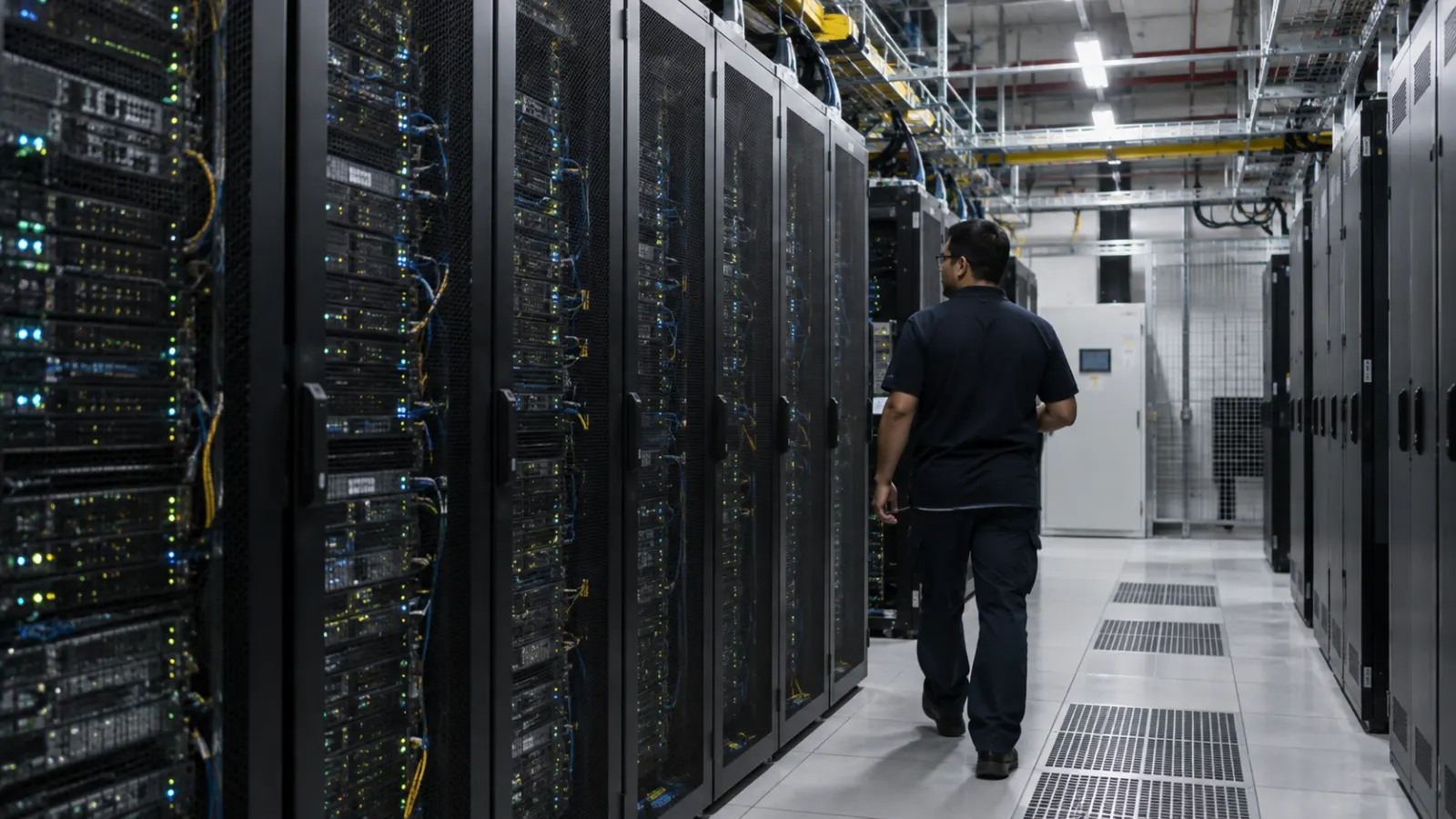
But the internet is not an abstract cloud. It is a global physical system containing billions of phones, laptops, televisions and routers; fibre-optic and mobile networks; switches and submarine cables; and data centres filled with servers, storage equipment, cooling systems and increasingly specialised computing hardware. All of that equipment has to be manufactured, powered, maintained and eventually replaced.
The internet therefore has a genuine environmental footprint, including greenhouse-gas emissions, electricity demand, material extraction, water use and electronic waste. What it does not have is one permanent carbon price attached to every digital action.
Claims such as “one email produces X grams of carbon” or “one search emits Y grams” can sound precise while hiding enormous uncertainty. The result can change with the device being used, the network connection, the computing workload, the electricity system, the geographical location of the data centre, the time the electricity is consumed and the method used to divide shared infrastructure among individual activities.
A useful explanation therefore begins with the system, not with a catchy number attached to one click.
The Internet's Footprint Comes From Devices, Networks, Data Centres and Electricity
One useful way to understand digital emissions is to divide the system into four connected layers: user devices, telecommunications networks, data centres and the electricity system supplying all three. Manufacturing adds another lifecycle component because much of the environmental cost of electronics occurs before the equipment is ever switched on.
The importance of each layer changes depending on what the internet is being used for. Watching a film on a large television can make the viewing device an important part of electricity consumption. Uploading files requires network infrastructure and storage. A computationally intensive AI workload can concentrate demand inside data centres equipped with specialised accelerators. Mobile connectivity and fixed fibre also have different technical characteristics, while older equipment can consume more energy than newer generations performing similar amounts of work.
An IEA analysis of streaming video illustrates why this distinction matters. Its assessment found that widely circulated estimates of streaming emissions had sometimes exaggerated electricity use dramatically because they used outdated assumptions about network and data-centre energy intensity. The IEA also found that, for the viewing patterns examined at the time, the consumer device represented the majority of streaming electricity use, with large televisions using much more power than smartphones. The precise numbers are now dated and should not be treated as current universal coefficients, but the analytical lesson remains useful: the device, connection and electricity mix can matter as much as the amount of data transmitted.
This is also why “per gigabyte” carbon estimates can become misleading. Telecommunications networks consume electricity even when traffic is relatively low, while improvements in equipment allow vastly more data to travel without electricity demand rising in proportion to traffic. The relationship between one additional gigabyte and an exact increment of energy use is therefore not as simple as multiplying data volume by a permanent energy factor.
Digital infrastructure has also become dramatically more efficient over time. Processing, storage and network equipment can perform far more work for each unit of electricity than earlier generations. That efficiency has helped the internet expand far faster than its electricity consumption in some periods.
But efficiency does not guarantee falling total demand.
If the amount of computing, streaming, storage and AI use grows faster than energy per task falls, aggregate electricity consumption can still increase. That tension between efficiency per unit and growth in total activity is becoming one of the defining questions in the environmental impact of digital technology.
Data Centres Are Growing Rapidly, but Electricity Demand Is Not the Same as Carbon Emissions
Data centres have become the most visible part of the digital-energy debate, particularly since the rapid expansion of artificial intelligence.
The International Energy Agency estimated that data centres consumed about 415 terawatt-hours of electricity in 2024, equivalent to approximately 1.5% of global electricity consumption. In its 2025 Energy and AI report, the IEA projected that data-centre demand could more than double to around 945 TWh by 2030 in its base case, with AI becoming the largest driver of the increase alongside continued growth in other digital services.
Growth accelerated further in 2025. An IEA update published in 2026 reported that global data-centre electricity demand increased by 17% during 2025, while electricity use at AI-focused facilities grew even faster. The agency simultaneously noted rapid improvements in energy consumed per AI task, demonstrating the same efficiency-versus-scale problem: individual computations may become cheaper in energy terms while the total number and complexity of computations expand much faster.
AI-focused computing changes data-centre design because graphics processors and other accelerators can create much higher power density than conventional server workloads. According to the IEA, servers already account for roughly 60% of electricity consumption in a modern data centre on average, while cooling can range from around 7% in highly efficient hyperscale facilities to more than 30% in less-efficient enterprise centres. Storage, networking and power-protection systems add further demand.
Yet electricity consumption should not be confused directly with greenhouse-gas emissions.
A data centre consuming one megawatt-hour of electricity in a grid dominated by coal does not have the same operational carbon footprint as one consuming the same amount on a system dominated by hydroelectricity, nuclear power, wind or solar.
Location therefore matters.
So does time.
An operator may contract annually for enough renewable generation to equal its annual electricity use, but its facilities still draw power from the physical electricity system every hour. During some hours, fossil generation may be contributing substantially to the electricity actually serving the grid. This is why increasingly sophisticated climate strategies examine hourly matching, flexible computing, storage and whether renewable procurement actually causes additional clean generation to be built.
The IEA makes this distinction explicitly in its analysis of electricity supply for data centres. Its physical-grid assessment estimated that coal supplied around 30% of data-centre electricity globally in 2024, renewables about 27%, natural gas roughly 26% and nuclear around 15%, although the mix varies greatly by region. That analysis deliberately examines the electricity physically serving data centres rather than merely companies' contractual renewable-energy claims.
Global averages can also conceal local pressure. A data centre sector representing a relatively small share of worldwide electricity consumption can account for a large proportion of new demand in one specific region. The IEA notes that data centres are geographically concentrated, making transmission capacity, generation availability, transformer supply and grid connections important constraints even when their contribution to global electricity demand remains comparatively modest.
The meaningful climate question is therefore not simply how much electricity data centres consume.
It is where that electricity is consumed, what produces it, when demand occurs and what new generation and grid infrastructure are built to serve it.
The Digital Footprint Starts Before Electricity Reaches the Device
Operational electricity is only one part of digital technology's environmental impact.
Every server, smartphone, television, network switch, battery and accelerator begins as materials extracted and processed somewhere in the world. Semiconductor manufacturing requires highly specialised factories, energy, water and chemical inputs. Metals have to be mined and refined. Devices must be assembled and transported.
These are embodied impacts: environmental costs created before equipment begins providing digital services.
UN Trade and Development's Digital Economy Report 2024 argues that digital environmental analysis needs to cover the entire lifecycle—from raw-material extraction and manufacturing through use and disposal. UNCTAD estimates that digital devices, data centres and ICT networks together account for a significant share of electricity use and reports that manufacturing can dominate the lifecycle greenhouse-gas footprint of some consumer electronics. For smartphones, it estimates production at roughly 80% of lifecycle greenhouse-gas emissions.
This changes how individual action should be evaluated.
The electricity required to recharge a modern phone can be relatively small compared with the emissions involved in producing a replacement device. Extending a device's useful life by another year or two may therefore avoid more environmental pressure than obsessing over tiny differences in day-to-day charging behaviour.
The same principle applies to digital infrastructure. Servers and networking equipment are periodically replaced as demand grows and newer equipment becomes more efficient. Efficiency upgrades can reduce operational electricity, but rapid replacement also creates repeated manufacturing impacts. The optimum replacement point is therefore a lifecycle question rather than a rule that newer is always better or that old equipment should always remain in service.
Electronic waste makes the issue especially visible.
The Global E-waste Monitor 2024, produced by ITU and UNITAR, estimated that the world generated a record 62 million tonnes of electronic waste in 2022, while only 22.3% was documented as formally collected and recycled in an environmentally sound manner. The report projected global e-waste to reach 82 million tonnes by 2030 under existing trends.
UNCTAD therefore advocates a more circular digital economy built around longer-lasting products, repair, refurbishment, reuse and improved material recovery. Its report also stresses that the environmental burdens of digitalisation are distributed unequally, with many developing economies supplying raw materials or receiving digital waste while capturing less of the higher-value economic activity associated with digital technologies.
The carbon footprint of the internet consequently cannot be understood only through electricity meters in data centres.
Part of it exists in mines, semiconductor fabrication plants, electronics factories, transportation systems and discarded equipment long before or after a digital service appears on a screen.
Why “One Email Produces X Grams” Is the Wrong Mental Model
The desire to assign emissions to individual digital activities is understandable.
A number feels actionable.
If one email supposedly creates four grams of carbon, perhaps deleting emails or sending fewer messages appears to offer a precise climate intervention.
The problem is that individual digital actions usually share infrastructure with millions of other activities.
A server remains powered whether one particular email is sent or not. Network equipment continuously carries traffic from many users. Data centres maintain baseline power for servers, cooling and reliability. A laptop or phone was manufactured long before a particular message was composed.
To calculate the carbon footprint of one email, an analyst therefore has to make allocation choices.
How much of the server's baseline electricity belongs to that email?
How long will the message and attachments be stored?
Is it read on a phone, a laptop or a large desktop monitor?
Does the recipient download a large file?
How should the embodied emissions of the devices be divided across thousands or millions of activities?
Should electricity emissions be calculated from the annual average grid mix, the hourly grid mix or the marginal generator responding to additional demand?
Different defensible assumptions can produce different answers.
That does not make digital carbon accounting meaningless. Companies can measure data-centre electricity, cooling efficiency, purchased hardware, network energy and greenhouse-gas inventories. Researchers can estimate ranges for services under stated assumptions.
What becomes problematic is presenting a modelling result as though it were a universal physical constant.
The same weakness affects simplistic figures for internet searches, cloud storage and AI prompts. Computational workloads vary enormously. A short text query and an image-generation request do not necessarily require similar computation. AI models differ in size, architecture, hardware, utilisation and optimisation. Data centres differ in cooling performance and electricity supply.
A credible claim therefore needs boundaries.
Which model?
Which hardware?
Which data centre?
Which electricity mix?
Which system components are included?
Are manufacturing impacts counted?
Is the estimate average or marginal?
Without those details, an impressively precise number may be less informative than a well-explained range.
The stronger public message is not that digital actions have no footprint. It is that the footprint comes from infrastructure and should be reduced where the actual energy and material flows occur.
AI Makes the Growth Problem More Important Than the Carbon Cost of One Prompt
Artificial intelligence has intensified public interest in digital emissions because large models can require substantial computing power both during training and during everyday use.
Training receives much attention because building a large model can involve long periods of accelerator use. But training is only one part of the lifecycle. Once a widely used model is deployed, inference—serving responses to millions or billions of requests—can create substantial recurring electricity demand.
As AI systems become embedded in search, software, customer service, image generation, scientific analysis and automated agents, the number and complexity of inference tasks can grow rapidly.
The IEA expects accelerated servers to account for a major share of future data-centre electricity growth. At the same time, there is substantial uncertainty in the forecast because computing hardware, model design and software efficiency are improving quickly. Its high-efficiency scenario shows that stronger improvements in software, hardware and infrastructure could reduce data-centre electricity requirements substantially compared with its base case while delivering the same level of digital services.
This creates a familiar rebound problem.
Suppose a new generation of hardware cuts the energy needed for one AI request in half. If AI usage then increases tenfold, total electricity demand can still rise sharply.
The environmental question is therefore not solved by asking whether tomorrow's AI model is more efficient than today's.
It is whether efficiency improves faster than total demand grows.
Model choice can also matter. Not every task requires the largest available model. Smaller models, specialised systems, efficient accelerators, better utilisation and intelligent workload scheduling can reduce resource use without necessarily reducing useful output.
Data-centre design matters as well. Cooling efficiency, server utilisation, power-management systems and the ability to move flexible workloads toward times or places with cleaner electricity can affect operational emissions.
But the largest climate lever remains the electricity system itself.
A computing industry supplied increasingly by low-carbon electricity can expand with a very different emissions trajectory from identical computing growth supplied mainly by fossil generation.
This is why AI's environmental impact should not be framed solely as a question of personal prompt discipline.
Individual behaviour influences demand, but infrastructure investment and energy policy determine much of the resulting carbon intensity.
The Most Effective Reductions Are Usually Structural
When environmental issues become popular, attention often moves rapidly toward small actions available to individuals: delete old emails, close browser tabs, reduce search activity or feel guilty about streaming.
Some of these actions can reduce tiny amounts of computing or device use.
They are not where the largest opportunities usually lie.
The structural levers are much larger: cleaner electricity, more efficient computing, better server utilisation, efficient cooling, efficient telecommunications equipment, longer-lived devices, repairability, responsible material sourcing and effective electronic-waste collection.
Data-centre operators can improve power usage and cooling systems, locate facilities where grids and water systems can support them, schedule flexible workloads intelligently and publish enough information for environmental performance to be evaluated.
Technology companies can design software that requires less computation for equivalent useful output.
Hardware manufacturers can improve energy efficiency while making equipment more durable and repairable.
Electricity planners can ensure that rapidly growing digital loads do not lock power systems into unnecessary fossil infrastructure.
Governments can strengthen electronics recycling and producer-responsibility systems.
Users still have meaningful choices. Keeping phones, laptops and televisions longer can reduce embodied impacts. Repairing devices where practical can postpone replacement. Efficient displays and power-saving settings can reduce operational electricity. Proper e-waste collection can recover materials and limit hazardous disposal. Avoiding unnecessarily high-resolution video on a large screen can reduce energy use where the additional quality provides little value.
These actions are more defensible than treating inbox housekeeping as a major climate strategy because they connect directly to equipment lifetime, device electricity and material flows.
The same materiality principle should guide organisations. A company whose largest digital impact comes from thousands of rapidly replaced employee laptops should not focus its environmental campaign mainly on asking workers to delete emails. A cloud provider should not emphasise office recycling while ignoring the electricity and hardware footprint of its infrastructure.
Good carbon management concentrates attention where the footprint actually sits.
Digital Technology Can Also Reduce Emissions Elsewhere
The internet's environmental footprint should not be interpreted to mean that digitalisation is simply an additional source of emissions.
Digital technologies can sometimes replace or improve more carbon-intensive activities.
Video conferencing can substitute for some business travel.
Building-management systems can reduce heating and cooling demand.
Smart grids can help integrate variable renewable generation.
Logistics software can reduce empty vehicle kilometres.
Remote sensing can identify methane emissions, forest loss and changes in land use.
Industrial controls can optimise manufacturing processes.
The environmental result depends on what the digital service changes.
A video call replacing an international flight can plausibly avoid much more emissions than the call produces. A video call replacing a short conversation that would otherwise have happened in the same office produces no comparable avoided travel.
Efficiency software that reduces a building's energy demand can have a positive environmental effect. But digital technology that simply creates new consumption can add its own footprint without replacing anything.
UNCTAD therefore distinguishes between the direct environmental impacts of digital technology and its indirect effects elsewhere in the economy. Digital tools can help reduce emissions in sectors such as transport, construction and energy, but they can also create rebound effects and stimulate additional consumption.
The question should therefore not be:
Is digital technology good or bad for the climate?
It should be:
What additional infrastructure does this digital service require, and what activity does it replace, improve or create?
The answer can differ from one use case to another.
The Internet's Carbon Footprint Is a Moving System, Not a Fixed Number
The environmental footprint of the internet is changing quickly because several forces are operating at once.
Computing hardware is becoming more efficient.
Networks can carry more traffic with improved equipment.
Electricity systems in many countries are adding renewable generation.
Those trends can reduce emissions for each unit of digital service.
At the same time, AI, streaming, cloud computing, connected devices and digital services are expanding. Data-centre investment is accelerating. More hardware is being manufactured. Electricity demand is rising in important regional clusters.
Those trends push total impact upward.
Both can be true simultaneously: digital services can become cleaner per task while the digital sector's total electricity and material demand grows.
This is why simplistic carbon labels attached to individual emails, searches or gigabytes provide such a poor mental model.
The more useful questions are systemic.
How much electricity does the infrastructure consume?
Where does that electricity come from?
How efficiently is computing capacity used?
How quickly is equipment being replaced?
What materials went into manufacturing it?
How much electronic waste is recovered?
Are clean-energy claims based on physical supply or only annual contractual accounting?
Can flexible computing shift away from carbon-intensive hours?
And what useful economic or social activity does the digital service enable or replace?
These questions are harder to fit into a headline than “one email equals X grams of CO2”.
They are also much closer to the places where meaningful emissions reductions can actually occur.
The internet is physical infrastructure disguised by a simple interface.
Understanding its carbon footprint means looking behind the screen.