When Frozen Water Redraws Geography
Melting glaciers and sea level rise are among the clearest signs that climate change is not an abstract change in air temperature. They show that heat is reshaping water stored in ice, oceans and landscapes. When glaciers shrink, mountain systems lose frozen reservoirs that have built up over centuries. When sea level rises, coastlines that once seemed stable become more exposed to flooding, erosion and saltwater intrusion. Both processes are slow compared with a storm, but their consequences can last for generations.
A glacier is a large, long-lasting mass of ice formed from accumulated snow that compresses over time and moves under its own weight. Glaciers exist in mountain ranges and polar regions. Ice sheets are even larger bodies of land ice, such as those covering Greenland and Antarctica. The distinction matters because sea level rise depends on land ice, not floating sea ice. When floating sea ice melts, it has little direct effect on sea level because it already displaces water. When glaciers and ice sheets on land melt and flow into the ocean, they add new water to the sea.
What Glaciers Are and Why They Shrink
Glaciers grow when snowfall adds more ice than melting removes. They shrink when melting, sublimation, calving or flow losses exceed accumulation. A warming climate changes that balance. Higher air temperatures increase surface melt. Warmer seasons last longer. Rain may fall instead of snow. Snowlines move upward. Darker surfaces exposed by melting absorb more sunlight. Soot, dust and wildfire particles can reduce reflectivity and speed melting. The result is not only a smaller glacier but a transformed mountain water system.
Mountain glaciers are often called natural water towers. They store winter snow and ice and release meltwater during warmer months. This seasonal release can support rivers, irrigation, hydropower and ecosystems. In the early stages of rapid glacier loss, meltwater may increase temporarily. But as glacier mass declines, the long-term water reserve shrinks. Eventually, dry-season flows can decrease. Communities downstream may face greater water uncertainty, especially where agriculture and hydropower depend on predictable meltwater.
Sea level rise has two main physical drivers. The first is thermal expansion. As seawater warms, it expands. Because the ocean is vast, even a small expansion contributes to higher global average sea level. The second is added water from melting land ice: mountain glaciers, Greenland and Antarctica. Other factors, such as changes in land water storage, groundwater extraction and dam reservoirs, also matter. Locally, land can sink or rise, ocean currents can shift, and winds can redistribute water. This is why sea level rise is global in cause but local in experience.
How Sea Level Rises
The ocean does not rise like water in a bathtub with perfectly even edges. Some coastlines experience sea level rise faster than the global average because land is subsiding. Delta regions can sink because of sediment compaction, groundwater withdrawal and reduced sediment supply from rivers. Some places experience different ocean dynamics because currents, winds and gravity effects from ice loss redistribute water. A global average is useful for science, but coastal planning needs local sea level information.
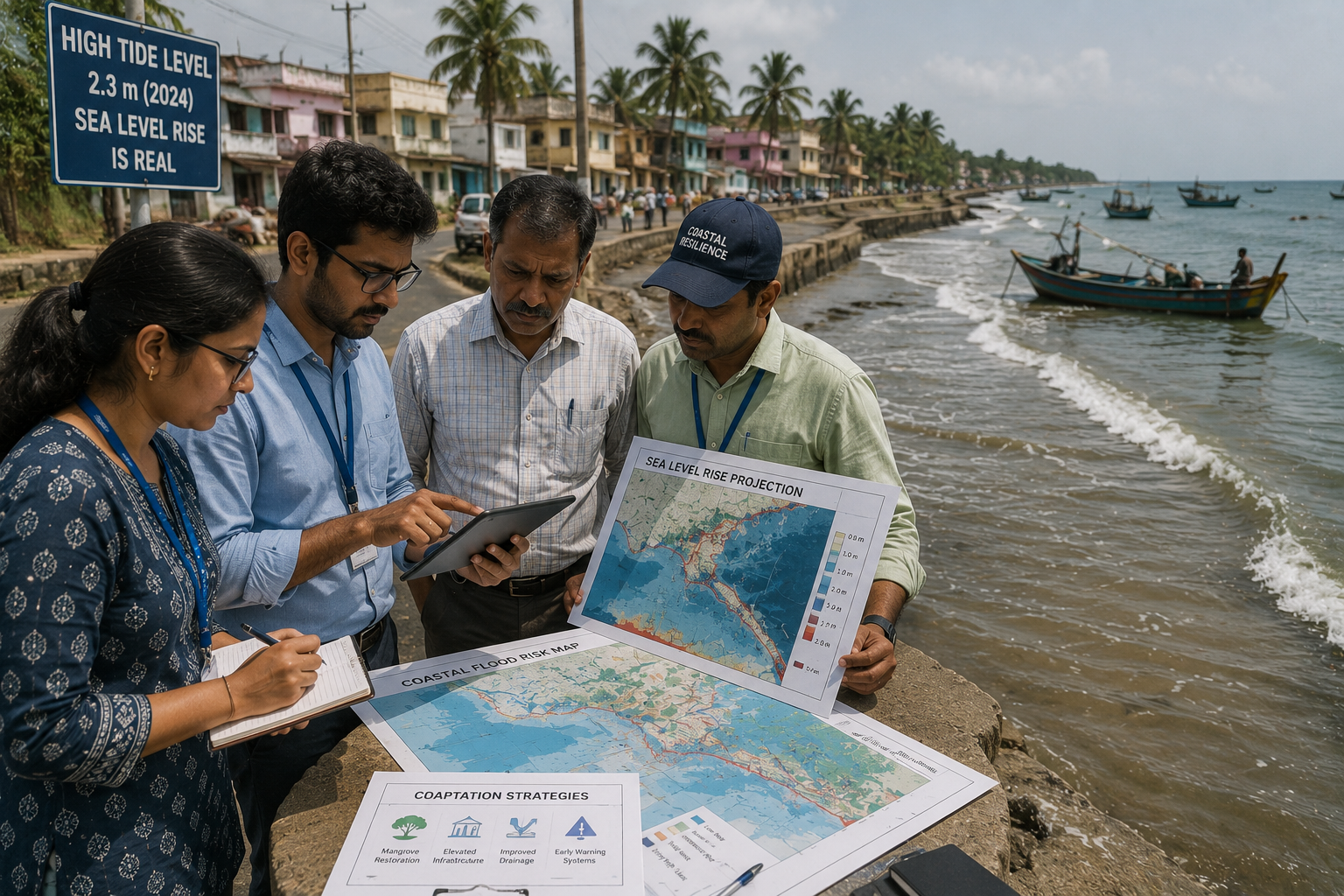
The consequences begin with flooding. Higher average sea level makes high tides higher, storm surges more damaging and coastal floods more frequent. A storm that once produced rare flooding can become more common when it starts from a higher baseline. Low-lying roads, ports, neighborhoods, airports, sewage systems and power infrastructure become more exposed. In many coastal cities, the problem is not only dramatic disaster flooding but repeated nuisance flooding that disrupts daily life, damages property and raises maintenance costs.
Coastal Impacts
Erosion is another major effect. Beaches, dunes and coastal wetlands are dynamic systems shaped by waves, sediment, vegetation and sea level. As seas rise, shorelines may move inland if space exists. But in many developed areas, buildings, roads and seawalls block natural movement. This is sometimes called coastal squeeze. Wetlands trapped between rising water and hard infrastructure may shrink, reducing habitat and weakening natural storm protection. Beaches may require expensive nourishment or may disappear in places where sediment supply is insufficient.
Saltwater intrusion is less visible but highly important. As sea level rises, salty water can move into coastal aquifers, rivers and soils. This threatens drinking water, agriculture and ecosystems. Farmers in delta regions may see soil salinity rise, reducing crop productivity. Cities may need new water sources or treatment systems. Wetlands may shift from freshwater to brackish or saline conditions, changing plant and animal communities. The salt line becomes an economic and ecological boundary.
Glacier loss also creates mountain hazards. As ice retreats, slopes once supported by ice can become unstable. Glacial lakes may form behind loose natural dams made of rock and sediment. If these dams fail, they can produce glacial lake outburst floods, sending water and debris downstream with little warning. Mountain tourism, hydropower projects, roads and settlements may face increased risk. In high mountain regions, climate change therefore affects both long-term water supply and immediate disaster danger.
Ice Sheets, Mountain Hazards and Long-Term Risk
The relationship between glaciers and sea level is not equal everywhere. Small mountain glaciers contain less total ice than the great ice sheets, but they can respond quickly to warming and contribute significantly to near-term sea level rise. Greenland and Antarctica contain enough ice to shape sea level over centuries, but their behavior involves complex ice dynamics, ocean interactions and thresholds. The stability of ice shelves, the flow of outlet glaciers and warming ocean water around ice margins are important scientific questions because they influence long-term risk.
One reason sea level rise is politically difficult is that it continues even after emissions fall. Oceans take time to warm and cool. Ice sheets respond over long periods. This means that some sea level rise is already committed because of past warming. However, the amount and rate of future rise are still strongly affected by emissions choices. Lower warming reduces long-term ice loss, slows the pace of change and gives communities more time to adapt. Higher emissions increase the risk of faster and larger sea level rise.
Adaptation choices vary by place. Some communities protect coastlines with seawalls, surge barriers, raised roads, pumps and drainage systems. Others restore mangroves, salt marshes, dunes and reefs that reduce wave energy and provide habitat. Some raise homes or change building codes. Some limit new construction in high-risk zones. In the most exposed locations, managed retreat may become necessary. There is no single solution because coastlines differ in wealth, geology, ecology, culture and population density.
Adaptation Choices and Trade-offs
Protection can also create trade-offs. A seawall may defend valuable property but worsen erosion nearby or damage beach ecosystems. Pumping systems may protect urban areas but require continuous energy and maintenance. Raising buildings may protect owners but not roads, schools or drainage. Retreat may reduce long-term risk but can break communities and raise questions of compensation and justice. Good coastal adaptation is therefore not only engineering. It is planning, finance, law, ecology and public trust.
Glacier adaptation is equally complex. Mountain regions may need improved monitoring, early warning systems for glacial lake outburst floods, water storage, diversified agriculture, watershed management and transboundary river cooperation. Hydropower planning must account for changing meltwater patterns. Tourism economies dependent on snow and glaciers may need diversification. Cultural and spiritual losses also matter. For many communities, glaciers are not only water sources; they are part of identity, landscape and memory.
A common misconception is that sea level rise matters only if a coastline is permanently underwater. In reality, risk increases long before permanent inundation. Higher seas raise the reach of storm surge, increase drainage problems, contaminate groundwater, damage foundations and make insurance more expensive. A few centimeters can matter when combined with high tides, waves and storms. The practical problem is frequency: events that were rare can become regular.
Misconceptions, Monitoring and Policy
Another misconception is that melting ice is a purely polar issue. The Arctic and Antarctic are central, but mountain glaciers in the Himalayas, Andes, Alps, Rockies and other regions affect water security and local livelihoods. Many people far from the coast depend on glacier-fed rivers. Many coastal people far from glaciers face the sea level consequences of ice loss. The cryosphere links distant places: a glacier melting in one region can influence ocean levels affecting another.
Science helps by monitoring change. Satellites measure ice mass, sea level, ocean heat, gravity changes and surface elevation. Tide gauges provide long-term coastal records. Field measurements reveal glacier thickness, flow and seasonal mass balance. Models help project future scenarios. But uncertainty should not be confused with ignorance. The direction of change is clear: warming melts land ice and warming water expands. The exact local timing and magnitude vary, but the risk is well established.
The policy message is direct. Reducing greenhouse gas emissions limits the long-term scale of glacier loss and sea level rise. Adaptation reduces harm from changes already underway. These two responses must work together. Mitigation without adaptation ignores current risk. Adaptation without mitigation becomes a losing race against accelerating change. The best strategy is to slow the water while preparing for the water.
Final Takeaway
The final takeaway is that melting glaciers and sea level rise turn climate change into geography. They redraw rivers, coastlines, risk maps and planning horizons. They remind us that heat does not stay in the air. It enters ice, water, land and infrastructure. Understanding this connection helps readers see why climate policy is not only about future temperature targets. It is about protecting water security, coastal safety, ecosystems and the physical shape of human settlement.
For editorial clarity, this subject should be presented as both a scientific explanation and a practical public-interest issue. The reader should not leave with only a definition. They should understand the mechanism, the evidence, the limits of certainty, the governance relevance and the real-world choices that follow. Environmental writing is strongest when it connects physical processes with human consequences without exaggerating beyond the evidence.
For editorial clarity, this subject should be presented as both a scientific explanation and a practical public-interest issue. The reader should not leave with only a definition. They should understand the mechanism, the evidence, the limits of certainty, the governance relevance and the real-world choices that follow. Environmental writing is strongest when it connects physical processes with human consequences without exaggerating beyond the evidence.
For editorial clarity, this subject should be presented as both a scientific explanation and a practical public-interest issue. The reader should not leave with only a definition. They should understand the mechanism, the evidence, the limits of certainty, the governance relevance and the real-world choices that follow. Environmental writing is strongest when it connects physical processes with human consequences without exaggerating beyond the evidence.
For editorial clarity, this subject should be presented as both a scientific explanation and a practical public-interest issue. The reader should not leave with only a definition. They should understand the mechanism, the evidence, the limits of certainty, the governance relevance and the real-world choices that follow. Environmental writing is strongest when it connects physical processes with human consequences without exaggerating beyond the evidence.
For editorial clarity, this subject should be presented as both a scientific explanation and a practical public-interest issue. The reader should not leave with only a definition. They should understand the mechanism, the evidence, the limits of certainty, the governance relevance and the real-world choices that follow. Environmental writing is strongest when it connects physical processes with human consequences without exaggerating beyond the evidence.
For editorial clarity, this subject should be presented as both a scientific explanation and a practical public-interest issue. The reader should not leave with only a definition. They should understand the mechanism, the evidence, the limits of certainty, the governance relevance and the real-world choices that follow. Environmental writing is strongest when it connects physical processes with human consequences without exaggerating beyond the evidence.
For editorial clarity, this subject should be presented as both a scientific explanation and a practical public-interest issue. The reader should not leave with only a definition. They should understand the mechanism, the evidence, the limits of certainty, the governance relevance and the real-world choices that follow. Environmental writing is strongest when it connects physical processes with human consequences without exaggerating beyond the evidence.
Key Takeaways
Melting land ice contributes to sea level rise, while warming seawater expands and raises ocean volume.
Glaciers also matter for mountain water security, hydropower, agriculture and disaster risk.
Sea level rise increases flooding, erosion, saltwater intrusion and coastal infrastructure stress long before permanent inundation.
The strongest response combines emission reduction with local adaptation and long-term coastal planning.