Tides are among the most ordinary and most revealing natural events on Earth. A beach that looks wide in the morning can be swallowed by the sea in the evening. Boats that float freely at one hour may rest on mud at another. For centuries, coastal communities learned to live by this rhythm before they knew the mathematics behind it. The cause is not a hidden engine inside the ocean. It is the gravitational relationship between Earth, the Moon and, to a smaller but important extent, the Sun.
The Moon as the Main Tide Maker
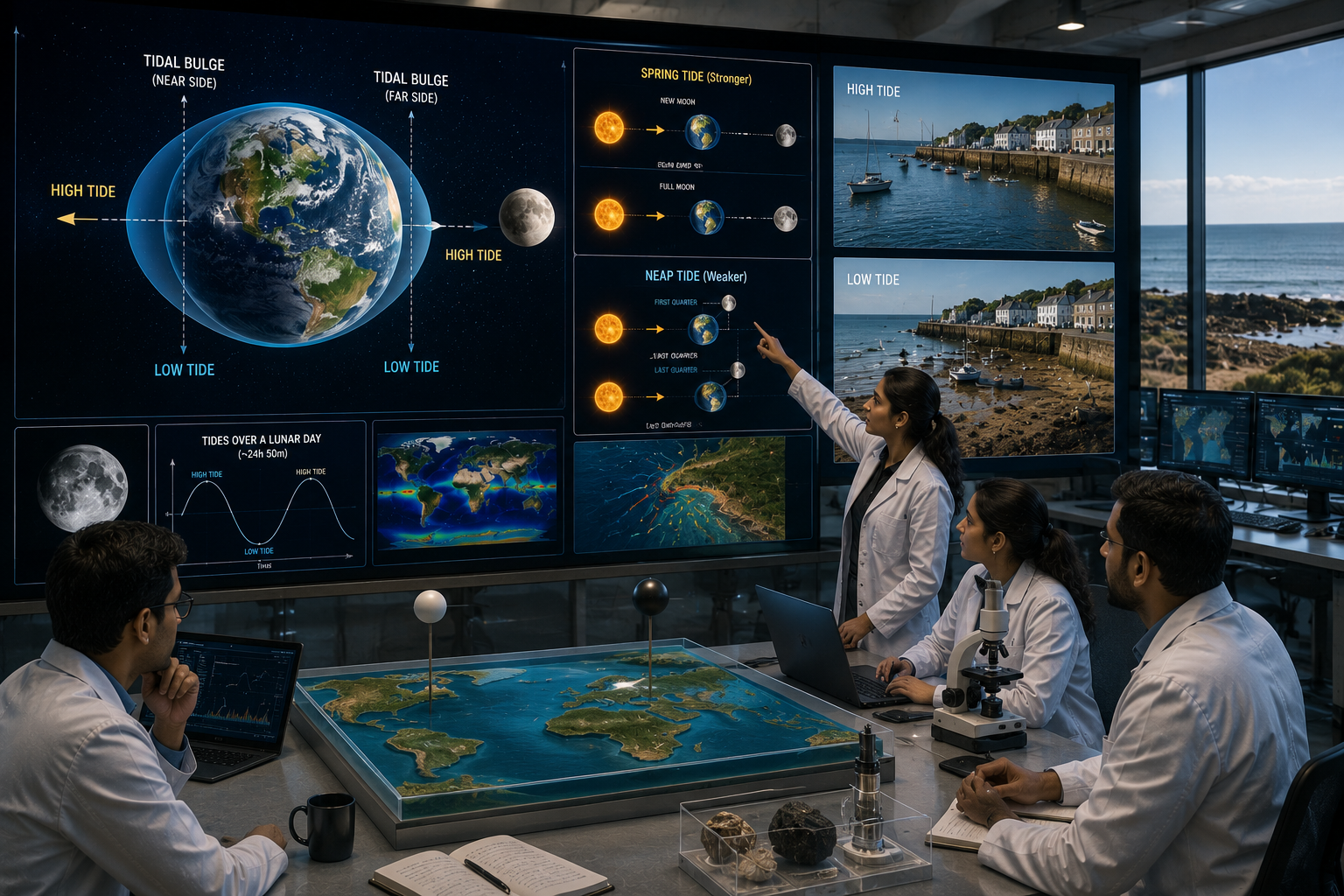
The Moon controls tides because gravity weakens with distance. The side of Earth nearest the Moon feels a slightly stronger lunar pull than Earths center, while the far side feels a slightly weaker pull. That difference is called tidal force. It stretches the ocean system, producing a bulge on the side facing the Moon and another bulge on the opposite side. The second bulge is often misunderstood, but it appears because the Earth-Moon system is being stretched, not because water is being pulled only in one direction.
Why High and Low Tides Happen
As Earth rotates, different coastlines pass through these tidal bulge regions. When a coastline moves into a bulge, the sea level there rises and the area experiences high tide. When it rotates away from the bulges, sea level falls and low tide occurs. In many places this creates roughly two high tides and two low tides each lunar day. The pattern is not perfectly twelve hours apart because the Moon is also orbiting Earth, so the tidal cycle follows a lunar day of about twenty-four hours and fifty minutes.
Why Tides Are Not the Same Everywhere
If Earth were covered by one smooth ocean of equal depth, tides would be easier to picture. The real planet is more complicated. Continents block ocean movement. Seafloor shape, bays, river mouths, islands, continental shelves and local winds influence how the tidal wave moves. This is why some places have enormous tides, while others have modest changes. The Bay of Fundy, for example, is famous for very large tidal ranges because its shape and natural resonance amplify the incoming tide.
The Role of the Sun
The Sun is far more massive than the Moon, but it is also much farther away. Its tidal influence is therefore weaker than the Moons, yet still important. When the Sun, Earth and Moon line up during new Moon or full Moon, their tidal effects combine. These are called spring tides, not because they happen only in spring, but because the water springs higher and lower than usual. When the Sun and Moon pull at right angles during quarter phases, their effects partly cancel, creating weaker neap tides.
Tides, Moon Phases and Misconceptions
Tides are linked with Moon phases because phases describe the changing geometry of the Sun, Earth and Moon. But phases do not directly create tides by changing the Moons shape or brightness. A crescent Moon is not weaker gravitationally than a full Moon. What changes is the alignment of the Sun, Earth and Moon, which affects whether solar and lunar tidal forces reinforce or offset each other. The Moon remains the main driver throughout the month.
Tidal Lag and Real-World Timing
High tide does not always occur exactly when the Moon is overhead. Earth rotates faster than the Moon orbits, ocean water has inertia, and coastlines reshape the movement of water. This produces tidal lag, meaning the largest water level may arrive after the idealized alignment. Tide tables are therefore based on detailed observation and prediction, not only on a simple Moon position. Mariners, fishers, port operators and coastal planners depend on these local predictions.
Why Tides Matter Beyond Beaches
Tides influence navigation, coastal ecosystems, fishing, sediment movement and even renewable energy planning. Mangroves, mudflats and estuaries depend on the rise and fall of water. Some marine animals time feeding, breeding and movement around tidal cycles. Engineers also study tides for tidal power, though practical generation depends on location, environmental impact and economics. Tides show how a distant astronomical body can shape daily life on Earths surface.
Final Takeaway
The Moon controls tides not by lifting the ocean like a magnet lifts iron, but by creating a tidal force across Earth. That force stretches the ocean system into bulges, while Earths rotation carries coastlines through high and low water. The Sun modifies the pattern, and local geography determines the details. Every tide is therefore a visible result of gravity, motion and Earths uneven oceans working together.