The solar system did not appear as a finished arrangement of planets neatly placed around the Sun. It formed through a long physical process involving gravity, rotation, heat, dust and repeated collisions. The calm diagram in a school textbook hides a violent origin story. The Sun, Earth, Jupiter, moons, asteroids and comets all emerged from a shared beginning: a vast cloud of gas and dust collapsing under its own gravity.
The Starting Cloud
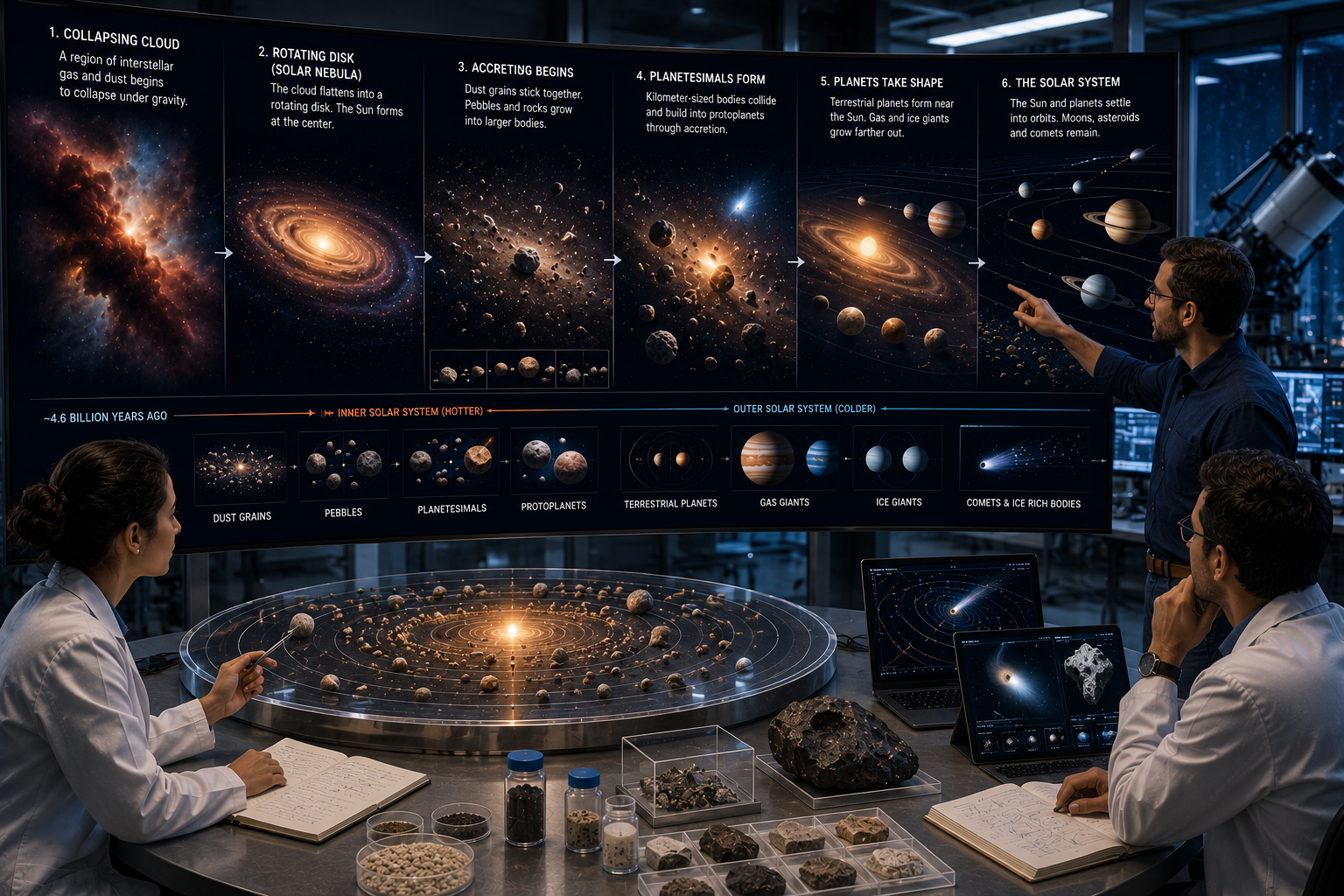
The story begins with a cold, dense region of interstellar gas and dust. Such clouds contain hydrogen, helium and tiny grains of heavier elements made by earlier generations of stars. A disturbance, perhaps from a nearby stellar explosion or other gravitational trigger, may have helped part of the cloud collapse. Once collapse began, gravity pulled more material inward. The cloud became denser and hotter as matter moved toward the centre.
Why a Disk Formed
The collapsing cloud was not perfectly still. It had some rotation. As it shrank, that rotation became more important, much as a spinning skater turns faster when pulling in the arms. The material flattened into a rotating disk called the solar nebula. The centre became dense and hot enough to form the young Sun. Around it, leftover gas and dust continued to orbit in a broad disk where planets would begin to grow.
The Birth of the Sun
At the centre of the disk, pressure and temperature rose dramatically. Eventually conditions allowed nuclear fusion to begin, turning hydrogen into helium and releasing enormous energy. This marked the Sun becoming a true star. The young Sun then influenced the surrounding disk through radiation, heat and solar wind. The inner region became warmer, while the outer region remained cold enough for ices and gases to play a larger role.
Dust to Planetesimals
Planets began with tiny particles. Dust grains collided and stuck together under gentle conditions. Small clumps grew into pebbles, rocks and then planetesimals, bodies large enough for gravity to help pull in more material. This process is called accretion. It was not smooth or peaceful. Collisions could build worlds, break bodies apart or change their orbits. Over time, larger protoplanets emerged from countless smaller impacts.
Why Inner and Outer Planets Differ
Temperature shaped the architecture of the solar system. Close to the young Sun, it was too hot for many volatile materials to condense, so the inner planets formed mostly from rock and metal. Farther out, beyond colder regions, ices were more abundant and cores could grow large enough to capture hydrogen and helium gas. This helps explain why Mercury, Venus, Earth and Mars are rocky, while Jupiter and Saturn became gas giants and Uranus and Neptune became ice giants.
Moon’s, Asteroids and Comets
Not all material became planets. Some became moons, captured objects, asteroid belt bodies, Kuiper Belt objects or comets. These smaller bodies are scientifically valuable because many preserve clues from the early solar system. Meteorites can carry chemical records of ancient materials. Comets can contain ice and organic molecules from cold outer regions. Asteroids and comets are therefore not cosmic leftovers without meaning; they are historical evidence.
A System Still Changing
Although the main formation phase ended billions of years ago, the solar system is not frozen. Planets continue to orbit, moons interact with tides, asteroids collide, comets visit the inner system and the Sun slowly evolves. Gravity still shapes motion. The solar system is stable enough for long-term patterns, but dynamic enough for change. Its formation story explains both its order and its remaining messiness.
Final Takeaway
The solar system formed from a collapsing cloud of gas and dust that became a rotating disk. The Sun ignited at the centre, while surrounding material collided and accreted into planets, moons and smaller bodies. The system we see today is the result of shared origin plus local conditions: heat, distance, composition and gravity. Every planet is therefore a chapter in one larger formation story.