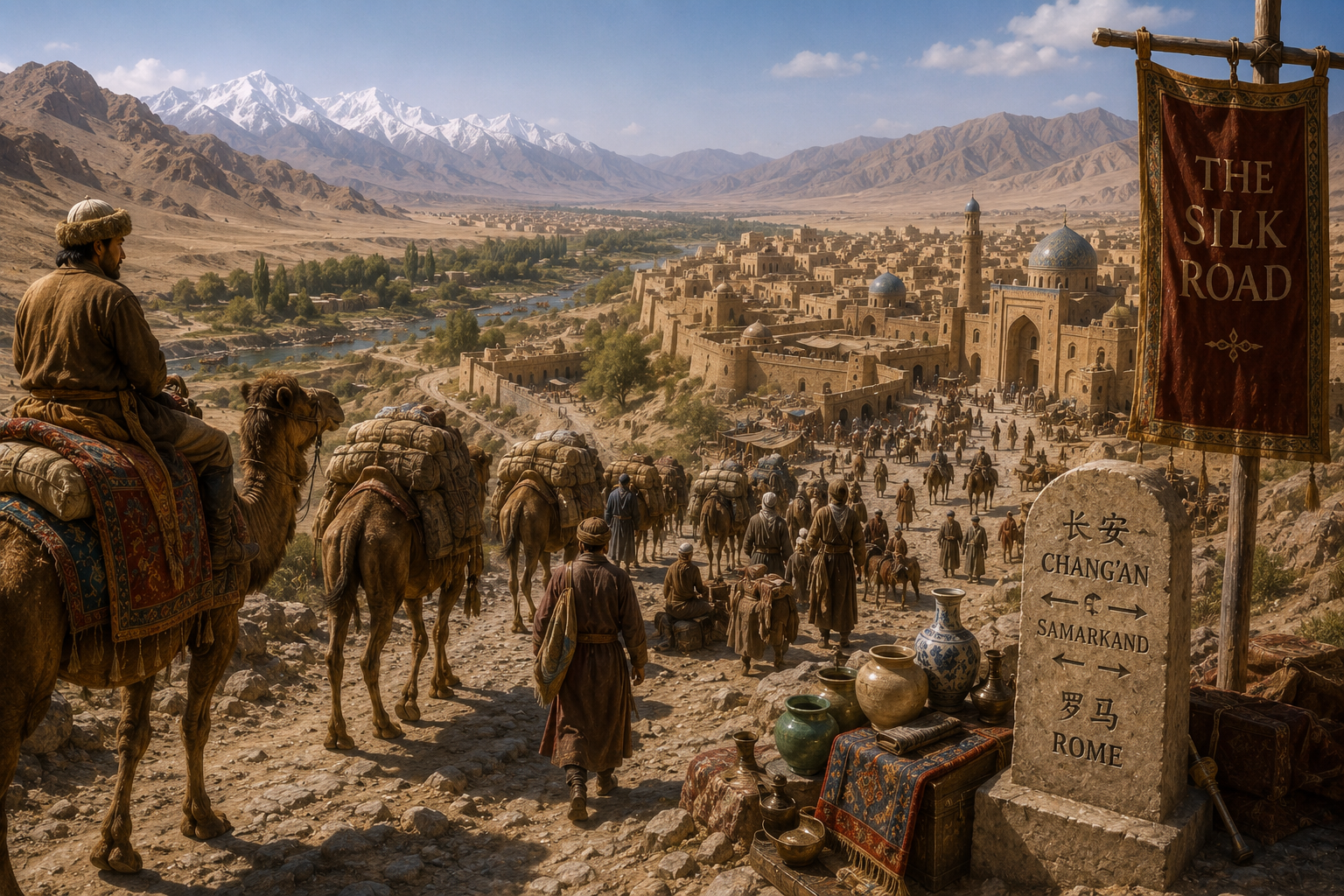
The Silk Road was never one road, and silk was never its only cargo. It was a shifting web of caravan tracks, oasis towns, mountain passes, sea lanes, river routes, markets, empires, monasteries and ports that connected East Asia, Central Asia, South Asia, the Middle East, Africa and Europe over many centuries. The name sounds simple, but the historical reality was complex: goods moved, but so did languages, religions, diseases, technologies, artistic styles, diplomatic missions, armies and stories.
To say that the Silk Road connected the world is not to claim that it created modern globalisation in a fully modern sense. Ancient and medieval connectivity was slower, riskier and more fragile. Merchants did not usually travel from China to Rome in one continuous journey. Goods passed through many hands. A bolt of silk, a Buddhist manuscript, a spice shipment or a glass vessel could move through relay systems of traders, rulers, monks and middlemen. Connection was therefore cumulative rather than direct.
The Silk Road matters because it reveals that civilisations were never sealed containers. China was shaped by Central Asian horses and Buddhism from India. Rome desired eastern luxuries. Islamic lands became bridges of trade, science and translation. Indian Ocean routes linked ports from Gujarat and Arabia to Southeast Asia and China. Oasis cities such as Samarkand, Bukhara, Khotan, Kashgar and Dunhuang flourished because geography made them necessary. The Silk Road was the world’s great lesson in interdependence before the age of steamships, telegraphs and modern capitalism.
Time, Place and the Network Behind the Name
The Silk Road is usually associated with routes between China and the Mediterranean, but that is only part of the story. The network stretched across deserts, mountains, steppes, river valleys and seas. It linked the Chinese capitals of Chang’an and Luoyang to the Hexi Corridor, Dunhuang, the Tarim Basin, Central Asian oases, Persia, India, the Levant and Europe. Maritime routes connected Chinese, Southeast Asian, Indian, Arabian and East African ports.
The phrase ‘Silk Road’ was coined in the nineteenth century, long after the routes themselves had flourished. Modern historians often prefer ‘Silk Roads’ because the system was plural. There were northern and southern desert routes, steppe routes, Himalayan crossings, Persian Gulf connections and Indian Ocean circuits. The network changed over time depending on empires, climate, warfare, technology and demand. Its power lay not in a single highway but in the ability of many routes to overlap and reconnect after disruption.
Before the Routes: Older Exchanges Across Eurasia
Long before formal Silk Road trade became famous, Eurasian communities exchanged goods, animals and technologies. Steppe peoples moved horses, pastoral skills and military techniques across grasslands. Agricultural products diffused slowly across regions. Metals, stones and ornaments travelled through elite exchange networks. The Silk Road did not begin from zero; it intensified older patterns of mobility that had already linked distant societies.
This background is important because connectivity was not invented by one empire. It developed wherever geography created need and opportunity. Pastoralists linked settled zones. Mountain passes connected valleys. River systems moved goods locally. Coastal sailors followed monsoon winds. The Silk Road emerged when these older movements became more regular and politically protected under large states, especially the Han Empire in China, Central Asian powers, Persian empires, later Islamic caliphates and Mongol rule.
The Han Dynasty and the Opening to Central Asia
The early development of the overland Silk Road is closely associated with the Han dynasty. Chinese rulers sought horses and alliances against steppe confederations, especially the Xiongnu. Diplomatic missions, including those associated with Zhang Qian in the second century BCE, expanded Chinese knowledge of Central Asia. What began as strategic exploration helped open channels for trade and diplomacy.
The Han desire for powerful Central Asian horses reveals a crucial truth: the Silk Road was not created by luxury alone. Military needs mattered. Horses, weapons, alliances and intelligence were as important as silk and jade. Once routes were opened, merchants followed. Chinese silk moved westward, while horses, glassware, precious stones, metals and other goods moved eastward. Political security and military ambition created commercial opportunity. The road of silk was also a road of strategy.
How the System Worked: Relay, Not One Journey
A common misconception imagines a merchant leaving China with silk and arriving in Rome after one heroic journey. In reality, goods often moved through relay trade. One merchant sold to another in an oasis city; caravans changed hands; middlemen added value; taxes were collected at frontiers; local rulers protected or exploited trade. By the time an object reached its final market, it might have passed through many languages and currencies.
This relay system explains why the Silk Road could survive distance. No single trader needed to know the whole route. Each community specialised in one segment: desert caravan, mountain transport, oasis storage, port shipping, translation, financing or brokerage. Connectivity was distributed. The system resembled a chain of trust and risk, held together by profit, protection, reputation and necessity. The Silk Road connected the world not by eliminating distance, but by dividing distance into manageable stages.
Oasis Cities: The Beating Heart of the Routes
Oasis cities made the overland Silk Road possible. Deserts such as the Taklamakan and Gobi were not crossed casually. Caravans needed water, fodder, food, repairs, animals, guides and information. Cities such as Dunhuang, Turfan, Khotan, Kashgar, Samarkand and Bukhara became essential stopping points. Geography turned them into service centres, markets and cultural meeting grounds.
These cities were not passive rest stops. They became centres of art, religion and politics. Monasteries, caravanserais, bazaars and courts attracted monks, merchants, envoys and translators. Local rulers gained revenue by taxing and protecting trade. Oasis communities often became multilingual and cosmopolitan because survival depended on dealing with strangers. The Silk Road’s culture was therefore not produced only by great empires; it was produced in intermediate places where travellers had to negotiate difference.
Silk, Spices, Horses and the Material Economy
Silk was the most famous product moving west from China, but the Silk Road carried many goods. Horses, jade, glass, silver, gold, ivory, spices, textiles, ceramics, paper, medicines, dyes, carpets, furs and precious stones all travelled through different routes. Some goods moved in bulk across shorter distances; others travelled farther because they were light, valuable and desirable.
Luxury trade mattered because high-value goods could survive the cost of transport. A caravan crossing deserts and mountains could not profitably carry cheap grain over thousands of kilometres, but silk, gems and spices justified risk. Yet luxury goods also had social meaning. Elites used them to display rank, taste and access to distant worlds. A Roman wearing silk, a Chinese court valuing horses, or a Central Asian ruler displaying silverware participated in a symbolic economy of distance.
Buddhism on the Road
One of the Silk Road’s greatest cultural effects was the spread of Buddhism from India into Central Asia and China. Monks, translators, merchants and pilgrims carried Buddhist texts, images and practices across mountains and deserts. Monasteries offered lodging, ritual protection and learning, making them important nodes in the network. Buddhism travelled not as a single unchanged package but through translation and adaptation.
Cave sites such as Dunhuang preserve the visual richness of this movement. Indian, Central Asian, Chinese and Iranian artistic influences blended in paintings and sculptures. As Buddhist ideas entered China, they encountered Confucian and Daoist traditions, generating new schools, translations and devotional practices. The Silk Road therefore changed religious history. It made Buddhism one of Asia’s great transregional traditions and showed that trade routes could become sacred routes.
Islamic Lands as Bridges of Exchange
From the seventh century onward, Islamic polities transformed the geography of Afro-Eurasian exchange. The caliphates and later Muslim dynasties connected the Mediterranean, Persia, Central Asia, Arabia, India and East Africa. Arabic, Persian and Turkic-speaking merchants, scholars and officials became central actors in Silk Road and Indian Ocean networks.
Islamic lands served not merely as middle zones but as creative centres. They transmitted, translated and transformed knowledge in astronomy, mathematics, medicine, geography and philosophy. Paper-making, which moved westward from China, found major development in Islamic cities and later reached Europe. Trade and scholarship often travelled together because merchants, courts and scholars depended on urban prosperity. The Silk Road was therefore a corridor not only of commerce but of intellectual circulation.
India, the Sea and the Southern Routes
India was not a side note in Silk Road history. South Asia connected overland routes through the northwest with maritime routes across the Indian Ocean. Goods from India, including spices, textiles, gems, ivory and religious texts, moved toward Central Asia, Southeast Asia, China, Arabia and the Mediterranean. Ports on the western and eastern coasts linked inland production to global exchange.
The monsoon system made Indian Ocean trade especially important. Sailors learned seasonal wind patterns that allowed predictable movement between Arabia, India, Southeast Asia and China. Maritime routes could carry bulkier goods than desert caravans and became increasingly important over time. A proper understanding of the Silk Roads must therefore include seas as well as deserts. The world was connected by sails as much as by camels.
China’s Tang Age and Cosmopolitan Chang’an
During the Tang dynasty, Chang’an became one of the great cosmopolitan capitals of the world. Merchants, monks, musicians, diplomats and artisans from Central Asia and beyond entered the city. Foreign clothing, music, foods and religious communities became visible in elite and urban culture. The Silk Road was not only a line on a map; it was experienced in city streets, markets and courtly fashions.
Tang cosmopolitanism shows how connectivity could enrich civilisation. Buddhism flourished, Central Asian music influenced court culture, and foreign communities participated in commerce. Yet openness also produced anxiety. Rebellions, frontier pressures and debates over foreign religions later made the state more cautious. The Tang case reveals a recurring pattern in Silk Road history: societies wanted the wealth and prestige of connection, but they also feared the instability that connection could bring.
Technology and Knowledge in Motion
The Silk Roads carried technologies as well as goods. Paper-making moved from China westward and transformed record-keeping, administration, scholarship and religious life. Printing, gunpowder knowledge, astronomical ideas, medical texts and mathematical concepts circulated in different periods through overlapping routes. Not every invention travelled quickly or directly, but the network created channels through which knowledge could move.
Knowledge changed as it travelled. Translators adapted terms. Scholars compared systems. Artisans modified techniques for local materials and tastes. A technology arriving in a new region could acquire new uses. This is why the Silk Road should not be imagined as simple transmission from one superior centre to passive receivers. It was a process of exchange, selection and reinvention. Connection created creativity because people borrowed, misunderstood, improved and localised what they encountered.
Disease, Risk and the Dark Side of Connectivity
Connectivity brought danger. Caravans faced bandits, deserts, mountains, political instability, taxation and animal loss. Empires could protect routes, but wars could close them. Merchants gained profit only by accepting risk. The romance of the Silk Road should not hide its hardship. Many travellers died nameless, and many goods never reached their destination.
Disease also moved along routes of exchange. The most famous example is the spread of plague across Afro-Eurasia in the fourteenth century, though disease movements were complex and not reducible to one road. The same networks that carried silk, spices and manuscripts could carry pathogens. This is one of history’s hardest lessons: interdependence multiplies both wealth and vulnerability. The Silk Road connected the world, but connection was never innocent.
The Mongol Moment and the Pax Mongolica
The Mongol Empire created one of the most important phases of Silk Road integration. After the conquests of Genghis Khan and his successors, much of Eurasia came under Mongol or Mongol-descended rule. This did not make travel safe everywhere, but it did create periods in which routes across Central Asia were more protected and administratively connected.
The so-called Pax Mongolica allowed merchants, envoys, missionaries and travellers to cross enormous distances with new possibilities. Marco Polo’s journeys became famous in Europe, though he was only one among many people moving through Mongol networks. The Mongol period intensified east-west awareness and helped transfer technologies, goods and information. Yet Mongol integration was built on conquest and violence. The road became safer for some because armies had first shattered many societies.
Decline, Diversion and Transformation
The Silk Roads did not simply disappear at one moment. They changed. The decline of certain overland routes resulted from multiple factors: the fragmentation of Mongol authority, the rise of maritime trade, shifting political powers, disease, warfare and the growing role of European oceanic expansion. Sea routes increasingly carried larger volumes of goods more efficiently than long caravan chains.
But decline of one route was transformation of connection, not the end of global exchange. Central Asian cities lost some importance, while ports gained. The Indian Ocean, South China Sea and eventually Atlantic routes reshaped world commerce. The Silk Road’s story therefore does not end in disappearance; it becomes part of the larger history of global trade. The early modern world did not replace connection with isolation. It redirected connection toward ships, empires and oceans.
Historical Debates: Myth, Metaphor and Reality
Historians debate the usefulness of the term Silk Road. Some argue that it exaggerates silk and creates the false image of a single east-west highway. Others defend the term as a powerful metaphor if used carefully. The modern correction is to speak of Silk Roads: plural, shifting and multidirectional. Goods and ideas moved north-south as well as east-west, by sea as well as land.
There is also debate over how connected the ancient world really was. Luxury goods could travel great distances, but most people lived local lives. A farmer in China or Persia may have known little about distant empires. The Silk Road connected elites, markets, monasteries and states more than it connected every ordinary person equally. Its importance lies not in universal integration but in selective, meaningful connectivity that changed art, religion, diplomacy and political imagination.
Legacy Conclusion
The Silk Road’s legacy is the recognition that civilisation has always been relational. China, India, Persia, Rome, Central Asia, the Islamic world and Europe did not develop in sealed rooms. They watched, borrowed, desired, feared and transformed one another. Silk moved west, horses moved east, Buddhism moved into China, paper moved toward the Islamic world and Europe, spices crossed seas, and artistic motifs travelled farther than armies could permanently rule.
Its most powerful lesson is that connection is neither purely good nor purely bad. Trade enriched cities, monasteries, courts and merchants. It spread religions and knowledge. It allowed strangers to become partners. But it also carried disease, conquest, exploitation and cultural anxiety. The Silk Road was a system of opportunity and danger. That is why it remains so relevant: every connected age must face the same double truth.
To say that the Silk Road connected the world is to say that it made distance historically productive. Deserts became corridors, oases became cosmopolitan cities, ports became gateways and translators became civilisational agents. The network did not abolish difference. It made difference exchangeable. Its legacy survives whenever we understand history not as separate civilisations developing alone, but as a long movement of goods, ideas, faiths and people across the difficult geography of the earth.
Extended Historical Analysis: Connection as Civilisational Method
The Silk Roads endured because they did not depend on one state, one people or one commodity. When one corridor became dangerous, another could rise. When one empire collapsed, merchants found new patrons. When overland trade weakened, maritime exchange expanded. This flexibility made the system historically resilient. Its shape changed, but the appetite for connection remained.
The deeper meaning of the Silk Roads lies in method. Civilisations grew by translating the foreign into the familiar. A religion became local through new art and language. A technology became useful through adaptation. A luxury became a status symbol through distance. The Silk Roads connected the world by making borrowing normal, profitable and prestigious.
The Human Labour Behind Romance
The Silk Road is often remembered through beautiful objects, but its foundation was labour. Camel drivers, animal handlers, guards, translators, innkeepers, money changers, scribes, porters, sailors, warehouse workers and market brokers made connection possible. Their names rarely survive, yet without them no silk, spice, manuscript or diplomatic gift could cross continents. The romance of the route rests on the endurance of people who faced thirst, cold, bandits, illness and political uncertainty.
Caravan travel required organisation. Animals needed fodder and rest. Water had to be planned. Guides knew which wells were reliable and which passes were dangerous. Merchants calculated risk against profit. Local rulers demanded taxes or protection payments. A successful journey depended on cooperation among strangers who might share no language or religion. The Silk Road connected the world because thousands of practical arrangements were repeated across generations. Its greatness was built from ordinary acts of transport, negotiation and survival.
Monks, Pilgrims and Translators as Cultural Engineers
Religious travellers were among the most important connectors of the Silk Road. Buddhist monks moved between India, Central Asia and China in search of scriptures, teachers and sacred sites. Translators worked in monasteries and courts to render Sanskrit, Prakrit and Central Asian texts into Chinese. This was not mechanical translation. It required conceptual creativity because religious ideas had to be fitted into new linguistic and philosophical worlds.
Pilgrims such as Faxian and Xuanzang became civilisational figures because their journeys produced knowledge. They described roads, kingdoms, monasteries, customs and texts. Their records connected geography with devotion. The movement of religion also changed art: Buddhas acquired new faces, robes, gestures and symbolic settings as artists adapted forms to local cultures. The Silk Road was therefore a school of translation in the broadest sense. It translated not only words, but images, rituals and worlds of meaning.
Art as Evidence of Connection
Art often preserves connections that political histories forget. A mural in Dunhuang, a glass vessel in China, a Sogdian silver plate, a Persian textile pattern or a Buddhist sculpture with Greco-Roman influence can reveal how styles crossed boundaries. Artists borrowed motifs without always knowing their original meaning. Patrons desired foreign beauty because distance itself gave objects prestige.
This artistic evidence complicates simple civilisational categories. A statue made in one region might show Indian religious ideas, Central Asian clothing, Chinese patronage and Iranian decorative influence. Such objects are not exceptions; they are the material grammar of Silk Road exchange. They show that culture travels through imitation, adaptation and taste. A route is not only proven by written records. It can be seen in the curve of a halo, the fold of a robe, the shape of a vessel and the colour of a pigment.
Maritime Silk Roads and the Power of the Monsoon
Overland caravans dominate the popular image, but maritime routes became equally significant. The Indian Ocean was not a barrier; it was a seasonal highway. Sailors used monsoon winds to travel between Arabia, East Africa, India, Sri Lanka, Southeast Asia and China. Ports became cosmopolitan zones where merchants, sailors, religious teachers and migrants formed mixed communities.
Maritime trade could carry bulkier goods than desert caravans. Ceramics, spices, timber, textiles, metals and food products moved through port networks. Coastal rulers taxed trade and competed for harbour advantage. The sea also spread religion: Buddhism, Hinduism and Islam all moved through maritime circuits in different periods. A complete history of the Silk Roads must therefore include ships, ports and monsoon knowledge. The camel and the sail were partners in connecting the premodern world.
Empires as Protectors and Predators
Empires made long-distance exchange easier when they protected routes, standardised taxes, punished banditry and maintained roads. The Han, Tang, Persian, Islamic and Mongol powers each supported connectivity in different ways. Merchants preferred predictable authority to anarchy. Even high taxes could be acceptable if roads were safe and contracts were respected.
Yet empires were also predators. They demanded tribute, seized goods, conscripted labour and used roads for armies as well as trade. The same infrastructure that moved silk could move soldiers. The same taxation that funded protection could become exploitation. This dual role is essential to understanding the Silk Road. Trade was never separate from power. It flourished when rulers saw profit in exchange, but it suffered when war, greed or suspicion overwhelmed cooperation.
Cities After the Caravan Age
When maritime routes and later global oceanic trade shifted the centre of exchange, many overland Silk Road cities declined in relative importance. Some lost wealth as caravan traffic shrank. Others survived by serving regional trade, pilgrimage, agriculture or political administration. The end of one age of connectivity did not erase their memories. Samarkand, Bukhara, Kashgar, Dunhuang and other cities remained symbols of cosmopolitan history.
Their later decline teaches an important lesson about infrastructure and geography. A city can flourish because it sits at a crossing point, but if routes change, its advantages can fade. Trade networks create prosperity but also dependency. The Silk Road’s old cities remind us that global connection is uneven. It makes some places central for centuries, then leaves them struggling when technology, politics or demand shifts. Their ruins and monuments are archives of both glory and vulnerability.
Modern Memory and the Politics of the Silk Road
Today the Silk Road is invoked in tourism, diplomacy, infrastructure projects and cultural branding. It suggests peaceful exchange, shared heritage and ancient globalisation. This memory has value, but it can also simplify history. The old routes involved cooperation, but also slavery, conquest, disease and exploitation. They were not a permanent festival of harmony.
Modern uses of the Silk Road should therefore be historically disciplined. The true lesson is not that trade automatically produces peace. The lesson is that societies have always been interconnected and that connection requires institutions, trust, security and cultural translation. The Silk Road remains powerful because it gives humanity a long memory of exchange across difference. Its legacy should inspire dialogue, but not erase the conflicts that shaped it.
Women, Families and Settlement Along the Routes
Silk Road history often focuses on male merchants and monks, but families and women shaped the settled life of route cities. Traders married locally, diasporic communities formed households, and women participated in textile production, food supply, hospitality, religious patronage and market exchange. A merchant corridor could become a residential world where children grew up speaking multiple languages and inheriting mixed cultural traditions.
This social layer explains how connection became durable. A caravan can pass through a city once, but a community makes exchange continuous. Sogdian merchants, for example, became famous as intermediaries across Central Asia and China because they built networks of trust through kinship, language and settlement. The Silk Road was therefore not only a road of travellers. It was a chain of homes, marriages, neighbourhoods and diasporas that made long-distance trade socially possible.
Diplomacy, Gifts and the Performance of Distance
Diplomatic missions were central to Silk Road connectivity. Envoys carried letters, gifts, tribute, marriage proposals, religious objects and political messages. A gift from one court to another was never just a present. It performed hierarchy, friendship, rivalry or curiosity. Horses, silk, glass, manuscripts, exotic animals and luxury objects became languages of diplomacy.
Diplomatic exchange also produced knowledge. Courts gathered information about distant rulers, military threats, trade opportunities and religious communities. Misunderstanding was common, but even misunderstanding could shape policy. The Silk Road connected political imaginations by making distant powers visible to one another. A ruler in China, Persia, India or Byzantium could think about worlds beyond the immediate frontier because envoys and goods made those worlds tangible.
Food, Language and Everyday Exchange
Not everything that travelled along Silk Road systems was luxurious. Foods, tastes and habits also moved. Grapes, pomegranates, walnuts, sesame, certain spices, tea cultures and culinary techniques circulated through different regions at different times. Such movements rarely appear as dramatically as diplomatic missions, but they changed everyday life. A food adopted into a new cuisine could become so familiar that its foreign journey was forgotten.
Language also carried traces of exchange. Loanwords moved with goods, religions and technologies. Translators created vocabularies for Buddhist concepts in Chinese, commercial terms in Persian and Turkic, and administrative expressions across imperial zones. Even when travellers did not share a language, repeated trade produced practical multilingualism in markets and caravan cities. The Silk Road connected the world not only through royal gifts and rare objects, but through tastes, words and habits that entered ordinary life.
Why the Silk Road Still Changes Historical Thinking
The Silk Road changes how history is written because it challenges the habit of studying civilisations separately. A purely national or isolated history cannot explain why a Buddhist cave in China shows Central Asian artistic forms, why Roman elites desired Chinese silk, why Islamic cities became centres of paper production, or why Indian Ocean ports shaped trade between East and West. The evidence forces historians to follow movement.
This mobile perspective does not erase local identity. On the contrary, it shows how local cultures became richer by selecting from external influences. Civilisations did not merely receive foreign things; they interpreted them. The Silk Road is therefore a method of historical thinking: start with movement, then ask how societies adapted what moved. Its enduring value lies in teaching that cultural confidence and openness were often intertwined.
The Fragile Ethics of Exchange
The Silk Road is sometimes celebrated as proof that commerce naturally creates peace, but history is less simple. Exchange could soften prejudice by making strangers useful to one another, yet it could also deepen inequality. Slaves, captives and coerced labour moved through some of the same networks as luxury goods. Powerful states could profit from trade while ordinary transport workers carried the danger.
The ethical meaning of the Silk Road therefore lies in ambiguity. It shows the beauty of contact, but also the need to govern contact justly. A connected world is not automatically humane; it must build rules, protections and shared expectations. The old routes remind us that interdependence is a condition, not a virtue by itself. What matters is how societies choose to organise it.
The Final Historical Takeaway of the Routes
The final takeaway is that the Silk Road connected the world by creating habits of passage. Once merchants, monks, sailors and rulers learned that distant exchange was possible, they built expectations around it. Markets waited for foreign goods, monasteries waited for texts, courts waited for envoys and artisans waited for new materials. Connection became part of historical imagination.
That imagination outlasted individual routes. Even when caravan cities declined, the memory of exchange survived in maps, stories, objects and cultural mixtures. The Silk Road therefore remains a symbol because it captures a permanent truth: human societies are changed not only by what they produce internally, but by what they are willing to receive from elsewhere.
The final value of the Silk Road is therefore interpretive as well as historical. It teaches readers to look for connectors: the merchant beside the monk, the port beside the palace, the translator beside the warrior, and the object that carries many cultures at once.