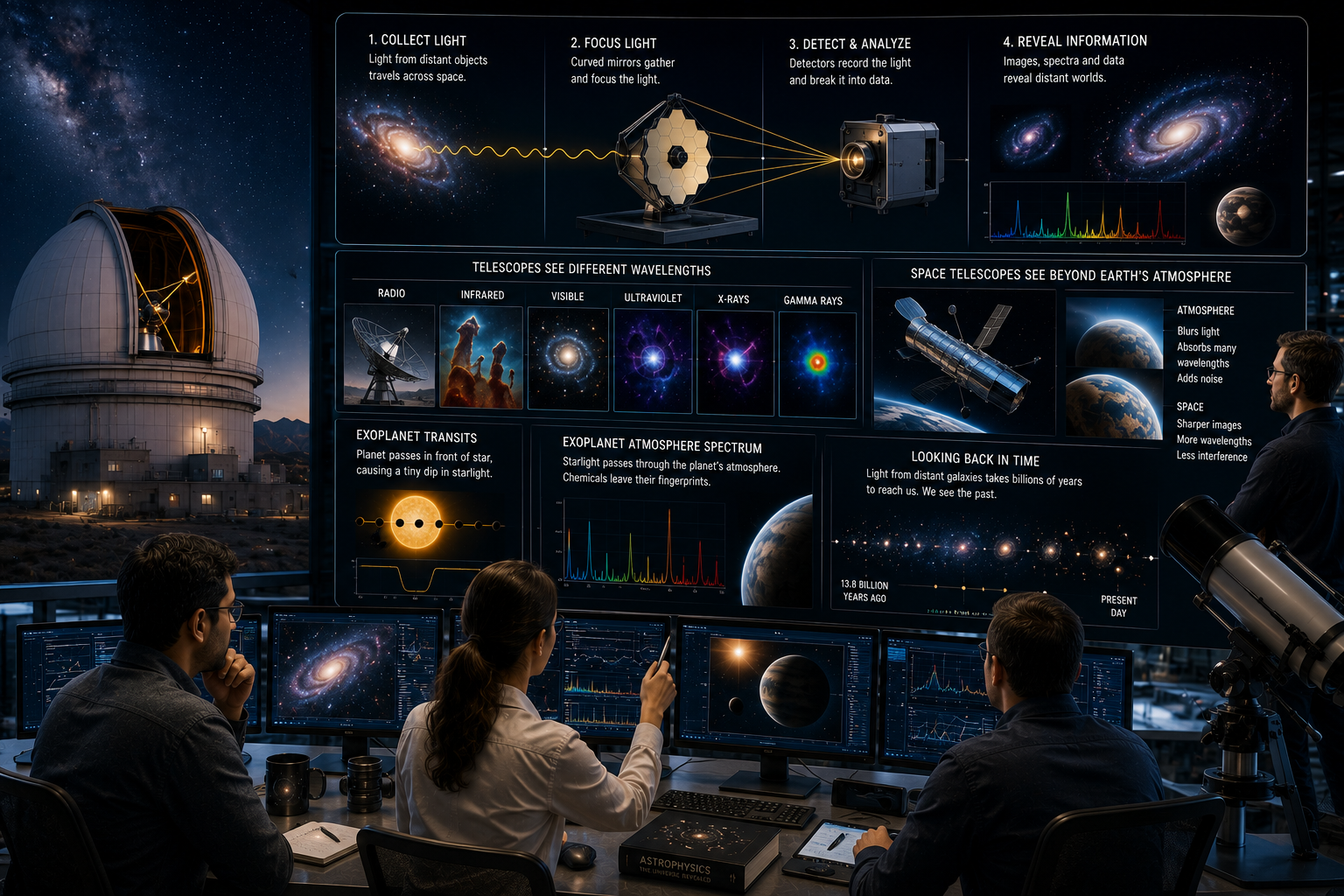
A telescope does not bring a distant planet closer in the way a vehicle crosses a road. It collects light that has already travelled across space. That light may have left a star years, centuries or billions of years ago. By gathering, focusing and measuring it, telescopes turn faint signals into images, spectra and data. Seeing distant worlds is therefore less like looking through a tube and more like decoding ancient messages carried by light.
The Basic Job of a Telescope
The simplest purpose of a telescope is to collect more light than the human eye can. The larger the collecting area, the more faint light it can gather. This matters because distant objects are incredibly dim. A planet orbiting another star may be overwhelmed by the star’s brightness. A young galaxy may appear as a tiny red smudge. A telescope’s power begins with its ability to gather enough photons to measure something meaningful.
Why Modern Telescopes Use Mirrors
Early telescopes often used lenses, but many large modern telescopes use mirrors. Curved mirrors can gather and focus light efficiently, and they can be built much larger than practical lenses. A primary mirror collects incoming light and directs it toward a secondary mirror or instrument package. The design varies, but the core idea is the same: collect faint light, focus it accurately and send it to detectors for analysis.
Images Are Only Part of the Story
When people think of telescopes, they think of dramatic images: colourful nebulae, spiral galaxies or planets. But scientific telescopes often do more than take pictures. They measure spectra, which split light into wavelengths. Spectra can reveal chemical composition, temperature, motion and even hints of atmospheric gases on distant worlds. A blurry point of light can therefore contain detailed physical information if scientists study its spectrum carefully.
Why Wavelength Matters
Human eyes see visible light, but the universe emits across the electromagnetic spectrum: radio, infrared, visible, ultraviolet, X-rays and more. Dust that blocks visible light may glow in infrared. Hot gas around energetic objects may emit X-rays. Cold gas clouds may be studied in radio wavelengths. Different telescopes act like different senses. A complete picture of the universe often requires combining observations across many wavelengths.
Ground Telescopes and Space Telescopes
Ground-based telescopes can be enormous and can be upgraded or repaired more easily than space telescopes. However, Earth’s atmosphere blurs light, absorbs some wavelengths and adds background interference. Adaptive optics can reduce some blurring, and high-altitude observatories can improve conditions. Space telescopes avoid much of the atmosphere and can observe wavelengths blocked from the ground. That is why missions such as Hubble and Webb are so valuable.
How Telescopes Study Exoplanets
Distant planets are hard to see directly because they are small, faint and close to bright stars from our perspective. Telescopes often detect them indirectly. In the transit method, a planet passes in front of its star and causes a tiny dip in starlight. In other cases, gravity from the planet makes the star wobble slightly. Some advanced instruments can block starlight to image planets directly. Spectra during transits can also provide clues about an exoplanet atmosphere.
Why Time Matters in Astronomy
Telescopes also see into the past. Light from the Moon takes a little over a second to reach Earth. Sunlight takes minutes. Light from nearby stars takes years. Light from distant galaxies takes billions of years. A deep-space telescope is therefore a time machine in a physical sense. It does not travel backward, but it receives old light. The farther astronomers observe, the earlier the cosmic chapter they may be studying.
Final Takeaway
Telescopes see distant worlds by collecting faint light, focusing it with lenses or mirrors, separating it into useful information and detecting wavelengths beyond human vision. They do not simply magnify space; they measure it. From exoplanets to galaxies, from star birth to the early universe, telescopes extend human perception by turning travelling light into evidence.