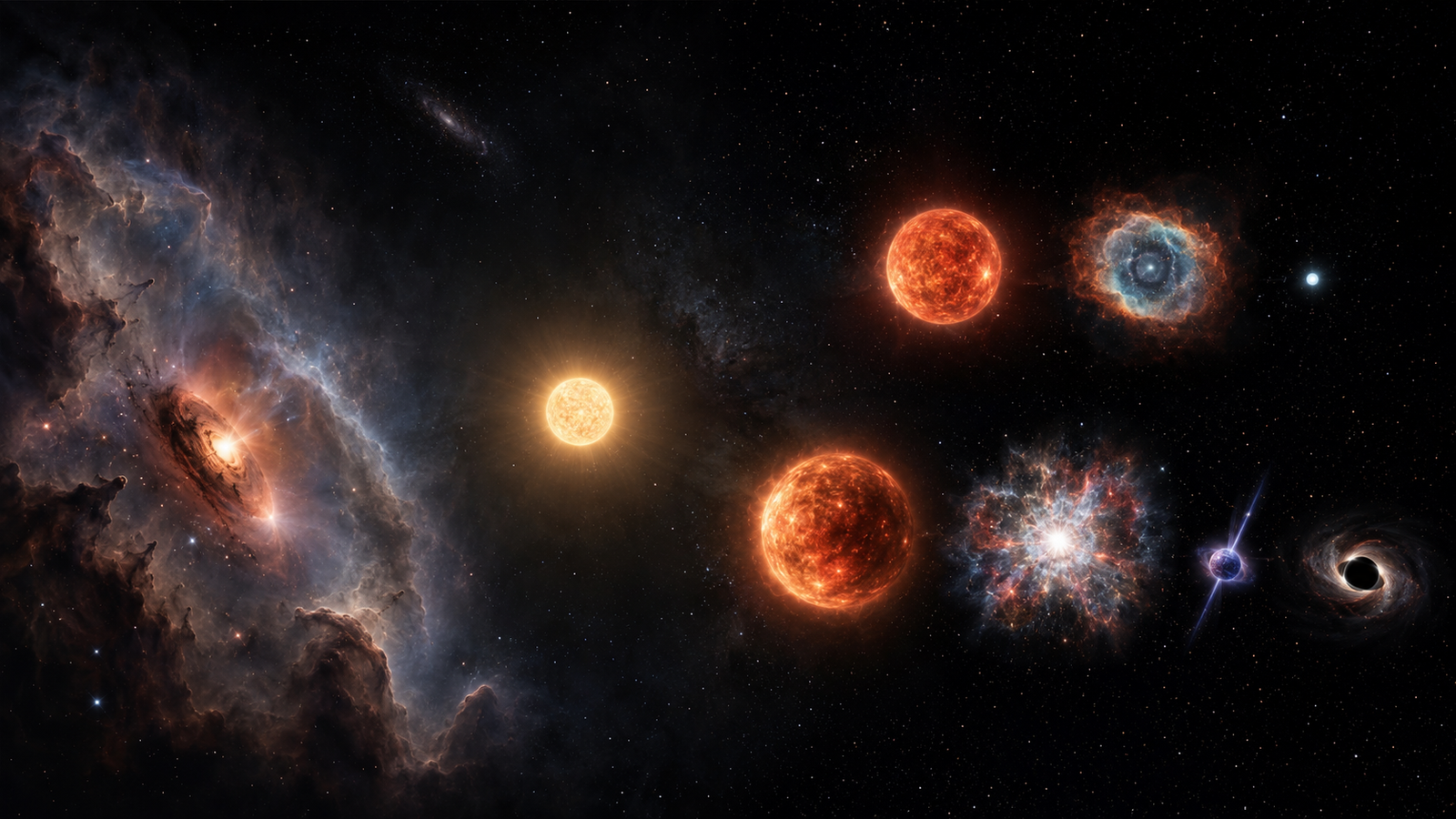
A star may look permanent from Earth, but every star has a history. It is born, changes, ages and eventually dies. The process takes millions, billions or even trillions of years depending on the star’s mass. What looks like a fixed point of light in the night sky is actually a long physical story about gravity, heat, pressure, nuclear fusion and the recycling of cosmic material.
Birth Inside Clouds of Gas and Dust
Stars begin in large clouds of gas and dust often called molecular clouds or nebulae. These regions are cold enough for material to clump together. If part of the cloud becomes dense enough, gravity begins to pull more material inward. As the clump collapses, it heats up and forms a protostar. The future star is not yet shining through stable nuclear fusion, but its centre is becoming hotter and denser.
The Ignition of Fusion
A star truly begins when conditions in its core become hot and dense enough for nuclear fusion. In stars like the Sun, hydrogen nuclei fuse to form helium, releasing energy. This energy travels outward and creates pressure that pushes against gravity. The star reaches a long-lived balance: gravity pulls inward, while pressure from the hot core pushes outward. This balance is called hydrostatic equilibrium.
The Main Sequence
Most stars spend the majority of their lives in the main-sequence stage, steadily fusing hydrogen into helium in their cores. The length of this stage depends strongly on mass. Small, cool stars burn fuel slowly and can live for extremely long periods. Massive stars have more fuel, but they burn it at a much faster rate, making their lives shorter. Bigger does not mean longer-lived in stellar evolution.
What Happens When Hydrogen Runs Low
Eventually, the core hydrogen supply begins to run out. The balance inside the star changes. In Sun-like stars, the core contracts and heats while outer layers expand, turning the star into a red giant. In more massive stars, the process can continue through additional fusion stages, forming heavier elements in the core. The star becomes a layered structure, with different fusion processes occurring in different regions.
The Death of Sun-Like Stars
A star roughly like the Sun does not usually explode as a dramatic supernova. After expanding into a red giant, it sheds its outer layers into space, creating a glowing planetary nebula. The remaining hot core becomes a white dwarf. A white dwarf no longer produces energy through fusion in the normal way. It slowly cools over immense timescales, becoming a stellar remnant rather than an active star.
The Death of Massive Stars
Massive stars end more violently. When their cores build up heavy elements and can no longer maintain enough pressure, collapse can happen rapidly. The outer layers may blast outward in a supernova, spreading heavy elements into space. The remaining core may become a neutron star, an incredibly dense object made mostly of neutrons. If the remnant is massive enough, it may collapse further into a black hole.
Why Stellar Death Creates New Possibilities
The death of stars is not only an ending. Supernovae and stellar winds spread elements into space, including many heavier elements needed for planets, rocks, oceans and life. New stars and planetary systems can form from material enriched by earlier generations of stars. In this sense, stellar death is part of cosmic renewal. The atoms in planets and living beings are linked to the long history of stars.
Final Takeaway
Stars are born when gravity gathers gas and dust into dense, hot cores. They live by balancing gravity with pressure from nuclear fusion. They die when that balance can no longer be maintained. The final result depends mainly on mass: white dwarf, neutron star or black hole. A star’s life is therefore not a simple fire burning out, but a grand physical cycle that shapes galaxies and produces the elements of the universe.