A Merchant Who Became a Bridge Between Worlds
Marco Polo stands at the edge between history and legend because his life turned movement into memory. He was not the first European to travel east, not the first merchant to cross Asia, and not the only traveller to reach the Mongol world. Yet his name became the shorthand for a great medieval encounter between Europe and Asia. His story begins not with a lonely adventurer walking into the unknown, but with a commercial family from Venice entering a world already connected by caravans, sea lanes, imperial roads, diplomatic missions and merchant communities. What made Marco Polo exceptional was not simply that he travelled, but that his journey became a book, and that the book helped Europeans imagine the East with new intensity.
The phrase “linked East and West” can easily become romantic if handled loosely. Marco Polo did not create contact between the two halves of Eurasia. The Silk Road, Islamic trade networks, Mongol diplomacy, Persian intermediaries, Armenian merchants, Central Asian caravans and Indian Ocean shipping had already linked continents for centuries. His importance lies elsewhere. He became one of the most famous narrative witnesses to that connected world. Through him, late medieval Europe received an account of the Mongol Empire, China under Kublai Khan, Asian cities, court rituals, paper money, postal systems, trade goods, religions and landscapes. His journey shows that civilisations are not isolated containers. They are porous, mobile and constantly reinterpreted through travellers, traders and texts.
Time, Place and the Eurasian World of Marco Polo
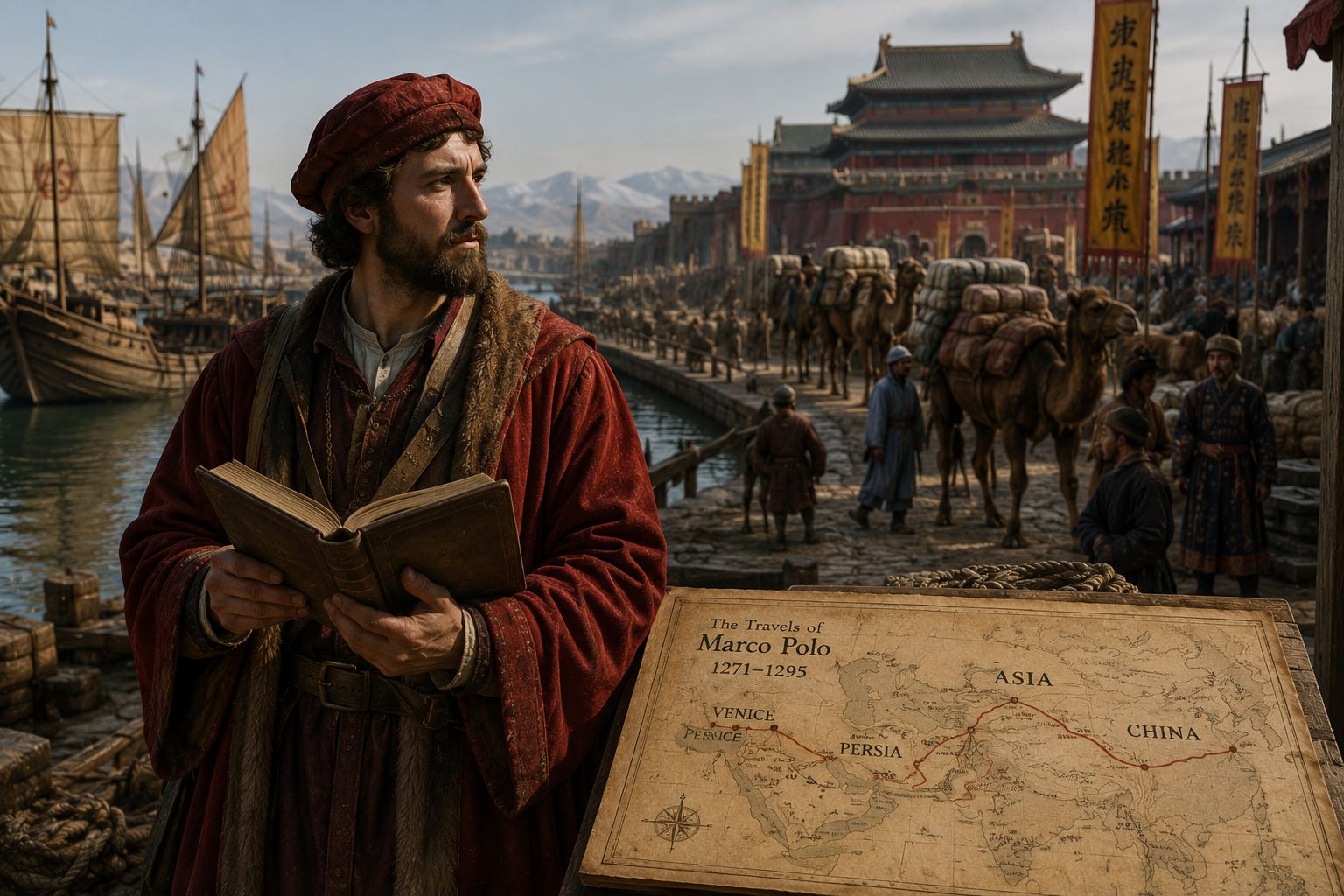
Marco Polo was born in Venice around 1254 and died there in 1324. His main journey took place between 1271 and 1295, when he travelled with his father Niccolo and uncle Maffeo through the eastern Mediterranean, the Middle East, Central Asia and eventually to the court of Kublai Khan. Britannica identifies him as a Venetian merchant and adventurer who travelled from Europe to Asia from 1271 to 1295 and remained in China for many years. The world he entered was not a vague “Orient” but a specific thirteenth-century Eurasian system shaped by the Mongol Empire and by older commercial routes.
The geography of his journey stretched from Venice to the Levant, from Anatolia and Persia to Central Asia, from the deserts and mountains of inner Asia to the Mongol-ruled regions of China. The Mongol conquests had been devastating in many places, but they also produced a temporary political order across much of Eurasia. This order, often called the Pax Mongolica in modern scholarship, did not mean universal peace, but it did mean that merchants, envoys and missionaries could sometimes move across regions under Mongol protection or through Mongol-controlled corridors.
Venice itself was crucial to the story. It was a maritime republic whose wealth depended on trade, ships, ports and commercial intelligence. Marco Polo did not begin as a modern explorer seeking abstract knowledge. He began within a merchant world where information was profit, routes were assets, and distant markets mattered. His journey belonged to commerce before it became literature.
Before Marco Polo: Routes, Traders and Older Connections
The meeting of East and West did not begin with Marco Polo. Long before his birth, Eurasia had been crossed by goods, ideas, diseases, diplomatic messages and religious movements. Silk had moved westward from China in antiquity. Buddhism had travelled from India through Central Asia into China. Islam had spread across West and Central Asia, creating vast networks of scholars, traders and pilgrims. Jewish, Armenian, Persian, Arab, Indian and Central Asian merchants moved through ports and caravan towns. The Silk Road was never one road; it was a shifting web of routes linking oases, empires, deserts, mountains and seas.
This background is essential because it prevents the common mistake of treating Marco Polo as a lone European discoverer of Asia. Asia was not waiting to be discovered. It contained powerful states, ancient cities, sophisticated bureaucracies, wealthy markets and cosmopolitan religious traditions. Europe, by contrast, was only one region within a much larger Afro-Eurasian world.
What changed in Marco Polo’s century was the Mongol imperial framework. The Mongols connected China, Central Asia, Persia and parts of Russia under related ruling houses. Even when the empire fragmented, elite networks, diplomatic exchanges and commercial movement continued. The Polos benefited from this wider order. Their travel was possible because earlier empires, merchants and envoys had already made Eurasia a connected space. Marco Polo’s contribution was to turn that connectivity into a famous European narrative.
Venice, Trade and the Commercial Mind
To understand Marco Polo, one must understand Venice. Venice was not a land empire. It was a commercial republic built on ships, warehouses, contracts, diplomacy and strategic access to Mediterranean trade. Venetian merchants dealt with Byzantines, Muslims, Crusader states, Mongols and other European powers. They understood that political power and commercial advantage were inseparable. A trader needed safe passage, credit, languages, partners and information about prices, rulers and routes.
Marco Polo grew up in this environment. His father and uncle were already experienced merchants who had travelled east before taking Marco with them. Their journey was not a schoolboy adventure but a family commercial enterprise. They carried goods, letters and diplomatic possibilities. Their ability to negotiate foreign courts came from the practical intelligence of merchant life.
This commercial background shaped the character of Marco Polo’s account. His book is full of attention to commodities, revenue, cities, production, ports, markets, administrative systems and the wealth of rulers. He notices paper money because merchants care about money. He notices salt revenue, trade goods, roads and postal stations because these matter to commerce. His eye is not that of a theologian alone or a knight seeking glory. It is the eye of a merchant measuring a world.
That commercial eye is one reason his narrative linked East and West so powerfully. It did not merely describe marvels. It introduced European readers to systems: how power, trade and urban life worked in distant places.
The Journey East: From Mediterranean Gateways to Inner Asia
The Polos’ journey eastward was slow, dangerous and dependent on many intermediaries. They moved through regions where political authority could shift, where deserts tested endurance, and where mountain routes demanded experience. Travel in the thirteenth century was not a smooth line on a map. It meant negotiating local rulers, surviving disease, securing guides, crossing linguistic borders and adapting to unfamiliar food, climate and customs.
Their route passed through the eastern Mediterranean and into the world of Islamic and Mongol power. Persia was an important zone, both as a land of old imperial traditions and as a bridge between the Mediterranean and Central Asia. From there, travellers could move toward the Oxus, the Pamirs, the Taklamakan edges and the oasis cities that connected inner Asia to China. These were not empty spaces. Caravan routes depended on towns, wells, markets, monasteries, garrisons and local knowledge.
The journey itself reveals one of the most important truths of premodern global history: distance did not prevent connection, but it shaped the form of connection. Movement required time, trust and layered networks. The Polos did not simply go from Europe to China; they passed through many worlds, each with its own language of power. The story is therefore not a simple meeting of two civilisations. It is a chain of encounters across Eurasia.
Kublai Khan and the Mongol Court
The destination that made Marco Polo famous was the court of Kublai Khan, the Mongol ruler who founded the Yuan dynasty in China. Kublai was not merely a steppe conqueror. He ruled a vast imperial order that combined Mongol military traditions with Chinese bureaucratic structures, Tibetan Buddhist influences, Central Asian personnel and international diplomatic contacts. His court was one of the great cosmopolitan centres of the thirteenth-century world.
Marco Polo’s account presents Kublai as a ruler of extraordinary wealth, command and curiosity. Whether every detail is literal or embellished, the portrait captures something historically real: the Mongol court gathered people from across Eurasia. Persians, Turks, Chinese, Tibetans, Europeans and others could appear in administrative, commercial or diplomatic roles. The empire needed translators, tax specialists, military commanders, engineers, artisans and envoys.
Marco Polo later claimed to have served Kublai in various capacities, including missions to different parts of the empire. Scholars debate the exact nature and extent of his service, but the broader context is plausible. Mongol rulers often used foreigners in administration because they could be useful intermediaries and were sometimes less tied to local elites. In this world, a Venetian merchant could become valuable not because he was European in a modern sense, but because he was mobile, observant and connected.
Kublai’s court became the place where Marco Polo’s life turned from trade into historical witness.
China Through Venetian Eyes
Marco Polo’s descriptions of China fascinated European readers because they presented a society of immense scale and administrative sophistication. He wrote about cities, canals, roads, court ceremonies, revenue systems, paper currency, coal, salt administration and postal relay networks. These details mattered because many of them differed sharply from European conditions. China under Mongol rule appeared not as a barbaric edge of the world but as a powerful, wealthy and organised civilisation.
One of the most striking themes in his account is infrastructure. The Yuan state inherited and adapted Chinese administrative traditions, including bureaucratic management, urban systems and transport networks. Marco Polo’s references to courier stations and official movement reveal a world in which empire depended on communication. Messages, officials and goods moved through systems that impressed a merchant from Venice.
His account also emphasised cities. European readers encountered descriptions of enormous urban centres, markets and populations. Even if medieval numerical claims were often exaggerated, the underlying impression was true: parts of China were highly urbanised, commercially active and technologically sophisticated. The Venetian gaze turned Asian urban life into a subject of European imagination.
Yet Marco Polo’s China was not a neutral photograph. It was filtered through translation, memory, narrative convention and the expectations of readers. He noticed what amazed him, what mattered to commerce and what his audience would find marvellous. His account is therefore both evidence and interpretation.
The Book That Made the Journey Famous
Marco Polo’s fame rests above all on his book, commonly known in English as The Travels of Marco Polo. According to tradition, he dictated his memories to Rustichello of Pisa while imprisoned in Genoa after a conflict between Venice and Genoa. Rustichello was associated with romance literature, and this shaped the narrative style. The result was not a modern academic travel report. It was a medieval text combining observation, hearsay, wonder, geography, commerce and literary craft.
This matters because the book’s power came from its form as much as from its content. It was readable, strange and expansive. It moved from place to place, describing rulers, customs, goods, landscapes and marvels. It made Eurasia narratively accessible to Europeans who would never travel beyond their own region. Manuscripts circulated in different versions, with variations, omissions and additions. The text was not fixed in the way modern printed books are.
The book linked East and West by turning experience into imagination. A journey affects only those who travel; a book affects those who read, copy, translate and reinterpret it. Marco Polo’s account entered the mental map of Europe. It fed curiosity about Asian wealth, routes and power. It also contributed to later European geographical imagination, including the world of exploration that would emerge centuries later.
The Polos crossed Asia. The book crossed time.
Merchants, Missionaries and the Wider Medieval Encounter
Marco Polo was part of a broader medieval pattern. Franciscan missionaries, papal envoys, Armenian traders, Muslim geographers, Persian officials and Central Asian merchants all participated in the movement of knowledge across Eurasia. The thirteenth century was not an age of sealed civilisations. It was an age of difficult but real contact, made possible by empire, commerce and religious ambition.
European interest in Asia had many motives. The Church hoped for alliances against Islamic powers and imagined the possibility of converting Mongol rulers. Merchants wanted access to spices, silks, precious stones and luxury goods. Rulers wanted diplomatic information. Intellectuals and mapmakers wanted to place distant lands within Christian geography. Marco Polo’s narrative served several of these interests at once.
For Asian polities, Europeans were not always central. To Kublai Khan, the Polos were small actors within a vast world of subjects and visitors. This imbalance is important. Marco Polo became famous in Europe, but in China he was one foreigner among many. His story tells us as much about Europe’s hunger for Asian knowledge as about Asia itself.
The wider encounter was therefore asymmetrical. Asia did not need Marco Polo to know itself. Europe needed Marco Polo to imagine Asia. His book became a mirror in which Europe saw both the wealth of the East and the limits of its own knowledge.
Political and Economic Meaning of the Link
The connection Marco Polo symbolised was not merely cultural. It had political and economic meaning. European merchants wanted access to Asian goods, but direct access was difficult because trade passed through many intermediaries: Muslim merchants, Central Asian traders, Persian markets, Indian Ocean ports and Mongol-controlled routes. Knowledge of routes and markets was therefore valuable.
Marco Polo’s descriptions of commodities, taxation and wealth helped shape European perceptions of Asia as a land of immense economic possibility. This perception did not immediately create direct European access to China, but it formed part of the long background to later exploration. When Europeans searched for sea routes to Asia in the fifteenth and sixteenth centuries, they inherited older dreams of eastern wealth. Marco Polo’s book was one of the texts that kept those dreams alive.
Politically, the journey also revealed a world in which Europe was not the centre. Kublai Khan’s court, Chinese cities and Asian trade systems appeared larger and wealthier than many European counterparts. This challenged provincial assumptions. It showed that power could be organised differently and at greater scale.
The link between East and West was therefore not a bridge of equality in modern terms. It was an encounter with difference. For Europe, Marco Polo’s Asia was both opportunity and humiliation: a source of goods, marvels and administrative sophistication that forced Europeans to expand their mental world.
Religions, Cultures and the Plurality of Eurasia
One of the richest dimensions of Marco Polo’s world was religious plurality. The routes across Eurasia passed through Christian communities, Muslim regions, Buddhist lands, Hindu and Jain zones, shamanic traditions and Confucian-Buddhist-Daoist Chinese cultures. The Mongol Empire itself was religiously flexible in many contexts, allowing Buddhists, Muslims, Christians and others to serve within imperial structures.
Marco Polo’s account reflects this plurality, though sometimes through the biases and misunderstandings of a medieval Christian observer. He noticed religious practices because they marked difference. Temples, monasteries, rituals, funerary customs and sacred landscapes became part of his description of the world. The reader encounters Eurasia not as a single East but as a mosaic of beliefs.
This matters because the linking of East and West was not simply the movement of goods. It was also the movement of images, stories, theological questions and cultural comparisons. Europeans learned that powerful rulers could patronise religions unfamiliar to them, that cities could contain multiple communities, and that moral order could be imagined outside Latin Christendom.
At the same time, Polo’s account reveals limits. He did not always understand what he saw. He interpreted through his own categories. That is part of the historical value of the text. It shows contact not as perfect understanding but as layered translation. Civilisations met, but they did not instantly comprehend one another.
Historical Debates: Truth, Exaggeration and Silence
Marco Polo has always provoked debate. Did he really go to China? Did he exaggerate his role at Kublai Khan’s court? Why does he omit or underplay certain famous Chinese practices or features, such as the Great Wall as later Europeans imagined it, tea drinking or footbinding? Are the marvels in his book reliable observations, hearsay or literary embellishments?
Most historians accept that Marco Polo did travel widely in Asia, though they remain cautious about specific claims. His text contains detailed knowledge that would have been difficult to invent entirely from European sources. At the same time, it includes second-hand reports, exaggerations and narrative conventions typical of medieval travel literature. The book must be read critically, not swallowed whole.
The omissions are especially interesting. A traveller does not record everything; he records what he notices, what he understands and what later narration preserves. Some features may not have been visible to him. Others may not have seemed important. Manuscript transmission may also have altered the text. Silence does not automatically prove absence or fraud.
The historical debate makes Marco Polo more valuable, not less. It teaches readers how travel writing works. A journey becomes a text through memory, mediation and audience. Marco Polo linked East and West not by giving Europe a perfect map of Asia, but by giving it a powerful, contested and enduring story of Asia.
Decline of the Overland World He Knew
The Eurasian world that made Marco Polo’s journey possible did not last unchanged. The Mongol Empire fragmented. The Yuan dynasty eventually fell in China. Political instability, plague, warfare and changing trade conditions affected overland movement. The Black Death in the fourteenth century travelled through connected Afro-Eurasian networks, demonstrating that the same routes that moved goods and people could also move catastrophe.
As overland routes became more difficult or less predictable, European interest in maritime access to Asia grew. The dream of eastern wealth remained, but the methods changed. Portuguese voyages around Africa, Spanish Atlantic ventures and later colonial expansion belonged to a different age. Yet Marco Polo’s book survived into that age as part of Europe’s inherited imagination of Asia.
This transition is important. Marco Polo belonged to a medieval world of caravans, Mongol courts and merchant diplomacy, not to the later world of cannon-armed oceanic empires. But his narrative helped feed the curiosity and ambition that later European powers would pursue by sea. His legacy was therefore double-edged. It encouraged knowledge and curiosity, but it also became part of the mental background to expansion, extraction and conquest.
The overland world faded, but the desire it awakened did not. Marco Polo’s Asia remained alive in European imagination long after the political conditions of his journey had disappeared.
Impact on Maps, Imagination and Exploration
The impact of Marco Polo’s book was not immediate in a modern mass-media sense, but over time it influenced European geographical imagination. Mapmakers, merchants and explorers drew on stories of Asian wealth and cities. Christopher Columbus owned or consulted a Latin edition of Marco Polo’s travels, and the dream of reaching Asia shaped early Atlantic exploration. This does not mean Marco Polo caused the Age of Exploration, but he contributed to the archive of expectation that made Asia the great prize of European ambition.
His account also widened the narrative map of the world. Medieval Europeans often understood distant lands through biblical geography, classical inheritance, rumours and marvels. Marco Polo provided a more detailed, commercially attentive and politically rich image of Asia. He described not only monsters or wonders, but administrations, cities, currencies and rulers.
This legacy was powerful because imagination precedes action. Before merchants invest, rulers fund expeditions or navigators sail, they must believe that distant worlds are worth reaching. Marco Polo helped make Asia imaginable as a place of wealth, order and possibility. He transformed distance into desire.
Yet his influence should be assessed carefully. The Asia Europeans imagined through Marco Polo was partly real and partly distorted. It mixed observation with fantasy. That mixture shaped later contact in both productive and dangerous ways.
Sea Routes, Land Routes and the Larger Geography of Exchange
Marco Polo is usually remembered through the land routes of Eurasia, but his story also belongs to the larger geography of maritime exchange. Venice itself was a sea power. Goods reaching Europe often moved across the Indian Ocean, the Persian Gulf, the Red Sea, the Black Sea and the Mediterranean before appearing in European markets. The distinction between land and sea was therefore less rigid than modern maps suggest. A bale of silk, a packet of spices or a report about an Asian ruler might pass through ports, caravans, warehouses and courts before reaching Venice.
This is why Marco Polo should be read as a witness to connectivity rather than as the representative of one road. His age was shaped by overlapping corridors. The Silk Road across Central Asia was important, but so were the sea routes linking China to Southeast Asia, India, Arabia and East Africa. Muslim merchants, Indian traders, Chinese ships and Southeast Asian ports formed a maritime world that was as sophisticated as the caravan world. Marco Polo’s descriptions of Asian coastal regions and island worlds reveal that he understood Eurasia partly through this commercial geography.
The link between East and West was therefore not a single line from Venice to China. It was a mesh. The power of the Mongols made some land routes more accessible. The skill of merchants kept sea routes alive. The wealth of Asian markets drew European imagination eastward. Marco Polo’s narrative sits at the meeting point of these systems. His journey reminds us that civilisations are connected not only by heroic travellers but by anonymous sailors, translators, caravan leaders, brokers, money changers and port officials.
The Social World Behind the Famous Traveller
The fame of Marco Polo can make the journey seem individual, but medieval travel was social. No one crossed Eurasia alone. Travellers depended on guides who knew deserts, merchants who understood credit, rulers who granted permission, interpreters who carried meaning between languages, and local communities that supplied food, animals and shelter. Behind the celebrated Venetian name stood a large cast of unnamed people who made movement possible.
This social dimension is crucial for historical analysis. A traveller’s account often hides the labour of others. Marco Polo could describe what he saw because local people built the roads, maintained the markets, staffed the postal stations, sailed the ships and explained unfamiliar customs. Even his book depended on collaboration: memory shaped by dictation, literary style shaped by Rustichello, and later meaning shaped by scribes and readers. The link between East and West was therefore collective before it became personal.
The Polos also moved through networks of trust. Merchant families relied on kinship, reputation and credit. A failed promise could ruin future trade. A useful contact could open a court or caravan route. This world was not modern globalisation, but it had its own mechanisms of integration. It used letters, seals, spoken guarantees, gifts, religious communities and commercial partnerships.
Seeing this hidden social world prevents hero worship. Marco Polo matters, but he matters as a node inside networks. His life became famous because it condensed the movement of many people into one memorable narrative.
Memory, Manuscripts and the Making of Authority
The authority of Marco Polo’s account did not come automatically from travel. It had to be made through narration, copying and reception. Medieval manuscripts were not identical printed objects. They varied as scribes copied, shortened, expanded or translated texts. This means that The Travels of Marco Polo reached readers in multiple forms. The Marco Polo known to one medieval reader might not be exactly the Marco Polo known to another.
This manuscript history matters because the book’s influence was cumulative. It did not spread as a fixed scientific report. It circulated as a flexible text capable of feeding curiosity, wonder, commercial planning and geographical speculation. Some readers believed its marvels. Some doubted them. Some mined it for information. Others enjoyed it as a book of wonders. Its authority grew because it was useful to different audiences in different ways.
The making of authority also involved comparison. As later travellers, missionaries and merchants brought additional reports, Polo’s claims could be confirmed, challenged or reinterpreted. The book became part of a larger European archive of Asian knowledge. It shaped maps not by providing perfect coordinates, but by giving names, places and expectations that cartographers and explorers could weave into world pictures.
Marco Polo therefore linked East and West not only by crossing space but by entering textual memory. His physical journey ended in Venice. His manuscript journey continued for centuries.
Why the Marco Polo Story Still Requires Caution
Marco Polo’s fame can make his narrative seem more transparent than it is. A responsible reading must hold admiration and caution together. His account offers valuable evidence about the thirteenth-century Eurasian world, but it is not a stenographic record. It passed through memory, dictation, literary shaping and manuscript variation. It includes direct observation in some places and second-hand reporting in others. The historian’s task is not to accept or reject the whole book, but to weigh each claim against context, comparison and probability.
This caution strengthens the story. It allows us to see Marco Polo as a historical actor rather than a mythic hero. He belonged to a medieval world in which wonder and information were not sharply separated. A description could be commercially useful and marvellous at the same time. Readers expected distant lands to astonish them, and writers often framed difference through amazement.
The real achievement of the book lies in its ability to preserve an encounter even through these filters. It tells us what a Venetian merchant, speaking to a European audience, found meaningful about Asia. That perspective is partial, but it is historically precious. It reveals not only Asia, but also Europe learning how much it did not know.
A Final Analytical Layer
The subject also deserves one final analytical layer. A historical narrative is never only a sequence of events; it is an explanation of how structures, choices and memories interact. In the case of How Marco Polo Linked East and West, the central story is not only about personalities or dates. It is about how geography, institutions, belief, economy and communication create durable historical change. Routes matter because they move people and ideas. Capitals matter because they concentrate authority. Texts matter because they turn experience into memory. Religious and political institutions matter because they outlive individual rulers. This is why the topic continues to matter for modern readers: it shows that civilisation is not made by one force alone. It emerges when material conditions and human imagination reinforce each other.
The topic also shows the need for balanced interpretation. Historical actors did not live inside the categories later generations impose upon them. They acted within their own worlds of faith, ambition, fear, duty, profit and honour. To understand them properly, one must avoid both blind admiration and easy dismissal. The past is most useful when it is treated neither as propaganda nor as a museum of dead facts, but as a living field of human choices. That is why the legacy of How Marco Polo Linked East and West remains powerful. It invites us to see history as continuity, conflict and transformation at the same time.
Legacy: The Traveller as a Civilisational Translator
Marco Polo’s legacy is not that he discovered the East. That claim would be historically false and civilisationally arrogant. His legacy is that he became one of the most influential translators of Eurasian experience for a European audience. He moved through networks created by others, witnessed the scale of Mongol and Chinese power, returned to Venice, and helped turn memory into one of the most famous travel narratives in history.
His life reminds us that civilisations are connected by intermediaries. Empires create routes, merchants use them, writers describe them, readers imagine them, and later generations act upon those images. The link between East and West was not a single bridge built by one man. It was a long chain of ports, deserts, courts, markets, languages and manuscripts. Marco Polo became famous because his story captured that chain at a moment when Eurasia was unusually connected.
His account also teaches humility. Contact is not the same as understanding. Marco Polo saw much, misunderstood some things, repeated hearsay and wrote through medieval expectations. But imperfect contact can still change history. His book expanded Europe’s sense of the possible. It made distant Asia intellectually present.
The most powerful conclusion is therefore not that Marco Polo joined two worlds that had never met. It is that he revealed to Europe a world already joined by trade, empire and movement. He was not the creator of Eurasian connectivity. He was its most memorable witness.