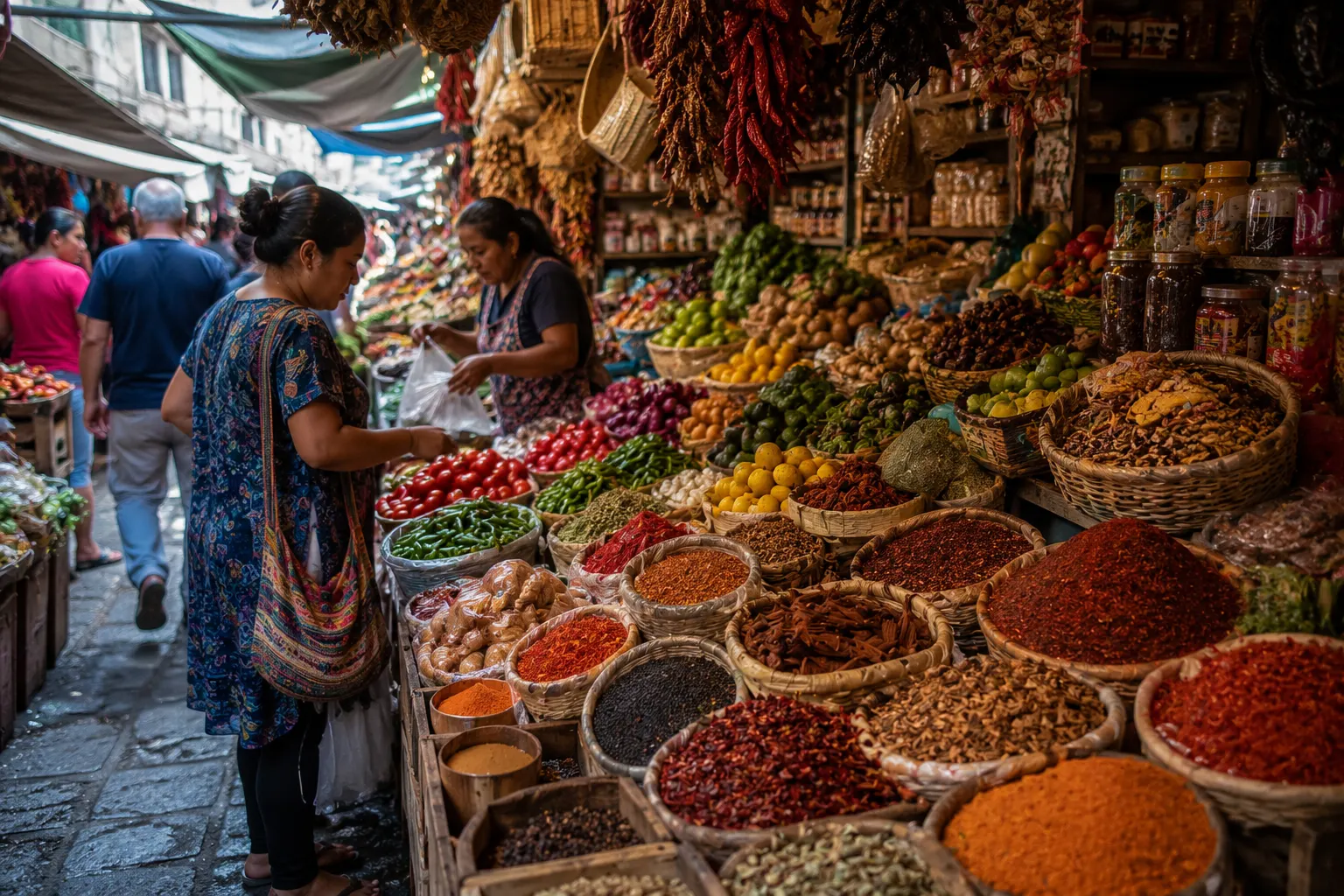
The Tomato Is a Traveller
Tomatoes feel Italian. Chilli peppers feel indispensable to many Asian cuisines. Potatoes evoke parts of Europe. Coffee is associated with societies far beyond the regions where the plant first grew.
These associations are culturally real, but they are not evidence that foods have always belonged where they are now most famous.
One of the central facts of culinary history is movement. Plants, animals, cooking methods and meal customs cross borders. Then something more interesting happens: communities make them local.
Food Has Always Travelled
Modern globalisation accelerated culinary exchange, but it did not invent it.
Ancient and medieval merchants carried grain, oils, wine, dried fruits, spices and luxury foods across land and sea routes. The Metropolitan Museum describes Abbasid-era trade networks reaching from Iraq towards Indonesia, with merchants moving spices from India and goods from China and Southeast Asia.
Ports were especially important. Merchants did not carry commodities alone. They carried languages, preferences, cooking knowledge and expectations about hospitality. Sailors ate in foreign ports. Migrant trading communities established households abroad. Local cooks adapted imported ingredients.
The history of food movement is therefore also a history of human contact.
The Columbian Exchange Changed Global Diets
No example demonstrates culinary diffusion more clearly than the exchange that followed sustained contact between the Americas and the Old World after 1492.
The National Park Service notes that maize, potatoes, tomatoes and chilli peppers spread so widely that many consumers no longer recognise their American origins. In the other direction moved wheat, livestock, sugar-related production systems and numerous other plants and animals.
This was not a neutral swap. The exchange occurred through conquest, colonisation, forced labour, disease and ecological disruption as well as trade.
Yet its culinary consequences were enormous. Ingredients crossed oceans and then entered cuisines so deeply that later national food identities were built around them.
Why Some Imported Foods Become Local
Not every foreign ingredient becomes culturally important.
Successful adoption usually depends on several factors.
The crop must grow—or be cheaply imported. It must fit existing cooking techniques. It must solve a nutritional, economic or agricultural problem. Its flavour must be acceptable or adaptable. And people need repeated opportunities to use it.
Potatoes expanded in many regions because they were productive and versatile. Chilli peppers fitted existing practices of seasoning and preservation. Tomatoes entered sauces and stews. Tea and coffee developed entire social institutions around their consumption.
Adoption is therefore both practical and cultural.
Migrants Carry Techniques, Not Just Recipes
When people migrate, they often cannot reproduce home cooking exactly.
Ingredients may be unavailable. Kitchens use different equipment. Religious or legal restrictions may alter sourcing. Work schedules reduce preparation time. Children develop new preferences.
So migrants improvise.
Substitutions become normal. A local vegetable replaces one from home. A restaurant changes spice levels for customers. A festival dish becomes easier to prepare with a commercial product.
Over time, these adaptations can create a distinct diaspora cuisine.
The Smithsonian’s Asian American foodways collections document restaurants, supermarkets, menus and food businesses as part of the cultural life of immigrant communities. Such institutions are crucial because they create infrastructure through which ingredients and tastes can circulate.
Restaurants Are Engines of Culinary Diffusion
Restaurants expose people to unfamiliar foods without requiring migration themselves.
An immigrant restaurant may begin by serving its own community. Neighbours become curious. Certain dishes become popular. Recipes are adjusted for local ingredients or price points. Other restaurants copy them.
Eventually, the food may escape the label of “foreign” and become ordinary urban eating.
The National Park Service notes that after the Second World War, French, Italian and Chinese foods became more popular in the United States beyond immigrant districts such as Chinatowns and Little Italys. Travel, military experience and social change helped broaden tastes.
Restaurant history therefore shows how cultural boundaries move.
Empire Spread Food Through Unequal Power
Culinary exchange is often romanticised as peaceful fusion. Much of it was not.
Empires moved crops deliberately to serve commercial goals. Plantation systems reorganised land for sugar, coffee, tea and other commodities. Enslaved people and indentured workers were moved across oceans, carrying culinary knowledge under coercive conditions.
Colonial administrators attempted to reproduce familiar foods while also consuming local ones. Armies required standardised provisioning. Ports linked colonies into commercial networks.
These systems produced hybrid cuisines, but the word “hybrid” should not hide the inequalities that created them.
Spices Connected Distant Worlds
Spices offer one of the oldest examples of foods functioning as global commodities.
Cloves and nutmeg from island Southeast Asia, pepper from South Asia and other aromatics moved through complex networks linking producers, regional traders, Indian Ocean ports, Middle Eastern merchants and European markets.
The Metropolitan Museum’s accounts of Venetian trade show how spices and other Eastern goods were central to commercial relationships with the Islamic world.
European attempts to control direct access to spice-producing regions later became entangled with maritime expansion and colonial violence.
The desire for flavour helped reshape global history.
Religious Communities Create Cross-Border Food Networks
Religious migration can spread culinary practices across regions.
Communities carry fasting foods, festival dishes, slaughter rules and ritual ingredients. Pilgrimage routes create markets. Diasporas establish bakeries, sweet shops, butchers and communal kitchens that preserve food practices outside ancestral territories.
Because religious meals recur annually or weekly, they can provide unusually stable structures for culinary transmission.
At the same time, they adapt to local ingredients. This creates continuity without exact replication.
Cookbooks, Media and Tourism Move Food Without Moving People
Food can cross a border even when the cook does not. Printed cookbooks translated unfamiliar dishes for new audiences long before television. Later, radio, magazines and television chefs made techniques visible to millions. Tourism added another pathway: travellers returned home looking for tastes they had encountered abroad, while destination cities adapted local food for visitors.
Digital media has intensified this process. A short video can make a regional preparation globally recognisable within days. But visibility is not the same as transfer. For a dish to take root elsewhere, viewers must be able to obtain ingredients, understand the technique and fit the food into existing habits. Media opens the door; local repetition determines whether the food stays.
Industrial Food Made Travel Faster
Modern food crosses borders differently from a spice caravan.
Refrigerated shipping, canning, freezing, containerisation and air freight allow fresh or processed products to travel enormous distances. Supermarkets standardise global availability. Fast-food companies reproduce recognisable menus internationally. Social media can make a dish globally desirable before local supply chains catch up.
The result is unprecedented speed.
But faster diffusion does not erase localisation. Global chains modify menus. Imported snacks acquire regional flavours. Consumers combine international products with domestic meals in ways manufacturers did not anticipate.
Global food still becomes local through use.
Recipes Change Meaning When They Move
A dish can signify one thing in its place of origin and something different abroad.
At home it may be inexpensive everyday food. In another country it may become a restaurant speciality. A dish associated with one region may be marketed overseas as representative of an entire nation. A street snack may become fine dining.
Migration changes status as well as ingredients.
This is why culinary diffusion should not be studied only through recipes. Price, setting, audience and symbolism also travel—and transform.
Appropriation, Appreciation and Unequal Recognition
Cross-border popularity creates ethical questions.
Who receives credit when a traditional food becomes fashionable? Do producers benefit when their ingredient becomes valuable? Is a community’s sacred or ceremonial food being stripped of meaning? Are migrant cooks recognised while celebrity chefs profit from the same techniques?
There is no single answer, but power matters.
Cultural exchange is normal. Exploitation is not identical to exchange. The distinction often depends on attribution, consent, economic benefit and whether the originating community retains voice.
“Fusion” Is Older Than the Word
Contemporary menus often advertise fusion cuisine as something new. Historically, cuisines have mixed for centuries.
Port cities, caravan towns, border regions and imperial capitals brought people into constant contact. The blending could be gradual enough that later generations forgot it had happened.
Many foods now defended as pure traditions are the results of older fusion.
What is modern is not mixture itself, but the speed, scale and self-conscious branding of mixture.
Globalisation Can Produce Homogenisation—and Revival
The spread of multinational food companies can make urban food environments look increasingly similar. Standardised ingredients and convenience foods may weaken local crops or techniques.
Yet globalisation can also create revival. Diaspora demand supports exports of regional ingredients. Online communities document recipes. Tourism can fund local food businesses. Chefs rediscover traditional grains as alternatives to industrial staples.
The same networks that spread uniformity can spread awareness of difference.
Food Travels, Then Belongs Again
Culinary exchange follows a recurring pattern.
Something moves. It enters a new environment. People adapt it. Repetition makes it familiar. Memory attaches to it. Eventually, later generations experience it not as imported but as part of home.
That process does not erase origin. Nor does origin cancel later belonging.
Food can have more than one history at once.
The tomato can be American in botanical history and Italian in cultural history. Chilli can be American in origin and deeply Indian in culinary identity. A migrant dish can belong to both an ancestral homeland and a new city.
That is not contradiction.
It is what happens when culture moves.