A Recipe Can Outlive the Event That Created It
Political regimes fall, trade routes shift, borders move and families migrate. Yet a preparation method can remain in a kitchen for generations. This is why cuisine can function as a historical record.
Food is not a written archive in the conventional sense. A curry, stew, bread or sweet does not explain its own history. But it can preserve evidence: an imported ingredient that became ordinary, a preservation technique developed for a climate, a dish shaped by migration, or a meal pattern altered by industrial technology.
The Smithsonian’s food-history work makes this point directly. Its collections use kitchens, tools, recipes, menus, advertising, technologies and personal stories to trace wider social and cultural change. Food history becomes a way of seeing transformations that standard political narratives can miss.
Cuisine Records Geography Before It Records Politics
The oldest layer of most food traditions is environmental. What grows locally, what can be stored, which animals are raised, how much water is available and how seasons change all shape a region’s food possibilities.
Coastal communities often develop around fish and marine resources. Pastoral areas use milk, meat and animal fats differently from rice-growing or millet-growing regions. Arid landscapes encourage particular forms of drying and preservation. Tropical zones offer different fruits, spices and oils from temperate ones.
This does not mean geography determines cuisine completely. Human movement constantly alters the ingredient map. But geography supplies the starting conditions from which a cuisine develops.
Trade Leaves Ingredients Behind
One of the clearest historical signals in cuisine is the presence of ingredients whose origins lie elsewhere.
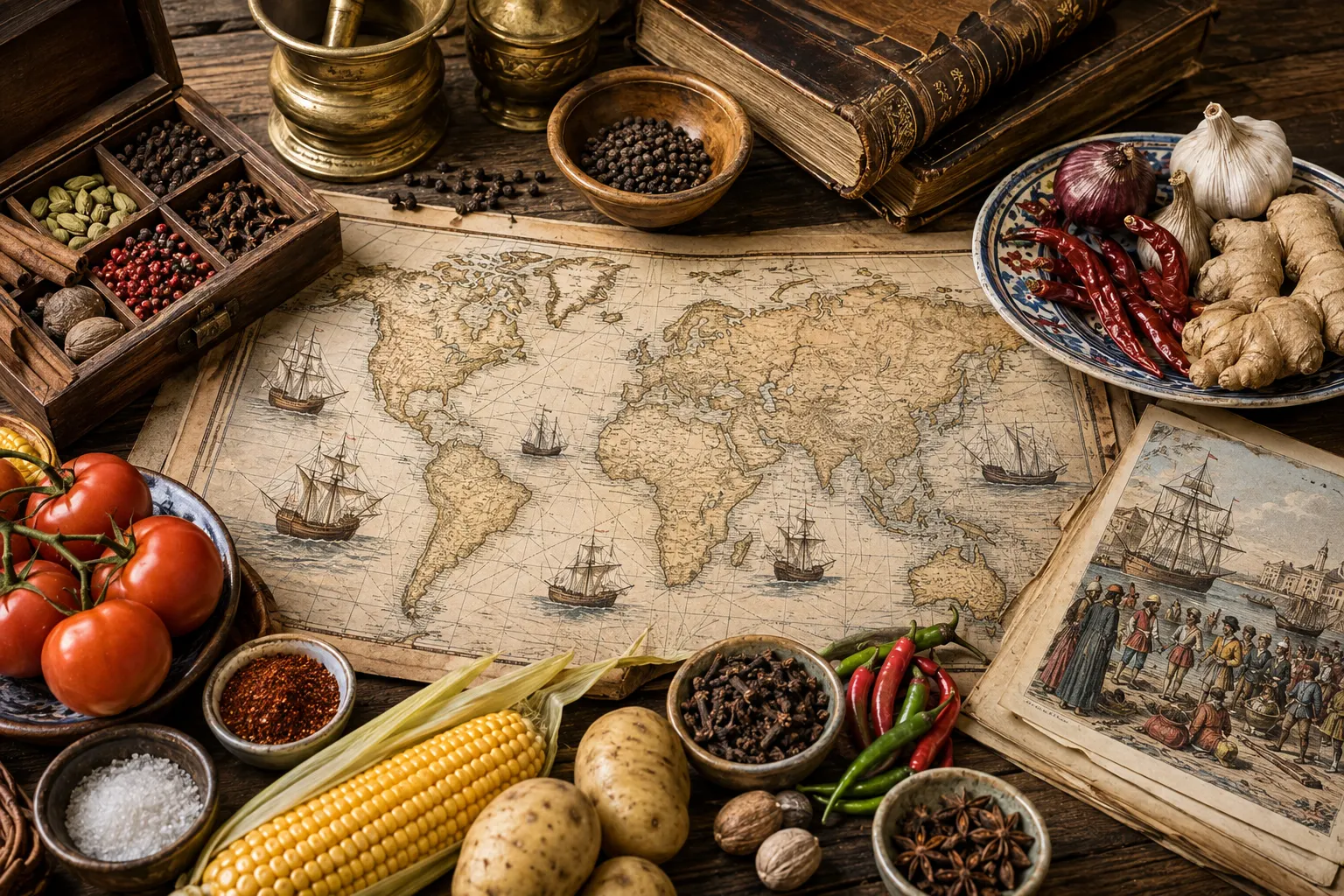
Long-distance trade moved pepper, cinnamon, cloves, nutmeg, tea, sugar, coffee and many other commodities across enormous distances. The Metropolitan Museum’s material on Islamic-world trade describes merchants moving spices from India and goods from Southeast Asia across networks linking the Indian Ocean, West Asia and the Mediterranean.
Over time, an imported ingredient can become so familiar that later generations experience it as local. This is a crucial historical lesson: cultural belonging and botanical origin are not the same thing.
A food may be deeply traditional in one region even if one of its defining ingredients arrived centuries after the region’s earliest culinary practices developed.
The Columbian Exchange Rewrote Kitchens
The transformations after 1492 provide an unusually dramatic example.
The National Park Service notes that foods domesticated in the Americas, including maize, potatoes, tomatoes and chilli peppers, spread so widely that their American origins are often forgotten. At the same time, crops, animals and food habits moved from Europe, Africa and Asia into the Americas.
This exchange reshaped cuisines on multiple continents. The chilli pepper is now central to many Asian food traditions, yet Capsicum species originated in the Americas. Tomatoes became foundational in parts of Mediterranean cooking. Potatoes became vital to European diets. None of these later cultural identities is made less authentic by the fact that the ingredient travelled.
Instead, the history shows that cuisines are built through adoption.
Migration Makes Memory Edible
People do not travel empty-handed. Even when migrants cannot carry fresh ingredients, they carry preferences, methods, ritual expectations and memories of taste.
The Smithsonian’s National Museum of African American History and Culture describes how Africans forced across the Atlantic brought planting and cooking techniques, as well as memories of ancestral and regional recipes. Those traditions interacted with ingredients and conditions in the Americas, contributing to new foodways.
Voluntary migration creates different circumstances but a similar culinary mechanism. Migrants recreate dishes, substitute unavailable ingredients and establish shops or restaurants that introduce foods to neighbours. Children inherit modified versions. Eventually, a dish can become part of both diaspora identity and the destination society’s everyday food landscape.
Cuisine therefore records migration not as a single moment, but as adaptation across generations.
Conquest and Empire Enter the Kitchen
Empires influence food through movement, taxation, elite taste, military provisioning, plantation systems and trade monopolies.
Colonial economies reorganised land around commodities such as sugar, tea, coffee, cocoa and spices. Enslaved and indentured labour moved people and food knowledge across oceans. Colonial administrations also created new hierarchies of dining in which certain foods signalled class, race or proximity to imperial culture.
Yet culinary influence was never one-directional. Colonisers adopted local ingredients and methods even while trying to reproduce familiar diets. Local cooks adapted imported techniques. Port cities became laboratories of mixing.
The result was rarely a clean replacement of one cuisine by another. More often, culinary history became layered.
Religion Leaves Repeating Patterns
Religious traditions shape what may be eaten, how animals are slaughtered, when people fast, what is offered ritually and which foods mark sacred days.
Because these practices recur, they can survive political upheaval. A festival food can preserve an older ritual sequence. A fasting tradition can maintain ingredient combinations long after the economic circumstances around them have changed.
But religious food histories also evolve. Communities interpret rules differently, migrate into new food environments and adopt new ingredients while preserving the logic of the observance.
For historians, therefore, a ritual meal can show both continuity and adaptation.
Scarcity Produces Cuisine Too
Some celebrated foods began not in abundance but in constraint.
Households developed ways to use stale bread, tough cuts, offal, leftover grains, preserved vegetables and inexpensive pulses because waste was unaffordable. Techniques such as fermenting, drying, pickling, smoking and slow cooking often reflect practical responses to preservation and scarcity.
Later prosperity can change the status of these foods. A dish associated with poverty may become nostalgic, fashionable or expensive. That shift itself is historical evidence: it reveals changing income, class identity and attitudes towards the past.
Technology Changes Taste
Culinary history is also technological history.
The stove, refrigerator, pressure cooker, mixer-grinder, industrial mill, freezer, microwave and packaged-food factory changed what people could cook, how long it took and which textures became normal.
The Smithsonian’s *FOOD: Transforming the American Table* exhibition explicitly tracks the influence of technology and social change on food and drink after the Second World War. Similar processes occurred elsewhere: refrigeration expanded access to perishable foods; mechanised milling changed flour; canning altered preservation; transport networks made formerly seasonal ingredients routine.
When technology changes the kitchen, it often changes the cuisine quietly.
Restaurants Can Accelerate Cultural Change
Restaurants are historical actors, not merely places where existing cuisines are served.
They standardise dishes, adapt recipes to customers, turn regional food into national food and sometimes create dishes that later acquire traditional status. Migrant restaurants can introduce unfamiliar ingredients to wider publics. Hotels and elite dining rooms can popularise hybrid styles. Street vendors can innovate quickly because they respond directly to urban demand.
Menus therefore deserve to be read as historical documents. They reveal what ingredients were available, what customers valued, how dishes were named and which cultural identities were marketable at a particular time.
National Cuisines Are Often Recent Constructions
Modern nations frequently speak as though each possesses one ancient, coherent cuisine. Historical reality is usually more fragmented.
Regions had different crops, religions, courts, languages, climates and trade connections long before modern national borders were drawn. Railways, mass print, urban migration, restaurants, tourism and television later helped circulate some regional dishes more widely.
A “national cuisine” can therefore be real as a shared modern identity without being timeless.
This distinction matters because food history is easily recruited into political mythology. Claims that a dish belongs exclusively to one modern nation may ignore older regional networks or populations that moved across borders that did not yet exist.
What Historians Can and Cannot Infer From Food
Cuisine is valuable evidence, but it must be handled carefully.
A surviving recipe does not prove everyone ate that way. Elite cookbooks often describe households very different from ordinary ones. Restaurant menus represent customers who could afford to eat out. Oral histories can preserve memory while also reshaping it. A dish’s current name may be newer than the preparation itself.
Strong food history therefore combines sources: cookbooks, account books, agricultural records, archaeological remains, trade documents, advertisements, oral histories, kitchen objects and scientific evidence about plants and animals.
Food becomes most revealing when it is placed beside other evidence.
Authenticity Is Historical, Not Frozen
People often ask whether a dish is “authentic.” History complicates the question.
If a food has changed for three hundred years, which version is authentic? The oldest recoverable one? The version a community remembers? The one served in a particular region today?
UNESCO’s approach to foodways as living heritage is useful here because it emphasises transmission, social practice and continuity rather than requiring traditions to remain unchanged. Living culinary traditions adapt while communities continue to recognise them as meaningful.
Authenticity, then, is better understood as a relationship between practice, community and history—not as immunity from change.
The Past Is Still Being Cooked
Cuisine reflects history because every meal is made from inherited possibilities.
The available ingredients have histories. Cooking tools have histories. Religious rules, trade routes, labour systems, migration patterns and class habits all leave traces in food.
A dish cannot tell us the past by itself. But once we ask why its ingredients are present, why a technique developed, who prepared it, when it was eaten and how its status changed, the plate begins to look different.
It becomes evidence.
And unlike many archives, this one is still being edited every day in ordinary kitchens.