The Atmospheric Blanket
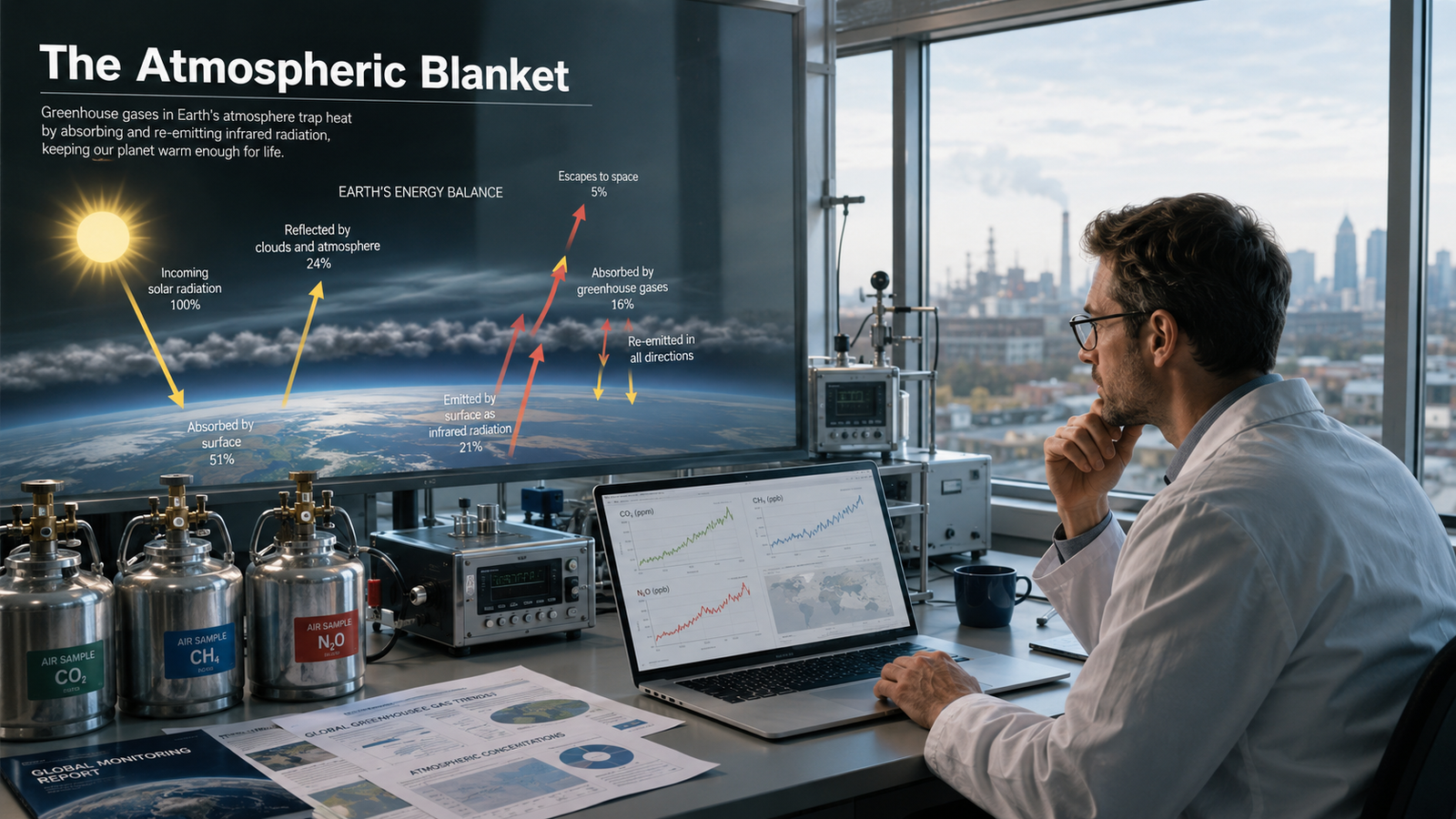
Greenhouse gases are often described as a blanket around Earth. The image is useful, but it can also become too simple. A blanket does not create heat by itself; it slows the escape of heat from a warm body. Greenhouse gases work in a similar broad sense. They allow much of the sun’s energy to enter the Earth system, but they absorb and re-emit part of the heat that Earth tries to send back into space. Without this natural effect, the planet would be far colder. With too much strengthening of this effect, the planet warms beyond the conditions under which human societies, agriculture, water systems and ecosystems developed.
The greenhouse effect is therefore not a problem in itself. It is a life-supporting feature of the atmosphere. The problem is the rapid increase in heat-trapping gases caused by human activity, especially since the Industrial Revolution. The atmosphere is being changed faster than many natural and human systems can comfortably adjust. Greenhouse gases sit at the center of climate change because they alter Earth’s energy balance. More heat enters than leaves, and the surplus energy accumulates in the atmosphere, oceans, land and ice.
A greenhouse gas is any gas that absorbs infrared radiation, the heat energy emitted by Earth’s surface and atmosphere. The main long-lived greenhouse gases discussed in climate policy are carbon dioxide, methane, nitrous oxide and fluorinated gases. Water vapor also plays a major role in the natural greenhouse effect, but it is usually treated differently in climate policy because its concentration is mainly controlled by temperature. As the planet warms, the atmosphere can hold more water vapor, which then amplifies warming. In that sense, water vapor is a feedback more than the primary human-controlled driver.
The Major Greenhouse Gases
Carbon dioxide, or CO2, is the most discussed greenhouse gas because of its scale, persistence and central role in fossil-fuel combustion. It enters the atmosphere when coal, oil and natural gas are burned for electricity, transport, industry and heating. It is also released through cement production, deforestation, land-use change and biomass burning. CO2 is removed by plants, soils and oceans, but these sinks do not remove all the additional CO2 humans emit. A substantial fraction remains in the atmosphere for a very long time, which is why cumulative emissions matter.
Methane, or CH4, is present in smaller quantities than CO2 but is much more powerful at trapping heat over the short term. It is released from fossil-fuel production and transport, livestock digestion, rice paddies, landfills, wastewater and wetlands. Methane does not stay in the atmosphere as long as CO2, but while it is there, it has a strong warming effect. This makes methane reduction especially important for slowing warming in the near term. Fixing leaks in oil and gas systems, improving waste management and changing some agricultural practices can reduce methane emissions.
Nitrous oxide, or N2O, is another significant greenhouse gas. It is emitted through agricultural soils, especially where nitrogen fertilizers are used inefficiently, and through manure management, industrial processes, fossil-fuel combustion, biomass burning and wastewater treatment. It has a long atmospheric lifetime and a high warming potential compared with carbon dioxide. Nitrous oxide also affects stratospheric ozone chemistry, adding another environmental dimension to its importance.
Fluorinated gases are synthetic gases used in refrigeration, air-conditioning, electronics, industrial processes and other applications. They are often emitted in smaller quantities than carbon dioxide, methane or nitrous oxide, but many of them have very high global warming potentials. Some can trap thousands of times more heat per unit mass than CO2 over a century. This is why leakage from cooling systems, industrial equipment and certain manufacturing processes receives attention even when the tonnage appears small.
To compare these gases, scientists use a concept called carbon dioxide equivalent, or CO2e. Since each greenhouse gas traps heat differently and stays in the atmosphere for different lengths of time, emissions are converted into a common unit using global warming potential. One ton of methane, for example, does not have the same warming effect as one ton of CO2. CO2e allows policymakers, companies and researchers to combine different gases into one accounting framework. It is not perfect, because the timescale chosen matters, but it is essential for climate inventories.
How Scientists Compare Different Gases
Three factors shape how much a greenhouse gas matters: how much of it is in the atmosphere, how strongly it absorbs heat, and how long it remains there. Carbon dioxide is important because huge quantities are emitted and it lasts long. Methane is important because it is powerful in the near term. Nitrous oxide is important because it has both high potency and long lifetime. Fluorinated gases are important because some are extraordinarily potent even in small amounts. Climate policy must therefore address both bulk emissions and high-impact gases.
One reason greenhouse gases are misunderstood is that their concentrations sound tiny. Carbon dioxide is measured in parts per million. Methane and nitrous oxide are often measured in parts per billion. To a non-scientist, those numbers can seem too small to affect a planet. But the atmosphere is enormous, and small changes in its chemical composition can produce major changes in energy flow. Ozone, for example, is also a trace gas, yet it has major effects in the stratosphere and near the ground. In climate, physical effect matters more than intuitive size.
Modern measurements show that greenhouse gas concentrations have increased sharply due to human activities. NOAA’s long-running measurements at Mauna Loa and global monitoring networks show the continuing rise of atmospheric CO2. Ice cores allow scientists to compare present concentrations with ancient air trapped in past snow and ice. These records show that today’s levels are far above pre-industrial levels and have risen at a speed unusual in the context of human civilization.
The sources of greenhouse gases are spread across the economy. Electricity generation emits when fossil fuels are burned to produce power. Transport emits through petrol, diesel, aviation fuel and shipping fuel. Industry emits through energy use and through chemical reactions in processes such as cement, steel and chemicals. Buildings emit directly through gas, coal or oil used for heating and cooking, and indirectly through electricity. Agriculture emits methane and nitrous oxide. Waste systems emit methane when organic matter decomposes without oxygen. Land-use change releases carbon stored in forests, soils and vegetation.
Where Emissions Come From
This spread means climate change is not caused by one sector alone. It is embedded in the energy, food, housing, transport and production systems of modern economies. That is why solutions cannot rely on one technology or one lifestyle change. Cleaner electricity, energy efficiency, electrification, public transport, low-carbon industry, better farming, forest protection, waste reduction and improved cooling systems all matter. The climate challenge is systemic because greenhouse gases come from systemic activities.
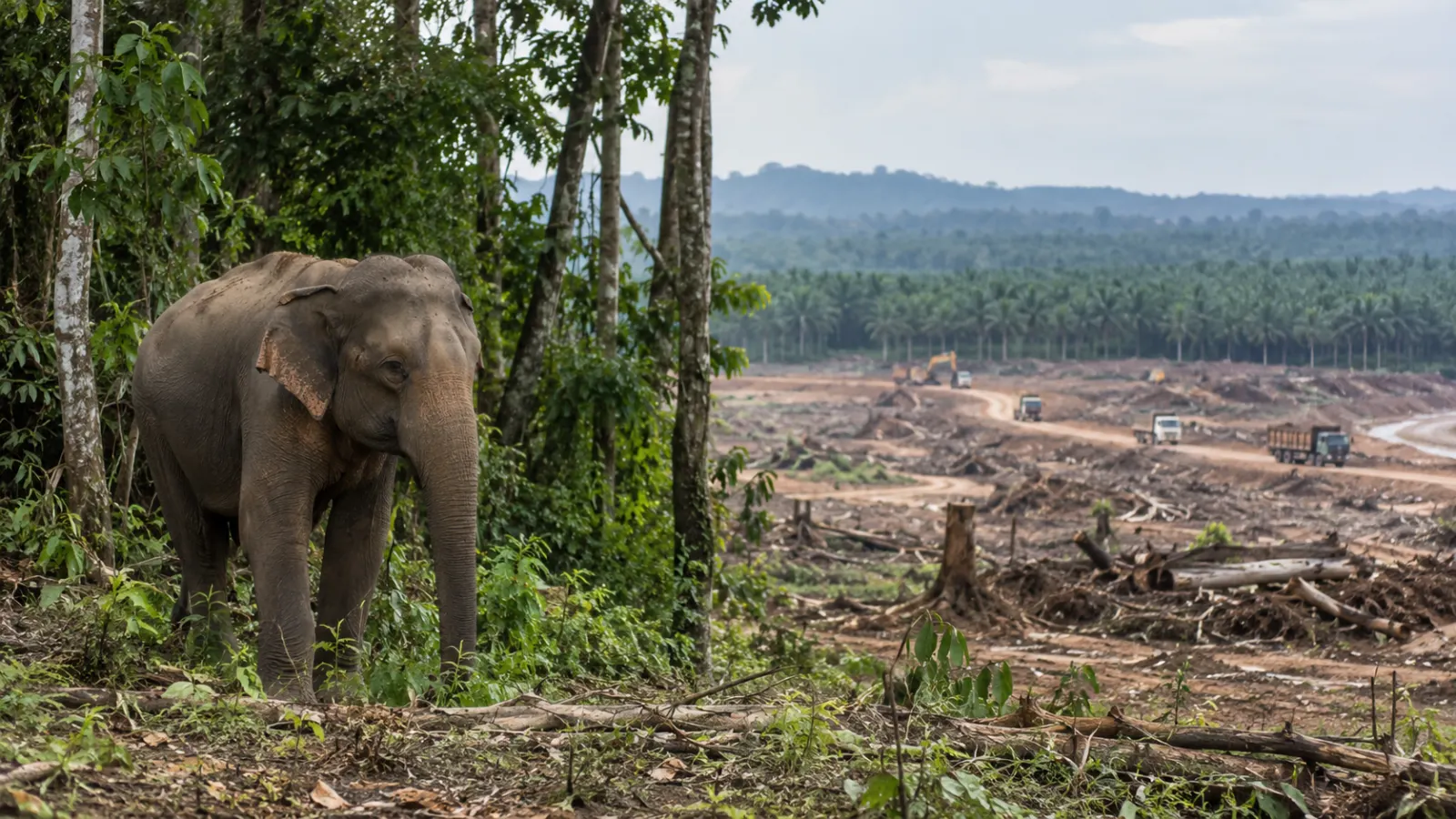
The role of forests, oceans and soils is also central. These natural systems absorb a portion of human-emitted CO2, reducing the amount that remains in the atmosphere. Forests take up carbon through photosynthesis. Oceans absorb CO2 through physical and biological processes. Soils store carbon in organic matter. But sinks are not unlimited. Deforestation can turn a forest from a sink into a source. Ocean absorption contributes to ocean acidification. Heat, drought and ecological stress can weaken carbon uptake. Relying on nature to absorb unlimited pollution is not a safe strategy.
A critical point is that greenhouse gases do not respect national borders. A ton of CO2 emitted in one country mixes into the global atmosphere. Methane released from one region affects global temperature. This is why climate change requires international cooperation. At the same time, responsibility and capacity are unequal. Countries have contributed differently to historical emissions, and people within countries have very different carbon footprints. Climate justice debates arise because those least responsible for emissions are often highly vulnerable to heat, floods, crop losses and sea-level rise.
Greenhouse gases also interact with air pollution, but the two are not identical. Some pollutants damage health immediately and stay in the air for short periods. Some aerosols can cool the planet by reflecting sunlight, even while harming lungs. Carbon dioxide is not toxic at normal outdoor concentrations, but it is climatically powerful because it changes the energy balance. Methane contributes to ground-level ozone formation, affecting health and crops. Understanding these distinctions helps avoid confusion between local air quality and global climate forcing.
Reduction, Net Zero and Responsibility
Policy discussions often focus on net zero. Net zero does not mean zero emissions from every activity. It means that remaining greenhouse gas emissions are balanced by removals. For CO2, stabilizing global temperature requires net zero CO2 emissions because continued CO2 emissions keep adding to long-term warming. For other greenhouse gases, deep reductions are also necessary. Carbon removal can help, but it cannot become an excuse for delaying emissions cuts, especially in sectors where clean alternatives already exist.
There are many ways to reduce greenhouse gas emissions. Replacing coal power with renewable electricity reduces CO2. Improving energy efficiency reduces the amount of energy needed for the same service. Electrifying vehicles and heating can cut emissions when electricity becomes cleaner. Detecting and fixing methane leaks reduces near-term warming. Better fertilizer management can reduce nitrous oxide. Phasing down high-GWP refrigerants can reduce fluorinated gas emissions. Protecting forests and restoring ecosystems can support carbon storage while benefiting biodiversity.
Individual choices also matter, but they sit inside infrastructure. A person can choose public transport only when safe, affordable options exist. A household can install efficient appliances only when products are available and affordable. Farmers can reduce emissions more effectively when supported with knowledge, finance and markets. Therefore, greenhouse gas reduction is not just a matter of personal virtue. It is a matter of technology, policy, economics, planning and culture.
The science of greenhouse gases gives climate change its mechanism. It explains why the planet is warming, why emissions accumulate, why different gases need different strategies, and why delayed action increases future risk. It also shows that climate change is not mysterious. The broad physics has been understood for more than a century. The uncertainty lies not in whether greenhouse gases warm the planet, but in how quickly societies will reduce emissions, how ecosystems will respond, and how severe the impacts will become.
For readers, the practical lesson is straightforward: do not treat all emissions as one blur. Ask which gas is being reduced, whether the reduction is permanent, whether it happens now or decades later, and whether it changes the underlying source. That is the difference between climate messaging and climate management.
A useful way to read greenhouse gas policy is to ask which gas, which source and which timescale is being addressed. A solar park mainly cuts carbon dioxide from power generation. Repairing oil and gas leaks mainly cuts methane. Better fertilizer timing mainly cuts nitrous oxide. Replacing high-GWP refrigerants mainly cuts fluorinated gases. Forest protection helps carbon storage but cannot cancel unlimited fossil-fuel combustion. This gas-specific thinking prevents vague climate talk. It also explains why credible national climate plans include sectoral targets, technology standards, land-use policies, methane programmes, refrigerant rules and energy-efficiency measures rather than one symbolic promise.
Measurement is equally important. Countries prepare greenhouse gas inventories, companies increasingly report emissions, and scientists monitor atmospheric concentrations through ground stations, aircraft, satellites and ice-core records. These different methods do not serve the same purpose. Inventories estimate where emissions come from. Atmospheric monitoring shows what is accumulating in the air. Models connect emissions, concentrations and warming. When these lines of evidence are combined, the greenhouse gas story becomes both measurable and actionable. The atmosphere is not reacting to speeches or intentions. It is reacting to tonnes of gases released, gases removed, and the speed at which societies change the systems behind them.
Key Takeaways
Greenhouse gases absorb outgoing heat and shape Earth’s energy balance.
Carbon dioxide, methane, nitrous oxide and fluorinated gases require different reduction strategies.
CO2e helps compare gases with different warming strengths and atmospheric lifetimes.
Reducing greenhouse gases requires energy, transport, industry, land, food and waste system changes.