When people hear “biodiversity loss”, they often imagine a rare animal going extinct.
That is part of the story.
It is not the whole story.
Biodiversity describes the variability of living organisms, including diversity within species, between species and across ecosystems. The Convention on Biological Diversity treats nature not merely as a collection of plants and animals but as the living foundation supporting food, water, health and human societies.
A forest may therefore lose biodiversity even if no species has yet become globally extinct.
A once-common bird may become rare.
A river may lose fish diversity.
Wild crop relatives may disappear.
A landscape may become dominated by a few agricultural species.
Genetic diversity within a population may shrink until it becomes less able to adapt.
Biodiversity loss is the progressive simplification of living systems.
Biodiversity exists at several levels
Genetic diversity
Members of the same species are not genetically identical.
Those differences can influence resistance to disease, tolerance of drought, reproductive success and the ability to adapt to environmental change.
A crop represented by many genetically distinct varieties may have a wider range of traits than one dominated by a narrow genetic base.
Likewise, small isolated wildlife populations can lose genetic variation over time.
Species diversity
This is the most familiar dimension: the variety and relative abundance of species in an ecosystem or across the planet.
Species extinction represents the final and irreversible stage of this loss, but population declines can seriously alter ecosystems long before global extinction occurs.
Ecosystem diversity
Forests, grasslands, wetlands, coral reefs, mangroves, rivers and other ecosystems contain different ecological communities and processes.
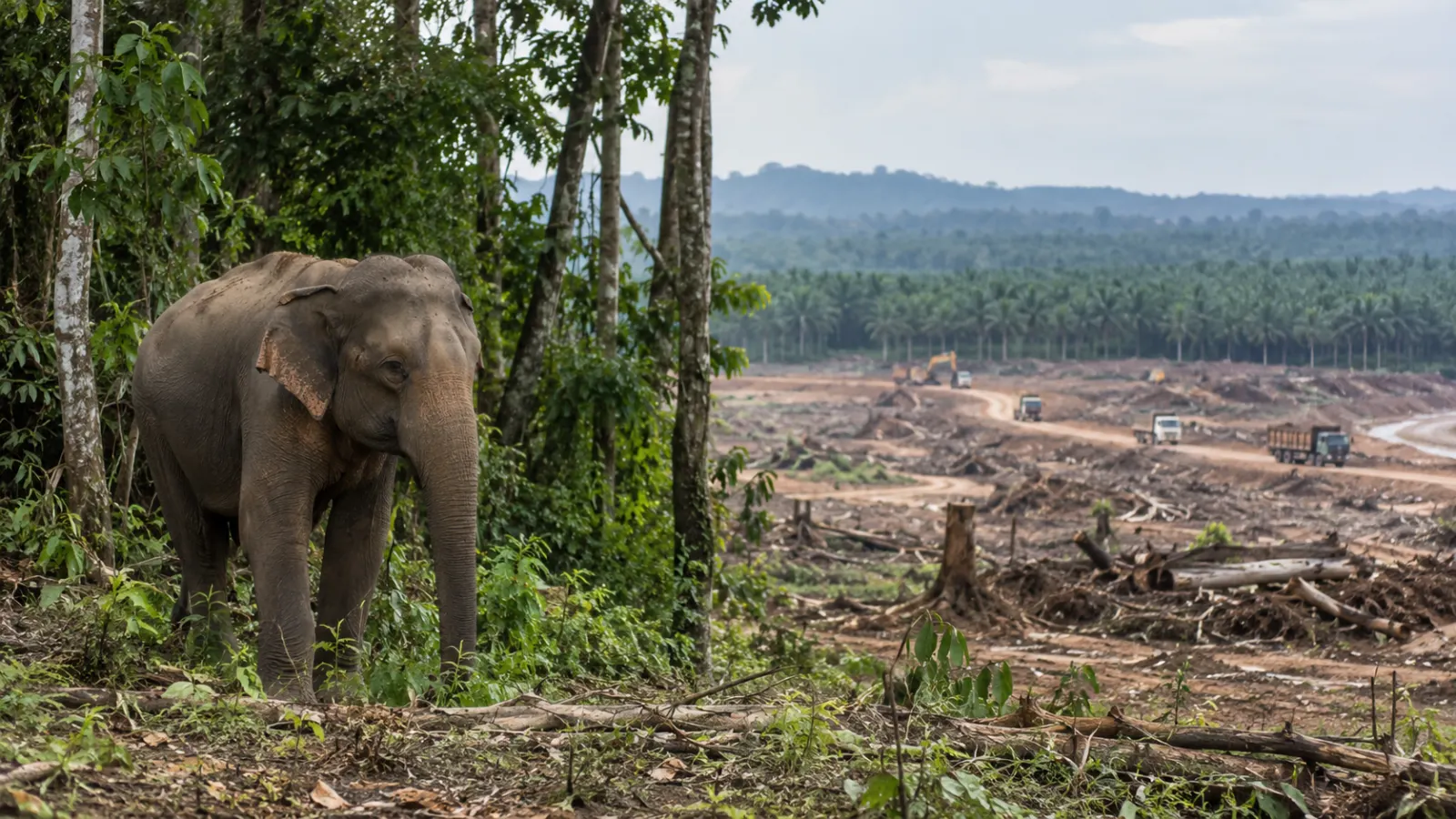
Replacing diverse ecosystems with a small number of highly modified landscapes reduces biodiversity even when some species remain.
Understanding these three levels prevents biodiversity from becoming shorthand for “number of endangered animals”.
How serious is the decline?
The 2019 global assessment produced by the Intergovernmental Science-Policy Platform on Biodiversity and Ecosystem Services concluded that nature is declining globally at rates unprecedented in human history and estimated that around one million animal and plant species were threatened with extinction, many within decades, unless the pressures driving decline were reduced. UNEP summaries of that assessment also report that human activities have substantially altered much of the terrestrial and marine environment.
The significance of these numbers is not that every threatened species will disappear.
Threatened means elevated risk, and conservation can change outcomes.
The warning is that pressures are operating simultaneously across enormous portions of the planet.
The five major direct drivers
IPBES identified five direct drivers with the largest global impacts on nature:
1. changes in land and sea use;
2. direct exploitation of organisms;
3. climate change;
4. pollution;
5. invasive alien species.
These drivers frequently reinforce each other.
A species already confined to fragmented habitat may become more vulnerable to climate change.
A polluted river may be less resilient to drought.
An ecosystem disrupted by invasive species may respond differently to fire or warming.
Biodiversity loss is therefore rarely the result of one pressure acting in isolation.
Land and sea-use change
Globally, changing land use has been one of the most important pressures on terrestrial biodiversity.
Forests are cleared for agriculture or settlements.
Wetlands are drained.
Grasslands are converted.
Roads and other infrastructure fragment habitats into isolated patches.
At sea, coastal development, seabed disturbance and other forms of habitat modification can alter marine ecosystems.
Habitat destruction matters because organisms need more than physical space.
They need food, breeding areas, shelter, migration routes and ecological relationships with other species.
A small patch of forest cannot necessarily perform the same ecological role as a large connected forest simply because both contain trees.
Direct exploitation
Humans harvest wild organisms for food, timber, medicine, trade and other uses.
Harvesting is not inherently incompatible with biodiversity.
Many communities have used wild species sustainably for generations.
The problem arises when extraction exceeds the ability of populations to recover.
Overfishing can deplete fish stocks.
Poaching can rapidly reduce vulnerable wildlife populations.
Unsustainable logging changes forest structure even if the land technically remains classified as forest.
IPBES ranks direct exploitation among the most important global drivers of nature loss.
Climate change
Climate determines where species can survive.
As temperatures and rainfall patterns shift, suitable habitat can move.
Species capable of migrating or adapting may follow those changes. Others may be blocked by cities, farms, mountains or fragmented habitats.
Marine organisms face warming waters, while coral reefs are especially vulnerable to thermal stress. Climate change can also alter fire regimes, flowering times, breeding seasons and interactions between predators and prey.
IPBES already identified climate change as one of the five major direct drivers, with its relative influence expected to increase.
This connection also works in reverse.
Healthy ecosystems - forests, wetlands, soils, mangroves and oceans - store carbon and can help societies adapt to climate impacts.
The climate crisis and biodiversity crisis are therefore deeply interconnected.
Pollution
Pollution changes the physical and chemical environment in which organisms live.
Pesticides can affect non-target species.
Nutrient runoff can produce algal blooms and oxygen-depleted waters.
Industrial chemicals can persist in ecosystems.
Plastic debris harms wildlife and breaks down into smaller particles.
UNEP identifies pollution as one of the principal direct pressures on biodiversity and notes that pollutants can contaminate habitats, accumulate through food webs and reduce ecosystem resilience.
Pollution may be less visually dramatic than clear-cutting a forest, but its ecological effects can extend through entire food webs.
Invasive alien species
Species naturally move over evolutionary time.
Human trade and travel, however, can transport organisms across barriers they would never normally cross.
Most introduced species do not become catastrophic.
Some do.
An invasive predator may encounter prey without evolved defences. An introduced plant may dominate local vegetation. Pathogens can spread into populations with little resistance.
Invasive alien species are therefore included among the five major direct global drivers of biodiversity loss.
Why biodiversity matters to people
Biodiversity is sometimes discussed as though conservation were a charitable act performed on behalf of wildlife.
That framing understates human dependence on functioning ecosystems.
Living systems contribute to pollination, soil formation, nutrient cycling, water purification, food production and climate regulation.
UNEP notes that ecosystem functions and services are closely tied to biodiversity and include processes such as pollination, soil fertility, water purification, food-web stability and climate regulation.
These services are not always visible because markets often do not price them directly.
A wetland filtering water has no cashier.
Pollinators moving between flowers do not send invoices.
Soils storing carbon and nutrients do not issue quarterly reports.
Yet replacing those functions after they are degraded can be enormously difficult or expensive.
Does every species perform an essential unique role?
Not necessarily.
Ecosystems contain redundancy: several species may perform similar ecological functions.
That redundancy can itself create resilience.
If one species declines, another may partly compensate.
But as biodiversity falls, ecosystems can lose options.
The risk is less like removing one indispensable bolt from a machine and more like progressively reducing the number of pathways through which a living system can respond to disturbance.
This is one reason biodiversity matters even when the precise economic value of a particular species cannot be calculated.
Agriculture is both dependent on and a driver of biodiversity
Food production illustrates the tension clearly.
Agriculture depends on soils, water cycles, genetic resources, pollination and pest-control processes.
Yet expanding and intensifying agriculture can also replace natural habitats and increase pressure from chemicals and water extraction.
UNEP identifies food systems as a major source of biodiversity pressure and notes the large overlap between agricultural expansion and threats faced by species.
The challenge is therefore not simply “nature versus food”.
Long-term food security itself depends on ecological systems.
Extinction is the endpoint, not the beginning
Waiting until a species is nearly extinct is a poor way to understand biodiversity loss.
By then, ecological decline may have been underway for decades.
Imagine a fish species that once supported a large population across a river basin.
It declines by 80%, disappears from several tributaries and becomes restricted to isolated areas.
The species still exists.
Technically, extinction has not happened.
Ecologically, however, something substantial has already been lost.
Population abundance, geographic range and ecological function matter alongside the final extinction count.
Can biodiversity loss be reversed?
Some losses are irreversible.
Extinction is permanent.
But degraded ecosystems can sometimes recover and threatened populations can rebound when pressures are removed.
Protected areas can conserve important habitats.
Restoration can reconnect forests and wetlands.
Fisheries management can reduce overexploitation.
Pollution controls can improve water quality.
Biosecurity can reduce invasive-species introductions.
Agricultural and urban planning can leave more space for functioning ecosystems.
The Convention on Biological Diversity's Kunming-Montreal Global Biodiversity Framework provides an international policy framework aimed at halting and reversing biodiversity loss through a set of global goals and targets. UNEP describes its implementation as central to efforts to reverse nature's decline.
But individual conservation projects cannot compensate indefinitely for economic systems that continue increasing the underlying pressures.
The deeper causes sit behind the five drivers
Why does habitat keep disappearing?
Why are some resources harvested beyond sustainable limits?
Why does pollution continue?
The answer often lies behind the immediate environmental driver.
Consumption patterns, agricultural incentives, infrastructure decisions, subsidies, governance, trade and economic institutions influence what happens to ecosystems.
The Convention on Biological Diversity has long recognised that biodiversity loss frequently arises indirectly from activities in agriculture, forestry, fisheries, transportation, urban development, energy and other economic sectors.
That is why modern biodiversity policy increasingly speaks of transformative change rather than conservation alone.
The 2024 IPBES Transformative Change Assessment focused specifically on the underlying causes of biodiversity loss and the societal changes required to address them.
Biodiversity is the architecture of a living planet
The extinction of a charismatic animal may attract public attention.
But biodiversity loss is much broader.
It is a decline in the variety, abundance, genetic variation and ecological relationships that make living systems function.
A simplified world may still look green from a distance.
A plantation can contain millions of trees while supporting far less biodiversity than a natural forest.
A river can still contain water while losing much of its ecological community.
A farm can remain productive for a time while soils and pollinators deteriorate.
The central environmental challenge is therefore not merely to prevent the last individual of a species from dying.
It is to retain enough of nature's complexity that ecosystems can continue functioning, adapting and supporting life - including human life - in a rapidly changing world.