Why Rituals Matter: Meaning, Psychology, Examples and Everyday Life
Rituals matter because they turn important ideas into actions people can repeat, recognise and share.
A wedding makes commitment public. A funeral gives grief a social form. A graduation marks a transition. A family meal can preserve identity across generations. Even a private pre-exam routine can help someone create order before an uncertain event.
Rituals are therefore much more than religious ceremonies.
They appear in families, schools, governments, sports, workplaces, political institutions and everyday life.
What separates a ritual from an ordinary routine is not simply repetition. Ritual usually adds meaning, symbolism, recognised form or emotional significance to repeated behaviour.
Understanding why rituals matter helps explain how human beings create memory, belonging, continuity and structure when ordinary behaviour is not enough.
What Is a Ritual?
A ritual is a patterned action or sequence of actions that carries meaning beyond its immediate practical purpose.
That meaning may be:
- religious,
- cultural,
- familial,
- civic,
- political,
- institutional,
- or deeply personal.
A person lighting a candle because the electricity has failed is performing a practical action.
A person lighting a candle each year in memory of someone who died is performing a similar physical action in a very different symbolic context.
The action alone does not define the ritual.
Meaning, context, repetition and recognition do.
There is no single definition of ritual accepted across anthropology, sociology, psychology and religious studies. Different fields emphasise different characteristics.
Many rituals, however, contain some combination of:
- repeated actions,
- a recognised sequence,
- symbolic meaning,
- special words or gestures,
- particular objects,
- rules about participation,
- collective attention,
- or separation from ordinary activity.
Ritual vs Routine: What Is the Difference?
Rituals and routines can look surprisingly similar.
Both involve repeated behaviour.
The main difference is usually why the sequence matters.
| Routine | Ritual |
|---|---|
| Mainly practical | Often symbolic or meaningful |
| Usually designed for efficiency | Often designed to mark significance |
| Can become automatic | May require deliberate attention |
| Missing one step may not matter much | Sequence or form may matter |
| Example: making coffee before work | Example: making a particular family drink every festival morning |
| Example: brushing your teeth | Example: ritual washing before worship |
| Example: entering an office | Example: swearing an oath before taking public office |
The boundary is not absolute.
A routine can become ritualised when people attach meaning to it.
Sunday dinner may begin simply because everyone happens to be free on Sunday. Years later, the meal may represent family continuity and become emotionally important enough that missing it feels significant.
So the better question is not:
“Is this repeated?”
It is:
“What does repeating this action mean?”
Why Do Humans Have Rituals?
Rituals solve several recurring social and psychological problems.
Human beings need ways to:
- recognise change,
- deal with uncertainty,
- remember important events,
- express values,
- create group identity,
- coordinate behaviour,
- and respond to emotionally difficult experiences.
Ordinary conversation cannot always do this effectively.
Imagine the death of a family member.
There is no obvious natural script telling everyone:
when to gather,
what to say,
how to recognise the person who died,
how to support the family,
or when ordinary activities should resume.
A funeral ritual supplies structure.
The ritual cannot eliminate grief.
But it gives people a recognised way to respond to it.
This ability to give form to experiences that otherwise feel difficult to organise is one of the most important functions of ritual.
1. Rituals Mark Important Life Transitions
Some of the most widespread rituals are rites of passage.
They mark changes such as:
- birth,
- coming of age,
- marriage,
- graduation,
- citizenship,
- religious initiation,
- retirement,
- and death.
A transition can happen privately.
Ritual makes it socially visible.
A student may technically complete all academic requirements before graduation day.
But crossing a stage, receiving recognition and celebrating with family transforms an administrative fact into a public transition.
The ritual tells everyone:
this stage has ended and another has begun.
Anthropologists have long paid particular attention to rites of passage because they reveal how communities organise changes in social status.
2. Rituals Turn Abstract Values Into Visible Actions
Ideas such as respect, loyalty, gratitude and remembrance are invisible.
Ritual makes them visible.
Respect might be expressed through:
- bowing,
- standing,
- removing shoes,
- lowering one's voice,
- observing silence,
- or greeting someone in a prescribed way.
Remembrance may be expressed through:
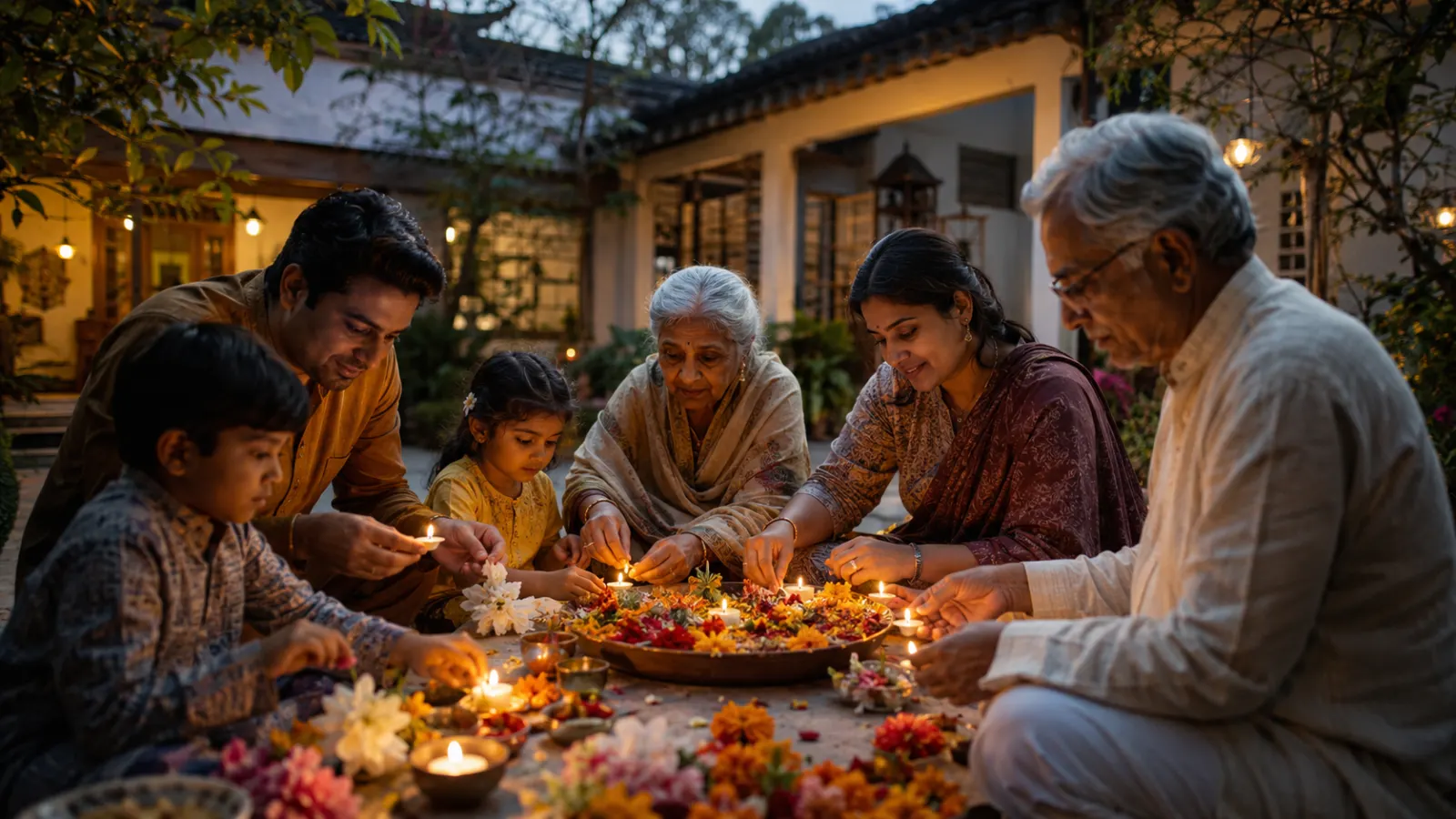
- lighting a candle,
- laying flowers,
- visiting a memorial,
- repeating a prayer,
- or observing an anniversary.
The action communicates meaning without requiring people to explain the entire value system each time.
Ritual therefore functions partly as a language of behaviour.
3. Rituals Help People Remember
Human memory is strongly connected with repeated cues.
Rituals repeatedly bring:
- stories,
- people,
- places,
- objects,
- smells,
- songs,
- food,
- gestures,
- and dates
back into awareness.
A child may know very little about the historical origins of a festival.
But they may remember:
the food their grandparents prepared,
the songs sung at home,
the clothing people wore,
the sequence of events,
and the stories repeatedly told.
Years later, those sensory and behavioural cues can reactivate a much larger cultural memory.
Ritual can therefore transmit history through participation before formal explanation.
4. Rituals Create Belonging
Participating in a ritual can communicate:
“I am part of this group.”
Members know:
- what happens next,
- which words are used,
- how people dress,
- where they stand,
- what foods belong,
- which gestures matter,
- and what would be inappropriate.
Much of this knowledge is learned through repeated participation rather than formal instruction.
A family, religious community, sports club, profession or nation can therefore create identity partly through ritual.
You do not merely say you belong.
You repeatedly perform belonging with other people.
5. Doing Things Together Can Strengthen Connection
Many rituals synchronise people physically.
Participants may:
- sing together,
- chant,
- march,
- dance,
- clap,
- pray,
- stand,
- walk,
- kneel,
- or remain silent simultaneously.
Research on collective ritual and synchronised behaviour has examined whether these shared actions can promote bonding and cooperation.
Results vary according to context, but there is evidence that synchronised collective activity can contribute to feelings of social connection.
The mechanism is intuitive.
A group of separate individuals begins acting as one coordinated unit.
For a short period, people experience not only:
“I am doing this.”
but:
“We are doing this together.”
That shared experience can reinforce group identity.
6. Rituals Can Help People Deal With Uncertainty
Rituals often appear in situations where people have limited control.
Examples include:
- examinations,
- sport,
- public performance,
- illness,
- dangerous work,
- travel,
- childbirth,
- competitions,
- and mourning.
An athlete may follow exactly the same pre-match sequence.
A performer may repeat particular actions before appearing on stage.
A student may arrange materials in the same order before an important examination.
The ritual may have no direct influence over the external outcome.
But it can still influence the person's psychological state.
Experimental research has found that performing actions understood as rituals can reduce anxiety in some performance settings and may improve performance partly through that reduction in anxiety.
That does not mean rituals magically control events.
It means predictable symbolic action can sometimes help people respond to uncertainty.
7. Rituals Can Give Grief a Structure
Grief is highly personal.
But death also creates a social problem.
Other people need to know:
when to visit,
what to say,
how to acknowledge the deceased,
how to support the bereaved,
and how to mark the transition.
Funeral and mourning traditions supply those scripts.
Depending on the culture, they may involve:
- prayer,
- cremation,
- burial,
- washing the body,
- music,
- food,
- particular clothing,
- silence,
- gathering,
- memorial services,
- or periods of mourning.
The details vary enormously.
The general function is recognisable.
Ritual does not remove loss.
It helps people give loss a form that can be experienced together.
8. Rituals Make Time Meaningful
Without social meaning, time is simply continuous.
Ritual divides it.
A birthday marks another year.
A festival separates special time from ordinary time.
A weekly religious observance interrupts everyday work.
An anniversary returns people to a particular memory.
A national commemoration brings an event from the past into the present.
Ritual therefore helps societies create social calendars, not merely chronological calendars.
Certain moments become:
- festive,
- sacred,
- solemn,
- commemorative,
- transitional,
- or historically significant.
This is one reason rituals appear repeatedly around beginnings and endings.
9. Rituals Help Families Preserve Identity
Family rituals can be very small.
A particular birthday meal.
Sunday lunch.
An annual trip.
A song sung to children.
A festival recipe.
Visiting relatives on a particular day.
Opening gifts in a specific order.
These behaviours may seem ordinary to outsiders.
Inside the family, they can become powerful markers of continuity.
They say:
“This is what our family does.”
Family rituals can be particularly important when generations live far apart or when families migrate to another cultural environment.
A meal or festival practice may preserve a concentrated form of identity even when language, neighbourhood and everyday life change.
10. Rituals Help Diaspora Communities Maintain Culture
Migration often removes people from the environment in which their traditions originally developed.
A community may lose easy access to:
- particular foods,
- religious institutions,
- extended family,
- familiar public holidays,
- ancestral languages,
- or culturally specific spaces.
Ritual can become a powerful tool of continuity.
Preparing festival food, observing a fast, performing a traditional greeting or teaching a ceremonial song gives younger generations a way to experience cultural membership.
But diaspora ritual is rarely an exact copy of the past.
It adapts.
A festival may move to the weekend.
Ingredients may change.
Ceremonies may become bilingual.
Relatives may join by video.
Continuity survives precisely because repetition is flexible enough to accommodate a different environment.
11. Rituals Can Make Institutions Feel Real
Governments, universities, courts and organisations also depend heavily on ritual.
Consider:
- presidential inaugurations,
- parliamentary openings,
- military parades,
- judicial oaths,
- graduation ceremonies,
- award presentations,
- citizenship ceremonies,
- and diplomatic receptions.
These events do not merely entertain.
They make authority and institutional continuity visible.
A constitution may legally define an office.
An inauguration publicly demonstrates that a person has entered that office.
A university can maintain academic rules in writing.
Graduation turns academic achievement into a collective public event.
Ritual therefore helps translate institutions from abstract systems into socially recognisable performances.
12. Secular Societies Still Have Rituals
Ritual is sometimes treated as something belonging primarily to religion or ancient societies.
Modern secular life disproves that idea.
Consider:
- standing for an anthem,
- birthday celebrations,
- graduation,
- retirement parties,
- sporting chants,
- political rallies,
- award ceremonies,
- moments of silence,
- New Year's celebrations,
- and workplace traditions.
Many contain no supernatural claim.
They still use patterned symbolic behaviour to mark:
identity,
transition,
achievement,
memory,
or belonging.
Modernity has not eliminated ritual.
It has created new forms of it.
13. Digital Rituals Are Becoming Normal
Ritual now appears online as well.
People:
- post birthday messages,
- commemorate deaths,
- attend livestreamed funerals,
- exchange festival greetings,
- join remote religious services,
- change profile pictures after public tragedies,
- and recreate annual traditions in messaging groups.
Digital participation is not identical to physical participation.
A livestream cannot reproduce every element of being physically present.
But ritual does not require only physical proximity.
Shared timing, recognised sequence and symbolic participation can also create meaningful digital practices.
The medium changes.
The human need to mark events remains.
Everyday Examples of Rituals
Ritual does not need to involve temples, ceremonial clothing or major public events.
Examples can include:
| Type | Example |
| Religious | Prayer, fasting, ritual washing, worship |
| Family | Sunday dinner, birthday traditions, festival meals |
| Educational | Graduation, school assemblies |
| Political | Swearing-in ceremonies, national commemorations |
| Sporting | Team chants, pre-match routines |
| Personal | Lighting a candle while journalling |
| Mourning | Funerals, memorial visits, anniversaries |
| Workplace | Induction ceremonies, annual awards |
| Digital | Livestreamed memorials, recurring online celebrations |
The details differ.
The common feature is that the action means more than its practical mechanics alone.
Can a Routine Become a Ritual?
Yes.
Consider making coffee.
For many people it is purely functional.
Coffee provides caffeine and breakfast follows.
But imagine someone who uses the same cup every Sunday morning, sits with their partner in the same place and treats that uninterrupted conversation as an important part of the relationship.
The same practical action has acquired another layer.
It now marks connection.
This illustrates why intention and meaning matter.
A routine organises behaviour. A ritual can organise meaning.
Can Rituals Improve Well-Being?
Research in psychology suggests rituals can sometimes influence emotion, performance and social connection.
A major psychological review has organised ritual effects around several broad functions, including:
- emotional regulation,
- goal-directed performance,
- and social connection.
Experimental work has also found that rituals may reduce anxiety before some high-pressure tasks.
However, these findings should not be turned into the claim that every ritual improves mental health.
Effects depend on:
- context,
- meaning,
- participation,
- individual differences,
- and the nature of the practice.
Ritual is not therapy simply because it is repetitive.
Are Rituals Always Good?
No.
The same mechanisms that create solidarity can create exclusion.
A ritual can tell people:
“We belong together.”
It may simultaneously communicate:
“You do not belong here.”
Some rituals restrict participation according to:
- gender,
- caste,
- religion,
- lineage,
- age,
- rank,
- office,
- or social status.
Others may preserve harmful practices.
Ritual can therefore reinforce:
- hierarchy,
- political authority,
- exclusion,
- or discrimination
as well as solidarity.
The word ritual is descriptive.
It does not automatically mean the practice is morally desirable.
Ritual and Power
Who performs the ritual?
Who watches?
Who may enter?
Who speaks?
Who stands at the centre?
Who must remain silent?
These questions reveal social organisation.
A coronation places one person physically above others.
A military parade displays disciplined state power.
A religious service may assign distinct roles to clergy and congregation.
A family ceremony may give elders particular authority.
Ritual therefore does more than express culture.
It can show how power is arranged within that culture.
Why Traditions Change
Rituals often look ancient because repetition creates continuity.
But living traditions constantly change.
People migrate.
Languages change.
New technology appears.
Working patterns shift.
Laws change.
Family structures change.
New generations question older rules.
A ceremony that once lasted three days may become a one-day event.
A ritual once performed only locally may be livestreamed internationally.
A festival dish may use substitute ingredients in another country.
This does not necessarily mean the ritual has disappeared.
UNESCO's concept of living heritage is useful here: cultural practices can remain recognisable while being continually recreated by the communities that practise them.
Tradition is often continuity through adaptation rather than perfect repetition.
Why Some Rituals Become Empty
A ritual can continue after some participants stop finding it meaningful.
Someone may participate because:
- their family expects it,
- the institution requires it,
- they respect older relatives,
- they value cultural identity,
- or they simply have always done it.
This does not necessarily mean the ritual is meaningless to everyone.
The same practice may be profound for one person and mechanical for another.
That difference reveals an important point:
shared ritual does not require identical private belief.
People can perform the same actions while attaching different meanings to them.
How to Create a Meaningful Personal Ritual
Ritual does not need to be inherited.
People can deliberately create meaningful practices.
A simple process is:
1. Decide what deserves attention
Perhaps you want to mark:
- the beginning of study,
- the end of the working day,
- an anniversary,
- remembrance,
- gratitude,
- family connection,
- or a personal transition.
2. Choose a simple action
It might involve:
- lighting a candle,
- preparing tea,
- walking,
- writing,
- saying a phrase,
- playing a particular piece of music,
- or sharing a meal.
3. Give the action a clear meaning
Ask:
What is this action reminding me of?
Without meaning, it may remain merely routine.
4. Make it repeatable
Complicated rituals are harder to maintain.
A meaningful sequence does not need to be elaborate.
5. Allow the ritual to change
If circumstances change, adapt it.
A living ritual should serve the meaning rather than force people to preserve every detail forever.
Frequently Asked Questions
What is the meaning of ritual?
A ritual is a patterned action or sequence that carries symbolic, cultural, social, religious or personal meaning beyond its immediate practical function.
Why are rituals important?
Rituals can mark transitions, preserve memory, express values, strengthen belonging, coordinate behaviour and help people organise uncertainty and emotionally important events.
What is the difference between a ritual and a routine?
A routine is generally repeated for practical organisation or efficiency. A ritual may involve similar repetition but carries additional symbolic, emotional or social meaning.
Are rituals always religious?
No. Graduations, sporting traditions, national commemorations, family celebrations and personal practices can all function as rituals.
What are examples of rituals?
Examples include weddings, funerals, graduation ceremonies, prayer, family meals, birthday traditions, sporting chants, memorial observances and citizenship ceremonies.
Why do rituals help people during difficult times?
Predictable actions can create structure when circumstances feel uncertain. Some psychological research suggests ritual can reduce anxiety in particular contexts, although effects are not universal.
Can rituals strengthen relationships?
Shared rituals may create opportunities for repeated connection and can reinforce family or group identity. Collective synchrony can also contribute to social bonding under some conditions.
Can rituals be harmful?
Yes. Rituals can reinforce hierarchy, exclusion, coercion or harmful practices. Cultural significance does not place a ritual beyond ethical evaluation.
Can I create my own ritual?
Yes. Personal rituals can develop around study, creativity, remembrance, relationships, gratitude or transitions when repeated actions acquire deliberate meaning.
Do rituals have to stay unchanged?
No. Rituals frequently evolve as communities, technology, migration and social conditions change. Adaptation can be part of keeping a tradition alive.
Why Rituals Matter
Rituals matter because human beings need more than information to organise social life.
We need ways to show:
this moment matters.
this person should be remembered.
this role has changed.
this community belongs together.
this event is different from an ordinary day.
Ritual turns those ideas into actions people can perform.
That is why rituals survive in ancient religious traditions and modern universities, family kitchens and national parliaments, sporting stadiums and online memorials.
They help turn:
memory into repetition,
values into gestures,
transitions into public events,
uncertainty into structure,
and
belonging into shared action.
Not every ritual is beneficial.
Not every participant interprets the same ritual identically.
And ritual should never be treated as automatically sacred, psychologically effective or ethically acceptable simply because it is traditional.
Its deeper importance is more fundamental.
Ritual is one of the ways humans make meaning visible.