Key Evidence Points for Editorial Verification
A rocket rises because it expels mass at high speed in one direction, producing thrust in the opposite direction.
Reaching orbit requires not only altitude but also very high sideways velocity so the spacecraft keeps falling around Earth instead of back to Earth.
Rocket staging improves efficiency by dropping empty tanks and engines, reducing mass as the vehicle climbs.
Opening Angle
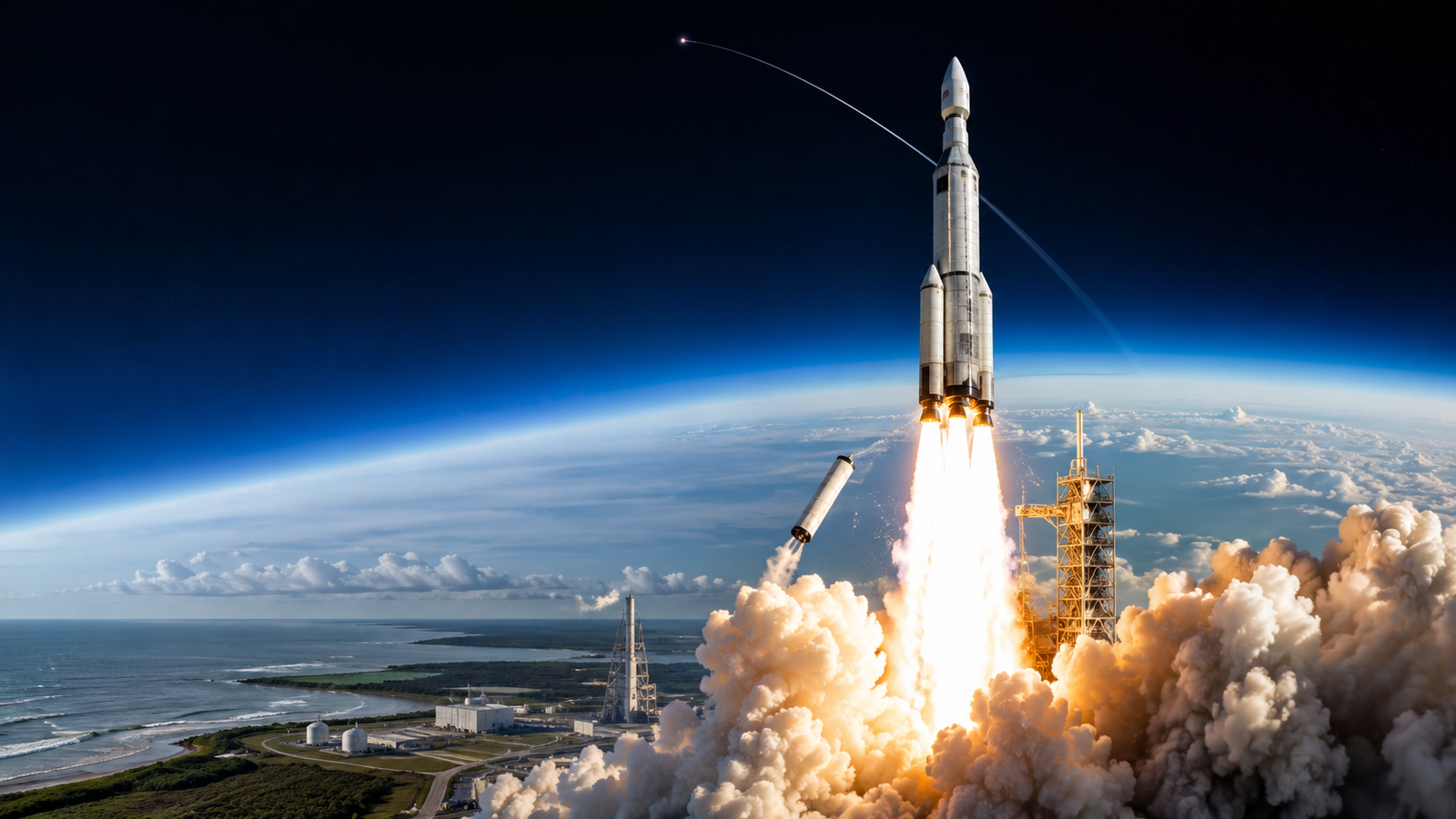
A rocket launch feels like pure power: fire, smoke, noise and a machine climbing against gravity. But reaching space is not simply a matter of going straight up. A rocket must fight gravity, push through the atmosphere, carry its own propellant, shed unnecessary mass and build enough speed to stay in space. The hardest part is not touching the edge of space for a moment. The harder achievement is reaching orbit.
The Simple Meaning
A rocket reaches space by producing thrust strong enough to accelerate upward and eventually sideways while carrying fuel, oxidizer, engines, structure and payload. Unlike a jet engine, a rocket does not need oxygen from the air. It carries the oxidizer needed for combustion, which allows it to operate above the atmosphere. This is why rockets can work in space, where there is no air for ordinary engines to breathe.
How Thrust Works
Rocket thrust comes from expelling hot gas at high speed out of the engine nozzle. The exhaust moves downward; the rocket is pushed upward. This follows Newton’s third law: for every action, there is an equal and opposite reaction. The engine burns propellant in a combustion chamber, creates high-pressure gas and directs that gas through a nozzle to increase its speed. The faster and heavier the exhaust flow, the more thrust the rocket can produce.
Gravity and Drag
At launch, a rocket must overcome its own weight. If thrust is less than weight, it cannot lift off. Once rising, the rocket also faces air resistance, called drag. Drag is strongest in the denser lower atmosphere and increases with speed. Engineers must balance the need to accelerate quickly with the stress of pushing through thick air. This is why a launch path is carefully designed rather than simply pointing straight upward forever.
Why Fuel Is the Central Challenge
Rockets need a huge amount of propellant because they must carry not only the payload but also the fuel and oxidizer needed to move that payload. Early in flight, much of the rocket’s energy is spent lifting fuel that will be burned later. This creates the classic rocket problem: to carry more fuel, the rocket becomes heavier; because it is heavier, it needs more fuel. Efficient engines, lightweight materials and staging help manage this problem.
Why Rockets Use Stages
Most large rockets use stages. A stage is a section with engines and propellant tanks. When a stage uses up its propellant, it becomes dead weight. The rocket drops it and continues with a lighter upper stage. This is one of the most important tricks in spaceflight. By discarding empty hardware, the rocket improves its ability to accelerate the remaining vehicle and payload.
Getting to Space vs Getting to Orbit
Crossing the commonly discussed boundary of space requires altitude, but staying in space requires orbital speed. Orbit is not floating because gravity disappears. Orbit is continuous falling around Earth. A spacecraft in orbit is moving sideways so fast that as it falls, Earth’s surface curves away beneath it. Without enough horizontal speed, it will come back down even if it reaches a very high altitude.
Guidance and Control
A rocket also needs guidance. Computers monitor position, speed, direction, engine performance and structural conditions. Small steering adjustments help the rocket follow a planned path. Some rockets steer by moving engine nozzles, others use small thrusters, fins or other control systems at different flight phases. Precision matters because a small early error can become a large trajectory error later.
Final Takeaway
A rocket reaches space through a combination of physics and engineering. Engines produce thrust by throwing exhaust backward. The vehicle fights gravity and drag, manages fuel mass, drops empty stages and bends its path toward orbit. The real achievement is not simply rising above the atmosphere. It is gaining enough controlled speed to place a payload where it can keep falling around Earth rather than falling back to it.