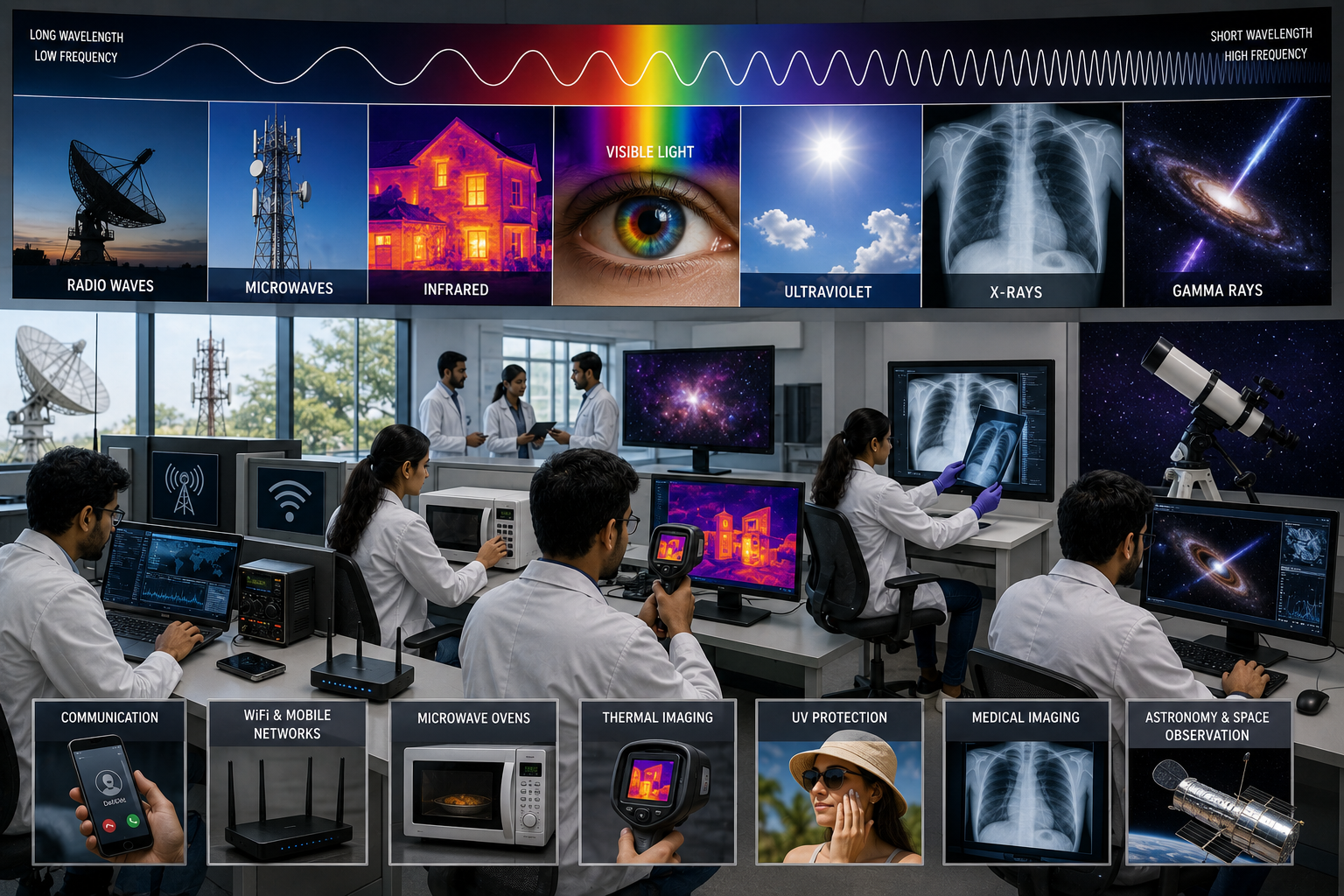
Human eyes see only a narrow slice of reality. The colours of a rainbow feel complete, but they are only a small part of a much larger family of radiation. Radio broadcasts, microwave ovens, thermal cameras, ultraviolet sunlight, medical X rays and gamma rays from cosmic events all belong to the electromagnetic spectrum. They differ in wavelength, frequency and energy, yet they are all forms of electromagnetic radiation.
One Family, Many Names
The electromagnetic spectrum is the full range of electromagnetic radiation. At one end are long-wavelength, low-frequency radio waves. At the other are very short-wavelength, high-frequency gamma rays. Between them are microwaves, infrared, visible light, ultraviolet and X rays. The names are human categories created for convenience. Nature does not place hard walls between them; the spectrum is continuous.
Wavelength, Frequency and Energy
Three ideas help organize the spectrum. Wavelength is the distance between repeating peaks of a wave. Frequency is how many wave cycles pass a point each second. Energy is connected with frequency: higher-frequency radiation carries more energy per photon. Radio waves have long wavelengths and low photon energies. Gamma rays have extremely short wavelengths and high photon energies. This is why different parts of the spectrum interact with matter in very different ways.
Visible Light Is a Small Window
Visible light occupies only a small band of the electromagnetic spectrum. Human eyes evolved to detect wavelengths useful under sunlight and Earths atmosphere. Red light has longer wavelengths than violet light, but both are within the visible range. Infrared lies just beyond red, while ultraviolet lies beyond violet. The fact that humans cannot see those regions does not make them less real. Many animals, instruments and technologies detect wavelengths beyond human vision.
Low-Energy Regions and Communication
Radio waves and microwaves are widely used for communication because they can carry signals across distances. Radio and television broadcasting, mobile networks, WiFi, radar, satellite links and Bluetooth all rely on electromagnetic waves. Different frequency bands have different strengths. Some travel far, some carry more data, some pass through obstacles better, and some require line-of-sight paths. Spectrum management is therefore a major technical and regulatory issue.
Infrared, Heat and Everyday Devices
Infrared radiation is often associated with heat because warm objects emit infrared energy. Thermal cameras detect infrared radiation to show temperature patterns. Remote controls, night-vision systems, weather satellites and some telescopes also use infrared. In astronomy, infrared observations can reveal stars forming inside dusty clouds because infrared can pass through regions that block visible light. This shows how invisible radiation can reveal hidden structures.
High-Energy Radiation
Ultraviolet, X rays and gamma rays carry higher photon energies than visible light. Ultraviolet radiation from the Sun can damage skin and eyes, which is why protection matters. X rays can pass through soft tissue better than bone, making them useful in medical imaging when controlled carefully. Gamma rays are associated with nuclear processes and extreme cosmic events. High-energy radiation can be useful, but it can also ionize atoms and damage living tissue, so safety and shielding are essential.
Why the Spectrum Matters
Modern science and technology depend on the full electromagnetic spectrum. Doctors image the body using X rays and other techniques. Astronomers study the universe in radio, infrared, visible, ultraviolet, X ray and gamma-ray bands. Engineers build communication systems by choosing frequency ranges. Climate scientists study Earths energy balance through infrared radiation. The spectrum is not a textbook chart; it is a toolkit for observing, communicating, heating, imaging and measuring.
Final Takeaway
The electromagnetic spectrum is the complete family of electromagnetic radiation, from long radio waves to short gamma rays. Visible light is only the tiny portion human eyes detect. By learning the spectrum, we understand why radios, WiFi, microwaves, night vision, X rays and space telescopes all belong to the same deeper physical story. The invisible universe is not empty; it is full of signals our instruments have learned to read.